The Municipal Code of Rexburg, Idaho began in-house in 2020 with the assistance of Municipal Code Corporation. This Municipal Code shall be cited as Rexburg City Code or “RCC” as an acronym.
RCC references found within the code maintain a structure by subject matter using a decimal numbering system which identifies the chapter and section (for example: 2.03.010). This complete set of numbers is designed to aid in searching and/or referencing the Municipal Code, and to assist in subsequent codification as new ordinances are added to the Municipal Code.
- The first number in the sequence (1.01.010) designates the TITLE level, as written in the table of contents
- The second series of numbers (1.01.010) designates the CHAPTER level, as written in the table of contents
- The last series (1.01.010) designates the Section level, and is expressed using three numerical values
- If a fourth series exists comprising letters or numbers beyond the section level, it designates a Subsection level
The legislation herein may be arranged as an alphanumeric ordered list 1, a, i, (1), (A), (a) to show hierarchal relationships. The legislation may also be arranged as an unordered list (using bullets, discs, squares, etc.) to show items without hierarchal relationships. These list structures assist in subsequent codification as new legislation is added.
Vacant titles, chapters, or sections may be designed for future use and may be marked “Reserved” to ease internal expansion. The legislative history identifies the specific legal sources of a section as may be provided in footnotes.
The Municipal Code is supplemented from time to time with amendments and additions made by the City of Rexburg. The specific legal sources that comprise this Municipal Code have been adopted during the codification process from the original formatting of the official hard copy. In the event of discrepancies between the online Municipal Code and the official hard copy, the official hard copy governs. Municipal Code Corporation, provides a searchable database of the Municipal Code for easy reference and convenience.
NOTICE: THE MUNICIPAL CODE MAY NOT REFLECT ALL OR THE MOST CURRENT VERSION OF LEGISLATION ADOPTED BY THE CITY COUNCIL THAT HAS YET TO BE UPDATED ONLINE. IN THE EVENT OF CONFLICT BETWEEN THE MUNICIPAL CODE AND A WRITTEN ORDINANCE, THE ORDINANCE TYPICALLY GOVERNS. ALSO, THE MUNICIPAL CODE MAY NOT REFLECT RULES OR OTHER REGULATIONS PROMULGATED UNDER THE AUTHORITY OF THE CODE, INCLUDING TECHNICAL SPECIFICATIONS. FOR MORE INFORMATION EMAIL THE CITY CLERK AT clerk@rexburg.org.
CHAPTER 1.2 PENALTY
CHAPTER 1.3 CITY LIMITS
CHAPTER 1.4 ELECTIONS
CHAPTER 1.5 INITIATIVE AND REFERENDUM
CHAPTER 1.6 CITY SEAL
CHAPTER 1.7 OFFICIAL NEWSPAPER
CHAPTER 1.8 CEMETERY
CHAPTER 1.9 LIBRARY
CHAPTER 1.10 DEPOSITORIES
CHAPTER 1.11 RIGHT OF ENTRY FOR INSPECTION
Title 1 sets forth the provisions applicable to the City generally and to all sections of the Code.
1.01.020 Grammatical Interpretation Of Terms
1.01.030 Prohibited Acts Include Causing, Permitting Or Concealing
1.01.040 Construction
1.01.050 Repeal Shall Not Revive Any Ordinances
1.01.060 Code Not To Affect Prior Offenses, Rights, Etc.
Note to Chapter 1.01: For statutory provisions continuing in force all ordinances passed by a city under its former organization, until altered or repealed by the mayor and council, see Idaho Code §50-201.
- The following words and phrases, whenever used in the ordinances of the city of Rexburg, Idaho, shall be construed as defined in this section unless from the context a different meaning is intended or unless a different meaning is specifically defined and more particularly directed to the use of such words or phrases:
- City/town: The City of Rexburg, Idaho, or the area within the territorial limits of the City of Rexburg, Idaho, and such territory outsi.de of the City over which the City has jurisdiction or control of virtue of any constitutional or statuatory provision.
- Computation of Time: The time within which an act is to be done. It shall be computed by excluding the first.day and including the last day; and if the last day be Sunday. or a legal holiday, that day shall be excluded.
- Council: The City Council of the City, of Rexburg, Idaho. "All its members" or "all councilmen" mean the total number of councilmen provided by the general laws of the State of Idaho.
- County: The County of Madison, Idaho.
- Law: Denotes applicable federal law, the constitution and statutes of the State of Idaho, the ordinances of the City of Rexburg, and when appropriate, any and all rules and regulations which may be promulgated thereunder.
- May: Is permissive.
- Month: A calendar month.
- Must and Shall: Each is mandatory.
- Oath: Shall be construed to include an affirmation or declaration in all cases in which, by laws, an affirmation may be substituted for an oath, and in such cases the words "swear" and "sworn" shall be equivalent to the words "affirm" and "affirmed."
- Ordinance: A law of the City; provided that a temporary or special law, administrative action, order or directive, may be in the form of a resolution.
- Owner: Applied to a building or land includes any part owner, joint owner, tenant in common, joint tenant or tenant by the entirely, of the whole or a part of such building or land.
- Person: Natural person, joint venture, joint stock company, partnership, association, club, company, corporation, business, trust, organization, or the manager, lessee, agent, servant, officer or employee of any of them.
- Personal Property: Includes money, goods, chattels, things in action and evidences of debt.
- Presceding and Following: Next before and next after, respectively.
- Property: Includes real and personal property.
- Real Property: Includes lands, tenements and herditaments.
- Sidewalk: That portion of a street between the curb line and the adjacent property line intended for the use of pedestrians.
- State: The State of Idaho.
- Street: Includes all streets, highways, avenues, lanes, alleys, courts, places, squares, curbs, or other public ways in this city which have been or may hereafter be dedicated and open to public use, or such other public property so designated in any law of this state.
- Tenant and Occupant: Applied to a building or land, includes any person who occupies·whole or a part of such building or land, whether alone or with others.
- Title of Office: Use of the title of any officer, employee, department, board or commission means that officer, employee, department, board or commission of the City.
- Written: Includes printed, typewritten, mimeographed or multigraphed.
- Year: A calendar year.
- All words and phrases shall be construed and understood according to the common and approved usage of the language; but technical words and phrases and such others as may have acquired a peculiar and appropriate meaning. in the law shall be construed and understood according to such peculiar and appropriate meaning.
- When an act is required by an ordinance the same being such that it may be done as well by an agent as by the principal, such requirement shall be construed as to include all such acts performed by an authorized agent.
Recorded by Ord. 562 Provided Definitions applicable generally to Ordinances to the City of Rexburg. on 6/18/1975
The following grammatical rules shall apply in the ordinances of the city:
- Gender. Designation in the form of any gender includes the masculine, feminine and neuter genders;
- Singular and Plural. The singular number includes the plural and the plural includes the singular;
- Tenses. Words used in the present tense include the past and the future tenses and vice versa, unless manifestly inapplicable;
- Use of Words and Phrases. Words and phrases not specifically defined shall be construed according to the context and approved usage of the language. (Ord. 562 §2, 1975).
Whenever in the ordinances of the city any act or omission is made unlawful, it shall include causing, allowing, permitting, aiding, abetting, suffering or concealing the fact of such act or omission. (Ord. 562 §3, 1975).
The provisions of the ordinances of the city, and all proceedings under them, are to be construed with a view to affect their objects and to promote justice. (Ord. 562 §4, 1975).
The repeal of an ordinance shall not repeal the repealing clause of such ordinance or revive any ordinance which has been repealed thereby. (Ord. 562 §5, 1975).
- Nothing in this Code or the ordinance adopting this Code shall affect any offense or act committed or done, or any penalty or forfeiture incurred, or any contract or right established or accruing before the effective date of this Code.
- The adoption of this Code shall not be interpreted as authorizing any use or continuance of any use of a structure or premises in violation of any ordinance of the City in effect on the date of adoption of this Code, except as otherwise provided.
1.02.020 Violations And Penalty - Infractions
1.02.030 Severability
- Unless otherwise provided by resolution of the Mayor and Council, the fine to be imposed for a municipal infraction shall be the maximum allowed by State law for a municipal infraction. Unless otherwise provided, each day a violation continues shall constitute a separate and repeat violation.
- The imposition of a municipal infraction does not prevent license revocation or the imposition of administrative sanctions.
Except as otherwise provided by ordinance of the Mayor and Council, any person found guilty of violating any provision of this Code shall be guilty of an infraction and shall be subject to a fine not exceeding three hundred ($300). Each day a violation continues shall constitute a separate offense. In addition to any other punishment prescribed for infractions in specific statutes of the Idaho Code, the court may also impose a fine of up to three hundred dollars ($300). This paragraph shall not apply if the specific infraction statute provides for the imposition of a fine. The imposition of a penalty pursuant to this section does not prevent license revocation or the imposition of administrative sanctions.
It is hereby declared to be the intention of the Council that the sections, paragraphs, sentences, clauses and words of this Code are severable, and if any word, clause, sentence, paragraph or section of the Code shall be declared unconstitutional or otherwise invalid by the valid judgment or decree of any court of competent jurisdiction, such unconstitutionality or invalidity shall not affect any of the remaining words, clauses, sentences, paragraphs and sections of this Code, because the same would have been enacted by the Council without the incorporation of this Code of any such unconstitutional or invalid word, clause, sentence, paragraph or section.
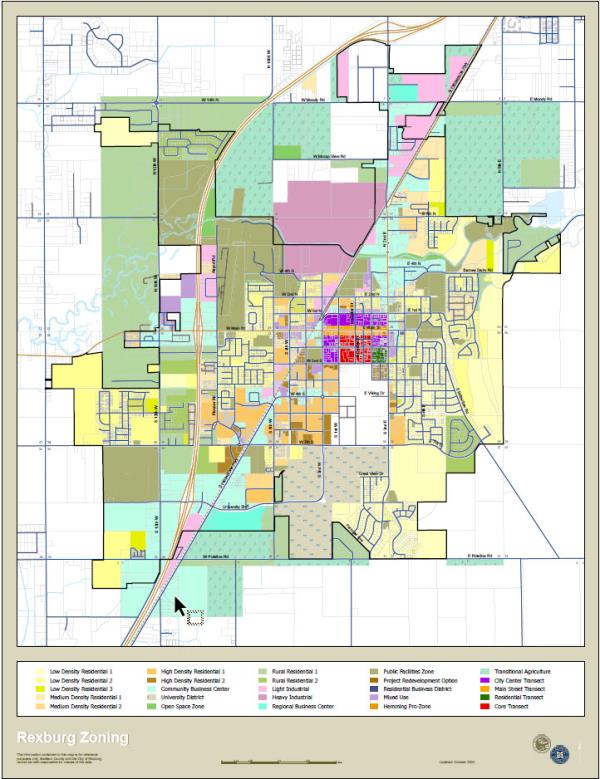
The current Rexburg Maps can be found at the follow web address: https://www.rexburg.org/o/cor/page/printable-pdf-maps
1.04.020 Election Precincts
1.04.030 Election Poll Hours
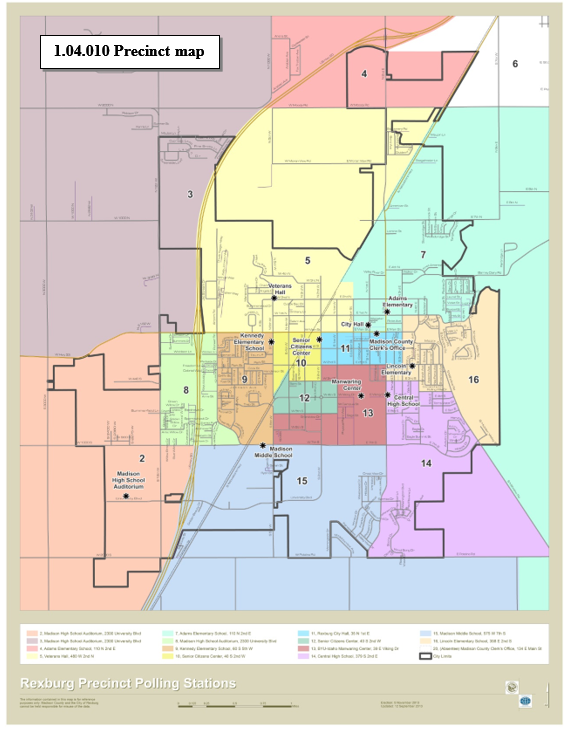
The current Rexburg Maps can be found at the follow web address:
https://www.rexburg.org/gis/page/printable-pdf-maps
The City of Rexburg shall be divided into Twelve (12) precincts which shall each and respectively comprise that portion of the City set forth as follows:
- Third Precinct: shall comprise and include all of that part of the City described as follows:
- North of West Main Street and West of U.S. Hwy 20; See attached Precinct map dated November 04, 2003.
- Fifth Precinct: shall comprise and include all of that part of the City of Rexburg described as follows:
- North of Main Street and west of Center Street; Also those areas that are part of the City of Rexburg north of the Eastern Idaho Rail Road tracks and west of Second East; See attached Precinct map dated November 04, 2003.
- Seventh Precinct: shall comprise and include all of that part of the City described as follows:
- Those areas south of the Eastern Idaho Rail Road and North of Main Street following an easterly direction to North 4th East then to Reed Street then to Morgan Drive then north on Millhollow Road to East 1st North then east on North Hill Road to Barney Dairy Road. Also, those areas that are part of the City east of 2nd East and north of Eastern Idaho Rail Road; See attached Precinct map dated November 04, 2003.
- Eighth Precinct: shall comprise and include all of that part of the City described as follows:
- The area that is located south of Main Street, east of 12th West, north of 7th South and the South Yellowstone Hwy, and west of South 5th West; See attached Precinct map dated November 04, 2003.
- Ninth Precinct: shall comprise and include all of that part of the City described as follows:
- The area south of Main Street, east of South 5th West, north of West 4th South and west of South 2nd West; See attached Precinct map dated November 04, 2003.
- Tenth Precinct: shall comprise and include all of that part of the City described as follows:
- The area south of West 4th South, east of the South Yellowstone Hwy, north of West 7th South, and west of South 2nd West; See attached Precinct map dated November 04, 2003.
- Eleventh Precinct: shall comprise and include all of that part of the City described as follows:
- The area south of Main Street, East of South 2nd west, north of West 2nd South, and west of South Center Street; See attached Precinct map dated November 04, 2003.
- Twelfth Precinct: shall comprise and include all of that part of the City described as follows:
- The area south of West 2nd South, east of South 2nd West, north of West 4th South, and west of South 1st West; See attached Precinct map dated November 04, 2003.
- Thirteenth Precinct: shall comprise and include all of that part of the City described as follows:
- The area south of West 4th South, West Viking Street, and East Viking Street; East of South 2nd West, north of East and West 7th South, and west of South 2nd East; See attached Precinct map dated November 04, 2003.
- Fourteenth Precinct: shall comprise and include all of that part of the City described as follows:
- The area south of Main Street between South Center Street and South 2nd East, then the area south of 2nd South between South 1st West and South 2nd East going south to West and East Viking Street. See attached Precinct map dated November 04, 2003.
- Fifteenth Precinct: shall comprise and include all of that part of the City described as follows:
- The area south of 7th South; also those parts of the City that are south of East 5th South, and Terra Vista Drive; also, the area south of Rolling Hills Drive between Shoshone Avenue and South Millhollow Road; See attached Precinct map dated November 04, 2003.
- Sixteenth Precinct: shall comprise and include all of that part of the City described as follows:
- The area east of 2nd East between East Main Street and East 5th South going in an easterly direction on East 5th South to South 4th East; then north to TerraVista Drive going east to Shoshone Avenue; then north and east on Rolling Hills Drive to South Millhollow Road; then south on South Millhollow Road to the City Limits. The north boundary goes east on East Main Street to North 4th East, then to Reed Street, then to Morgan Drive, then north on Millhollow Road to East 1st North, then east on North Hill Road to the City Limits on Barney Dairy Road. See attached Precinct map dated November 04, 2003. (Ord. 905, §2, 2003)
The polls for all general and special city elections shall be opened from 8:00 A.M., and remain open until all registered electors of that precinct have voted or until 8:00 P.M., whichever comes first. (Ord. 773 §1, 1995).
Note to Chapter 1.5: For provisions regarding the requirements for initiative and/or referendum guidelines, see Idaho Code §34-18.
Initiative and referendum petitions with the requisite number of signatures attached shall be filed with the secretary of state in accordance to their respective gathering and filing times. (Idaho Code §§34-1802 and 34-1803).
1.06.020 Previous City Seal
1.06.030 Previous Redesigned City Seal And Logotype
1.06.035 Active City Seal 2022
Note to Chapter 1.06: For further detail on powers and duties of the city clerk see §2.03.080 of this code.
The city clerk shall be the keeper of the common seal of the city, and shall affix it to all public instruments or official acts of the council, which by the law or Ordinance are required to be attested by the City seal; and in the meantime preserve said seal in a secure place and secure from interference. (Ord. 116 §2 1904: Ord. 58 §2(part), 1903).
Recorded by Ord. 58 Prescribed the Duties of Officers of the City of Rexburg. on 3/31/1903
Amended by Ord. 116 Amended Ord. 58, Chapter 2, Part 1, Section 2. on 6/4/1907


New City Branding and City Seal amendment approved by Rexburg City Council on October 19, 2022.

Note to Chapter 1.7: For statutory provisions regarding the designation of an official newspaper, see Idaho Code §50-213. For provisions concerning the qualifications of such a newspaper, see Idaho Code §60-106.
The Rexburg Standard-Journal Newspapers, printed and published in the city, are designated the official newspapers of the city and such ordinances, notices and publications as are required by law to be published in a newspaper shall be published in the Rexburg Standard-Journal Newspapers. (Ord. 472 §1, 1968).
Managed through own county or taxing district.
Managed through own county or taxing district.
Note to Chapter 1.10: For provisions regarding the requirements for official depositories, see Idaho Code Ch. §57-1.
All official depositories for the City of Rexburg shall be designated by resolution as an official depository for the funds of the City of Rexburg, Idaho. The City Treasurer is hereby ordered, required and directed to keep moneys belonging to, or in the care of, the City Treasurer in any so designated depository; provided, however, that when so authorized by the Mayor and Council, city funds may be, by the Treasurer, invested in securities authorized by law. (Ord. 1009 §1, 2008).
Whenever necessary to make an inspection to enforce any ordinance or resolution, or whenever there is reasonable cause to believe there exists an ordinance or resolution violation in any building or upon any premises within the jurisdiction of the city, any authorized official of the city may, upon presentation of proper credentials, enter such building or premises at all reasonable times to inspect the same or to perform any duty imposed upon him by ordinance; provided, that except in emergency situations or when consent of the owner and/or occupant to the inspection has been otherwise obtained, he shall give the owner and/or occupant, if they can be located after reasonable effort, twenty-four hours' written notice of the authorized official's intention to inspect. The notice transmitted to the owner and/or occupant shall state that the property owner has the right to refuse entry and that in the event such entry is refused, inspection may be made only upon issuance of search warrant by a duly authorized magistrate. In the event the owner and/or occupant refuses entry after such request has been made, the official is empowered to seek assistance from any court of competent jurisdiction in obtaining such entry. (Ord. 563 §1, 1975).
CHAPTER 2.2 CITY COUNCIL
CHAPTER 2.3 APPOINTIVE OFFICERS
CHAPTER 2.4 RECORDKEEPING
Title 2 sets forth the creation, procedures, functions, powers and duties of the various administrative positions of the City government.
2.01.020 Qualifications To Hold The Office Of Mayor
2.01.030 Term Of Office
2.01.040 Vacancy In The Office Of Mayor
2.01.050 Duties Of Mayor
2.01.060 Powers Of Mayor
2.01.070 Police Powers Of The Mayor
2.01.080 Special Meetings Of Council, Calling
2.01.090 Messages To The Council
2.01.100 Mayor Salary
Note to Chapter 2.1: For Statutory provisions concerning the composition and powers of the mayor, see Idaho Code §50-6.
The mayor, except as provided in Idaho Code, sections 50-801 through 50-812, shall be the chief administrative official of the city, preside over the meetings of the city council and determine the order of business subject to such rules as the council may prescribe, have a vote only when the council is equally divided, have the superintending control of all the officers and affairs of the city, preserve order, and take care that the ordinances of the city and provisions of this act are complied with and enforced (Idaho Code §50-602). The Mayor shall be the Supervising Executive and Administrative Officer of the City government, shall enforce the laws of the City and require the faithful performance of all administrative duties.
Any person shall be eligible to hold the office of mayor who is a qualified elector of the city at the time his declaration of candidacy or declaration of intent is submitted to the city clerk and remains a qualified elector during his term of office (Idaho Code §50-601).
The term of office of mayor shall be for a period of four (4) years except as otherwise specifically provided. He shall take office at the time and in the manner provided for installation of councilmen (Idaho Code §50-601).
In case of a temporary vacancy in the office of mayor due to absence or disability, the president of the council shall exercise the office of mayor during such disability or temporary absence, and until the mayor shall return. When a vacancy occurs in the office of mayor by reason of death, resignation or permanent disability, the city council shall fill the vacancy from within or without the council as may be deemed in the best interests of the city, which appointee shall serve until the next general city election, at which election a mayor shall be elected for the full four (4) year term. (Idaho Code §50-608).
- Appointment and dismissal. Appoint competent, qualified officers and employees to the administrative service, and shall have the power to dismiss, suspend and discipline, in accordance with the Personnel Handbook, all officers and employees in the administrative service under his control. He also shall have the power to authorize a department head or officer responsible to him to appoint and remove subordinates serving under that department head or officer.
- Appointment to acting capacity. Designate himself or some other officer or employee to perform the duties of any office or position in the administrative service under his control which is vacant or which lacks administration due to the absence or disability of the incumbent.
- Annual report. Prepare and present to the Council an annual report of the City's affairs, including a summary of reports of department heads, and such other reports as the Council shall require.
- Budget report. In collaboration with the Director of Finance, the Mayor shall assemble estimates of the financial needs and resources of the City for each ensuing year, and shall prepare a program of activities within the financial power of the City, embodying in it a budget document with proper supporting schedules and analyses.
- Assignment of employees. Have the power to assign any employee of the City to any department or branch thereof requiring services appropriate of the employee so assigned.
- Prescribe rules. Have the power to prescribe such rules and regulations as he shall deem necessary or expedient for the conduct of administrative agencies subject to his authority, and he shall have the power to revoke, suspend, or amend any rule or regulation of the administrative service by whomever prescribed.
- Investigate. Have the power, either by himself or by any officer or person designated for the purpose by him, to investigate and to examine or inquire into the affairs or operation of any department, division, bureau, or office; and when so authorized by the Council, he shall have power to employ consultants and professional counsel to aid in such investigations, examinations, or inquiries.
- Overrule officials. Have the power to set aside any action taken by a department head and may supersede him in the functions of his office.
- Delegate duties. Have the power to direct any department, division or bureau to perform the work for any other department, division or bureau.
- Coordinate departments. Be responsible for the coordination of the administrative heads of each department of City government and for the review and analysis of the operation and administration of all departments, boards and commissions established by the administrative ordinance.
- Accounts and Reports. Have the power to require all appointed administrative officers and administrative employees of the City to furnish any information connected with or related to their official or assigned duties. Annually, at the request of the Chief Executive, all heads of departments, boards and commissions shall provide the Chief Executive with a comprehensive report analyzing the conditions and operations of the department, shall recommend measure, and shall project need for the ensuing fiscal year. The mayor shall have the power, when he deems it necessary, to require any officer of the city to exhibit his accounts or other papers, and to make written reports pertaining to his office to the council.
The mayor shall have such jurisdiction as may be vested in him by ordinance over all places within five (5) miles of the corporate limits of the city, for the enforcement of any health or quarantine ordinance and regulation thereof, and shall have jurisdiction in all matters vested in him by ordinance, except taxation, within one (1) mile of the corporate limits of said city and over such properties as may be owned by the city without the corporate limits. (Idaho Code §50-606). The mayor is authorized to call on every resident in the city over twenty-one (21) years of age to aid in enforcing the laws. (Idaho Code §50-609).
The mayor shall have the power to call special meetings of the city council, the object of which shall be submitted to the council in writing; the call and object, as well as the disposition thereof, shall be entered upon the journal by the clerk. (Idaho Code §50-604).
The mayor shall, from time to time, communicate to the city council such information and recommend such measures as, in his opinion, may tend to the improvement of the finances, the protection, the health, the security, the ornament, the comfort, and the general welfare and prosperity of the city. (Idaho Code §50-603).
The Mayor shall receive an annual salary in the sum of Seventy Nine Thousand One Hundred Ninety Two Dollars ($79,192), and shall be paid Three Thousand Two Hundred Ninety Nine Dollars and Sixty Seven Cents ($3,299.67) semi-monthly; and receive benefits consistent with employee coverage. (Ordinance 1209, §1, 2019).
Amended by Ord. 1102 on 5/1/2013
Amended by Ord. 1165 on 7/5/2017
Amended by Ord. 1209 on 4/17/2019
2.02.020 Special Meetings - Procedure
2.02.030 Executive Session
2.02.040 Agenda
2.02.050 Minutes
2.02.060 Presiding Officer
2.02.070 Substantive Motions
2.02.080 Procedural Motions
2.02.090 Withdrawal Of A Motion
2.02.100 Renewal Of A Motion
2.02.110 Physical Presence
2.02.120 Duty To Vote
2.02.130 Classifications Of Bills, Ordinances And Resolutions
2.02.140 Reading Of Bills And Resolutions
2.02.150 Boards, Commissions And Committees
2.02.160 Unresolved Questions
2.02.170 Council Member Salary
2.02.180 Qualifications To Hold The Office Of City Council Member
2.02.190 Term Of Office For City Council Members
2.02.200 President Of The Council, Election Of
2.02.210 Vacancies On The Council And Appointment To The Council
2.02.220 Powers Of The Council
2.02.230 Change In Number Of Council Members
2.02.240 Examination Of Accounts Of Fiscal Officers
Note to Chapter 2.2: For Statutory provisions concerning the composition and powers of the City Council, see Idaho Code 50-7.
The Council shall hold regular meetings the first and third Wednesday of the month at 6:30 p.m. at City Hall at 35 North 1st East Street. The City Clerk shall provide forty-eight (48) hour agenda notice prior to each meeting, however, additional agenda items may be added to the agenda by the Mayor and City Council up to and including the hour of the meeting, provided a good faith effort is made to include in the notice all agenda items known at the time to be probable items of discussion. Meeting and agenda notices shall be posted on the bulletin board at City Hall and on www.rexburg.org. The regular meeting schedule may be altered, and meetings may be added to the regular schedule by an action of the Council. (Resolution No. 2016-16 §1C) A quorum of the actual membership, excluding vacancies, shall be necessary to conduct business and take official action. A majority of the actual membership physically present shall constitute a quorum. The Mayor shall not be counted in determining a quorum. (Resolution No. 2005-06 §1B) All meetings of the City Council except as provided in Resolution No. 2005-06 §1E, shall be open to the public in compliance with Idaho Open Meeting Law Act (Idaho Code 74-201 through 74-208).
Approved by Res. 2005-06 Council Rules of Procedure on 5/4/2005
Adopted by Res. 2016-16 City Council Time for Regularly Scheduled City Council Meetings on 12/7/2016
A special meeting of the Council may be called at any time by the Mayor or a majority of the members of the full Council. Meeting and agenda notice shall be made at least twenty-four (24) hours prior to any special meeting, unless an emergency exists. In the event of an unexpected circumstance that requires immediate attention of the Council, the Mayor may call an emergency meeting of the Council. Only those items relative to the emergency and requiring immediate attention may be considered at an emergency meeting. If an emergency meeting is called, all reasonable efforts shall be made to notify the public. (Resolution No. 2005-06 §1D).
Executive session shall mean any meeting or part of a meeting of the City Council which is closed to any persons for deliberation on any of the below listed matters. Upon a two-thirds (2/3) roll call vote of the full Council, the Council shall meet in executive session, after the presiding officer has identified the specific authorized purpose for the executive session, as listed below. No executive session may be held for the purpose of taking any final action or making any final decision.
- To consider hiring a public officer, employee, staff member or individual agent, but not appointment to a vacancy in an elective office;
- To consider the evaluation, dismissal, disciplining or hearing complaints or charges against a public officer, employee, staff member or agent;
- To conduct deliberations concerning labor negotiations, or to acquire an interest in real property which is not owned by a public agency;
- To consider records that are exempt by law from public inspection;
- To consider preliminary negotiations involving matters of trade or commerce in which the City Council is in competition with governing bodies in other states or nations;
- To consider and advise legal representatives in pending litigation or where there is a general public awareness of probable litigation;
- To conduct labor negotiations if either side requests closed meetings. (Resolution No. 2005-06 §1A).
An item may be placed on the agenda only by the Mayor or a member of the City Council. To be included on the agenda, an item must be received by the City Clerk two (2) working days in advance of the subject meeting. A consent calendar may be used for common and non-controversial items. An item on the agenda may be discussed without preceding motion. Any citizen or group wishing to address the Council may be placed on the agenda by the Mayor or a member of the City Council. The Mayor may provide for a public comment period on any agenda. (Resolution No. 2005-06 §2A).
The City Clerk shall take full and accurate minutes of all Council proceedings. Minutes shall contain the roll call of the Council; all motions by verbatim, resolutions, orders, or ordinances proposed; the Council Members moving and seconding each question; the disposition of each question; and the results of all votes. Minutes shall include the motion and roll call vote to convene an executive session, and the specific authorized purpose for the executive session, as listed in Section 1, Subsection E of this Resolution. Minutes shall be available for public inspection during normal office hours within a reasonable time after each meeting. (Resolution No. 2005-06 §2B).
The Mayor shall preside at all meetings of the City Council, and control the order of the agenda. In the absence of the Mayor, the Council President shall preside. When any
member is about to speak in debate or deliver any matter to the Council, he/she shall respectfully address the presiding officer, and shall confine him/herself to the question in debate and shall not make personal comments or criticisms addressed to any individual.
The presiding officer has the power to:
- Control the floor and grant permission to speak;
- Rule motions in or out of order;
- Determine whether a speaker has gone beyond reasonable standards of courtesy, and rule a member out of order on this ground;
- Entertain and rule on questions of procedure;
- Call a brief recess at any time;
- Adjourn in the case of an emergency. (Resolution No. 2005-06 §3).
A motion may be made by any Council Member. A motion requires a second from another Council Member. A member may make only one motion at a time. Only one substantive motion may be considered at a time. A motion may be adopted only by majority vote of Council Members present. A roll call vote shall be taken upon the request of any member. The presiding officer shall state the motion, and then open the floor for Council discussion and debate according to the following principals:
- A member must be recognized by the presiding officer in order to speak.
- The maker of the motion is entitled to speak first.
- A member who has not spoken on the issue shall be recognized prior to one who has previously spoken on the issue.
- To the extent possible, debate shall alternate between proponents and opponents of the issue. (Resolution No. 2005-06 §4A).
A procedural motion takes precedence over a substantive motion, and may interrupt deliberations on a substantive motion. A procedural motion is debatable and may be amended. In order of priority, allowable procedural motions are:
- Motion to Appeal a Ruling of the Presiding Officer. A ruling of the presiding officer may be appealed. A motion to appeal the ruling of the presiding officer shall only be in order immediately following the ruling in question and prior to any further action. The member making this motion need not be recognized by the presiding officer, and, if timely made, can not be ruled out of order.
- Motion to Adjourn. A member may move to adjourn prior to completion of the agenda, providing no other motion is pending and the motion to adjourn does not interrupt deliberations.
- Motion to Recess. A member may move to take a brief recess, providing it follows consideration of a substantive action and does not interrupt deliberations. If passed, the presiding officer shall establish the duration of the recess.
- Motion to Suspend the Rules. A member may move to suspend the rules. The motion must state the rule(s) being suspended. Rules imposed by state or federal law may not be suspended.
- Motion to Convene an Executive Session. A member may move to close deliberations to the public and convene an executive session. The reason for the executive session, as listed in Section 1, Subsection E of this Resolution, must be stated in the motion. Substantive motions are not in order in executive session.
- Motion to Leave Executive Session. The Council must leave executive session and return to open session prior to adjournment. This must be done by motion and voted upon.
- Motion to Divide the Question. A member may move to divide a question under deliberation. The division must be stated in the motion.
- Motion to Defer Consideration. A member may move to defer consideration of a substantive motion or other matter before the Council. The motion to defer may state a time certain. If it is not revived prior to achieving the stated time, the substantive motion which has been deferred expires. If no time certain is stated in the motion to defer, and the issue is not revived, the deferred substantive motion expires in 180 days. If consideration of a motion has been deferred and the deferral remains pending, a new motion having substantially the same effect is not in order.
- Motion to Revive. A member may move to revive consideration of a substantive motion, which has been deferred regardless of whether that member made the motion to defer. A motion to revive shall not be in order in the same meeting in which a motion to defer has passed on the same question.
- Motion to Call the Previous Question. A member may move to call for a vote on the previous question. A motion for the previous question is not in order until every member who wishes to speak has had the opportunity to speak at least once.
- Motion to Refer to Committee. A member may move to refer a matter before the Council to a committee for study and review. Thirty days after a matter before the Council has been referred to a committee, the maker of the original substantive motion may move the original motion again regardless of action or lack thereof by the committee.
- Motion to Amend. A member may move to amend a substantive motion before the Council. A motion to amend must be pertinent to the original motion. A motion to amend is out of order if the effect of the amendment is the same as rejecting the original motion. A motion may be amended, and that amendment may be amended, but no further amendments may be made until the last-offered amendment is decided on by vote. An amendment shall be reduced to writing before the vote on the amendment.
- Motion to Substitute. A member may move to substitute completely different wording for a motion currently under deliberation.
- Motion to Reconsider. A member on the prevailing side of a vote may move to reconsider the outcome of that vote. The motion to reconsider is only in order at the meeting at which the original vote was taken. The motion cannot interrupt deliberations on a pending matter, but is in order at any time prior to final adjournment of the meeting.
- Motion to Repeal. A member may move to rescind or repeal any earlier action of the Council. The motion is not in order if rescission or repeal would violate by state or federal law.
- Motion to Prevent Reintroduction. A member may move to prevent reintroduction of a matter before the Council for up to six months. This motion shall be in order immediately following defeat of a substantive motion and at no other time. (Resolution No. 2005-06 §4B).
The maker of the motion may withdraw a motion, either substantive or procedural, at any time before it is amended or the presiding officer puts it to a vote. (Resolution No. 2005-06 §4C).
A substantive motion that is defeated may be reintroduced at a later meeting unless a motion to prevent reconsideration has been adopted. (Resolution No. 2005-06 §4D).
A member must be physically present to vote. Proxy voting is not allowed. (Resolution No. 2005-06 §4G). For the purpose of holding regular or special meetings a number less than a majority may compel the attendance of absent members in such manner and under such penalties as the council may, by ordinance, have previously prescribed. Regular or special meetings of the council may be recessed until further notice. (Idaho Code §50-705).
A member may not abstain from voting unless a conflict of interest is declared, and the nature of the conflict is described in open session. A member declaring a conflict of interest for the purpose of abstaining from a vote may be compelled to vote by a majority vote of the remaining members. (Resolution No. 2005-06 §4H).
All actions of the Council involving the exercise of the City’s legislative and police power functions, or actions otherwise required by law to be in ordinance form, shall be designated upon final passage as Ordinances and appear in form required by law. Upon first reading and prior to final passage, all ordinances shall be issued a Bill number. All other actions of the Council relating to the administrative business of the City and requiring written findings or statements shall be designated as resolutions. (Resolution No. 2005-06 §6A).
- Bills: Prior to final passage, all bills shall be read on three (3) different days, two (2) readings of which may be by title only and one reading of which shall be in full, unless a majority of the members of the full Council shall dispense with the rule.
- Resolutions: Prior to final passage, all resolutions shall be read on one day, the reading of which may be by title only. (Resolution No. 2005-06 §6B).
The Council may establish citizen boards, commissions, and committees to assist and advise it in its work. Bylaws, organization, membership, scope and jurisdiction, and procedural rules of such committees shall be established by the Council. (Resolution No. 2005-06 §7).
Questions not resolved by rules established by the Council shall be settled by the current edition of Roberts Rules of Order, so long as it does not conflict with Idaho law. (Resolution No. 2005-06 §8).
Each member of the City Council shall receive an annual salary in the sum of Nine Thousand Two Hundred Twenty Six Dollars ($9,226), and shall be paid Three Hundred Eighty Four Dollars and Forty Two Cents ($384.42) semi-monthly; and receive benefits consistent with employee coverage. The City Council President shall receive an extra Fifty Dollars ($50.00) semi-monthly to compensate for additional duties and responsibilities of that office. (Ordinance 1209 §2, 2019).
Amended by Ord. 1102 on 5/1/2013
Amended by Ord. 1165 on 7/5/2017
Amended by Ord. 1209 on 4/17/2019
Any person shall be eligible to hold the office of councilman of his city who is a qualified elector at the time his declaration of candidacy or declaration of intent is submitted to the city clerk, and remains a qualified elector under the constitution and laws of the state of Idaho. Each councilman elected at a general city election, except as otherwise specifically provided, shall hold office for a term of four (4) years, and until his successor is elected and qualified. Councilmen elected at each general city election shall be installed at the first meeting in January following election. The manner of conducting that meeting shall be as herein set forth and not otherwise: the incumbents shall meet and conduct such business as may be necessary to conclude the fiscal matters of the preceding year; the newly elected shall then subscribe to the oath of office, be presented certificates of election, assume the duties of their position, and conduct such business as may be necessary, one (1) item of which shall be the election of a member as president of the council. (Idaho Code §50-702).
For additional information please see Idaho Code §50-702.
For additional information please see Idaho Code §50-702.
A vacancy on the council shall be filled by appointment made by the mayor with the consent of the council, which appointee shall serve only until the next general city election, at which such vacancy shall be filled for the balance of the original term. (Idaho Code §50-704).
The legislative authority of each city in the state of Idaho, except those operating under the provisions of section[s] 50-801 through 50-812 shall be vested in a council consisting of either four (4) or six (6) members, one half (1/2) of whom shall be elected at each general city election. Councils shall have such powers and duties as are now or may hereafter be provided under the general laws of the state of Idaho. (Idaho Code §50-701).
- Any city may change to the greater or lesser number of councilmen after an election instituted by resolution of the council or by petition as provided for initiative in Idaho Code §50-502 through §50-517, such election to be held not less than sixty (60) days before any general city election. When the proposition submitted to the electors shall receive a favorable vote, officials shall be elected at the succeeding general city election, provided however, that should such election be conducted in a year when no general city election is to be held, such new positions shall be filled by appointment within thirty (30) days.
- When the number of councilmen to be elected is to be reduced from six (6) to four (4), there shall be elected one (1) councilman, to serve a term of four (4) years. At the next succeeding general city election, there shall be elected two (2) councilmen, each to serve a term of four (4) years, and one (1) councilman to serve a term of two (2) years.
- When the number of councilmen to be elected is to be increased from four (4) to six (6), there shall be elected three (3) councilmen, each to serve a term of four (4) years, and one (1) councilman to serve a term of two (2) years.
- Any city operating under the city manager form of government may change to the greater or lesser number of councilmen after an election instituted under subsection (A).
- When the number of councilmen to be elected is to be reduced from seven (7) to five (5);
- If there are four (4) councilmen up for election at the next general city election, there shall be elected two (2) councilmen, each to serve a term of four (4) years.
- If there are three (3) councilmen up for election at the next general city election, there shall be elected one (1) councilman, to serve a term of four (4) years. At the next succeeding general city election, there shall be elected three (3) councilmen, each to serve a term of four (4) years and one (1) councilman, to serve a term of two (2) years.
- When the number of councilmen to be elected is to be increased from five (5) to seven (7);
- If there are two (2) councilmen up for election at the next general city election, there shall be elected four (4) councilmen, each to serve a term of four (4) years.
- If there are three (3) councilmen up for election at the next general city election, there shall be elected four (4) councilmen, each to serve a term of four (4) years and one (1) councilman to serve a term of two (2) years. (Idaho Code §50-703).
- When the number of councilmen to be elected is to be reduced from seven (7) to five (5);
At least once in each quarter of each year, the council shall examine, either in open session or by committee, the accounts and doings of all officers or other persons having the care, management or disposition of moneys, property or business of the city (Idaho Code §50-708).
2.03.020 Oaths Of Office
ARTICLE I CITY TREASURER
ARTICLE II CITY CLERK
ARTICLE III CHIEF OF EMERGENCY SERVICES
ARTICLE IV CITY ATTORNEY
ARTICLE V CHIEF OF POLICE
ARTICLE VI RECREATION DIRECTOR
ARTICLE VII PUBLIC WORKS DIRECTOR
The following officers are appointed by the Mayor and ratified by the City Council:
| Department | Officer |
| Financial Management | City Treasurer |
| Customer Support Services | City Clerk |
| Emergency Services | Chief of Emergency Services |
| Legal | City Attorney |
| Police | Chief of Police |
| Parks and Recreation | Recreation Director |
| Public Works | Public Works Director |
| * The GIS Coordinator is appointed jointly by the city and county. | |
Note to §2.07.020: Rexburg’s Official Oath is adapted from Idaho Code §59-401.
- Persons Required to take Oath of Office. Each of the following officers and employees in the Administrative Service shall be required to take an oath of office before entering upon the discharge of his duties, which oath shall be subscribed by the person taking it and shall be filed and preserved in the office of the City Clerk.
- Officers: The mayor, city council, city attorney and each appointed officer.
- Policemen: Every member of the Department of Police (including private, auxiliary, special, temporary or substitute policemen, which the City might find necessary to appoint).
- Official Oath: “I, (insert name) do solemnly swear (or affirm) that I will support the Constitution of the United States, and the State of Idaho, and the Laws and Ordinances of the City of Rexburg, and that I will to the best of my ability, faithfully discharge the duties of the office of (insert office) in the city of Rexburg, Madison County, Idaho, during my continuance therein, so help me God.” (Signature of person taking oath) Subscribed and sworn to before me this (date) (Signature of City Clerk)
2.03.040 Appointment Of Director
2.03.050 Powers And Duties
Note to Article I: For statutory provisions requiring the mayor to appoint a city treasurer, see Idaho Code §50-204. For provisions concerning the duties of a city treasurer, see Idaho Code §50-208.
The office of treasurer shall be held by one person, who shall perform all of the duties of city treasurer as prescribed and required by the laws of the state and the ordinances of the city, and such other duties as the city council may designate and require. (Ord. 619 §3, 1980).
Approved by Ord. 449 City Clerk and City Treasurer Offices held by 1 person on 12/16/1964
Approved by Ord. 619 Repealed Ord. 449; Provided a City Clerk and a City Treasurer on 5/7/1980
The Director of the Department of Financial Management shall be appointed by the Mayor with the consent of the Council, and shall be in the unclassified service of the City.
In all cases where the duty is not expressly charged to any other department or office, it shall be the duty of the Director of Financial Management to act to promote, secure and preserve the financial and property interests of the City, subject to the supervision and control of the Mayor. The Director of Financial Management shall:
- Fiscal supervision over Officers. Exercise general supervision over all officers of the City regarding the proper management of the fiscal concerns of their respective offices
- Standard accounting practices. The Director of Financial Management shall keep controlling accounts with every department, agency and bureau of City government, and with all activities whatever owned or controlled by the city or in which the City has any pecuniary interest. The head of the Department of Financial Management is hereby authorized and directed, from time to time, to prepare forms of accounts, vouchers, reports, bills, orders, receipts, checks and other necessary forms to be used by the several city departments, agencies and bureaus in the transaction of all parts of public business as concerns the City's finances. He shall prescribe and issue the forms herein named to all City departments, agencies and bureaus to be used in the parts of public business which concern the City's finances.
- Report delinquent payments and financial reports. See that officers receiving money pay the same into the City Treasury, when thereto required, and that all necessary financial reports are made by officers, and shall report all delinquents in such payments or reports to the Executive and Council.
- Duty upon default of officer. Report the default of any officer of the City to the Mayor who shall direct the City Attorney to take immediate legal measures for the recovery of the amount for which such officer may be in default
- Responsibility for proceeds of bonds. Deposit the proceeds of all sales of bonds with the City Treasurer immediately after he shall have received the same, and, until such deposit, he shall be responsible for the amount thereof.
- Payments of money from special trust funds. Pay out to the persons duly entitled thereto, on warrant of the Director of Finance and Management Services, without appropriation by the Council, any money paid into the Treasury pursuant to condemnation proceedings, or for the redemption of property sold for taxes, or arising from special assessments for public improvements, park fund certificates, condemnation fund certificates and all special trust funds.
2.03.070 Appointment
2.03.080 Powers And Duties
Note to Article II: For statutory provisions requiring the mayor to appoint a city clerk, see Idaho Code §50-204. For statutory provisions outlining the duties of a city clerk, see Idaho Code §50-207.
The office of city clerk shall be held by one person, who shall perform all of the duties of the city clerk as prescribed and required by the laws of the state and the ordinances of the city, and such other duties as the city council may designate and require. (Ord. 619 §2, 1980).
Approved by Ord. 449 City Clerk and City Treasurer Offices held by 1 person on 12/16/1964
Approved by Ord. 619 Repealed Ord. 449; Provided a City Clerk and a City Treasurer on 5/7/1980
The City Clerk shall be appointed by the Mayor with the advice and consent of the Council, and such individual shall be qualified by training and experience to perform the duties of the office.
The City Clerk shall:
- Keep records of the Council. Maintain and preserve the minutes and records of the proceedings of the Council in accordance with the Charter and the proceedings of all Council committees.
- Record ordinances. Record in full, uniformly and permanently, all ordinances and be the legal custodian of the same.
- Publish Council action. Publish daily all adopted ordinances and resolutions of the Council, and all legal notices required by law or ordinance.
- Serve meeting notices. Cause all notices of regular and special meetings of the Council to be served in accordance with state statutes, Charter provisions, City ordinances and the rules of the Council, and as directed by the Chair of the Council.
- Maintain City seal. Have custody of the seal of the City and affix it to such documents as may be required and authorized pursuant to law.
- Keep election records. Keep and maintain all election records and have custody of all property used in connection with elections.
- Keep vital statistics. Prepare, attest and report on the vital statistics of the City.
- Permits and licenses. Issue all permits and licenses except those which are required by ordinance to be issued by a particular department or office.
- Custodian of bonds, contracts, etc. Be charged with the custody of the official bonds of City employees, except his own, which shall be in the custody of the City Treasurer, and with the custody of all deeds, mortgages, contracts, judgments, notes, debts, and chooses in action. He shall keep and administer all securities, bonds, or other forms of negotiable instruments owned by or belonging to the City.
- Custodian of City documents. The Department of Finance and Management Services shall be the custodian of all official and surety bonds, deeds, insurance policies, contracts, agreements and such other instruments of a similar nature, except as may be otherwise provided in the City Charter.
- Notice of expiration of term. Notify the appointing authority of the impending expiration of the term of office of a member of any board or commission, said notice to be given at least 30 days before such expiration.
2.03.100 Powers And Duties
2.03.110 Assistant Chiefs Of Emergency Services
Note to Chapter 2.10: For statutory provisions authorizing the mayor to appoint a chief of emergency services see Idaho Code §50-204.
The Emergency Services Department shall consist of a chief of emergency services, and other assistant chiefs as appointed by the chief of emergency services. (Ord. 380 §2, 1952).
Approved by Ord. 380 Organization and Regulation of the City of Rexburg Fire Department on 4/2/1952
The chief of emergency services shall be the chief executive officer of the Emergency Services Department and shall be invested with the following authority and duties:
- To have direct control, management and direction of all officers and men of the Emergency Services Department and the power to detail any of them to such public service as he may see fit, looking to the best interests and efficiency of the department;
- To carry out strictly the enforcement of the rules and regulations of the department and be able to suspend or remove from service any officer or employee for cause in such manner as is provided in these regulations;
- To exercise supreme command over the department at emergencies and over all equipment belonging to it;
- To cause to be resolved all emergencies with the least possible damage to life and property and prevent unnecessary damage;
- To see that the premises on which fires occur are left in such condition that they will not rekindle and cause further damage to life and property;
- To observe the general condition of the department and apparatus and make a quarterly report to the supervisory body concerning same along with a complete report of the activities of the department;
- To make a complete investigation of appropriate fires, keeping the record of and determining the cause to the best of the department’s ability, and report fires to the National Fire Incident Reporting Service;
- To keep complete records of the attendance of every employee to training, schools and meetings. (Ord. 380 §3(a), 1952).
It shall be the duty of the Emergency Services Board to have complete supervision of the fire department and require the chief of emergency services to make a complete annual report concerning the department in general, giving the description of the condition of the department, making suggestions and recommendations for major improvements, and telling of the activities during the year.
The chief of emergency services shall be directly responsible to the Emergency Services Board in his capacity as head of the Emergency Services Department. (Ord. 380 §1, 1952).
Approved by Ord. 380 Organization and Regulation of the City of Rexburg Fire Department on 4/2/1952
The assistant chiefs of emergency services shall rank next to the chief of emergency services and shall have similar qualifications. One assistant chief shall be over emergency medical services. The other assistant shall be over the fire department. The assistant chiefs shall take complete charge in the absence of that officer and be invested with the same authority and duties while so acting. (Ord. 380 §3(b), 1952).
Approved by Ord. 380 Organization and Regulation of the City of Rexburg Fire Department on 4/2/1952
2.03.130 Powers And Duties
Note to Article IV: For statutory provisions requiring the mayor to appoint a city attorney, see Idaho Code §50-204. For statutory provisions outlining the duties of a city attorney, see Idaho Code §50-208A.
The City Attorney shall be appointed by the Mayor with the advice and consent of the Council and shall, prior to such appointment, be admitted to practice before the Supreme Court of the State of Idaho. (Ord. 58 §38, 1903).
The City Attorney shall represent the City in all causes in which the City is interested and shall have full and complete charge of the legal business of the City. The City Attorney shall be the legal advisor to the Mayor, to the Council and to all departments and agencies of the City except as may be otherwise provided by the Code. The City Attorney shall prosecute and defend actions and proceedings by and against the City and every department and agency thereof. In the furtherance of these general powers, the City Attorney shall:
- Advise officers. Advise the Mayor, the Council or its committees, and the heads of all departments, agencies, boards, and commissions on all matters relating to their official powers, duties and functions
- Verify ordinances. Be responsible for the verification of all ordinances and resolutions as requested by the Mayor or the Council. The City Attorney shall advise the Council as to the form and sufficiency of all ordinances prior to their adoption, and no ordinance shall be introduced until it shall either have been approved as to form by the City Attorney or until the City Attorney has filed with the City Clerk a statement of reasons why the ordinance is defective.
- Give opinions. Render legal opinions upon any question of law submitted by the Chief Executive, the Council, or the heads of all departments, agencies, boards, or commissions.
- Attend Council meetings. Attend in person or by designee all Council meetings in their entirety for the purpose of giving the Council any legal advice requested by its members, and, at the request of the presiding officer, attend committee meetings of the Council.
- Prepare legal instruments. Prepare, review and approve all contracts, deeds, documents and instruments prior to the execution thereof by or on behalf of the City, its departments and agencies.
- Prosecute offenders and defend officials. Prepare, when authorized by the Council, all charges and complaints against the City and appear in the appropriate court in the prosecution of, every person charged with the violation of a City ordinance or of any regulations adopted under authority of the Code or ordinances, or with the commission of an infraction as declared by the Code or by virtue of its authority.
- Appeals. Conduct and prosecute appeals from orders, decisions or judgments affecting any interest of the City as the City Attorney may, in the exercise of discretion, determine to be necessary or desirable.
- Settlement of claims. Have the power to adjust, settle, compromise or submit to arbitration, any action, causes of action, accounts, debts, claims, demands, disputes and matters of favor of or against the City or in which the City is concerned as debtor or creditor, now existing or which may hereafter arise, not involving or requiring payment to exceed $5000 and with the permission of the Mayor may do likewise in matters not involving or requiring payment to exceed $25,000, provided the money to settle claims generally has been appropriated and is available therefore.
- Make reports:
- Prompt report of decision. Promptly report the outcome of any litigation in which the City has an interest to the Executive and Council.
- Annual report of pending litigation. Make an annual report, to the Executive and Council, as of the 1st day of January, of all pending litigation in which the City has an interest and the condition thereof.
- Workers' compensation. Prepare and approve all workers' compensation payrolls and investigate all cases in which workers' compensation is involved and be responsible for the filing of all documents and papers required by the Workers' Compensation Act of the State
- Rates and utilities. Be responsible for representing the City in all causes, hearings, trials, and administrative or judicial review concerning rates, franchises, valuations, utility conducts, or other issues involving the City and the public utilities which affect it or are under its control, including, but not limited to, telephone, telegraph, radio, television, cable television, lighting, heating, water, sewer and transportation. In so doing, the City Attorney may retain a rate expert or experts to ensure proper review, analysis, study and recommendations on all utility matters, which expert shall prepare for submission to the Chief Executive and the Council, upon request, such reports and recommendations as may assist them in resolving rate determinations and other utility matters.
- Keep records:
- Suits. Keep a complete record of all suits in which the City had or has an interest, giving the names of the parties, the court where brought, the nature of the action, the disposition of the case, or its condition if pending, and the briefs of counsel.
- Opinions and titles. Keep a complete record of all written opinions furnished by him.
- Deliver records to successor. Deliver all records, documents and property of every description in his possession, belonging to his office or to the City, to his successor in office, who shall give him duplicate receipts therefore, one of which he shall file with the City Auditor
- Professional assistants. The City Attorney may appoint deputy assistants and such other assistants as in his judgment are needed to carry on the legal business of the City.
- Special counsel. In case of special or unusual circumstances or in any case where the City Attorney by reason of interest cannot represent the City, the Council, upon the request of the City Attorney, may by resolution appoint special counsel and fix his or her compensation.
2.03.150 Powers And Duties
Note to Article V: For statutory provisions authorizing the mayor to appoint a chief of police see Idaho Code §50-204.
The Chief of Police shall be appointed by the Chief Executive with the consent of the Council, in accordance with the provisions of the City Charter, and shall serve for the term specified therein.
The Chief of Police shall be accountable to the Chief Executive and, subject to his supervision and control, shall have the following duties:
- Administer the affairs of the Department.
- Have general authority and control over all departmental staff and oversee the proper fulfillment of all tasks and duties assigned to the Department.
- Prescribe such rules and regulations as he deems necessary or expedient for the proper operation of the Department and to that end keep himself informed of the latest administrative practices.
- Take all personnel actions, including hiring, assigning and reassigning employees, including supervisory personnel, within his Department and shall supervise their performance.
Note to Article VI: For statutory provisions authorizing the mayor to appoint a recreation director see Idaho Code §50-204.
The Director of Recreation shall plan, promote, organize and supervise a comprehensive municipal recreation program and administer the same in the interest of the entire community, and shall:
- Design all parks, parkways and public grounds.
- Provide for the care, maintenance and landscaping of all public lands, including parks, parkways, golf courses and playgrounds.
- Provide for the care, trimming and removal of all trees and shrubberies on all public lands and the maintenance, for assessment purpose, of accurate records pertaining to tree trimming.
- Provide for the administration and maintenance of an arboreal disease control program, pest control program, and all reforestation and nursery programs.
- Organize and program all recreational activities involving general public participation in a comprehensive and diversified program, including municipal athletics, senior citizen programs, arts and crafts, and other such programs.
- Manage and coordinate public recreational and educational activities available for general public participation for which fees are charged, including such activities as golf, tennis, swimming, boating, biking, skiing, stadium use, concessions and other special entertainment or seasonal activities.
- Preserve and maintain various forms of domesticated animals and wildlife for general exhibition, and the care, feeding and sheltering of the same.
The City designates the Mayor in cooperation with the Rexburg Arts Council to be responsible for the conservation and maintenance for all works of art in the public art program. (Ord. 1086, 1.10.040(A), 2012: Ord. 937, 1.10.040(A), 2005).
Recorded by Ord. 937 Established a Fee for the Arts on all Eligible Capital Improvement Projects in Rexburg. on 5/4/2005
Amended by Ord. 1086 Amended Ord. 937 on 8/1/2012
2.03.180 Powers And Duties
Note to Article VII: For statutory provisions authorizing the mayor to appoint a public works director see Idaho Code §50-204.
The Public Works Director of the Department of Public Works shall be appointed by the Mayor with the consent of the Council, and shall be in the unclassified service of the City.
The Public Works Director shall be accountable to the Mayor and, subject to his supervision and control, shall have the following duties:
- Administer the affairs of the Department.
- Have general authority and control over all departmental staff and oversee the proper fulfillment of all tasks and duties assigned to the Department.
- Prescribe such rules and regulations as he deems necessary or expedient for the proper operation of the Department and to that end keep himself informed of the latest administrative practices.
- Take all personnel actions, including hiring, assigning and reassigning employees, including supervisory personnel, within his Department and shall supervise their performance.
Note to Chapter 2.4: For provisions regarding the requirements for recordkeeping, see Idaho Code §50-9.
The City Clerk shall be responsible for the retention of all municipal records for Rexburg. The purpose of “destruction or removal” of all municipal records is strictly prohibited. (Idaho Code §50-908).
CHAPTER 3.2 DEPARTMENT OF CUSTOMER SUPPORT SERVICES
CHAPTER 3.3 DEPARTMENT OF EMERGENCY SERVICES
CHAPTER 3.4 POLICE DEPARTMENT
CHAPTER 3.5 DEPARTMENT OF PARKS
CHAPTER 3.6 DEPARTMENT OF PUBLIC WORKS
CHAPTER 3.7 DEPARTMENT OF GEOGRAPHICAL INFORMATION SYSTEMS
CHAPTER 3.8 DEPARTMENT OF TECHNOLOGY COORDINATION SERVICES
CHAPTER 3.9 DEPARTMENT OF RECREATION
For provisions concerning the creation of departments see subsection 2.01.060, entitled Powers of Mayor, of this code.
3.01.020 Departmental Functions
3.01.030 Divisions
There is hereby established an executive department to be known as the Department of Financial Management. The head of such department shall be the director, who, prior to such appointment, shall possess such qualifications as the Council may by ordinance provide.
The Department shall be responsible for the following:
- Property management, including space allocation and communication systems;
- Maintenance of a uniform system of accounts for all City money matters, and a system for receipt, deposit and recording of all moneys received by the City;
- Management and operation of the treasury;
- Management and operation of human resources;
- Management and operation of risk management.
The Department of Finance and Management Services shall be divided into the following divisions and supervisors thereof:
- Division of the Treasury, supervised by the City Treasurer, who shall:
- Accounts of receipts and expenditures. Keep in proper books, a full and accurate account of all the moneys received and disbursed by him on behalf of the City, specifying the time of receipt and disbursement, from whom received and to whom disbursed, and on what account received and disbursed, and how paid.
- Cancellation of evidences of debt. Cancel all warrants and other evidences of debt against the City, whenever paid by him, by writing or stamping across the face thereof the words, "Paid by the City Treasurer," with the date of payment written or stamped thereon.
- Receive and disburse moneys. Receive and have custody of all moneys paid to the City and shall disburse City moneys upon the warrant of the City Auditor.
- Collect moneys and fees due City. Demand and receive all moneys and fees owing to the City whenever any person is indebted to the City in any manner and the means of collection of such debt is not otherwise provided for by law. When any claim shall not be collectible by other methods, he shall report the same to the City Attorney for prosecution.
- Division of Accounts, headed by the Financial Officer, who shall:
- Audit accounts. Examine and audit the accounts of all officers and departments subject to the approval of the Chief Executive and Council.
- Prescribe form. Prescribe the form of accounts and reports to be rendered to him.
- Pay City employees. Pay City employees upon presentation of the properly certified payroll.
- Budget duties. Prepare estimates of revenue, and shall give such other assistance in the preparation of the budget as may be required of him by the Executive.
- Financial statements. Transmit to the Executive at least semi-monthly audited statements of cash on hand and of classified unencumbered appropriation balances for the City as a whole, and such other financial statements as the Chief Executive may from time to time require. He shall keep all departments, boards, commission, or institutions currently informed of its classified unencumbered appropriation balances.
- Keep accounts. Keep all general accounts of the City government and of the respective departments, offices, boards, commissions and institutions thereof.
3.02.020 Departmental Functions
There is hereby established an executive department of the City of Rexburg to be known as the Customer Support Services Department. The head of such department shall be known as the City Clerk, who shall be appointed by the Mayor with the advice and consent of the Council.
Note to Chapter 3.2: The Department of Customer Support Services responsibilities falls under the duties of the City Clerk, see Chapter 2.3, Article II.
The Department shall perform the following functions under the direction of the City Clerk:
- Assist with the duties of the City Clerk.
- Receiving and posting payments made to various accounts for the City of Rexburg.
- Answer visitor/customer inquiries and complaints.
- Directing visitors/customers to their destinations.
- Sorting and handing out mail.
- Answer incoming calls.
- Scheduling and making reservations for city facilities and venues.
- Reconciling cash received for various city facilities and venues.
- Ordering and managing supplies.
- Scheduling and creating ads for the Romance Marquee.
3.03.020 Firemen
3.03.030 Drills
3.03.040 Building Inspections
Note to Chapter 3.3: The Department of Emergency Services is made up the Fire Department (City, County, Fire District), Ambulance Services (County facilitated) and the Hospital (County facilitated). There is an Emergency Services Board with representatives from the city and county. The Emergency Services Board, The Fire District Board, County Commissioners and City Council make up the four governing bodies for the Department of Emergency Services. The city and county support their portion of the Fire Department through their own budget allocations. The Ambulance District has its own taxing district. The Fire District also has its own taxing district and covers all residents outside the city. The Hospital is supported by its own revenue, but it is governed by the county.
It shall be the duty of the City Council of the City of Rexburg to have complete supervision of the Fire Department and require the Fire Chief to make a complete annual report concerning the department in general, giving the description of the condition of the department, make suggestions and recommendations for major improvements and tell of the activities during the year.
The Fire Chief shall be directly responsible to the City Council in his capacity as head of the Fire Department. (Ord. 380 §1, 1952).
- In general all firemen shall be trained to handle any and all of the fire apparatuses provided, also the act in any desired capacity in handling first aid, fire appliances, hose, chemical engines, or doing salvage work.
- Any fireman leaving town for some time shall inform the Fire Chief immediately and obtain a leave of absence. Failure to do so may leave the company undermanned and shall be punishable (by fine, demerit, or other type of disciplinary action adopted by the department)
- Appointment of new men to the Fire Department shall be made with the object of improving the operation efficiency and general excellency of the man-power. In the selection of men consideration shall be given to the following rules:
- All firemen shall be required to pass a physical examination as shall be prescribed by the City Physician.
- Membership in the Fire Department should of itself confer distinction and should carry some privileges sufficiently attractive to make membership desirable and sought after. The rate of payment for service at fires and drills shall be established by the City Council.
- It shall be mandatory for a fireman to retire at the age of 62 years.
- Strict discipline shall at all times be maintained for the purpose of contributing as a necessary factor, to the smoothness of operation and efficiency of the department.
- Fireman shall hereby note that absolute discipline and the prompt obedience to orders is at all times required. (Ord. 380 §4, 1952).
- The department shall be drilled and maintained to the end that fires shall be controlled immediately at their start so far as possible. Drills shall be in charge of a competent officer of fireman who shall be responsible for the proper training and drilling of men and the standardization of methods.
- Complete drills shall be held by each company at least twice a month. (Company drills for full paid men should be held at least weekly.) (Ord. 380 §5, 1952).
- The fire Chief or any person he may so designate is hereby authorized, empowered, and required to inspect from time to time, but no less frequently than twice yearly, all buildings and premises where accumulation of combustible materials or other hazardous conditions and liable to exist and to order such changes or removals as in his opinion are necessary for safety from fire, principally in the business and industrial sections; for the purpose of inspection, he is hereby empowered to enter any and all buildings and premises at any reasonable hour.
- Also, in the same districts for the purpose of facilitating fire fighting, building inspections shall be made by the department officers from time to time but not less frequently than once every three months to determine the arrangements of buildings with respect to one another, to familiarize themselves with the inside of every building and its contents, to study the best methods of attacking every building in case of fire and to note all new constructions.
- Records shall be kept of all inspections including notes and sketches. These records shall be made a permanent part of the records of the Fire Department.
- The Fire Chief or any person he may so designate, is hereby authorized, empowered and required to inspect buildings in which public gatherings are held at the time of such gatherings and to prohibit the overcrowding of any building in which such gatherings are held and to prohibit the closing or crowding of exits by people and the obstruction of stairways at such gatherings. (Ord. 380 §6, 1952).
3.04.020 Departmental Functions
3.04.030 Regulations - Administration And Enforcement Authority
3.04.040 Peace Officer Training
Note to Chapter 3.4: For statutory provisions requiring local officers to enforce the Idaho Motor Vehicle Laws, see Idaho Code §49-103.
There is hereby established an executive department of the City of Rexburg to be known as the Police Department. The head of such department shall be the Chief of Police, who shall be appointed by the Mayor and ratified by the City Council.
The Department shall perform the following functions:
- Crime prevention. Preserve the public peace, prevent crime, and detect and arrest offenders.
- Traffic enforcement. Administer and enforce laws regulating, directing, controlling and restricting the movement of vehicular and pedestrian traffic, and the general use of the streets by vehicles and the public.
- Training. Operate a training program to maintain and improve the competency and efficiency of the members of the Department.
- Incident report preparation. Prepare reports on injuries to persons and property occurring by accident or otherwise on the streets, in alleys and other public places within the City as required by law.
- Weapons disposition. Provide a procedure for the sale, destruction or other disposition of all weapons or other articles used in the commission of crime or coming into the custody of the Department; provided, that where such weapon or article may be used as evidence in either a civil or criminal proceeding, it shall in no way be disposed of except upon a written order of a court of law.
- Lost property. Provide a procedure for the sale of unclaimed, lost or stolen articles coming into the custody of the Department.
Administration and enforcement of this title shall be vested in the police department, subject to the control of the mayor and council as provided for in this title. (Ord. 482 §1(part), 1968).
Note to Chapter 3.04.040: For statutory provisions concerning the training of peace officers and requiring the participation of political subdivisions in same, see Idaho Code §19-5115 to §19-5122.
- Desire to qualify for aid. The city declares that it desires to qualify to receive aid for police training from the Law Enforcement Planning Commission under the provisions of Idaho Code §19--5118. (Ord. 506 §1, 1970).
- Adherence to standards. Pursuant to said Idaho Code §19-5118, the city, while receiving aid from the Law Enforcement Planning Commission pursuant to said statute, will adhere to the standards for employment and training established by the Idaho Peace Officer Standards and Training Advisory Council. (Ord. 506 §2, 1970).
3.05.020 Departmental Functions
There is hereby established an executive department of the City of Rexburg to be known as the Parks Department. The head of such department shall be known as the Parks Director, who shall be appointed by the Mayor and ratified by City Council.
The Department shall perform the following functions:
- Manage and maintain the beautification of city owned parks, facilities, venues, and certain city streets (e.g. Main Street).
3.06.020 Division Of Streets Department
3.06.030 Wastewater Department
3.06.040 Sanitation Department
3.06.050 Shop Department
3.06.060 Engineering Department
3.06.070 Water Department
3.06.080 Planning And Zoning Department
There is hereby established an executive department of the City of Rexburg to be known as the Department of Public Works. The head of such Department shall be the Director of Public Works, who, prior to such appointment, shall possess such qualifications as the Council may by ordinance provide. The Department of Public Works shall be organized into the Divisions of Engineering Department, Equipment Shop, Street Department, Sanitation Department, Water Department, and Wastewater Department. (Ord. 58 §30, 1903).
Within the Department of Public Works, there shall be a Street Department. Under the supervision of the Public Works Director, the Street Department shall:
- Have charge of all matters relating to the design and engineering functions to be performed by the Department of Public Works, involving streets, alleys, sidewalks and bridges.
- Have charge of all matters relating to the construction of public works' street and bridge projects including inspecting, advising and approving the construction of all such works.
- Have charge of the preparation and maintenance of the City's records dealing with streets, bridges and other public ways located within the City limits.
- Be responsible for the maintenance of all public streets, sidewalks, alleys and bridges.
- Be responsible for the control and usage of all public streets, sidewalks, alleys and bridges.
Within the Department of Public Works, there shall be a Wastewater Department. Under the supervision of the Public Works Director, the Wastewater Department shall:
- Have charge of all matters relating to the design and engineering functions to be performed by the Department of Public Works, involving sewers, flood control and drainage.
- Have charge of all matters relating to the construction of public works' sewers and related structural projects, including inspecting, advising and approving the construction of all such works.
- Be responsible for the maintenance of all public sewers and other drainage facilities.
- Be responsible for the control and usage of all public sewers and other drainage facilities.
- Be responsible for the physical inspection and maintenance of flood-control devices.
- Implement flood-control measures in cooperation with the emergency preparedness functions of the City and of other governmental agencies.
Within the Department of Public Works there shall be a Sanitation Department. Under the supervision of the Public Works Director, the Sanitation Department shall:
- Provide for a municipal solid waste collection, recycling and disposal system and establish billing procedures therefore.
- Regulate the public collection and removal of solid waste and assist in the enforcement of all laws governing the storage, removal and handling of such solid waste within the City.
- Coordinate and administer any assigned duties involved in the planning, construction and maintenance of solid waste disposal or resource reclamation facilities including cogeneration facilities or other energy-producing facilities.
Within the Department of Public Works there shall be a Shop Department. Under the supervision of the Public Works Director, the Shop Department shall:
- Have charge of the repair of all equipment and vehicles belonging to the Department of Public Works.
- Have charge of the repair of all other assigned City equipment.
Within the Department of Public Works there shall be a Municipal Engineering Division. Under the supervision of the City Engineer and Director, the Division shall:
- Be responsible for the planning, design and construction of all assigned public works improvement projects.
- Be responsible for the planning, design and construction of other assigned City improvement projects.
- Be responsible for land surveying.
- Be responsible for project management of all projects generated externally from public works, but involving more than one line division of the Department of Public Works.
Within the Department of Public Works, there shall be a Water Department. Under the supervision of the Public Works Director, the Water Department shall:
- Have charge of all matters relating to the design and engineering functions to be performed by the Department of Public Works, involving piping, pumping, and storage of water.
- Have charge of all matters relating to the construction of public works' water storage containers, and piping and related structural projects, including inspecting, advising and approving the construction of all such works.
- Be responsible for the maintenance of all public water facilities.
- Be responsible for the control and usage of all public water facilities.
Within the Department of Public Works, there shall be a Planning and Zoning Department. Under the supervision of the Public Works Director, the Planning and Zoning Department shall:
- Have charge of all matters relating to the planning and zoning functions to be performed by the department of Public Works.
3.07.020 Departmental Functions
There is hereby established an executive department of the City of Rexburg to be known as the Geographical Information Systems (GIS) Department. The head of such department shall be the GIS Coordinator, who shall be appointed by the Mayor and ratified by the City Council.
Note to Chapter 3.7: The GIS Department works in conjunction with Madison county to provide Madison County and the City of Rexburg with a GIS program. The GIS Department serves both Madison County and the City of Rexburg in meeting their mapping and data analysis needs.
The Department shall perform the following functions:
- Management and operation of the Geographical Information Systems hardware and software.
- Collecting and maintaining geographic data, including parcels, roads, land-use zones, utilities, and other datasets used for planning and meeting decisions.
- Create maps and graphs, using GIS software and related equipment.
- Meet with customers/users to define needs, information/data, project requirements, answer questions, etc.
- Conduct Research to locate and obtain existing databases.
- Gather, analyze, and integrate data for geographic statistics to incorporate into documents and reports.
- Compile geographic data from a variety of sources including censuses, field observation, satellite imagery, aerial photographs, and existing maps.
- Design and update the GIS database.
3.08.020 Departmental Functions
There is hereby established an executive department of the City of Rexburg to be known as the Technology Coordination Services (TCS) Department. The head of such department shall be the TCS Director, who shall be appointed by the Mayor and ratified by City Council.
The Department shall perform the following functions:
- Management and operation of computer servers.
- Management and operation of communication systems.
- Management and operation of the Internet Web Site.
- Maintenance and repairing of computer systems.
- Training and implementation of new software and technology.
- Receiving and management of concerns centered on the aforementioned.
3.09.020 Departmental Functions
There is hereby established an executive department of the City of Rexburg to be known as the Recreation Department. The head of such department shall be the Recreation Director, who shall be appointed by the Mayor and ratified by City Council.
The Department shall perform the following functions:
- Management and operation of recreational activities, services, programs and events.
- Management and operation of Rexburg Rapids
CHAPTER 4.2 TABERNACLE CIVIC CENTER COMMITTEE
CHAPTER 4.3 HISTORICAL PRESERVATION COMMITTEE
CHAPTER 4.4 DOWNTOWN VISION COMMITTEE
CHAPTER 4.5 MAYORS YOUTH ADVISORY BOARD
CHAPTER 4.6 UPPER VALLEY ARTS COMMITTEE
CHAPTER 4.7 REXBURG BEAUTIFICATION COMMITTEE
CHAPTER 4.8 PARKS AND RECREATION COMMITTEE
CHAPTER 4.9 MUSEUM COMMITTEE
CHAPTER 4.10 INTERNATIONAL BUILDING CODE (I.B.C.) COMMITTEE
CHAPTER 4.11 GOLF BOARD (JOINT CITY/COUNTY)
CHAPTER 4.12 AIRPORT BOARD (JOINT CITY/COUNTY)
CHAPTER 4.13 TRAILS OF MADISON COUNTY COMMITTEE (JOINT CITY/COUNTY)
CHAPTER 4.14 TRAFFIC SAFETY COMMISSION
Title 4 sets forth the purpose, creation, duties and compensation of the various committees and boards of the City government.
4.01.020 Term Of Office - Expiration
4.01.030 Chairman - Meetings - Rules - Recordkeeping Required
4.01.035 Meeting Times
4.01.040 Powers And Duties Generally
4.01.050 Zoning Commission Duties
4.01.060 Expenditure Restrictions
4.01.070 Current Planning And Zoning Map
Note to Chapter 4.01: For statutory provisions concerning the creation, powers and duties of the planning commission, see Idaho Code Ch. 50-11. For provisions authorizing the planning commission to operate as a zoning commission, see Idaho Code §50-1210.
There is created a planning commission for the city pursuant to the provisions of Chapter 51 of the First Extraordinary Idaho Session Laws of 1935. The planning commission shall consist of seven members, one to be designated from among the members of the city council by the mayor, and the other six to be appointed by the mayor from among the resident taxpayers of the city (provided one member may be a nonresident taxpayer), at least four of whom shall hold no other public municipal office. Of the six members first appointed, two shall be appointed for two years, two for four years, and two for six years; all subsequent appointments shall be for periods of six years, or until their successors shall have been appointed. All appointments to the planning commission by the mayor shall be subject to approval of the city council, and any member of the planning commission may be removed for cause after public hearing by the city council. Members of the planning commission shall be selected without respect to political affiliations and shall serve without compensation. (Ord. 353 Art. 1 §1(part), 1946).
The term of office of members of the planning board shall expire May 1st and the organization of the board shall take place biannually at the first meeting of the planning commission in June, commencing with the year 1953. The term of office of a member of the planning commission from the city council shall expire every six months commencing June 1, 1951. (Ord. 376 §1, 1951: Ord. 353 Art. 1 §1A, 1946).
The planning commission shall select its own chairman for a term of one year from among the six appointive members. Regular meetings shall be held at least once each month. The planning commission shall adopt roles for its own organization and for the transaction of business and shall keep a public record of its proceedings. All meetings shall be open to the public. (Ord. 353 Art. 1 §1(part), 1946).
The Rexburg Planning and Zoning Commission has expressed a desire to change their meeting times from 7:00 P.M. to 6:30 P.M. for their regularly scheduled meeting times on the first and third Thursday of each month. (Resolution 2016 - 16, §2, 2016).
It shall be the duty of the planning commission to recommend and make suggestions to the city council, for the adoption of coordinated plans for the physical development of the city; for the formation of zoning districts; to make suggestions concerning the laying out, widening, extending and locating of streets, roads and highways for the relief of traffic; to make suggestions concerning density of population and development of land within the jurisdiction of the city; to make suggestions concerning the future growth, development and beautification of the city in order to promote the public health, morals, safety and welfare of the inhabitants thereof; to give suggestions and advice to individuals, firms, or corporations concerning landscaping or location of buildings, structures of works to be erected, constructed or altered by or for such individuals, firms or corporations. The planning commission may cooperate with other and like commissions along the lines and purposes prescribed in this chapter. The planning commission may recommend to the mayor and city council programs for public improvements and the financing thereof. In general, the planning commission shall have such powers as may be necessary to enable it to perform its functions and promote municipal planning. (Ord. 353 Art. 3, 1946).
The Planning Commission shall also serve as a Zoning Commission, pursuant to the provisions of Idaho Code 49-406, Annotated. (Ord. 353 Art. 1 §1(part), 1946).
The Planning Commission may appoint employees and may contract with city planners and other consultants, provided its expenditures, exclusive of gifts, shall be within the amounts appropriated for the purpose by the City Council. (Ord. 353 Art. 1 §1 (part), 1946).
The current Planning and Zoning Map web address:
http://mrgis.maps.arcgis.com/sharing/rest/content/items/af6ff7f531814920bb7c4f1df44dca8b/data
Note to Chapter 4.2: For provisions concerning the creation of commissions and or committees, see §2.01.060, entitled Powers of Mayor, of this code.
Museum Volunteers will be under the direction of the Cultural Director/Museum Curator. (Ord. 1144 §2C, 2016).
4.03.020 Definitions
4.03.030 Appointment
4.03.040 Compensation
4.03.050 Vacancies
4.03.060 Organization, Officers, Rules, Meetings
4.03.070 Powers, Duties, And Responsibilities
4.03.080 Commission Funding
4.03.090 Special Restrictions
Note to Chapter 4.3: For provisions concerning the creation of commissions and or committees, see §2.01.060, entitled Powers of Mayor, of this code.
The purpose of this committee is to promote the educational, cultural, economic and general welfare of the public of the City of Rexburg through identification, evaluation, designation, and protection of those buildings, sites, districts, areas, structures, and objects that reflect significant elements of the City’s, the State’s, and the Nation’s historic, architectural, archaeological, and cultural heritage. (Ord. 884, §1, 2002).
The following words and phrases when used in this Ordinance shall have, unless the context clearly indicates otherwise, the following meanings:
- City: The City of Rexburg.
- Commission: The Historic Preservation Commission of the City of Rexburg.
- Historic Property: Any building, structure, district, area or site that is significant in the history, architecture, archaeology or culture of this community, the State or the Nation.
- Designated Historic Property: In order for any historic property to be designated in the ordinance, it must, in addition, meet the criteria established for inclusion of the property in the National Register of Historic Places.
- Historic Preservation: The identification, evaluation, recordation, documentation, curation, acquisition, management, protection, restoration, rehabilitation, stabilization, maintenance, interpretation, conservation, and education of buildings, structures, objects, districts, areas, and sites significant in the history, architecture, archaeology or culture of this State, its communities or the Nation. (Ord. 884, §2, 2002).
- The Historic Preservation Commission shall consist of at least five (5) members but no more than nine (9) who shall be appointed by the Mayor with the advice and consent of the Council.
- (2) All members of the commission, shall be residents of the City and shall demonstrate an interest in the historical and architectural development of the City, with at least one (1) member who meets the Secretary of the Interior’s Professional Qualifications Standards and shall be appointed with due regard to the proper representation of such fields as history, architectural history, architecture, landscape architecture, urban planning, engineering, archeology, real estate, and law. Members of the commission cannot be employed by the City, but an employee of the City will be appointed as a liaison to the commission by the Mayor with the advice and consent of the council. Members serving on the commission are tasked with formulating new ideas, information gathering, receiving public testimony and comments, analyzing complex issues, and making recommendations on specific projects. The members involved in the decision-making process serve as representatives for their entire community.
- Members shall be appointed by the Mayor with the consent of the City Council, and shall serve terms of three (3) years. Terms of current members shall not be affected by passage of this Ordinance. Members may be reappointed upon approval of the Council.
- Vacancies shall be filled in the same manner as original appointments and the appointee shall serve for the remainder of the unexpired term. (Ord. 1305, §2(part), 2023).
The members of the Commission shall serve without compensation, but may be reimbursed by the City for approved expenses incurred in connection with their duties. (Ord. 884, §3(part), 2002).
Vacancies shall be filled in the same manner as original appointments and the appointee shall serve for the remainder of the unexpired term. (Ord. 884, §3(part), 2002).
- The Commission shall have the power to make whatever rules are necessary for the execution of its duties as set forth in this Ordinance. Rules of procedure and bylaws adopted by the Commission shall be available for public inspection.
- The commission shall elect officers from among the Commission members. The chairperson shall preside at meetings of the Commission. The vice-chairperson shall, lacking the chairperson, perform the duties of the chairperson.
- All meetings of the Commission shall be open to the public, and follow the requirements of Idaho Open Public Meeting laws. The Commission shall keep minutes and other appropriate written records of its resolutions, proceedings, and actions.
- The Commission may recommend to the Council, within the limits of its funding, the employment of or the contracting with other parties for the services of technical experts or other persons as it deems necessary to carry on the functions of the Commission. (Ord. 884, §4, 2002).
The Commission shall be advisory to the Council and shall be authorized to:
- Conduct a survey of local historic properties.
- Recommend the acquisition of fee and lesser interests in historic properties, including adjacent or associated lands, by purchase, bequest, or donation.
- Recommend methods and procedures necessary to preserve, restore, maintain and operate historic properties under the ownership or control of the City.
- Recommend the lease, sale, or other transfer or disposition of historic properties subject to rights of public access and other covenants and in a manner that will preserve the property.
- Contract, with the approval of the Council, with the state or federal government, or any agency of either, or with any other organization.
- Cooperate with the federal, state, and local governments in the pursuance of the objectives of historic preservation.
- Make recommendations in the planning processes undertaken by the county, the city, the state, or the federal government and the agencies of these entities.
- Recommend ordinances and otherwise provide information for the purposes of historic preservation in the City.
- Promote and conduct an educational and interpretive program on historic preservation and historic properties in the City.
- Commission members, employees or agents of the Commission may enter private property, buildings, or structures in the performance of its official duties only with the express consent of the owner or occupant thereof.
- Review nominations of properties to the National Register of Historic Places for properties within the City’s jurisdiction. (Ord. 884, §5, 2002).
The City Council may make funds available to the Commission for grant-matching purposes, or for projects deemed suitable by the Council. Any such funds may be retained in a special account by the City. (Ord. 884, §6, 2002).
Under the provisions of Idaho Code 67-4612, the City of Rexburg may provide by ordinances, special conditions or restrictions for the protection, enhancement and preservation of locally designated historic properties. (Ord. 884, §7, 2002).
4.04.020 Appointment
4.04.030 Compensation
4.04.040 Vacancies
4.04.050 Bylaws
Note to Chapter 4.4: For provisions concerning the creation of commissions and or committees, see §2.01.060, entitled Powers of Mayor, of this code.
The Downtown Vision Committee works to promote Downtown Rexburg by discussing and making decisions about incentives, promotions, recruitment, retention, expansion and future direction of the downtown area.
The Mayor, with the consent of the City Council, shall appoint committee members.
All members of the committee shall serve and act without compensation, except that their actual and necessary expenses shall be allowed, and the city shall purchase the necessary and suitable equipment and supplies to enable the committee to properly transact and attend to its business.
The Mayor, with the consent of the City Council, shall appoint a qualified person to fill the unexpired term of any at-large Commission member in the event of a vacancy.
The committee shall adopt bylaws with which to govern themselves. These bylaws shall be ratified by the city council and shall act as the rules of the committee.
4.05.020 Appointment
4.05.030 Compensation
4.05.040 Vacancies
4.05.050 Bylaws
Note to Chapter 4.5: For provisions concerning the creation of commissions and or committees, see §2.01.060, entitled Powers of Mayor, of this code.
The Mayor’s Youth Advisory Board works to strengthen the relationship between the youth and the community by communicating and working with the mayor and community leaders. They provide information, do research, and oversee community projects.
The Mayor, with the consent of the City Council, shall appoint committee members.
All members of the committee shall serve and act without compensation, except that their actual and necessary expenses shall be allowed, and the city shall purchase the necessary and suitable equipment and supplies to enable the committee to properly transact and attend to its business.
The Mayor, with the consent of the City Council, shall appoint a qualified person to fill the unexpired term of any at-large Commission member in the event of a vacancy.
The committee shall adopt bylaws with which to govern themselves. These bylaws shall be ratified by the city council and shall act as the rules of the committee. (Ord. 825;1144, §2C, 2016).
The Arts Council is governed by a private organization called the Rexburg Arts Council.
4.07.020 Appointment
4.07.030 Compensation
4.07.040 Vacancies
4.07.050 Bylaws
Note to Chapter 4.7: For provisions concerning the creation of commissions and or committees, see §2.01.060, entitled Powers of Mayor, of this code.
The Beautification Committee promotes beautification projects and coordinates holiday decorations and beautification awards for the City of Rexburg.
The Mayor, with the consent of the City Council, shall appoint committee members.
All members of the committee shall serve and act without compensation, except that their actual and necessary expenses shall be allowed, and the city shall purchase the necessary and suitable equipment and supplies to enable the committee to properly transact and attend to its business.
The Mayor, with the consent of the City Council, shall appoint a qualified person to fill the unexpired term of any at-large Commission member in the event of a vacancy.
The committee shall adopt bylaws with which to govern themselves. These bylaws shall be ratified by the City Council and shall act as the rules of the committee. (Ord. 1144, § 2B, 2016).
4.08.020 Appointment
4.08.030 Compensation
4.08.040 Vacancies
4.08.050 Bylaws
Note to Chapter 4.8: For provisions concerning the creation of commissions and or committees, see §2.01.060, entitled Powers of Mayor, of this code.
The purpose of the Parks and Recreation Committee shall be to advise the City Council on the parks and recreational needs of the City of Rexburg.
The Mayor, with the consent of the City Council, shall appoint committee members.
All members of the committee shall serve and act without compensation, except that their actual and necessary expenses shall be allowed, and the city shall purchase the necessary and suitable equipment and supplies to enable the committee to properly transact and attend to its business.
The Mayor, with the consent of the City Council, shall appoint a qualified person to fill the unexpired term of any at-large Commission member in the event of a vacancy.
The committee shall adopt bylaws with which to govern themselves. These bylaws shall be ratified by the city council and shall act as the rules of the committee.
4.09.020 Appointment
4.09.030 Compensation
4.09.040 Vacancies
4.09.050 Bylaws
Note to Chapter 4.9: For provisions concerning the creation of commissions and or committees, see §2.01.060, entitled Powers of Mayor, of this code.
The purpose of the Museum Committee is to supervise a permanent museum for the collection, preservation and exhibition of artifacts relating to Rexburg. The committee serves as the administrative staff for the museum and gift shop, making decisions about fund raising, display, special events and other areas vital to preserving the heritage of the area.
The Mayor, with the consent of the City Council, shall appoint committee members.
All members of the committee shall serve and act without compensation, except that their actual and necessary expenses shall be allowed, and the city shall purchase the necessary and suitable equipment and supplies to enable the committee to properly transact and attend to its business.
The Mayor, with the consent of the City Council, shall appoint a qualified person to fill the unexpired term of any at-large Commission member in the event of a vacancy.
The committee shall adopt bylaws with which to govern themselves. These bylaws shall be ratified by the city council and shall act as the rules of the committee. (Ord. 1144, § 2B, 2016).
4.10.020 Appointment
4.10.030 Compensation
4.10.040 Vacancies
4.10.050 Bylaws
Note to Chapter 4.10: For provisions concerning the creation of commissions and or committees, see §2.01.060, entitled Powers of Mayor, of this code.
Review complaints of improper application of the International Building Code.
The Mayor, with the consent of the City Council, shall appoint committee members.
All members of the committee shall serve and act without compensation, except that their actual and necessary expenses shall be allowed, and the city shall purchase the necessary and suitable equipment and supplies to enable the committee to properly transact and attend to its business.
The Mayor, with the consent of the City Council, shall appoint a qualified person to fill the unexpired term of any at-large Commission member in the event of a vacancy.
The committee shall adopt bylaws with which to govern themselves. These bylaws shall be ratified by the city council and shall act as the rules of the committee. (Ord. 1144, § 2A, 2016).
4.11.020 Appointment
4.11.030 Compensation
4.11.040 Vacancies
4.11.050 Bylaws
Note to Chapter 4.11: For provisions concerning the creation of commissions and or committees, see §2.01.060, entitled Powers of Mayor, of this code.
The Golf Board serves as a forum for communication between various golfing constituencies and the contract operator and the City of Rexburg and Madison County. They render advice and opinions concerning future capital improvements or infrastructure replacement needs required at the courses. They also recommend adjustments in rates and charges at the courses.
The Mayor, with the consent of the City Council, shall appoint committee members.
All members of the committee shall serve and act without compensation, except that their actual and necessary expenses shall be allowed, and the city shall purchase the necessary and suitable equipment and supplies to enable the committee to properly transact and attend to its business.
The Mayor, with the consent of the City Council, shall appoint a qualified person to fill the unexpired term of any at-large Commission member in the event of a vacancy.
The committee shall adopt bylaws with which to govern themselves. These bylaws shall be ratified by the city council and shall act as the rules of the committee. (Ord. 1144, § 2A, 2016).
4.12.020 Appointment
4.12.030 Compensation
4.12.040 Vacancies
4.12.050 Bylaws
Note to Chapter 4.12: For provisions concerning the creation of commissions and or committees, see §2.01.060, entitled Powers of Mayor, of this code.
The purpose of the Airport Board is to provide recommendations to the Rexburg City Council and Madison County Commissioners for their consideration on the various phases of airport operations.
The Mayor, with the consent of the City Council, shall appoint committee members.
All members of the committee shall serve and act without compensation, except that their actual and necessary expenses shall be allowed, and the city shall purchase the necessary and suitable equipment and supplies to enable the committee to properly transact and attend to its business.
The Mayor, with the consent of the City Council, shall appoint a qualified person to fill the unexpired term of any at-large Commission member in the event of a vacancy.
The committee shall adopt bylaws with which to govern themselves. These bylaws shall be ratified by the city council and shall act as the rules of the committee. (Ord. 1144, § 2A, 2016).
4.13.020 Appointment
4.13.030 Compensation
4.13.040 Vacancies
4.13.050 Bylaws
Note to Chapter 4.13: For provisions concerning the creation of commissions and or committees, see §2.01.060, entitled Powers of Mayor, of this code.
To advise the City and County in planning, promoting and facilitating the design and construction of walking, jogging and biking trails in Madison County.
The Mayor, with the consent of the City Council, shall appoint committee members.
All members of the committee shall serve and act without compensation, except that their actual and necessary expenses shall be allowed, and the city shall purchase the necessary and suitable equipment and supplies to enable the committee to properly transact and attend to its business.
The Mayor, with the consent of the City Council, shall appoint a qualified person to fill the unexpired term of any at-large Commission member in the event of a vacancy.
The committee shall adopt bylaws with which to govern themselves. These bylaws shall be ratified by the city council and shall act as the rules of the committee. (Ord. 1144, § 2B, 2016).
4.14.020 Membership And Terms Of Office
4.14.030 Vacancies
4.14.040 Organization
4.14.050 Meetings
4.14.060 Duties
Note to Chapter 4.14: For provisions concerning the creation of commissions and or committees, see §2.01.060, entitled Powers of Mayor, of this code.
There is hereby created and established a commission to be known as "Rexburg Traffic Safety Commission." (Ord. 497, §1, 1969).
The Traffic Safety Commission shall consist of ten (10) members to be appointed by the Mayor, with the consent and approval of the Council. Members of said commission shall hold office for a period of six (6) years each and said terms shall be staggered in such a manner so that the terms of not more than four (4) members shall expire in any one (1) year. Two (2) of such members shall hold office for a term of three (3) years; four (4) for four (4) years, and four (4) for six (6) years, the respective terms of office to be determined by lot at the first meeting of the commission. Thereafter, the term of office for each appointive member shall be six (6) years.
Members shall be selected so that there shall always remain in the commission one (1) school administrator; one (1) City Engineer or public Works director or personnel director; one (1) city judge or magistrate; one (1) county commissioner; one (1) chief of Police; one (1) city attorney, and four (4) local citizens, and shall serve without compensation. (Ord. 497, §2, 1969).
Vacancies shall be filled by appointment of the Mayor, with the consent of the Council. (Ord. 497, §3, 1969).
The commission shall elect its own chairman and secretary, and create and fill such other offices as it may determine necessary, and adopt such rules as it shall deem necessary to carry out its purposes. (Ord. 497, §4, 1969).
The commission shall hold one (1) regular meeting each month for not less than nine (9) months in each year. A majority of the appointive members of the commission shall be necessary to constitute a quorum at any meeting. All meetings shall be open to the public. A written record of its meetings, resolutions, findings, and determinations shall be kept, Which shall be a public record. The commission may require the attendance at any meeting of such other city Officials as it may deem necessary. (Ord. 497, §5, 1969).
It shall be the duty of the commission to recommend and make suggestions to the Council for the adopting of plans for traffic safety as recommended by the National Safety Council Study of 1968; to coordinate all Rexburg City Traffic Safety Plans into the State of Idaho Plan; to make suggestions for projects designed to increase safety in pedestrian and school traffic in the City and to generally recommend to the Council plans to improve traffic safety in the entire City of Rexburg. (Ord. 497, §6, 1969); (Ord. 1144, § 2A, 2016).
CHAPTER 5.2 ARTS FEE ON CAPITAL IMPROVEMENT PROJECTS
CHAPTER 5.3 WATERWORKS FUND
CHAPTER 5.4 REVOLVING LOAN FUND
CHAPTER 5.5 STREETS DEVELOPMENT IMPACT FEE REPORT
Title 5 sets forth the financial provisions applicable to the city generally.
5.01.020 Disposition And Expenditure Of Collected Funds
Note to Chapter 5.1: For statutory provisions authorizing a city to levy a capital improvement fund or a specific purpose, see Idaho Code §50-236.
There is levied upon all taxable property within the city limits subject to taxation for the city purposes for city government a special tax not to exceed in aggregate two mills in any one year, said special tax to be levied each and every year commencing with the year 1968, and such fund never to exceed in aggregate two percent of the assessed valuation. (Ord. 476 §1, 1968).
The moneys received from the special tax described in Section 5.01.010 shall be placed in a capital improvements fund and used for the specific purpose of purchasing and/or constructing, repairing and furnishing a city hall for the city, and for purchasing necessary office equipment. (Ord. 476 §2, 1968).
5.02.020 Definitions
5.02.030 General Requirements For Art
5.02.040 Administrative Responsibilities
5.02.050 Source Of Funds
It is the purpose of this chapter and the policy of the City of Rexburg through the dedication of one and a quarter percent (1.25%) of the total cost of all eligible capital improvement projects to include art in public places in the City in order to, beautify public areas, enhance the quality of life for Rexburg citizens, attract tourism, and provide incentives to business’ to locate within the City, thus expanding Rexburg’s economic base. (Ord. 1086 §1, 2012: Ord. 937, §1, 2005).
Recorded by Ord. 937 Established a Fee for the Arts on all Eligible Capital Improvement Projects in Rexburg. on 5/4/2005
Amended by Ord. 1086 Amended Ord. 937 on 8/1/2012
- Capital Improvement Project: "Project" means the City's portion of all capital municipal construction or improvement projects or portions of projects, including construction, renovation or remodel of any public park, eligible street projects, building, parking facility or any portion thereof within the City limits;
- Eligible Capital Improvement Projects:
- Those capital improvement projects which are developed privately and leased back to the City of Rexburg.
- Any capital improvement project to remodel any municipal building where the cost of the remodeling is in excess of Twenty- five Thousand and No/100 Dollars ($25,000.00)
- Eligible Capital Improvement Projects do not include projects paid for from the City Streets budget or a Local Improvement District (LID).
- In the event bonds are used to fund capital improvement projects, the capital improvement project shall be an eligible capital improvement project if so approved by:
- The bond election ordinance; or
- The bond ordinance authorizing revenue bonds; or
- Other appropriate laws or regulations; or
- An official interpretation by another governmental entity regarding reliable use of funds which the agency is providing for the project and which includes art as an expenditure of funds.
- Nothing contained herein shall preclude funding the acquisition of public art for municipal property in other ways. The City encourages matching funds whenever possible.
Recorded by Ord. 937 Established a Fee for the Arts on all Eligible Capital Improvement Projects in Rexburg. on 5/4/2005
Amended by Ord. 1086 Amended Ord. 937 on 8/1/2012
- Works of art may be an integral part of a structure, attached to a structure or detached from a structure within or outside of it. Works of art may also be located on any publicly owned property. Costs associated with management, maintenance, operation and creation of venues for the Arts, such as live theaters, auditoriums, or public performance venues shall also constitute Works of art for purposes of this Chapter.
- Any works of art which are chosen must comply with the following standards in addition to any guidelines subsequently established by the City Council upon recommendation of the Rexburg Arts Council.
- The work of art must be located in a public place with public visibility and impact.
- The work of art must be consistent with general standards of decency and respect for the beliefs and values of the community.
- The work of art must be located in a public place with public visibility and impact.
- A Public Arts Account shall be established, into which monies from this ordinance shall be deposited. Preference shall be given to arts projects which are apart of the capital project generating the funds, but in the event that such is not practicable the funds may be set aside for future public arts projects. Art shall be selected with the goal of:
- Integrating a wide range of public art into the community which reflects the diversity of artistic disciplines;
- Developing a collection of public art which reflects the history and character of the community with an eye towards its future;
- Educating about art and artists and encouraging public dialog;
- Providing opportunities for artists to advance their work, with a preference for local artists, including commissioning original works of art;
- Enabling the preservation of cultural traditions.
- Money from the Public Arts Account may not be spent for:
- Works of art which are not approved by the City Council;
- Objects of standard design or mass production excluding works of art approved by the City Council;
- Directional elements (signs providing direction) unless executed by the artist; (Ord. 1086, §1.10.030, 2012: Ord. 937, §1.10.030, 2005).
Recorded by Ord. 937 Established a Fee for Arts on all eligible Capital Improvement Projects; Requirements for Public Art on 5/4/2005
Amended by Ord. 1086 Amended Ord. 937; Added to section A; Changed Upper Valley Arts Council and Rexburg Beautification Committee to Rexburg Arts Council. on 8/1/2012
- The City designates the to be responsible for the conservation and maintenance for all works of art in the public art program.
- Works of Arts shall not be inconsistent with the City’s comprehensive plan, goals, and purposes, zoning and subdivision ordinances, and land uses contemplated therein.
Recorded by Ord. 937 Established a Fee for the Arts on all Eligible Capital Improvement Projects in Rexburg. on 5/4/2005
Amended by Ord. 1086 Amended Ord. 937; Replaced Parks, Recreation, and Cultural Arts Director or Director's designee in cooperation with the Upper Valley Arts Council and the Rexburg Beautification Committee with Mayor in cooperation with the Rexburg Arts Council; Removed B; Public Arts replaced by Works of Arts on 8/1/2012
- From each eligible capital improvement project, the City Council shall place in the public art account an amount equal to one and one quarter percent (1.25 %) of the project's capitalized costs to the City regardless of whether the project is completed. The City's contributions to the public art account pursuant to this chapter shall be funded from the City's current expense fund.
- In computing the amount to place in the public art account, the project's capitalized costs to the City shall include:
- All capitalized amounts paid by the City to third parties in connection with the projects, including; however not limited to, amounts paid on contracts relating to the project and consultant fees incurred in connection with the project; and
- In computing the amount to place in the public art account, the project's capitalized costs to the City shall not include any portion of the project's cost which is not funded by the City unless it meets the conditions of B of this subsection. (Ord. 1086, §1.10.050, 2012: Ord. 937, §1.10.050, 2005.)
Recorded by Ord. 937 Established a Fee for the Arts on all Eligible Capital Improvement Projects in Rexburg. on 5/4/2005
Amended by Ord. 1086 Amended Ord. 937; Removed section B on 8/1/2012
5.03.020 Source Of Moneys
Note to Chapter 5.3: For statutory provisions requiring the treasurer to deposit all funds in a place provided by ordinance, see Idaho Code §50-1013.
There is created a fund which shall be known as the "waterworks fund." (Ord. 105 §1, 1906).
All moneys received from the sale of waterworks bonds shall be apportioned to the waterworks fund. All moneys received from assessments, or tax levy on property abutting the pipelines of the city water works system, which may have been taxed or assessed, or which shall hereafter be taxed or assessed for the purpose of building or constructing the city waterworks system shall be apportioned to the waterworks fund. (Ord. 105 §2, 1906).
5.04.020 Repayment Conditions
5.04.030 Purpose
5.04.040 Withdrawals
The city of Rexburg hereby establishes a revolving loan fund in the amount of one million dollars which shall be used to create a permanent pool of funds to attract and maintain businesses in the city and its surrounding area and also may be loaned to the city for city projects and improvements. (Ord. 701 §1, 1990).
All loans are to be repaid on the terms and conditions designated by the city, together with a loan interest rate near the prime rate. (Ord. 701 §2, 1990).
The purposes for which these funds shall be loaned are for job creation or job purposes that will create or retain jobs in the city and/or its surrounding area. (Ord. 701 §3, 1990).
Any withdrawals from the fund for any such purposes and projects, together with interest thereon, shall be repaid to this revolving loan fund. The terms and conditions of such loan shall be determined by the city. (Ord. 701 §4, 1990).
5.05.020 Title And Purpose
5.05.030 Definitions
5.05.040 Application
5.05.050 Collection Of Impact Fees
5.05.060 Capital Improvement Projects
5.05.070 Calculation Of Impact Fee
5.05.080 General Methodology Of Calculation
5.05.090 Inflationary Adjustment For Impact Fee
5.05.100 Administration Of Impact Fee
5.05.110 Credits And Reimbursement
5.05.120 Refunds
5.05.130 Appeals
5.05.140 Extraordinary Impacts
5.05.150 Streets Development Impact Fee Report
5.05.160 Bonding
5.05.170 Effects Of Impact Fee On Zoning And Subdivision Regulations
5.05.180 Other Powers And Rights Not Affected
5.05.190 The Report
Note to Chapter 5.5: For statutory provisions authorizing a city to require a streets development impact fee, see Idaho Code §67-82. For “City of Rexburg Streets Development Impact Fee Report” click here.
After a public hearing by the City Council to consider a Report entitled, "City of Rexburg Streets Development Impact Fee Report," dated July 05, 2006, hereinafter referred to in Chapter 5.14 as “Report,” the City Council has made and does hereby make the following findings, to wit:
- That the City is responsible for and committed to the provision of public facilities and services at levels necessary to cure any existing public service deficiencies in already developed areas;
- That the City is responsible for and committed to the provision of public facilities and services at levels necessary to cure any existing public service deficiencies in already developed areas;
- That new development, however, will cause and impose increased and excessive demands on existing City public facilities and services that would not otherwise be necessary;
- That the City Council has considered and accepted the findings contained in the "City of Rexburg Streets Development Impact Fee Report," dated July 05, 2006 which indicates build out projections, public facilities analysis and the methodology for the determination of impact fees and that these findings are incorporated herein by reference;
- That the build out projections as contained in the 'Report" are based on the land use assumptions obtained from the Madison County Transportation Plan, adjusted for the study area;
- That the build out projections as contained in the 'Report" indicate that such development will continue and will place ever increasing demands on the City to provide necessary public facilities;
- That to the extent that new development places demands on public facility infrastructure, those demands should be satisfied by shifting the responsibility for financing the provision of such facilities from the public at large to the developments actually creating the demands;
- That the amount of the impact fee to be imposed shall be determined by the cost of the additional public facilities needed to.support such development;
- That the City Council, after careful consideration of the matter, hereby finds and declares that an impact fee imposed upon future development to finance public facilities, the demand for which is created by such development is in the best interest of the general welfare of the City and its residents, is equitable, does not impose an unfair burden on such development by forcing developers and builders to pay more than their fair share or proportionate share of the cost, and deems it advisable to adopt this ordinance as hereinafter set forth;
- That there is a reasonable relationship between the amount of the impact fee and the cost of public facilities attributable to the development upon which the fee will be imposed because the fee is based only on the cost of providing the facilities necessary to serve the new development as discussed in the "Report." (Ord. 961(part), 2006.)
The provisions of Ordinance 961 shall be known as the "City of Rexburg Streets Development Impact Fee Ordinance." The purpose of these regulations is to prescribe the procedure whereby developers of land shall pay an impact fee as set forth in Ordinance 961 for the purpose of providing the public facilities and system improvements needed to serve future residents and users of such development. It is further the purpose of Ordinance 961 to:
- Ensure that adequate facilities are available to serve new growth and development;
- Promote orderly growth and development by establishing uniform standards by which the City may require that those who benefit from new growth and development pay a proportionate share of the cost of new public facilities needed to serve new growth and development;
- Ensure that those who benefit from new growth and development are required to pay no more than their proportionate share of the cost of public facilities needed to serve new growth and development and to prevent duplicate and ad hoc development requirements;
- Collect and expend development impact fees pursuant to the enabling powers granted by the provision of the Idaho Development Impact Fee Act, Title 67, Chapter 82, Idaho Code;
- Provide the legal and procedural basis for the implementation of development impact fees within the area of city impact; and
- Ensure that any capital improvement funded wholly or in part with impact fee revenue shall first be included in an approved capital improvements plan that lists the capital improvements that may be funded with impact fee revenues as well as the estimated costs and timing for each improvement. (Ord. 961, §01.010, 2007).
- As used in this section, the following words and terms shall have the following meanings, unless another meaning is plainly intended:
- Building Permit: The permit required for new construction and additions.
- Capital Improvements: Improvements with a useful life of ten (10) years or more, by new construction or other action, which increase the service capacity of a public facility, or service improvement.
- Capital Improvements Plan: A plan adopted and amended pursuant to the provision of the Development Impact Fee Act, Idaho Code 67-8208 that identifies capital improvements for which development impact fees may be used as a funding source. The capital improvements plan is included as a part of the Development Impact Fee Report.
- City: The City of Rexburg, a municipal corporation duly organized pursuant to the laws of the state of Idaho.
- Development: Any man-made change to improved or unimproved real property, the use of any principal structure or land, or any other activity that requires issuance of a building permit, or manufactured/mobile home permit, which creates additional demand and need for public facilities.
- Developmental Approval: Any written duly authorized document from the City that authorizes the commencement of a development.
- Development Impact Fee: A payment of money imposed as a condition of development approval to pay for a proportionate share of the cost of system improvements needed to serve development. This term is also referred to as an impact fee in this Ordinance. The term does not include the following:
- A charge or fee to pay the administrative, plan review or inspection cost associated with permits required for development;
- Connection or hookup charges;
- Availability charges for drainage, sewer, water, or transportation charges for services provided directly to the development;_ or
- Amounts collected from a developer in a transaction in which the City has incurred expenses in constructing capital improvements for the development if the owner or developer has agreed to be financially responsible for the construction or installation of the capital improvements, unless a written agreement is made pursuant to Idaho Code Section 67-8209(3), for credit or reimbursement.
- Development Requirement: A requirement attached to a developmental approval or other governmental action approving or authorizing a particular development project including, but not limited to a rezoning, which requirement compels the payment, dedication or contribution of goods, services, land, or money as a condition of approval.
- Extraordinary Costs: Those costs incurred as a result of an extraordinary impact.
- Extraordinary Impact: An impact which is reasonably determined by the City to:
- Result in the need for system improvements, the cost of which will significantly exceed the sum of the development impact fees to be generated from the project or the sum agreed to be paid pursuant to a development agreement as allowed by Idaho Code 67-8214(2);
- Result in the need for system improvements which are not identified in the Capital Improvements Plan;
- Have an impact which results in a lower than acceptable level of service.
- Fee Payer: That person who pays or is required to pay a development impact fee.
- Gross Floor Area: The sum of the areas of the several floors of the building or structure, including areas used for human occupancy or required for the conduct of the business or use, as measured from the exterior faces of the walls. It does not include cellars, unenclosed porches, or attics when not used for human occupancy, nor any floor space in an accessory building, carport, or the main building intended or designed for the parking of motor vehicles in order to meet any City parking requirement nor nonresidential facilities; arcades, porticoes, and similar open areas which are located at or near street level, which are accessible to the general public, and which are not designed or used as sales, display, storage, service, or production areas.
- Impact Fee: See Development Impact Fee.
- Land Use Assumptions: A description of the service area and projections of land uses, densities, intensities, and population in the service area over at least a twenty (20) year period.
- Level of Service: A measure of the relationship between service capacity and service demand for public facilities.
- Manufactured Home: A structure, constructed according to HUD/FHA manufactured home construction and safety standards, transportable in one (1) or more sections, which:
- In the traveling mode, is eight (8) feet or more in width or is forty (40) body feet or more in length, or
- When erected on site, is three hundred twenty (320) or more square feet; and
- Is built on a permanent chassis and designed to be used as a dwelling with or without a permanent foundation when connected to the required utilities; and
- Includes the plumbing, heating, air conditioning, and electrical systems contained therein;
- Except that such term shall include any structure which meets all the requirements of this subsection except the size requirements and with respect to which the manufacturer voluntarily files a certification required by the secretary of housing and urban development and complies with the standards established under 42 U.S.C. 5401, et seq.
- Mobile Home: A structure similar to a manufactured home, but built to a mobile home code prior to June 15, 1976, the date of enactment of the Federal Manufactured Housing and Safety Standards Act (HUD Code).
- Modular Building: Any building or building component, other than a manufactured / mobile home, which is constructed according to standards contained in the Uniform Building Code,. as adopted or any amendments thereto, which is of closed construction and is either entirely or substantially prefabricated or assembled at a place other than the building site.
- Present Value: The total current monetary value of past, present, or future payments, contributions or dedications of goods, services, materials, construction, or money.
- Project: A particular development on an identified parcel of land.
- Project Improvements: In contrast to system improvements, project improvements are site improvements and facilities that are planned and designed to provide service for a particular development project and that are necessary for the use and the convenience of the occupants or users of the project.
- Proportionate Share: That portion of the cost of system improvements determined pursuant to Idaho Code 67-8207, which reasonably relates to the service demands and needs of the project.
- Public Facilities: Means those types of improvements described in Idaho Code 50-1703, including but not limited to the following:
- Circulation facilities, streets
- Parks, open space and recreation areas, and related capital improvements; and
- Public safety facilities, including law enforcement, fire, emergency medical and rescue.
- Recreational Vehicle: A vehicular type unit primarily designed as temporary quarters for recreational, camping, or travel use, which either has its own motive power or is mounted on or drawn by another vehicle.
- Service Unit: A standardized measure of consumption, use, generation, or discharge attributable to an individual unit of development calculated in accordance with generally accepted engineering or planning standards for a particular public facility category (i.e. parks, law enforcement, fire, etc.) of capital improvements.
- System Improvements: In contrast to project improvements, mean capital improvements to public facilities which are designed to provide service to a service area including and without limitation, the type of improvements described in Idaho Code Section 50-1703.
- System Improvement Costs: Costs incurred for construction or reconstruction of system improvements, including design, acquisition, engineering and other costs attributable thereto, and also including, without limitation, the type of costs described in Idaho Code 50-1702 (h), to provide additional public facilities needed to service new growth and development. For clarification, system improvement costs do not include:
- Construction, acquisition or expansion of public facilities other than capital improvements identified in the capital improvements plan;
- Repair, operation or maintenance of existing or new capital improvements;
- Upgrading, updating, expanding or replacing existing capital improvements to serve existing development in order to meet stricter safety, efficiency, environmental or regulatory standards;
- Administrative and operating costs of the City unless such costs are attributable to development of the capital improvements plan, as provided in Idaho Code 67-8208, or
- Principal payments and interest or other finance charges on bonds or other indebtedness except financial obligations issued by or on behalf of the City to finance capital improvements identified in the capital improvements plan.
- Unit(s) of Development: A quantifiable increment of development activity measured in terms of dwelling units, or other appropriate measurements contained in the impact fee schedule incorporated in the "Report." (Ord. 961, §01.020, 2006.)
- The provisions of the City of Rexburg Streets Development Impact Fee Ordinance (Ordinance 961) and Chapter 5.05 of this code shall apply uniformly to all those who benefit from new growth and development except as provided below.
- The provisions of the City of Rexburg Streets Development Impact Fee Ordinance (Ordinance 961) and Chapter 5.05 of this code shall not apply to the following:
- Rebuilding the same amount of floor space of a structure that was destroyed by fire or other catastrophe, providing the structure is rebuilt and ready for occupancy within two (2) years of its destruction;
- Remodeling or repairing a structure that does not increase the number of service units;
- Replacing a residential unit, including a modular building or manufactured/mobile home, with another residential unit on the same lot, provided that the number of service units does not increase;
- Placing a temporary construction trailer or office on a lot;
- Constructing an addition on a residential structure that does not increase the number of service units;
- Adding uses that are typically accessory to residential uses, such as tennis courts or clubhouse, unless it can be clearly demonstrated that the use creates a significant impact on the capacity of system improvements;
- Upon demonstration by fee payer by documentation such as utility bills and tax records, to the installation of a modular building, manufactured/mobile home or recreational vehicle on that same lot or space for which a development impact fee has been paid previously, and as long as there is no increase in service units.
- An exemption must be claimed by the fee payer upon application for a building permit. Any exemption not so claimed shall be deemed waived by the fee payer. Applications for exemption shall be submitted to and determined by the City Clerk, or his or her duly designated agent, within ninety (90) days. Appeals of the City Clerk’s, or his or her duly designated agent, determination shall be made under the provisions of §5.05.130 of this code entitled “Appeals.” (Ord. 961, §2, 2006).
- The development impact fee shall be paid and collected at the time of issuance of a building permit or a manufactured/mobile home installation permit.
- No building permit or other equivalent City approval shall be issued for development as herein defined unless the impact fee is paid pursuant to Chapter 5.05 of this code.
- A manufactured/mobile home unit may not locate on a manufactured / mobile home site unless the impact fee is paid pursuant to Chapter 5.05 of this code or has been paid on a previous manufactured/ mobile home unit on the same site.
- In the event payment is dishonored, the City shall have all lawful remedies including but not necessarily limited to the withholding of utility services, the imposition of reasonable interest and penalties, the imposition of liens pursuant to Idaho Code 45-5, the withholding of other City approvals required for the development of other properties owned by the fee payer, and the issuance of “stop work” orders, and the revocation or suspension of the building permit. (Ord. 961, §3, 2006).
The capital improvement projects to be financed by the impact fee are those as listed in the "Report,” incorporated herein by reference along with all footnotes, exhibits, appendices, and other attachments referenced. (Ord. 961, §4, 2006).
- The City shall calculate the amount of the impact fee due for each building permit and manufactured / mobile home installation permit by the procedure set forth in the "Report".
- The calculation of a development impact fee shall be in accordance with generally accepted accounting principles. A development impact fee shall not be deemed invalid because payment of the fee may result in an incidental benefit to owners or developers within the service area other than the person paying the fee.
- A development impact fee shall be calculated on the basis of the Performance Standard for public facilities adopted in the City of Rexburg Streets Development Impact Fee Ordinance (Ordinance 961) or Chapter 5.05 of this code and in the “Report” that are applicable to existing development as well as new growth and development. The construction, improvement, expansion or enlargement of new or existing public facilities for which a development impact fee is imposed must be attributable to the capacity demands generated by the new development.
- If the development for which a building permit is sought contains a mix of uses, the impact fee will be calculated for each type of use.
- Certification: Prior to making an application for a building permit or manufactured / mobile home installation permit, a prospective applicant may request in writing a written certification of the development impact fee schedule or individual assessment for a particular project which shall establish the development fee for a period of one (1) year from the date of certification. The certification shall include an explanation of facilities considered under Idaho Code 67-8207. The certification shall specify the system improvement(s) for which the impact fee is intended to be used.
- Individual Assessment: Individual assessment of impact fees is permitted in situations where the fee payer can demonstrate by clear and convincing evidence that the established impact fee is inappropriate.
- Individual assessments of development impact fees may be made by application to the City Clerk, or his or her duly designated agent, prior to receiving building permits manufactured / mobile home installation permits, or other necessary approvals from the City. The City Clerk, or his or her duly designated agent, shall evaluate such individual assessments under the guidelines provided for in section 05.010.17.4. If the guidelines are met, the individual assessment shall be approved by the City Clerk, or his or her duly designated agent. Any decision regarding a request for an individual assessment shall be provided in writing to the applicant and a copy of said decision, along with supporting documentation, shall be provided to the City Council within thirty (30) days of the decision.
- Late applications for individual assessments may be submitted within thirty (30) days after the receipt of a building permit only if the fee payer makes a showing that the facts supporting such application were not known or discoverable prior to receipt of a building permit and that undue hardship would result if said application is not considered.
- The City Clerk, or his or her duly designated agent, shall render a written decision regarding the individual assessment and forward it to the City Council within thirty (30) days of the date a complete application is submitted. The decision of the City Clerk, or his or her duly designated agent, shall establish the impact fee for the project in question for a period of one (1) year from the date said decision becomes final.
- The City Clerk, or his or her duly designated agent, shall evaluate an application for individual assessment and may approve the same if fee payer has shown by clear and convincing evidence that the established impact fee is inappropriate and that the following facts and conditions exist.
- Exceptional or extraordinary circumstances or conditions apply to the development that does not apply generally to other properties in the vicinity of the development.
- An individual assessment is necessary for the reasonable and acceptable development of the property.
- The approval of the individual assessment will not be materially detrimental to the public welfare or injurious to property in the vicinity in which the development is located.
- The approval of the individual assessment will not adversely affect the capital improvement plan for the City.
- Appeals to the City Clerk, or his or her duly designated agent, determination of individual assessment shall be made to the City Council by the filing of an appeal with the City Clerk within thirty (30) days of the date of mailing, faxing, or personal delivery of written notice of the decision of the City Clerk, or his or her duly designated agent. Final determination regarding the appeal of individual assessments shall be made by the City Council. (Ord. 961, §5, 2006).
- The amount of the impact fee shall be calculated using the methodology contained in the “Report.”
- A development impact fee shall not exceed a proportionate share of the cost of system improvements determined in accordance Idaho Code 67-8207. Development impact fees shall be based on actual system improvement costs or reasonable estimates of such costs.
- A developer shall have the right to elect to pay a project’s proportionate share of system improvement costs by payment of development impact fees according to the fee schedule as full and complete payment of the development project’s proportionate share of system improvement costs, except as provided in Idaho Code 67-8214(3). The schedule of development impact fees for various land users per unit of development shall be as set forth in the “Report.”
- Proportionate Share Determination:
- All development impact fees shall be based on a reasonable and fair formula or method under which the development impact fee imposed does not exceed a proportionate share of the costs incurred or to be incurred by the City in the provision of system improvements to serve the new development. The proportionate share is the cost attributable to the new development after the City considers the following:
- Any appropriate credit, offset, or contribution of money, dedication of land, or construction of system improvements;
- Payments reasonably anticipated to be made by or as a result of a new development in the form of user fees, debt service payments, or taxes which are dedicated for system improvements for which development impact fees would otherwise be imposed; and
- All other available sources of funding such system improvements.
- In determining the proportionate share of the cost of system improvements to be paid by the developer, the following factors shall be considered by the City:
- The cost of existing system improvements within the service area or areas;
- The means by which existing system improvements have been financed;
- The extent to which the new development will contribute to the cost of system improvements through taxation, assessments, or developer or landowner contributions, or has previously contributed to the cost of system improvements through developer or landowner contributions.
- The extent to which the new development is required to contribute to the cost of existing system improvements in the future.
- The extent to which the new development should be credited for providing system improvements, without charge to other properties within the service area or areas;
- Extraordinary costs, if any, incurred in serving the new development;
- The time and price differential inherent in a fair comparison of fees paid at different times; and
- The availability of other sources of funding system improvements including, but not limited to, user charges, general tax levies, intergovernmental transfers, and special taxation. The City shall develop a plan for alternative sources of revenue, which shall include but not necessarily be limited to plans generated during the City's annual budget process, lobbying efforts, tax increment financing, implementation of user fees and various forms of utilities. (Ord. 961, §6, 2006).
- All development impact fees shall be based on a reasonable and fair formula or method under which the development impact fee imposed does not exceed a proportionate share of the costs incurred or to be incurred by the City in the provision of system improvements to serve the new development. The proportionate share is the cost attributable to the new development after the City considers the following:
The City of Rexburg Streets Development Impact Fee Ordinance (Ordinance 961) provides for an automatic annual adjustment to the impact fee based on the Constructions Materials index for Seattle. The adjustment may increase or decrease the impact fee depending on the value of the index for that year. The inflationary adjustment will be capped at 2.5% each year. The annual effective date of this fee adjustment shall coincide with the beginning date of the City’s annual budget. (Ord. 961, §7, 2006).
- Transfer of funds to City Finance Officer: Upon receipt of impact fees, the City Finance Officer, or his or her duly designated agent, shall be responsible for placement of such funds into separate accounts as hereinafter specified. All such funds shall be deposited in interest-bearing accounts, within the Capital Projects Fund, in a bank authorized to receive deposits of city funds. Interest earned by each account shall be credited to that account and shall be used solely for the purposes specified for funds of such account.
- Establishment and maintenance of accounts: The City Finance Officer, or his or her duly designated agent, shall establish separate accounts and maintain records for each such account whereby impact fees collected can be segregated.
- Maintenance of records: The City Finance Officer, or his or her duly designated agent, shall maintain and keep accurate financial records for each such account that shall show the source and disbursement of all revenues; that shall account for all monies received; that shall ensure that the disbursement of funds from each account shall be used solely and exclusively for the provision of projects specified in the capital improvements program; and that shall provide an annual accounting for each impact fee account showing the source and amount of all funds collected and the projects that were funded.
- Development impact fees shall only be spent for the public facility category (i.e. streets, parks, law enforcement, fire, etc.) of system improvements for which the fees are collected and either within or for the benefit of the service area in which the project is located.
- Review and modification: Unless the City Council deems some other time period is appropriate, the City shall at least once every five (5) years commencing from the date of the original adoption of the capital improvement plan, review the development potential of the area and update the capital improvements plan in accordance with the procedures set forth in Idaho Code Section 67-8206. The City may make any updates as are deemed necessary as a result of (1) development occurring in the prior year; (2) capital improvements actually constructed; (3) changing facility needs; (4) inflation; (5) revised cost estimates for capital improvements; (6) changes in the availability of other funding projects; and (7) such other factors as may be relevant.
- The City shall annually adopt a capital budget.
- As part of its annual audit process, the City shall prepare an annual Report describing the amount of all development impact fees collected, appropriated, or spent during the preceding year by category of public facility and service area.
- All other requirements of Idaho Code 67-8210, regarding earmarking and expenditure of collected development impact fees, shall apply. (Ord. 961, §8, 2006.)
- In the calculation of development impact fees for a particular project, credit or reimbursement shall be given for the present value of any construction of system improvements or contribution or dedication of land or money required by the City from a developer for system improvements of the public facility category (i.e. parks, police, circulation) for which the development impact fee is being collected. Credit or reimbursement shall not be given for project improvements unless those improvements are identified in the "Report" as a system improvement. In that event, the credit given will only be given for those project improvements that are specifically listed in the "Report' and not for any portion of the improvements that would otherwise be required by zoning, subdivision, or other city regulations.
- If a developer is required to construct, fund or contribute system improvements in excess of the development project's proportionate share of system improvement costs, the developer shall receive a credit on future impact fees or be reimbursed at the developer's choice for such excess construction, funding or contribution from development impact fees paid by future development which impacts the system improvements constructed, funded or contributed by the developer(s) or fee payer. If a credit for the payment of future impact fees is requested, the credit shall be given only for the public facility category that received system improvements in excess of the development's proportionate share.
- If credit or reimbursement is due to the developer pursuant to this section, the City shall enter into a written agreement, with the fee payer, negotiated in good faith, prior to the construction, funding, or contribution. The agreement shall provide for the amount of credit or the amount, time and form of reimbursement.
- Any person requesting such credit or reimbursement shall submit their request in writing on a form provided by the City and present documentation of costs or payments for facilities to the City Public Works Director or his or her duly designated agent prior to issuance of a building permit or manufactured / mobile home installation permit. The determination shall be made no more than forty-five (45) days after complete documentation is submitted to the City Public Works Director or his or her duly designated agent. Any appeal from such a determination by the City Public Works Director, or his or her duly designated agent, shall be pursuant to Section 11 of this Ordinance. (Ord. 961, §9, 2006.)
- The current owner or contract purchaser of property on which an impact fee has been paid may request a refund of such fee if:
- Service is available but never provided;
- The project for which a building permit has been used has been lawfully altered resulting in a decrease in the amount of the impact fee due; or
- The City, after collecting the fee when service is not available, has failed to appropriate and expend the collected development impact fees pursuant to Idaho Code 67-8210 (4).
- A building permit or permit for installation of a manufactured / mobile home is denied or abandoned.
- The request for refund must be filed in writing and submitted to the City Clerk or his or her duly designated agent on a form provided by the City for such purpose. The Owner shall provide such documentation as the City Clerk, or his or her duly designated agent, may require proving such satisfaction, reconveyance, or releases from contract sellers, mortgagees, lien holders, and / or others having an interest in the real property for which an impact fee has been paid.
- A request for refund must be filed within the time allowed by law.
- Within ninety (90) days of the date of receipt of a request for refund, the City Clerk or his or her duly designated agent must provide the owner, in writing, with a decision on the refund request including the reasons for the decision. If a right to refund exists, the City is required to send a refund to the owner of record within ninety (90) days after it is determined that a refund is due. A refund shall include a refund of interest at one- half (1/2) the legal rate provided for in Idaho Code 28-22-104.
- Owner may appeal the determination of the City Clerk, or his or her duly designated agent, to the City Council pursuant to the provisions in Section 11 of this Ordinance. (Ord. 961, §10, 2006.)
- A developer or fee payer may appeal the written determination of the applicability and amount of the development impact fee, or refund, or any discretionary action or inaction by or on behalf of the City to the City Council.
- The developer or fee payer must file a notice of appeal to the City Council with the City Clerk within thirty (30) days following the written determination, discretionary action, or inaction. When filing an appeal, the fee payer shall submit a letter providing a full explanation of the request, the reason for appeal, as well as all supporting documentation.
- The filing of an appeal shall not stay required payment of the impact fee, however, a fee payer can pay a development impact fee under protest in order to obtain development approval or building permit.
- Upon voluntary agreement by the fee payer and the City, any disagreement related to the impact fee for the proposed development may be mediated by a qualified independent party.
- Mediation may take place at any time during the appeals process and participation in mediation does not preclude the fee payer from pursuing other remedies provided for in the City of Rexburg Streets Development Impact Fee Ordinance (Ordinance 961) and Chapter 4.14 of this code.
- The fee payer and the City shall share mediation costs equally. (Ord. 961, §11, 2006).
In determining the proportionate share of the cost of system improvements to be paid by the developer, the City Clerk or his or her duly designated agent shall consider whether any extraordinary costs will be incurred in serving the development based upon an extraordinary impact as defined in subsection 5.05.030 of this code. This determination shall be made prior to issuance of any permit for development and shall be paid prior to any such issuance except as may be provided pursuant to a private agreement between the parties as authorized by Idaho Code 67-8214.
If the City Clerk or his or her duly designated agent determines that the development will result in an extraordinary impact, it shall advise the fee payer in writing what the extraordinary impact is, the reason for the extraordinary impact, and the estimated costs to be incurred as a result of the extraordinary impact.
Nothing in the City of Rexburg Streets Development Impact Fee Ordinance (Ordinance 961) or Chapter 5.5 of this code shall obligate the City to approve any development that results in extraordinary impact.
The fee payer may appeal the determination of an extraordinary impact or the amount of extraordinary costs incurred in writing by filing a notice of appeal to the City Council with the City Clerk pursuant to the terms set forth in Section 11 of Ordinance 961 or subsection 5.05.130 of this code, entitled “Appeals.” When filing an appeal, the fee payer shall submit a letter providing the reason for the appeal along with supporting documentation. The City Council shall consider the appeal and make a final determination within ninety (90) days of receipt of the written appeal. (Ord. 961, §12, 2006).
Addendum “A” entitled “Streets Development Impact Fee Report” dated July 05, 2006, along with all footnotes, exhibits, appendices, and other attachments referenced therein, all of which are by this reference incorporated herein as if set forth fully. A description of acceptable levels of service for system improvements is described in the “Report.” (Ord. 961, §13, 2006).
For the full “Report” please click here.
Funds pledged toward retirement of bonds, revenue certificates, or other obligations of indebtedness for such projects may include impact fees and other city revenues as may be allocated by the City Council. (Ord. 961, §14, 2006).
The City of Rexburg Streets Development Impact Fee Ordinance (Ordinance 961) or Chapter 5.05 of this code shall not affect, in any manner, the permissible use of property, density of development, design and improvement standards and requirements, or any other aspect of the development of land or provision of capital improvements subject to the zoning and subdivision regulations or other regulations of the City, which shall be operative and remain in full force and effect without limitation with respect to all such development. (Ord. 961, §15, 2006).
- Nothing in this Ordinance shall prevent the City from requiring a developer to construct reasonable project improvements in conjunction with a development project.
- Nothing in this Ordinance shall be construed to prevent or prohibit private agreements between property owners and developers, the Idaho Transportation Department, the City, and other governmental entities in regard to the construction or installation of system improvements or providing for credits or reimbursements for system improvement costs incurred by a developer including inter -project transfers of credits or providing for reimbursement for project improvements which are used or shared by more than one (1) development project. If it can be shown that a proposed development has a direct impact on a public facility under the jurisdiction of the Idaho Transportation Department, then the agreement shall include a provision for the allocation of impact fees collected from the developer for the improvement of the public facility by the Idaho Transportation Department.
- Nothing in this Ordinance shall obligate the City to approve development that results in an extraordinary impact. Extraordinary impacts shall be determined and processed pursuant to Section 12 of this Ordinance.
- Nothing in this Ordinance shall obligate the City to approve a development request that may reasonably be expected to reduce levels of service below minimum acceptable levels established in the development impact fee ordinance. To this end, the City may impose a development impact fee for system improvement costs incurred subsequent to adoption of the ordinance to the extent that new growth and development will be served by the system improvements.
- Nothing in this Ordinance shall be construed to create any additional right to develop real property or diminish the power of the City in regulating the orderly development of real property.
- Nothing in this Ordinance shall work to limit the use by the City of the power of eminent domain or supersede or conflict with requirements or procedures authorized in the Idaho Code for local improvement districts or general obligation bond issues.
- Nothing herein shall restrict or diminish the power of the City to annex property into its territorial boundaries or exclude property from its territorial boundaries upon request of a developer or owner, or to impose reasonable conditions thereon, including the recovery of project or system improvement costs required as a result of such voluntary annexation. ( Ord. 961, §16, 2006.)
Ordinance 961, the City of Rexburg Streets Development Impact Fee Ordinance, reads, “Addendum ‘A’ entitled ‘Streets Development Impact Fee Report’ dated July 05, 2006, along with all footnotes, exhibits, appendices, and other attachments referenced therein, all of which are by this reference incorporated herein as if set forth fully. A description of acceptable levels of service for system improvements is described in the ‘Report.’” For the complete “Report” please click here (Ord. 961, §13, 2006).
CHAPTER 6.2 PEDDLERS, SOLICITORS AND VENDORS
CHAPTER 6.3 BEER AND WINE SALES
CHAPTER 6.4 APARTMENTS
CHAPTER 6.5 PLUMBERS
CHAPTER 6.6 MOBILE HOMES
CHAPTER 6.7 COIN OPERATED DEVICES
CHAPTER 6.8 PAWNBROKERS AND SECONDHAND STORES
CHAPTER 6.9 SCRAP METAL DEALERS
CHAPTER 6.10 RENTAL REGISTRATION
CHAPTER 6.11 TOWING
CHAPTER 6.12 BOOTING - Vehicle Immobilization On Private Property
Title 6 sets forth the registration and licensing procedures, regulations and requirements necessary for the legal operation of businesses within the City’s corporate limits.
For statutory provisions authorizing cities to license occupations and businesses and to regulate same by ordinance, see Idaho Code §50-307. For provisions authorizing the licensing and regulation of amusements, see Idaho Code §50-308.
6.01.020 License Or Registration Required
6.01.030 Exceptions
6.01.040 Definitions
6.01.050 Types Of Fees
6.01.060 License Or Registration Fees
6.01.070 Fee Payment Required
6.01.080 Application
6.01.090 Investigation
6.01.100 Term Of License Or Registration
6.01.110 Administrative Appeals
6.01.130 Number Limitations
6.01.140 Duty To Issue
6.01.150 Fire Extinguishers
6.01.160 Inspections
6.01.170 Alternative Methods
6.01.180 Fake Repairs Prohibited
6.01.190 Violation - Penalty
6.01.200 Bond Requirements For Non- Peddler, Solicitor Or Canvasser, Or Transient Merchant
6.01.210 Exhibition Of License Or Registration
6.01.220 Location Restrictions
6.01.230 Unlawful To Conduct
6.01.240 Enforcement
6.01.250 Renewals
6.01.260 Expiration Of License Or Registration
6.01.270 Penalty
6.01.280 Severance Clause
6.01.290 Suspension
- The provisions of this chapter apply to all business licenses or registrations of the city, except where an ordinance concerning a particular business contains a specific provision to the contrary, in which case the specific provision shall apply.
- The purpose of this chapter is to provide for the issuance or renewal of licenses or registrations for any business by the city and their license or registration fees, investigation fees ,or processing fees . The City Council shall modify or update the city fees by resolution as needed.
- A further purpose of this Chapter is to protect the health, safety, and welfare of the City of Rexburg and its residents. This ordinance is not intended to prohibit or hamper speech which is protected by the First Amendment, but merely to regulate specific activities which are commercial in nature. (Ord. 1029, §1, 2010).
Registration is required for all businesses, including professional services No fees shall be charged unless they are delineated on the City’s master fee list. It shall be unlawful for any vendor, solicitor, or temporary merchant, as the same are herein defined, to engage in such business or to employ another in such business within the corporate limits of the City without first obtaining a license or registration from the City Clerk's Office in compliance with the provisions of this Chapter. All vendors, solicitors, or temporary merchants must meet all applicable city, state, and federal law and licensing requirements including District Seven Health Department Regulations and Requirements, before a registration or license is issued. The applicant must continually maintain a City issued license or registration.(Ord. 1029, §2, 2010).
The provisions of this Chapter shall not apply to:
- Any sales under court order;
- A bona fide auction sale;
- Traveling salespersons, commercial travelers or the like who exclusively or primarily sell to, or solicit orders for future delivery, from local retailers, local businesses, local governments, local schools, or local wholesale firms;
- The sale of farm or garden products by the person producing the same;
- The sale of a newspaper subscription in which the seller is a person engaged in both the delivery and sale of the newspaper;
- Contribution solicitation where the person being solicited to contribute personally knows the identity of the person soliciting the contribution, the name of the group or organization they represent, and the nature of the services performed or offered by the group or organization;
- The occasional sale of admission by local school students to a function of their school; or fund raising sales by local service clubs or groups such as Elks, Kiwanis, Lions, Boy or Girl Scouts;
- Any political group seeking funds or membership;
- Garage, yard, or similar sales by individuals at their residence or place of business not exceeding fourteen (14) separate sales in one (1) calendar year, not to exceed three (3) days each, which sales shall not include business inventory or items that have been purchased for the purpose of resale at another garage sale;
- Any organization exempt from taxation as provided by 26 U.S.C. 501 and meeting all the requirements for the exemptions provided by U.S.C. 503 (501c3 organizations - this includes Farmer's Market);
- A sale made pursuant to prior negotiations between the parties at a business establishment at a fixed location in Madison County where goods or services are offered or exhibited for sale;
- Any activity conducted pursuant to a Special Events Permit. (Ord. 1029, §3, 2010);
- Any businesses where the proprietor is a minor, and where sales do not exceed $10,000 annually (Idaho §15-5-409a).
- As used in this chapter and in any ordinance regulating business or requiring a license or registration for the operation of a business, the following terms shall have the following meanings, except where the context clearly indicates that a different meaning is intended and except where an ordinance concerning a particular business contains a specific provision to the contrary:
- Adult: Any person eighteen years of age or older.
- Approved: complying with all applicable state laws and city ordinances. The word "approved" does not give any city officer or employee discretion to fail to approve any item or method, except for failure to comply with applicable city ordinances and state laws.
- Business District: streets within commercial and industrial zones on streets designated as non-arterial and identified on the Mobile Vendor Map.
- Child: Any person under the age of eighteen years, provided that provisions relating to sale of liquor may refer to persons under the age of twenty-one years, and other ordinances may refer to persons of younger ages.
- City: The city of Rexburg, Idaho.
- City Officer: When duties and responsibilities are given to any city officer such as the City Clerk or the Chief of Police, the duties may be performed by the named officer or any city officer or employee under that officer's supervision, if that city officer or employee has been assigned by his superior to perform the duties in question. Duties concerning drafting regulations, drafting forms or making recommendations to the governing body of the city are not to be delegated. Duties concerning administrative appeals are not to be delegated.
- Clerk: The City Clerk. The licensing or registration officer of the City of Rexburg.
- Dangerous: Not safe. See "safe."
- License or registration appeal: An appeal in accordance with city ordinances relating to license or registration appeals.
- License or registration year: The period for which business licenses or registrations are issued. In the absence of a specific provision to the contrary relating to a particular business, the license or registration year is from January 1" to December 31" of the following year.
- Minor or minor child: has the same meaning as child. See "child."
- Mobile Vending Court: An area that consists of four (4) or more vendors in an open air location with designated stalls or areas. (See Development Code 9.4 for further information.)
- Mobile Vending Pushcart: A moveable pushcart that is operated by a vendor standing on the sidewalk or street.
- Mobile Vending Structure: A temporary, approved structure for mobile vending.
- Mobile Vending Trailer: A mobile trailer operated by a vendor standing on or within the frame of the trailer.
- Mobile Vending Vehicle: A self-contained motorized vehicle operated by a vendor standing on or within the frame of the vehicle, which is capable of moving under its own power. (Ex: Bus, Van)
- Parks: any city owned open space defined as a public park. (See Municipal Code 12.4.)
- Parking: As defined in the Rexburg Development Code (Development Code 3.4).
- Person: An individual or a corporation, firm, partnership, association or business entity.
- Public Safety Officer: Is defined as a city licensing officer, fire fighter, police officer, and meter monitor.
- Safe: Having no defect in design, materials, workmanship, method of installation or method of normal use which creates a hazard to any person or property.
- Sidewalk: That portion of the public right of way which is between the curb lines or the lateral lines of a roadway and the adjacent property line intended for the use of pedestrians in public places of the City of Rexburg.
- Solicitor: Is defined as an individual, including an employee or agent of a group of individuals, partnership, or corporation, whether a resident of the City or not, making appeals at residences, as when selling or canvassing (door to door sales), and attempting to take, in person , orders for sale of food, beverages, goods, merchandise or services to be furnished, or performed in the future, whether he is collecting advance payments on such sales or not. Such definitions shall include any person who, for himself, or for another person hires, leases, uses or occupies any building, structure, or motor vehicle within the city for the sole purpose of exhibiting samples and taking orders for future delivery.
- Special Event: The temporary use, with a valid permit, of public property, including streets, beaches, parks, community centers and waterways, for the purpose of conducting certain short-term events such as art shows, music concerts, fund-raising events, sidewalk sales, amusement attractions, circuses, carnivals, rodeos, swap meets, sporting events, including, but not limited to, organized float trips, contests, street dances, tournaments, walkathons, marathons, races, exhibitions or related activities. Requires a Public Gathering Permit.
- Temporary: Is defined as six months or less.
- Vendor: Is defined as any person, including an employee or agent of a group of individuals, partnership, or corporation, who sells or offers to take orders or sell food, beverages, goods, or merchandise from a mobile vending pushcart, mobile vending vehicle, or mobile vending trailer, or any other type of conveyance or from his or her person. The word vendor shall include the words "hauler', "huckster" and "peddler".
- Mobile Vendor. A business exhibiting goods or services within the City of Rexburg from a mobile vending vehicle, mobile vending trailer, or mobile structure.
- Mobile Vendor Locations. (See 12.04.070 for restrictions on public park vending.)
- Mobile Court Vendor: A mobile vendor on private property.
- Pushcart Vendor: A daily mobile vendor, vending from a mobile pushcart to persons on the designated, public right-of-way.
- Street Vendor: A daily mobile vendor in a designated parallel parking stall selling only to persons or pedestrians on the sidewalk. (See Development Code 9.04.050 for map).
- Mobile Court Vendor: A mobile vendor on private property.
- Mobile Vendor Operation Times.
- Daily Vendor. A business exhibiting goods and services within the City of Rexburg from a temporary or mobile structure or vehicle, or in a similar manner for not more than eighteen (18) hours in twenty-four (24) hours on any one site.
- Special Events. Hours of operation may be amended with approval of a Public Gathering Permit allowing setup and take-down to occur one hour before or after the stated times.
- Private Property Vendor: A business exhibiting goods and services within the City of Rexburg from a temporary or mobile structure or vehicle, or in a similar manner on private property for greater than fourteen (14) days in a calendar year.
- Temporary Vendor: A business exhibiting goods or services with the City of Rexburg from a temporary or mobile structure or vehicle, or in a similar manner for less than fourteen (14) days in a calendar year.
- Mobile Vendor Locations. (See 12.04.070 for restrictions on public park vending.)
- Mobile Vendor. A business exhibiting goods or services within the City of Rexburg from a mobile vending vehicle, mobile vending trailer, or mobile structure.
The following are the types of fees that are covered by this chapter:
- License or Registration Fee. A license or registration fee paid by the operator of the business for the issuance of the license or registration;
- Investigation Fee. A nonrefundable investigation fee, covering the cost of investigating to determine whether the applicant is eligible for a license or registration. This type of fee shall be charged only in instances specified in this chapter or in any other applicable ordinance. This fee shall be in addition to the license or registration fee;
- Processing Fee. A nonrefundable processing fee, covering the cost of processing an application. This type of fee shall be charged per the City's Master Fee List. This fee shall be in addition to the license or registration fee. (Ord. 1029, §5, 2010);
- Inspection Fee. A nonrefundable safety inspection fee for mobile structures or life safety inspections for short-term-rentals.
Business license or registration fees shall be reviewed annually and any changes shall be made by resolution of the City Council. Any license or registration fee that is not on the City's Master Fee List shall have fees set by the mayor and city council in each individual situation. The vendor, solicitor or canvasser, or temporary merchant non-refundable license or registration fee, in an amount established by the Rexburg City Council and listed on the City's Master Fee List , shall be paid in advance. (Ord. 1029, §6, 2010).
No person shall operate any business for which a license or registration fee is established by this chapter until and unless the license or registration fee has been paid on behalf of that business. No business license or registration shall be issued until after the payment of the fee required by this chapter. No license or registration shall be issued until any applicable investigation fee or processing fee has been paid. All license or registration fees, investigation fees and processing fees shall be paid in to the city treasurer. To the extent permitted by the budget, investigation fees and processing fees may be spent on behalf of the offices or departments actually making the investigations or processing the applications in question. (Ord. 1029, §7, 2010).
- Issuance. Applicants for a business license or registration under the provisions of this ordinance must file with the City Clerk an application, furnished by the City Clerk, which shall contain such information as the Clerk shall request.
- When the applicant proposes to peddle any prepared food product for human consumption, a certification by the District Seven Health Department and a Rexburg City Business Registration, issued under Rexburg City Code, shall be required prior to issuance and throughout the duration of a license or registration;
- No license or registration issued hereunder shall be transferable.
- No license or registration shall be issued until all appropriate fees required by ordinance have been paid. If all required information is supplied, the required fees have been paid and it does not appear that any applicable state law or city ordinances will be violated by the operation of the business, the license or registration shall be issued.
- The City Clerk or other person responsible for processing license or registration applications shall provide assistance in filling out license or registration application forms to any person asking for assistance.
- The City Clerk shall approve or deny the application within thirty (30) days of receipt of the completed application and application fee. Any denial may be appealed pursuant to the provisions of Rexburg City Code. If not denied within that period, the application shall be deemed approved.
- Once a license or registration is issued, the applicant has an affirmative duty to maintain all applicable license or registrations and certifications and to notify the City Clerk in writing of any material change in the information provided by the Applicant in the original application.
- Sworn Statements. Wherever any city ordinance requires a "sworn" statement or application relating to any business, the person making the statement may make the statement either under oath or under affirmation to tell the truth. (Ord. 1029, §8, 2010)
- Such application, or application for renewal, the City Clerk shall refer it to the Chief of Police, who shall cause an investigation to determine the validity and completeness of the information presented on the application. The Chief of Police shall endorse upon the application the findings of the investigation and return it to the City Clerk within five (5) working days. Providing, where application for renewal of a license or registration is involved, and the City Clerk has received no complaint or allegation, the City Clerk may waive payment of the investigation fee and issue the renewal license or registration, upon payment of the license or registration fee, without referral of the application to the Chief of Police.
- If required, the applicant shall pay an investigation fee to the City Clerk, and in the event the applicant is a business entity, a separate fee for each individual authorized to act on its behalf in the City, as follows:
- For an investigation within the State of Idaho, an amount established by the Rexburg City Council and listed on the City's Master Fee List;
- For an investigation outside the State of Idaho, an amount established by the Rexburg City Council and listed on the City's Master Fee List;
- If the applicant, his employer, or a person authorized to solicit on its behalf has been convicted of any crime, misdemeanor, or violation of any municipal, state or federal laws, except for minor traffic violations, in the previous five (5) years; or if the applicant has made a false statement on the application then it shall be disapproved. Such disapproval may be appealed pursuant to the provisions of the Rexburg City Code.
- If required, the applicant shall pay an investigation fee to the City Clerk, and in the event the applicant is a business entity, a separate fee for each individual authorized to act on its behalf in the City, as follows:
- The City Clerk shall notify the applicant whether his license or registration request is approved and upon payment of the prescribed license or registration fee, shall issue a license or registration. Such license or registration shall show the name, address, the type of license or registration issued, the amount of fee paid, the date of issuance and the date of expiration. The license or registration for peddlers, solicitors, canvassers, or transient merchants will also include a photograph of said licensee and the kind of goods to be sold or type of sales to be solicited there under.
- The City Clerk shall notify the applicant if his license or registration request is disapproved the reasons therefore, and advise him of the appeal procedure. (Ord. 1029, §9, 2010)
- License or Registration Year. Except where otherwise specifically provided in connection with a business, the license or registration year shall run from January 1st until December 31st of the same year. No person, firm or corporation may continue to operate a business after the expiration of the license or registration unless an application has been made for a new license or registration and a new license or registration has been issued.
- License or Registration for Less Than a Year. If a business or operation is started after the middle of the license or registration year, the fee for the license or registration shall be one-half of the annual fees in the absence of a specific provision to the contrary. (Ord. 1029, §10, 2010).
Any person aggrieved by any decision relating to the issuance of a license or registration may file an administrative appeal in the manner provided by ordinance. (Ord. 1029, §11, 2010).
In the absence of a specific provision to the contrary, no ordinance is to be interpreted as limiting the number of license or registration that may be issued or as limiting the number of business enterprises of any particular kind that may be operated in the city. No city officer or employee may refuse to issue a license or registration because of the officer or employee's belief that there is enough of a particular type of business in the city already. (Ord. 1029, §13, 2010).
No city ordinance relating to business license or registration shall be interpreted as granting or attempting to grant to any city officer or employee any discretionary authority to issue a license or registration to refuse to issue a business license or registration. License or registration shall be issued to each applicant complying with all applicable state laws and city ordinances, and license or registration shall be refused for any applicant failing to comply with all such applicable laws and ordinances. (Ord. 1029, §14, 2010).
Each business shall have at least one city approved fire extinguisher on the premises. This is required not only for fires that may originate in the business but also for use for any nearby fire in a vehicle or other place. All such fire extinguishers shall be kept charged and ready to use, in an accessible location known to all employees on the premises. (Ord. 1029, §15, 2010).
Any business in the city may be inspected by city officers and employees authorized to enforce provisions of ordinances which include building, fire, plumbing, and electrical codes relating to that business. In the absence of an emergency and in the absence of sound reasons whereby an inspection cannot be made during regular business hours, inspections shall be made during normal business hours. Immediately upon arriving at a place of business for the purpose of making an inspection, the city officer or employee making the inspection shall identify himself or herself and shall state that the purpose of the visit is to make an inspection. No person having control of any business premises shall refuse to permit a city officer or employee to enter for the purpose of making an inspection. If entry is refused, the city officer or employee shall leave and seek a search warrant or other appropriate court order, to gain entry. (Ord. 1029, §16, 2010).
When any city ordinance requires a business to use a particular procedure or material for health or safety reasons, an alternative procedure may be proposed by the person, firm or corporation operating the business. If the City Clerk finds that the alternative proposal has been proven to provide at least equal safety and at least equal protection to public health as the method or material required by ordinance, the alternative shall be approved. The burden of proof is on the person advocating the alternative. After approval of the alternative, other persons in the same business may continue to use the method authorized by the ordinance or the alternative method, at the option of the person operating the business. The city officer approving the alternative shall report the matter to the governing body of the city, for consideration of amendments to the ordinance. Any person aggrieved by a refusal to approve an alternative method or material may call the matter to the attention of the governing body of the city and request an amendment to the ordinance. (Ord. 1029, §17, 2010).
No person doing business anywhere in the city shall charge for any repair or maintenance work on any vehicle or other device or thing, unless such repair or maintenance work has in fact been done. (Ord. 1029, §18, 2010).
Any person, firm or corporation violating any provision of this chapter, or of any ordinance relating to licensing, where no other penalty is provided, shall be fined not less than twenty-five ($25) dollars nor more than three hundred ($300) dollars for each offense. A separate offense shall be deemed committed on each day during or on which a violation occurs or continues. (Ord. 1029, §19, 2010).
Bonding for other businesses may require bonding as deemed necessary by the City Clerk. (Ord. 1029, §20, 2010).
- The City Clerk shall notify the applicant whether his license or registration request is approved and shall issue a license or registration. Such license or registration shall show the name, address, the type of license or registration issued, the amount of fee paid, the date of issuance and the date of expiration. The license or registration for solicitors (door to door sales) will also include a photograph of said licensee and the kind of goods to be sold or type of sales to be solicited there under.
- The City Clerk shall notify the applicant if his license or registration request is disapproved, the reasons therefore, and advise him of the appeal procedure pursuant to the provisions of this ordinance.
- The license or registration issued to the license or registration hereunder by the City Clerk shall be exhibited in a conspicuous place if the license or registration is using a vehicle or a building in his business, and otherwise must be kept by the person and exhibited at any time upon request. (Ord. 1029, §21, 2010).
No license or registration hereunder shall have any exclusive right to any location in a public street or sidewalk, nor shall he be permitted to operate in any congested area where his operations might impede or inconvenience the public. For the purpose of this ordinance, the judgment of a police officer, exercised in good faith, shall be deemed conclusive as to whether the area is congested or the public impeded or inconvenienced. No business activity shall be carried on in any area of the City by any licensee that is licensed or registered pursuant to this ordinance, where such business activity is prohibited by the City of Rexburg Development Code. This license or registration does not preclude the issuance of a Public Gathering Permit or other permits by the Parks Department in public parks or the granting of permission to sell and/or operate on private property by its owners. (Ord. 1029, §24, 2010).
Mobile Street Vending Map will show the locations that allow street vending.
- No license or registration hereunder shall:
- Make physical contact with the person being solicited unless that person's permission is obtained;
- Misrepresent the purpose of, or affiliation of those engaged in, the solicitation;
- Fail to comply with any of the requirements and restrictions set forth in this ordinance;
- Continue efforts to solicit from an individual once that individual informs the solicitor that he does not wish to give anything to or to buy anything from that solicitor;
- Represent the issuance of any license or registration under this ordinance as an endorsement or recommendation of the solicitation;
- Enter upon any premises when the same is posted with a sign stating "No Peddlers or Solicitors Allowed" or other words to such effect;
- Knowingly make any false statement on an application for a license or registration or registration hereunder;
- Fraud, misrepresentation or false statement made in the course of carrying on the business. (Ord. 1029 §27, 2010)
Any public safety officer or city licensing officer of the City to enforce this ordinance. The Chief of Police shall report to the City Clerk all violations of this ordinance. (Ord. 1029, §28, 2010).
License or registrations which are not renewed for a minimum of any six (6) quarters within the two (2) year period from the date of the original issue shall be, upon application for renewal, treated as an original application. (Ord. 1029, §29, 2010).
All license or registrations issued under the provisions of this ordinance shall expire on the date specified in the permit. No license shall be issued for a period longer than one (1) year. (Ord. 1029, §30, 2010).
Any person, business, firm, company or corporation who shall violate any of the provisions of this ordinance shall be guilty of an infraction and upon conviction shall be punished by a fine not to exceed three hundred dollars ($300.00). (Ord. 1029, §31, 2010). Each day or violation continued shall be separate offenses, punishable as herein above described.
The provisions of this ordinance are declared to be severable if any section, sentence, clause, or phrase of this ordinance shall not affect the validity of the remaining sections, sentences, clauses and phrases of this ordinance but they shall remain in effect, it being the legislative intent that his ordinance shall stand notwithstanding the invalidity of any part. (Ord. 1029, §32, 2010).
Any person or business in violation of any portion of this ordinance or of the Rexburg City Code shall have their rights to engage in business within the City of Rexburg suspended. (Ord. 1029, §34, 2010).
6.02.070 Bond Requirement
6.02.100 General Restrictions For Vendor, Solicitor, Or Temp Merchant
6.02.130 Street Vending Restrictions
6.02.200 Cancellation Of Sale
Adopted by Ord. 707 Regulation of Peddlers, Solicitors or Canvassers, and Transient Merchants on 4/18/1990
Amended by Ord. 1029 Business Registrations on 6/23/2010
Amended by Ord. 1256 on 1/5/2022
As used in this article:
- Peddler: Any person, whether a resident of the city or not, traveling by foot, motor vehicle or any other type of conveyance, however propelled, drawn, pushed or moved, from place to place, from house to house (door to door sales) or from street to street, carrying, conveying or transporting goods, wares, merchandise, food or farm products or provisions, offering and exposing the same for sale or making sales and delivering articles to purchasers, or who, without traveling from place to place shall sell or offer the same for sale from a wagon, vehicle, railroad car, or any other type of conveyance. The word "peddler" shall include the words "hauler" and "hucksters."
- Solicitor or Canvasser: An individual, whether resident of the city or not, traveling either by foot, motor vehicle or any other type of conveyance, from place to place, from house to house (door to door sales) or from street to street, taking or attempting to take, whether in person or by telephone, orders for sale of goods, wares and merchandise, personal property of any nature whatsoever for future delivery, or for services to be furnished or performed in the future, whether he is collecting advance payments on such sales or not. Such definitions shall include any person who, for himself, or for another person hires, leases, uses or occupies any building, structure, tent, railroad boxcar, boat, hotel room, lodging house, apartment, shop or any other place within the city for the sole purpose of exhibiting samples and taking orders for future delivery.
- Before any license or registration as provided herein shall be issued for engaging in the business of peddler, solicitor or canvasser, or transient merchant as defined in this ordinance, every applicant plying his trade as an individual, shall file with the City Clerk a surety bond running to the City or a cashier's check as outlined in the current city fee resolution. Every business, firm, company or corporation, which has one or more employees or agents acting in the capacity of peddler, solicitor, canvasser or transient merchant, shall file with the City Clerk a surety bond covering all such employees or agents and running to the City or a cashier's check as outlined in the current city fee resolution for each employee and/or agent. The current business registration fees may be found on the City's Master Fee List - business registration fees.
- Every applicant plying his trade as an individual, shall file with the City Clerk a bond, in the amount of one thousand dollars ($1000.00)
- Every business association, company or corporation, which has employees or agents acting in the capacity of vendor, solicitor, or temporary merchant, shall file with the City Clerk a bond covering all such employees in the amount of one thousand dollars ($1000.00) per employee to a maximum of five thousand dollars ($5000.00).
- The bond may be in form of a surety bond issued by a company license or registration to issue insurance in the State of Idaho, a money order or cashier's check payable to the City of Rexburg, or cash delivered to the City Clerk. The bond shall protect against any and all claims against the vendor, solicitor or temporary merchant arising during the effective dates of the license or registration issued under this Chapter and filed with the City Clerk within sixty (60) days of the expiration of any such license or registration. Vendors, Solicitors and Temporary Merchants shall notify each customer that they are bonded and that any claim may be presented to the City Clerk at 35 N 1" East during regular business hours.
- Vendors, Solicitors, and Temporary Merchants maintaining a stationary location through the term of the license or registration may satisfy this requirement by a notice conspicuously posted near the point of sale.
- After expiration of a license or registration, the City Clerk shall, upon application of the license or registration, return the bond to the person designated in the application sixty (60) days after receipt of application for return, unless the Clerk has been notified of the pendency of any claim or cause of action by any person upon the bond. If the Clerk received notice of a claim, the bond shall not be released except as directed by a court or the persons(s) submitting the claim. After being license or registration for one (1) year, without claims against the bond, the above bonding requirements will be waived. (Ord. 1029, §20, 2010).
Vendors, solicitors, and temporary merchants are subject to the following restrictions:
- Vendors shall be allowed to engage in their license or registration business only between seven (7) a.m. and (11) p.m. Sunday through Thursday and seven (7) a.m. and (12) a.m. on Friday and Saturday in commercially zoned areas. All mobile vending carts, trailers, or vehicles must be removed from public property during non-vending hours. If a Special Event Permit is sought, the City may make an exception to the usual hours of operation. Setup can occur up to one hour before and take down can occur on hour after stated times.
- Any public safety officer or city licensing officer shall be authorized to enforce this ordinance.
- Location. Mobile vendors shall only be permitted in Commercial, Mixed Use, Industrial zones, or on city streets as identified in the Mobile Vendor Map (see Zoning Use Tables in Development Code under Permitted Uses for each zone). Unless otherwise provided, mobile vending carts, trailers, or vehicles shall not be placed within fifty (50) feet of another mobile vending cart, trailer, vehicle, or Identified Vending Location (See Municipal Code 6.01.220).
- Mobile vending carts, trailers, or vehicles shall not be locked or chained to a parking meter, tree, street light or other street furniture.
- Mobile vending carts, trailers, and vehicles shall not be left unattended on city streets or sidewalks for more than fifteen (15) consecutive minutes.
- Utility service connections are not permitted on city facilities including street light unless authorized by the city. Electrical lines are not allowed overhead or lying in the pedestrian portion of the sidewalk.
- Vendors, solicitors, and temporary merchants shall keep the area of operation free of debris. Vendors selling food or beverages must provide trash receptacles and waste removal adjacent to or as a part of their operations. All spilled food, beverages, grease, or other trash or debris accumulating within twenty (20) feet of any mobile vending cart, trailer or vehicle shall be cleaned and collected by the vendor and deposited in the vendor's trash receptacle. The vendor is prohibited from depositing its waste, ice, and any grey or waste water into sidewalk waste receptacles, privately owned dumpster, City planters, gutters or the street drainage system.
- Mobile vending carts, trailers, or vehicles shall be maintained in such a manner that prevents the spilling or splattering of grease, water, food, or trash on any public right-of-way where the cart, trailer or vehicle is located. The cart, trailer, or vehicle owner shall be responsible for the cleaning and repair of any public right-of-way soiled, stained, or damaged by the placement and operation of their mobile vending operations. (Ord. 1029, §23, 2010.)
In addition to the restrictions and qualifications contained in this chapter, street vendors are additionally subject to the following restrictions:
- Parking Restrictions. Vendor trailer or vehicles must at all times be parked in a legal manner. Vending operations shall be conducted only to pedestrians on sidewalks. No service to the public shall be made from the street side of the vehicles(s).
- "Open for Business" Sign. To differentiate between vending trailers or vehicles that are merely legally parked on the street from those that are actively engaged in vending operations, any street vending cart, trailer, or vehicle must place an "open for business" sign on the cart, trailer, or vehicle in a conspicuous manner when the vending operations are open for business. Conversely, this sign must be taken down when vending operations have ceased. (Ord. 1029,§25, 2010).
The buyer shall have the right to cancel the door-to-door sale within three business days. A business day is any calendar day except Sunday, or the following holidays New Year's Day, Civil Right's Day, President's Day, Memorial Day, Juneteenth, Independence Day, Labor Day, Columbus Day, Veterans' Day, Thanksgiving Day and Christmas Day. (Ord. 1029, §33, 2010).
6.03.020 License Requirements
6.03.030 Application - Information Required
6.03.040 Issuance Conditions Generally - County License Prerequisite
6.03.050 Posting Of License Required - Transfer Prohibited
6.03.060 Premises To Be Sanitary And Orderly
6.03.070 Issuance Prohibited To Premises Lacking Direct Access To Public Street
6.03.080 Employees - Health Certificate Requirements
6.03.090 Employee - Dispensing
6.03.100 Issuance Prohibited To Nonresidents
6.03.110 Issuance Prohibited To Food Stores Or General Merchandise Businesses - Exceptions
6.03.120 Denial Or Revocation Of License Authorization
6.03.130 Hours When Sales Prohibited
6.03.140 Violation - Penalty
6.03.150 Application - Fees
6.03.160 Licensing Year
6.03.170 Beer And The Addition Of Wine Licenses
6.03.180 Issuance Prohibited To Premises In Certain Locations
6.03.190 Beer And Wine Catering Permit
Note to Chapter 6.03: For statutory provisions requiring a municipal license as a condition precedent to the retail sale of beer within a city, see Idaho Code §§23-1009 and 23-1016. For provisions covering beer generally, see Idaho Code Ch. 23-10. For statutory provisions requiring persons licensed to sell beer to close between one a.m. and six a.m. every day, see Idaho Code §23-1012. For statutory provisions concerning the sale of beer to minors or the procurement of beer for minors, see Idaho Code §§23-1013 and 23-1023 et seq.
As used in this chapter, the words "beer," “wine”, "person" and "retailer," and other words used in connection with the subject matter of this chapter, shall have the same meanings as are given such words in the laws of Idaho relating to Laws of this state (Idaho Code Ch. 23-10) and amendments thereof; and the words “draft beer" as used in this chapter shall mean and include any and all beer drawn or poured from the container thereof by the vendor, or with his consent, for consumption of same on the premises when sold; and the words "council" and "city council" as used in this chapter shall mean the city council of the city of Rexburg. (Ord. 1128 §1, 2015).
It is unlawful for any person as a retailer to sell, deliver, distribute or otherwise furnish or dispose of or offer for sale, or keep or have in his possession for sale, delivery or other disposition, any wine or beer, within the limits of the City of Rexburg, except for his own consumption or the consumption of his family or guests, without first paying the tax and obtaining the license provided for in this chapter. (Ord. 1128 §2, 2015).
Any person desiring to engage in the business of sale, barter, trade, delivery or disposition of wine or beer as a retailer within the limits of the City of Rexburg shall, before doing so, make application to the city council for a license and pay the fee herein provided to be paid in such cases. Such application shall be in writing and shall state the name, age and sex of the applicant, the business in which he is engaged, whether an individual, firm, co-partnership or corporation, or other association of persons, and the street number or brief description and location of the place where wine or beer is to be sold or kept for sale by such applicant. (Ord. 1128 §3, 2015).
- No license shall be issued to any applicant to engage in the sale of wine or beer as a retailer within the said City of Rexburg until the tax has been paid, and the application of such applicant shall have been approved by the city council, and an order entered on the journal of the proceedings of the council directing the issuance of such license; and before ordering the issuance of any license under the provisions of this chapter the city council shall examine into the character and reputation of the applicant and of the place where he proposes to engage in business as a retailer; and the city council may refuse to grant a license to any person who, in their judgment, may not be a fit or proper person to conduct the business of selling wine or beer at retail in the city; or, if the place where the applicant proposes to carry on such business is not a suitable or orderly place.
- Also, no license shall be issued to any person to engage in business in the city as a retailer of wine or beer unless such person shall have first obtained a county license from the Board of County Commissioners of Madison County, as provided by the laws of the State of Idaho. (Ord.1128 § 4, 2015).
Every license issued pursuant to the provisions of this chapter shall be kept posted at all times at the place of business of the licensee named therein, where wine or beer is sold or offered for sale; and such license shall not be transferable and shall not authorize the licensee or any person to sell wine or beer at any place within the City of Rexburg, except the place mentioned and described in the application for such license. Any attempt to transfer such license, or any sale or offering for sale of wine or beer at any place other than that mentioned and described in such application, shall be a violation of the provisions of this chapter. (Ord. 1128 §5, 2015).
Every place where wine or beer is sold within the City of Rexburg shall be maintained in a sanitary and orderly condition and the same shall be open at all times to inspection by the police officers of the City of Rexburg, or any officers of Madison County, or of the State of Idaho, or of the United States. (Ord. 1128 § 6, 2015).
No license shall be granted to sell wine or beer at retail within the City of Rexburg in any room or rooms in any second or third story of any building or in any basement room or cellar, or in any room or rooms not in the first story or upon the ground floor of any building; and no wine or beer shall be sold in any room or place which does not have a direct and immediate entrance from a public street. (Ord. 1128 § 7, 2015).
Every person employed to sell wine or beer at retail within the City of Rexburg shall, before selling or dispensing any wine or draft beer, submit to the examination and test required by the health regulations of the State of Idaho, and obtain a valid health certificate as provided in Idaho Code Chapter 12 of Title 38 Annotated. (Ord. 1128 §8, 2015).
No person shall be employed in the dispensing of wine or beer except as provided for by state code. (Ord. 1128 §9, 2015).
No license shall be issued to any corporation to sell wine or beer within the city which does not have a regularly established place of business in said city. (Ord. 1128 § 10, 2015).
It shall be unlawful to permit wine or beer sold in any place of business to be consumed at any grocery store or place where groceries or foods are sold to the general public, or at any general merchandise store. (Ord. 1128 § 11, 2015).
The City Council reserves the right and power to deny, for cause, any application for a license to sell wine or beer at retail within the City of Rexburg, and the power to revoke any license issued under the provisions of this chapter, if the holder of such license shall be convicted of a violation of any of the provisions of this chapter or of any law of the State of Idaho relating to the retail sale of wine or beer. (Ord. 1128 §12, 2015).
- All places where wine or draft beer is sold at retail shall discontinue the sale of beer and wine each day at 2:00 a.m. until 6:00 a.m. in the morning of the day following. (Ord. 1128 §13, 2015).
- That No wine or beer shall be sold, offered for sale, or given away, or be permitted to be consumed upon any licensed premises or where wine or beer is sold or dispensed to be consumed on the premises, whether conducted for pleasure or profit, on and during the following hours: on any day between the hours of 2:00 a.m. and 6:00 a.m. (Ord. 1128 §15, 2015).
Any violations of the provisions of this chapter shall be an infraction, and any person convicted of a violation of any of the provisions hereof shall be punished in accordance with then existing infraction provisions. If any retailer to whom a license has been issued pursuant to the provisions of this chapter shall be convicted of any violation of the provisions hereof, or of any law of the State of Idaho, relating to the sale of retail sale of wine or beer, the license of such retailer may be revoked or suspended for such time as the council and Mayor may determine by order of the council, and after revocation such retailer shall not be eligible to receive a license to sell wine or beer in the City of Rexburg for a period of at least one year after the date of such revocation. (Ord. 1128 § 14, 2015).
The license fee to be paid and collected for the respective kinds of licenses hereby authorized, shall be the following:
- Where the applicant applies for a. license to sell as a retailer, only bottled or canned beer and wine, none of which is consumed, or to be consumed, on the premises where sold, the license fee shall be $50.00 per year until such fee is amended by resolution of the Council.
- Where the applicant applies for a license to sell beer or wine as a retailer for consumption on premises:
- Draft beer and bottled or canned beer only, the amount of the license fee shall be $200.00 per year, or if
- Bottled, boxed or canned wine only, the amount of the license fee shall be $200.00 per year.
Otherwise, the fee shall be as set forth and amended from time to time by Resolution of the Council. Current license fees may be found in the City of Rexburg Master Fee List - search under 'Business Registration'.(Ord. 1128, §16, 2015)
Every applicant for a license under the provisions of this ordinance shall deposit with the City Clerk for the uses and purposes of the City of Rexburg at the time of filing of his application, the amount in lawful money of the United States, herein required for the kind of license applied for, for the current licensing year. If such application is filed between the first (1st) day of October and the thirty first (31st) day of March, there shall be so deposited the fee for the full year, and if filed between the first (1st) day of April and the thirtieth (30th) day of September, one-half of the yearly fee. All licenses shall expire on the 30th day of September of the licensing year. (Ord. 1128, §16, 2015)
The City Council recognizes that the State of Idaho requires every Community to offer Wine Licenses to separate those sales from beer sales. Now therefore be it resolved that the City Council of the City of Rexburg approves the addition of Wine Licenses in addition to the traditional Beer Licenses for beer and wine retail sales in the City of Rexburg; and be it further resolved, that the annual expiration of said Wine and Beer Licenses will expire on the same date of September 30, each year to coincide with the State of Idaho and Madison County’s expiration dates; and be it further resolved, that Wine Licenses and Beer Licenses will be regulated under the same City Ordinances. (Res. 2004 – 24 Wine License)
No license shall be issued to any person to sell or distribute draught beer, or bottled or canned beer to be consumed on the premises where sold or delivered, in any residential district or section of said city chiefly occupied by residences. Such licenses may be issued to retailers to sell or deliver such beer, in retail trade, only in that part of said city, hereinafter described and designated the business section. No license shall be issued to any retailer to sell or deliver draught beer, or bottled or canned beer to be consumed on the premises where sold, at or in any place or room within the distance of two hundred feet from the county court house, or the Rexburg city building, or any public library, schoolhouse, room or place in which any kind of instruction or training is given to classes of children of legal school age (as defined by the laws of Idaho), or place provided for high school or college students to assemble for receiving instruction or training of any kind, or any school or college dormitory; or within two hundred feet of any church, or church building, or any public park or playground, or any public campground, or premises where any camp cabins or cottages for housing or accommodation of tourists or travelers are maintained.
Proximity of School. No liquor store or distribution station shall be located within three hundred (300') feet of a school. Idaho Code 23-300 Alcohol Distribution
Alcohol beverage catering permits for a single party or convention may be obtained from the City of Rexburg by any person holding an Idaho Retail Beer and/or Wine License to serve and sell beer and/or wine by the drink at a party or convention not to exceed five (5) consecutive days in accordance with Idaho Code §23-934A. A filing fee in the amount of $20.00 per day, or such other amount as may be established by resolution of the City Council, for each permit (beer or wine) shall be paid to the City of Rexburg and is nonrefundable.
6.04.020 Residential Rental - Registration Required
6.04.030 Application - Issuance Procedure
6.04.040 Fee - Schedule
6.04.050 Fees - Refund
6.04.060 Term - Proration
6.04.070 Separate Registration Required
6.04.080 Business - Change Of Ownership
6.04.090 Interpretation Of Provisions - Unlawful Business
6.04.100 Right To Refuse Or Revoke Registration
6.04.110 Parking Space Management
6.04.120 Parking Space Restrictions
6.04.130 Non-Parking Agreements
6.04.140 Owner Responsibility
6.04.150 Penalties
The following words and phrases, when used in this chapter, shall have the following meanings respectively ascribed to them in this section.
- Apartment, Apartment House or Residential Rental Unit: A dwelling unit or suite of rooms that are designed to be occupied for living purposes, rented on a monthly or longer basis.
- City: The city of Rexburg, Madison County, state of Idaho.
- Employee: Any person employed by a Business including active owners, managers, active partners and agents, also including sales persons and all persons engaged in or associated directly with the management and operation of the property concerned. The intention is to include as "employees" all persons hired by, or working for the property involved, and to include owners and proprietors within the designation. In case of part-time employees, the number of full-time equivalent employees will be determined by dividing the total number of hours worked by all part-time employees by two thousand eighty (2,080).
- Hotel, Motel, Roominghouse, or Lodginghouse: Any building or buildings containing guest rooms intended to be rented or hired out for sleeping purposes for periods less than thirty (30) consecutive days.
- Mayor: The mayor of the city.
- Nonprofit Organization: Any religious, charitable, social, educational, or civic group which does not distribute profits or dividends to the members thereof and where profit is not their object.
- Office: A room or building in which a person transacts his business or carries on his stated occupation.
- Person: A corporation, partnership, company, association, or society as well as a natural person and the agents and representatives thereof.
- Residential Rental: A dwelling unit or suite of rooms that are designed to be occupied for living purpose, rented on a monthly or longer basis.
- Temporary premises: Any hotel, roominghouse, storeroom, building, or any part of any building whatsoever, tent, vacant lot, freight station, railroad car, motor truck, trailer or other vehicle or any public or quasi -public place temporarily occupied for the purpose of transacting business.
- Trailer court or mobile home park: A tract of land providing two or more mobile home lots for lease or rent to the general public.
- Year (for general city business registration purposes): A period of time of twelve months commencing each year on January 1st and ending the last day of December of the same year. (Ord. 975 §2(part), 2007).
For the protection and general welfare of the inhabitants of the city, every Residential Rental in excess of one rental unit per parcel operated within the city comes within the police power of the city, and no person shall engage in the operation of a Residential Rental, Apartment House or Apartment without first registering unless exempt under this Ordinance or exempted by state law. The charge for such registration shall be as fixed in Section 6.04.040 unless otherwise provided in this code. Money received from registration shall be used to defray the expense of issuing the registration and the physical facilities review, regulation and control of Residential Rental, Apartment House or Apartment within the city. This registration requirement is intended to apply to all entities operating a Residential Rental, Apartment House or Apartment within the city unless the entity is otherwise expressly excluded in this chapter from this requirement. (Ord. 975 §2(RR03.010), 2007).
The city clerk shall be charged with the collection of all Residential Rental, Apartment House or Apartment registration fees required by the city. The city clerk shall provide an application form in substantially the same format as addendum “A” to this Ordinance for the purpose of facilitating registration. As directed by the City Clerk, each applicant for registration shall file with the city clerk an application in writing on the form provided for such registration application. (Ord. 975 §2(RR03.020), 2007).
The schedule of fees for registration of a Residential Rental, Apartment House or Apartment shall be set forth in the the City of Rexburg Master Fee List - search under 'Business Registration'., and may be amended from time to time by Resolution of the Rexburg City Council in accordance with applicable State laws. (Ord. 975 §2(RR03.030), 2007).
If an application for a registration is denied, the fee that accompanied the application shall be returned to the applicant in its entirety except for fees associated with inspection in aid of granting or rejecting the registration. (Ord. 975 §2(RR03.040), 2007).
All business registrations shall be annual, unless otherwise specified. All applicants for registration shall pay the annual fee irrespective of the point in the year at which the registration is sought. (Ord. 975 §2(RR03.050), 2007).
A registration shall be obtained for each individually identifiable location, irrespective of ownership. (Ord. 975 §2(RR03.060), 2007).
Whenever a Residential Rental, Apartment House or Apartment changes ownership, the new owner shall report such change to the city clerk so that the registration may be transferred. (Ord. 975 §2(RR03.070), 2007).
The registration provisions of this chapter shall not be construed to grant permission to carry on or conduct any unlawful business, or to operate any Residential Rental, Apartment House or Apartment in an unlawful manner, or to grant immunity to any entity from lawful regulation and control, or to authorize the violation of any zoning ordinance, regulation, or restriction. (Ord. 975 §2(RR03.080), 2007).
Whenever the council deems it in the public interest, it may, by resolution adopted by a majority vote of the members of the council and approved by the mayor, refuse to authorize the issuance of any registration provided for in this chapter, the council may also, upon a majority vote of members of the council and approved by the mayor, revoke any registration issued under this chapter if deemed in the public interest to do so. (Ord. 975 §2(RR03.090), 2007).
Each Residential Rental, Apartment House or Apartment must inventory all approved parking spaces, and issue contractual obligations relative to all such parking spaces. No agreements for tenancy shall be executed on behalf of the owner, operator or their agents, relative to a Residential Rental, Apartment House or Apartment without affirmatively designating whether the same has a parking space available. (Ord. 975 §2(RR04.010), 2007).
All designation of available parking as referenced in Section 6.04.110 above must have an approved parking space associated with the designation such that if all designated tenants were to park a vehicle there would be adequate spaces. No allowance for absenteeism shall be allowed. For each agreement containing an affirmative designation of parking space, there must be a space. (Ord. 975 §2(RR04.020), 2007).
Any agreement for tenancy in a Residential Rental, Apartment House or Apartment which is not specifically designated as a “Parking Space” agreement, there must be an affirmative statement notifying the parties to the agreement that there is no overnight, on site parking provided in connection with the agreement. (Ord. 975 §2(RR04.030), 2007).
Any owner, employer or other person in charge of a Residential Rental, Apartment House or Apartment, shall be responsible for insuring to the best of their ability that all provisions of this Ordinance are complied with. (Ord. 975 §3, 2007).
- Any person who violates a provision of this chapter shall be guilty of an infraction, and shall be subject to fines consistent with Idaho Code, Section 18-113, as amended.
- Upon a second conviction within a three year period, the person shall be guilty of an infraction and punished pursuant to Idaho Code, Section 18-113, as amended, and be fined no less than One Hundred Dollars ($100.00) in conjunction with any other sentence or costs deemed appropriate by the Court.
- Upon a third or greater conviction within a three year period, the person shall be guilty of an infraction and punished pursuant to Idaho Code, Section 18-113, as amended, and be fined no less than Two Hundred and Fifty Dollars ($250.00) in conjunction with any other sentence or costs deemed appropriate by the Court. (Ord. 975 §4, 2007).
6.05.020 Certificate Of Competency Required
6.05.030 Issuance Through Authorized Agent
6.05.040 Sewer Contractor Licensing
6.05.050 State Certificate Required - Examination
6.05.060 Classifications Of Competency - Generally
6.05.070 Classifications - Plumbing Contractor
6.05.080 Classifications - Plumbing Journeyman
6.05.090 Classifications - Plumbing Apprentice
6.05.100 Violation - Penalty
6.05.110 License Required
6.05.120 Fees
6.05.130 Liability Not Assumed By Municipality
6.05.140 Master Plumber's License - Application
6.05.150 Master Plumber's License - Renewal
6.05.160 Journeyman Plumber's License - Application
6.05.170 Journeyman Plumber's License - Renewal
6.05.180 Apprentice Registration And Work Supervision
Before any person, firm, partnership or corporation shall carry on or engage in the business of plumbing, such person, firm, partnership or corporation shall first procure a business license and pay to the city department having jurisdiction the annual license fee imposed on such business. (Ord. 617 §1(A), 1980).
No business license shall be issued to any person to engage in the business of plumbing unless such person possesses a valid plumbing journeyman's certificate of competency; provided, however, that a business license may be issued to any person, firm, partnership or corporation who makes application for such license by or through a bona fide member or authorized agent thereof, who possesses a valid plumbing journeyman's certificate of competency. (Ord. 617 §1(B), 1980).
Whenever a business license has been issued to any person, firm, partnership or corporation who applied for such license, to engage in the business of plumbing by or through a bona fide member or authorized agent thereof, pursuant to the provisions of Section 6.05.020; such member or authorized agent, or some other member or authorized agent or employee possessing a valid plumbing journeyman's certificate of competency shall at all times be in actual charge and control of all plumbing done or to be done by such person, firm, partnership or corporation. (Ord. 617 §1(C), 1980).
Before any person, firm, partnership or corporation shall carry on, or engage in business as sewer contractor, such person, firm, partnership or corporation shall first procure a business license and pay to the city the annual license fee imposed on such business. (Ord. 617 §1(D), 1980).
It is unlawful for any person, firm, copartner ship, association or corporation to engage in the business, trade, practice or work of plumbing in the city unless such person, or responsible person representing such firm, copartner ship, association or corporation, has successfully passed an examination as provided by Idaho Code Chapter 27, Title 39, The Plumbing Law of the state of Idaho, and has issued to him a State Certificate of Competency, which shall not be transferable. (Ord. 617 §2(1), 1980).
There shall be three classifications of competency in the business, trade, practice or work of plumbing set out in Sections 6.05.070, 6.05.080 and 6.05.090. (Ord. 617 §2(2) (part), 1980).
A plumbing contractor shall be any person, or a member, representative or agent of a firm, copartner ship, association or corporation skilled in the planning and supervision of the construction, installation, improvement, extension and alteration of plumbing systems, and who is familiar with the provisions of this chapter, the Uniform Plumbing Code of the International Association of Plumbing and Mechanical Officials, and the Plumbing Law of the state of Idaho, Idaho Code Chapter 27, and who is competent to offer and to assume to work on a contract basis and to direct the work of qualified employees. A contractor who in person does plumbing work shall also be qualified as a journeyman plumber, or have in his employ on all work a qualified plumbing journeyman. (Ord. 617 §2(B) (1), 1980).
A plumbing journeyman shall be any person who, as his principal occupation, is engaged in the installation, improvement, extension and alteration of plumbing systems, and who is familiar with the provisions of this chapter, the Uniform Plumbing Code and the Plumbing Law of the state of Idaho, and who works in the employ and under the direction of a plumbing contractor. (Ord. 617 §2(B) (2), 1980).
A plumbing apprentice shall be any person who, as his principal occupation, is engaged in learning and assisting in installation, improvement, extension and alteration of plumbing systems. Apprentices shall not perform plumbing work except under the supervision of a journeyman. (Ord. 617 §2(B) (3), 1980).
Any person, firm or corporation violating any of the provisions of this chapter shall be deemed guilty of an infraction and upon conviction thereof shall be punishable by a fine of not to exceed three hundred dollars. Each separate day or any portion thereof during which any violation of this chapter occurs or continues shall be deemed to constitute a separate offense, and upon conviction thereof shall be punishable as provided in this section. (Ord. 617 §3, 1980).
Any individual or firm desiring to engage in the business of a plumbing contractor must first obtain a current plumbing contractor's license from the State of Idaho. (Ord. 686 §1, 1988).
From and after January 1, 1986, applicants for permits shall pay to the plumbing board fees established by the plumbing board by rule and regulations subject to the approval of the city council. (Ord. 686 §2, 1988).
This chapter shall not be construed to relieve from or lessen the responsibility of any person owning, using or installing any plumbing or plumbing fixtures, for damages to anyone injured or damages either in person or property by any defect therein; nor shall the city or any agent thereof be held as assuming such liability by reason of inspection authorized herein or certificates of inspection issued by the administrative authority. (Ord. 686 §3, 1988).
Any person desiring to secure a Rexburg master plumber's license shall file with the clerk his application therefore and shall deposit with the clerk a license fee set forth in Appendix 1. Every contractor, before securing a license as hereinafter provided, must post a certificate of insurance with the clerk showing that he is insured against property damage and liability in an amount of not less than one hundred thousand dollars and bodily injury (including death) liability with limits of not less than twenty thousand dollars per person and three hundred thousand dollars total for each occurrence. Such insurance shall be approved by the city. The applicant must possess at the time the application is received a valid plumbing contractor's certificate of competency issued by the state of Idaho. (Ord. 686 §4, 1988).
All Rexburg master plumbers’ licenses shall expire on December 31 of each year unless sooner revoked, and shall not be transferable. Licenses will be renewed only after the applicant has complied with Section 6.20.040 above and has paid the city clerk a renewal fee set forth in Appendix 1. (Ord. 686 §5, 1988).
Any journeyman desiring to secure a journeyman Rexburg plumber's license shall file with the clerk his application therefore and shall deposit with said clerk a license fee set forth in Appendix 1. Said application shall contain the name, age and place of residence of the person desiring to secure such license. Applicant must possess at the time application is received, a valid journeyman plumber's certificate of competency issued by the State of Idaho. (Ord. 686 §6, 1988).
All Rexburg journeyman plumbers’ licenses shall expire on December 31st of each year unless sooner revoked and shall not be transferable. Licenses will be renewed only after the applicant has compiled with Section 6.05.160 above and has paid the city clerk a renewal fee set forth in Appendix 1. (Ord. 686 §7, 1988).
An apprentice must register with the city clerk and pay an annual registration fee set forth in Appendix 1. Any registration expires on December 31st. The fee for renewal of registration set forth in Appendix 1. (Ord. 686 §8, 1988).
6.06.020 Licensing Existing Mobile Home Parks
6.06.030 Improvement Requirements To Obtain A Business License
6.06.040 Penalty Of Delinquency- New Or Renewal License Fee
6.06.050 Transfer Of License
6.06.060 Display Of License
6.06.070 Revocation Of License
No person shall construct, maintain, operate or alter any mobile home park unless he holds valid license issued annually, in the name of such person for the specific mobile home park. All applications for license upon compliance by the applicant with provisions of the chapter and of any regulations adopted pursuant thereof, and the payment of a business license fee. Said fee shall be determined as follows:
- $2.00 per space for the first twenty (20) spaces.
- $1.00 per space in excess of twenty. (Ord. 548 §6(A), 1974).
- An application for a license to operate an existing mobile home park shall be filed with the City Clerk. Upon receipt of the application the building inspector or his representative shall make an inspection of the mobile home park.
- A regular license shall be issued after payment of the appropriate fee is provided in the preceding Section 6.06.010. If the examination reveals that the conditions and facilities of the park meet the standards herein set forth.
- A conditional license shall be issued if the examination of the park reveals any condition or facilities which do not meet the standards provided for in Section 6.06.030. The owner of such an existing park shall have to meet the required standards within a reasonable period of time set by the Building Inspector. At the end of such period the Building Inspector shall reinspect the park and if the requirements have been met, will issue a business license as provided in Section 6.06.010. If the required standards have not been met the conditional license shall be suspended according to the procedures set forth in Section 6.06.070.
- Existing mobile home parks developed to standards lower than established by this chapter shall not be reconstructed or enlarged to standards lower than the standards existing on the effective date of this ordinance. (Ord. 548 §6(B), 1974).
Before a business license can be issued to any existing mobile home parks, the following improvements have to be met:
- Sewers - Existing sewer lines within the park which do not meet the minimum requirements of this chapter may remain in use so long as they function properly and the park conforms to the City and State regulations governing sewage and water. Any replacement of the sewers facilities shall conform to the requirements of new mobile home parks.
- Water Supply - An existing water supply system which does not meet minimum requirements of this chapter with respect to general availability, etc., may remain in use so long as it continues to function properly and the park conforms to the City and State regulations governing water supply. Any replacement of water supply facilities shall conform to the requirements for new mobile home parks.
- Lighting and Wiring - The electrical and lighting system shall be made to conform to existing electrical codes.
- Service buildings - Service building shall be made to conform to the standards for new mobile home parks by May 1, 1976.
- Improvement Requirements - Surfacing for access ways, walkways, patios, and stands will be made to conform to the following standards by May 1, 1976.
- Access way shall be surfaced to a minimum width of twenty feet (20') with crushed gravel, the minimum depth of which shall be at least eight inches (8 ").
- Mobile home stands shall be surfaced with crushed gravel to size equal to or greater than the dimensions of the mobile home located on the stand, but shall not be less than ten feet (101) by thirty feet (30').
- Patio may have a paved surface area of concrete, asphalt, flagstone or the equivalent, of at least one hundred forth (140') square feet, and a minimum width of ten feet (10'). Deck may be utilized if approved by the Building Inspector.
- Walkways shall be provided for each mobile home space to the service buildings and from, the patio to the surfaced part of the Access way. Common walkways shall have a minimum width of three (3) feet, and private walkway on individual lots shall have a minimum width of (1 %x) feet. The Access way may be considered as part of the walkway to the service building, provided said Access way had a minimum with of twenty-five (25') feet. Walkways shall have a paved surface of concrete, asphalt or equivalent.
- Outside Storage - All outside storage in mobile home space shall be in an enclosed building as required for new mobile home parks or fenced storage areas.
- Plot Plan Required for Existing Mobile Home Parks - The owner or operator of a mobile home park existing at the time of passage of this ordinance shall file with the Building Inspector, plot plans of this park in accordance with Section 5 (A) of Ordinance 548. (Ord. 548 §6(C), 1974).
Any person failing to pay the business license fee before engaging in the mobile home park business shall pay a penalty of twenty per cent (20%) or the business license fee in addition to the fee provided in Section 6.06.010. (Ord. 548 §6(D), 1974).
If a transfer of license for mobile home park under these provisions is desired, a written application for transfer shall be filed with the City Clerk, accompanied by a fee of ten dollars ($10.00). Such application shall be made within twenty-four (24) hours after any change in ownership, interest or control of any mobile home park. The application shall contain the name and address of the present licensee, the applicant, the location of the park. Before the transfer of the license so approved, the application shall be signed by the Building Inspector certifying that the mobile home park conforms to all regulations governing mobile home parks. Upon receipt of approval, the City Clerk shall issue a new license to be valid until the first day of the following January. If the application for transfer is disapproved, the City Clerk shall set forth in writing the reasons therefore and state the action necessary to receive approval. The applicant may appeal the ruling to the City Council by filing a written notice of appeal with the City Clerk. (Ord. 548 §6(E), 1974).
Any required mobile home park license shall be displayed in a conspicuous place on the mobile home park premises. (Ord. 548 §6(F), 1974).
- Whenever, upon inspection of any mobile home park, the Building Inspector finds that conditions or practices exist which are in violation of any provision of this chapter of this chapter, or of any regulation adopted pursuant thereto, the Building Inspector shall give notice in writing to the person to whom the license was issued Inspector shall give notice in writing to the person to whom the license was issued. Inspector shall give notice in writing to the person to whom the license was issued.
- Such notice shall:
- Include a statement of the reason for its issuance.
- Be served upon the owner or his agent or the occupant as the case may require; provided, that such notice or order shall be deemed to have been properly served upon such owner or agent, or upon such occupant, when a copy thereof has been sent by registered mail to his last known address; or when a copy thereof has been posted in a conspicuous place in or about the dwelling affected by the notice; or when he has been served with such notice by any other method authorized or required by the Laws of this State.
- Contain an outline of remedial action, which, if taken, will effect compliance of this chapter, and with regulations adopted pursuant thereto.
- Allow a reasonable time for the performance of the remedial action.
- At the end of such person, the Building Inspector shall reinspect such mobile home park and if such conditions or practices have not been corrected, he shall give notice in writing to the person to whom the license'was issued that the license has been suspended. Upon receipt of notice of suspension, such persons shall cease operation of such mobile home park.
- Any person whose license has been suspended, or who has received notice from the Building Inspector that his license shall be suspended unless certain conditions or practices at the mobile home park are corrected, may request and shall be granted a hearing on the matter before the Building Inspector, a written petition request such hearing and setting forth a brief statement of the grounds therefor within (10) days after the day the notice was served.
- Any such license suspended by a notice shall be deemed to be automatically revoked if a petition for hearing shall not have been filed in the Office of the Building Inspector within ten (10) days after such notice was served.
- Upon receipt of such petition, the Building Inspector shall set a time and place for such hearing, and shall give the petitioner written notice there. At such hearing the petitioner shall be given an opportunity to be heard, and to show any such notice should be modified.
- The hearing shall be commenced not later than ten (10) days after the day on which the petition was filed; provided, that, upon application of the petitioner, the Building Inspector may postpone the date of the hearing give a reasonable time beyond such ten (10) days period on his judgement that the petitioner has submitted a good and sufficient reason for such postponement.
- After such hearing, the Building Inspector shall sustain, modify, or withdraw the notice, depending upon his findings as to compliance or noncompliance with the provisions of his chapter, and of regulations adopted pursuant thereto. If the Building Inspector should sustain or modify such notice, it shall be deemed to be an order.
- After a hearing in the case of any notice suspending any license required by this chapter, or by any regulation adopted pursuant thereto, when such notice shall have been sustained by the Building Inspector, the license shall be deemed to have been revoked.
- The proceedings at such hearing, including the findings and decisions of the building inspector, shall be reduced to writing and entered as a matter of public record in the office of the City Clerk. Such record shall include, also, a copy of every notice or order issued in connection with the matter.
- Any person aggrieved by the decision of the Building Inspector may seek relief there from in any Court of competent jurisdiction, as provided by the laws of this state.
- Whenever the Building Inspector finds that an emergency exists which requires immediate action, to protect the public health, he may, without notice or hearing, issue an order reciting the existence of such an emergency and requiring that any other provisions of this chapter such order shall be effective immediately. Any person to whom such an order is directed shall comply therewith immediately but, upon petition to the Building Inspector, shall be afforded a hearing as soon as possible. After such hearing, depending upon his findings as to compliance or noncompliance with the provisions of this chapter, and of regulation adopted pursuant thereto, the Building Inspector shall continue such order in effect of modify it or revoke it. (Ord. 548 §6(G), 1974.)
6.07.020 License Required
6.07.030 Application For License
6.07.040 License Fees
6.07.050 Issuance Of License
6.07.060 Premises
6.07.070 Substitute Licenses
6.07.080 Revocation And Cancellation Of Licenses
6.07.090 Hours When Use Prohibited
6.07.100 Violation - Penalty
For the purpose of this ordinance, the following definitions shall apply in the interpretation of the provisions of this ordinance;
- Coin operated machine or amusement device is a machine or mechanical device into which money be inserted and piece of money, or other object and from which as a result of such insertion and application on physical or mechanical force, may issue wholly upon and chance or uncertain or contingent event, any piece or pieces of money, or any check memorandum, or any other tangible evidence by any person whatsoever; which device is defined as and hereby declared to be a gaming but not a lottery.
- For the purpose of this act any machine having multiple slots, or combinations, for coins of like or different denominations, that can be operated by the insertion, in separate slots, of like or different denominations each such slot shall be deemed a separate machine and device and shall be required to pay the license fee hereinafter prescribed for each device.
- The word person included an individual person, partnership, corporation, or association. (Ord. 360 §1, 1947).
It shall be unlawful for any person, firm or corporation or association to possess, lease, rent, license, or permit the use of or control place, maintain, or to permit the operation of , upon any premises or at any place location or building in the City of Rexburg, any coin operated amusement device, unless and until such coin operated amusement device shall be licensed by the City of Rexburg, Idaho, as hereinafter provided; and it shall be unlawful to permit any person under the operation of such device in any public place where persons under twenty years of age would have access thereto. (Ord. 360 §2, 1947).
Before any such coin operated amusement device may be operated within the City, an application for a license for each such device or devices, shall be filed with the City Clerk of the City of Rexburg, Idaho, on an application form provided by the city. Said application form shall provide, among other things, the following information; The name of the applicant; the name of the place and the location where it is proposed such coin operated device is, or devices are, to be operated; the number of such devices and the make, serial number, type, and coin denomination of each machine desired to be operated by the applicant at such location; such application shall be signed and verified by the applicant, or if the application or association, then by an officer of the such corporation or association. (Ord. 360 §3, 1947). Such application, accompanied by the necessary license fees, shall be filed with the City Clerk, and be presented to the City Council at any regular or Special meeting of the City Council for approval or disapproval. If the City Council determine that said application fully complies with all the provisions of said chapter 151 of the 1947 session laws of the State of Idaho and this ordinance, it shall approve said application and authorize the clerk to issue a license for each such machine so approved as hereinafter provided. In the event such application be disapproved, the tendered license fee shall be returned to the applicant. (Ord. 360 §5, 1947).
The license fee required for obtaining a license stamp for each of said coin operation devices for the calendar year shall be as follows:
- $750.00 per calendar year for each machine played or operated with Nichol or dimes;
- $850.00 per calendar year for each machine played or operated with quarter dollars;
- $1,000.00 per calendar year for each machine played or operated with half dollars or dollars;
- In case any device may be operated with money of more than one denomination, the license fee required for such device shall be double the amount of the license fee required for a device operated with money of only one denomination, computed on the basis of the highest denomination with which the said device will operate.
Said license fee will be prorated as beginning with the actual month of issue for the remainder of the calendar year and in computing the license fee, the month in which the license is issued shall be included. Of the license fee so collected on each such devices $125.00 thereof for the calendar year, or the pro rate share thereof if issued for less than a full calendar year shall be collected for Madison County: and $125.00 thereof , or the pro rata portion thereof, if issued for less than a calendar year, shall be collected for the State of Idaho; and the balance of said license fee shall be deposited in the general Fund of the City. Provided further that the money so collected by the City for the State of Idaho and for the County of Madison quarter annually on April 1st. July 1st, October 1st, and January 1st of each year. (Ord. 360 §4, 1947).
The license issued under this ordinance shall be in the form of a license stamp, and a separate license must be issued to for each coin operated amusement device. The licensee, immediately upon assurance thereof, shall securely affix the said stamp to the coin operated amusement device in a conspicuous place, and cancel the same by cutting it crisscross with a sharp knife or instrument. (Ord. 360 §7, 1947).
No coin operated amusement device may be operated on any premises except those owned or leased by the license. No person other than the licensee may have any legal, equitable, or financial right, title or interest in such device, whether by ownership or, mortgage, conditional sales, contract, or otherwise, nor receive any rental or remuneration therefrom the operation thereof. (Ord. 360 §6, 1947).
- No license stamp shall be used on any device other than the one for which said license stamp is issued; provided however, the City Council may authorize the issuance of a substitute license upon presentation to the City Council of a duly verified application, on a form to be provided by said city, showing such device to have become wholly or in part, worn out, accidentally broken, stolen, or accidentally destroyed to such an extent that it is rendered useless, the substitute license shall bear the same license number as the one originally issued and shall be designated a substitute license and the same shall have thereon the name of the owner, location, type and serial number of the device for which the substitute license is issued, such substitute license shall be affixed to the device for which it is issued, and to be canceled in all respects as required by law for an original license. The original license shall then be void and shall be destroyed by the licensee, if possible.
- The City Council may authorize the transfer of a licensed device, with the license stamp attached, from one owner thereof to another person of from one location to another location on application by the licensee, or his transferee, on a form to be provided by the city. Upon approval by the City Council, a permit for said transfer shall be issued by the City Clerk, which permit shall bear the same number as the license stamp issued for said device and the number of the transferee. Said permit shall be affixed to the device transferred and shall be canceled in the same manner as the license stamp originally issued shall remain on said device so transferred.
- A fee of $5.00 shall be collected by the City Clerk for each substitute license or permit, and the same shall be placed in the General fund of said City. (Ord. 360 §8, 1947).
If any licensee of a coin operated amusement device violates any of the provisions of this ordinance or any of the provisions of said chapter 151 of the 1947 Session Laws of the State of Idaho, the City Council is hereby authorized to and empowered to revoke all licenses to operate such devices issued to said licensee; provided, however, that in the event it is brought to the attention of the City Council that such violations have taken place then, before revoking such licenses, the City council shall cause a notice in writing to be served upon such licensee setting forth in general terms the violations claimed to exist or to have existed, and such notice shall provide a time for hearing thereon before the City Council, which date of hearing shall provide a time for hearing thereon before the City Council, which date of hearing shall not be less than tem (10) days nor more than twenty (20) days from the date of service of said notice, and upon or following said hearing, the City Council, upon finding that the provisions of this ordinance or the provisions of the State law, said chapter 151 of the 1947 Sessions Laws of the State of Idaho, have been violated by such licensee, such license or licenses shall be revoked, and no refund of any unused portion of the license fee paid shall be made to the licensee. And the granting to him of another license shall be in the discretion of the Council. (Ord. 360 §9, 1947).
It shall be unlawful for any person within the corporate limits of the City of Rexburg to operate of play any coin operated amusement device, and for any owner of persons in charge thereof, to permit the operation or playing of any coin operated amusement device between the hours of 1:00 o’clock a.m. Sunday and 7:00 o’clock a.m. Monday in any week. And all coin operated amusements devices shall be covered and kept covered during said hours. (Ord. 360 §10, 1947).
Any violation of the provisions of §6.07.010-§6.07.100, the penalty for which is not provided for by said chapter 151 of the 1947 Session Laws of the State of Idaho, shall be unlawful, and any person so violating such provisions shall be guilty of an infraction, and upon conviction thereof shall be fined not to exceed $300.00, and upon failure to pay such shall be sent to a collection agency. (Ord. 360 §11(part), 1947).
6.08.020 License Requirements
6.08.021 Pawnbroker License Required
6.08.030 Application
6.08.040 Approval And Issuance Conditions
6.08.050 License Fees
6.08.052 Single Act Constitutes Pawnbroker Business
6.08.060 Records To Be Kept - Contents
6.08.061 Accurate Records; Transaction Details Required
6.08.062 Transmittal Of Daily Reports Required
6.08.070 Records - Open For Inspection
6.08.080 Records - Retention - Time
6.08.090 Property Holding Period Before Resale
6.08.091 Retention Of Property
6.08.100 Compliance With The Law
6.08.101 Stolen Property; Notification; Holding Period
6.08.102 Release Of Held Property
6.08.110 Prohibited Purchases
6.08.111 Receiving Goods From Certain Persons Prohibited
6.08.120 Age Of Employees And Staff
6.08.130 Pawnbroker Responsibility For Compliance
6.08.140 Penalties
6.08.150 Repeal
6.08.160 Severability
As used in this article:
- Garage Sale: A sale of new or used personal property, not more than three consecutive days in duration and conducted not more frequently than once every six months at the same location.
- Pawnbrokers: Persons who engage in the business of lending or advancing money on the security of personal property pledged or deposited in their possession.
- Precious Metals: Gold, silver, platinum and other alloys.
- Secondhand Goods: Articles of personal property, other than operable motor vehicles, previously possessed and used by a person other than their current possessor.
- Secondhand Precious Metals Dealer: A person who engages in the business of buying, selling, exchanging or trading old or used precious metal or secondhand goods containing any precious metal.
- Exceptions: The following shall not be considered secondhand precious metals dealers:
- Persons who in the ordinary course of business buy or sell uncast precious metals primarily for use in any manufacturing or photographic developing process, jewelry manufacture or repair, or dental restoration or repair.
- Persons who in the ordinary course of business accept or receive secondhand goods containing precious metals as consideration for the sale of new merchandise and who subsequently dispose of such secondhand goods in the same form as they existed at the time of their receipt.
- Exceptions: The following shall not be considered secondhand precious metals dealers:
- Secondhand Storekeeper: A person who engages in the business of buying, selling, exchanging or trading secondhand goods.
- Exception: Persons who sponsor or conduct garage sales shall not be considered secondhand storekeepers. (Ord. 732 §1(1)--(6), 1992).
No person shall engage in the business of a pawnbroker, secondhand storekeeper or secondhand precious metals dealer without first obtaining a license issued by the city. (Ord. 732 §1(7), 1992).
- The transactions set out herein are hereby declared to constitute the carrying out of a pawnbroker business. It is unlawful for any person to own/operate any such business or carry on any of the following business transactions without having first obtained a pawnbroker's license to do so:
- Loaning or advancing money, whether in the form of cash, check or draft, to any person on the deposit, pledge, or bailment of personal property of any kind as security for such loan or advancement when the personal property may be repurchased by the parry upon paying of a sum of money;
- Loaning or advancing money, whether in the form of cash, check, or draft, upon a chattel mortgage(s) on personal property where the said property is taken into the possession of the lender as security for the advancement or loan upon any assignment(s), pledge(s) of earned or unearned salary, wages, or earnings;
- Loaning or advancing money, whether in the form of cash, check, or draft, upon any contract or agreement which assigns, pledges, or binds the earned or unearned salary, wages, or earnings of the borrower as security for the loan or advancement.
- A sign or advertisement indicating that a person or place of business is engaged in any of the above types of transactions shall be considered prima facie evidence that the operation constitutes a pawnbroker business, regardless of any business name or term or phrase by which the business may be described.
- A sign or advertisement indicating that a person or place of business is engaged in any of the above types of transactions shall be considered prima facie evidence that the operation constitutes a pawnbroker business, regardless of any business name or term or phrase by which the business may be described. (Ord. 1053, 2010).
Applications for pawnbrokers, secondhand storekeepers and secondhand precious metals dealers’ licenses shall be made on a form provided by the city clerk. The application shall state the applicant's name, residential address, business name, address of place of business, type of license applied for and a general description of the goods and/or materials to be purchased, sold, exchanged or traded. The relevant license fee shall accompany the application. (Ord. 732 §1(8), 1992).
Applications for licenses required under this article shall be forwarded by the city clerk to the city council for its review and approval or denial. The city council shall have authority to approve or deny issuance of licenses required by this article. Upon approval of an application, the city clerk shall issue the license. If a license application is denied by the city council, the license fee shall be refunded to the applicant. (Ord. 732 §1(9), 1992).
The license fee for a pawnbroker as defined herein shall be fifty dollars ($50.00) per year or fraction thereof. For current license fees, refer to the City of Rexburg Master Fee List - search under 'Business Registration'. (Ord. 1053, 2010) (Ord. 753(10), 1992)
The doing of any single act enumerated in section 6.08.021 of this chapter shall constitute the carrying on of a pawnbroker's business within the meaning of this chapter. (Ord. 1053, 2010)
All pawnbrokers, secondhand storekeepers and secondhand precious metals dealers shall keep the following written records:
- An accurate description of all precious metals and personal property purchased, acquired or received. The description shall include the make, model, model number, serial number and other identifying marks, numbers or features of such personal property;
- The name, residence, driver's license number or social security number of the person from whom any precious metals or personal property is purchased, acquired or received at storekeeper's place of business;
- The date and place of the purchase, acquisition or reception;
- Any other records required to be kept under Idaho law. (Ord. 732 §1(11), 1992).
- It shall be the duty of every pawnbroker doing business in the city to maintain in his place of business a permanent electronic record, through software compatible with the city's law enforcement record system, of all parties entering into transactions regulated by this chapter and a complete description of the transactions. The pawnbroker shall be responsible for ensuring that each person entering into a transaction provides a current driver's license or other identification card issued by any state, federal, or local government which includes a photograph in order to verify the person's identity. The information to be transmitted shall include:
- The nature and date of the transaction, and number identifying it.
- The store identification number assigned by the city and the name and/or employee identification number of the person conducting the transaction on behalf of the pawnbroker.
- Name, date of birth, sex, height, weight, race and address of the person with whom the transaction is made.
- Type and identifying number of the personal identification used by the person with whom the transaction was made.
- Complete description of the property pledged, bought, or consigned, including as applicable, brand name; serial number; model number by name; any initials or engravings or other identifying marks; size, pattern, and type of jewelry, including color and cut information of any stones; type of firearm, its caliber, barrel length, and type of action.
- Every transaction shall be evidenced by a written document, signed by the person entering into the transaction, and a copy shall be furnished to the pledger. The document must contain, at a minimum, the date of the transaction, the term of the loan, the date on which the loan is due and payable, and information that the pledger has the right to redeem the pledge within ten (10) days after the expiration of the loan term. The signed original must be retained on file at the pawnbroker's business address for at least one year.
- All paper and computer records of property received and transactions made shall be open to, and made available for, inspection by the city's law enforcement personnel during the pawnbroker's normal business hours. (Ord. 1053, 2010)
Every pawnbroker doing business in the city shall maintain in his place of business a complete paper and electronic record as described in this chapter of all transactions conducted either by him/herself or by his employees or other staff. A record of each day's transactions shall be transmitted by five o'clock (5:00 p.m.) the following business day to the Rexburg police department via electronic transfer or through such other method as approved by the Chief of Police. (Ord 1053, 2010)
All records required to be kept under this article shall be made available for inspection by designated police officers appointed by the chief of police of the city during normal business hours. No pawnbroker, secondhand precious metals dealer or secondhand storekeeper or any of their agents or employees shall refuse to permit any designated police officer of the city to inspect or copy such records. A clear and readable copy shall be furnished to the police. (Ord. 732 §1(12), 1992).
All records required to be kept under this article shall be kept for not less than three (3) years. (Ord. 732 §1(13), 1992).
No person licensed under this article shall sell, trade, rent or otherwise dispose of any property acquired for the purpose of resale or other conveyance for a period of five days from the date of receiving the property. (Ord. 732 §1(14), 1992).
A pawnbroker must retain any property received in pledge until ten (10) days after the term of the original loan has expired. Provided, however, that gold, silver, and other precious metals not in the form of jewelry may be disposed of as soon as the term of the loan has expired. (Ord 1053, 2010)
Persons licensed under this article shall conduct their businesses in compliance with all applicable federal, state and city laws, ordinances and regulations. (Ord. 732 §1(15), 1992).
If a pawnbroker has reasonable cause to believe that any property received in the course of his business is property that may have been lost or stolen, the pawnbroker shall immediately report that fact in writing to the Rexburg Police Department, together with the name of the owner, if known, the date of the transaction, and the name of the party from whom the property was received. The Rexburg Police Department shall regularly review the records provided by pawnbrokers and provide notice to any pawnbroker whose records show property which appears to be stolen.
- Notice To Hold Property: If a pawnbroker receives written or verbal notification from the Rexburg Police Department that any item of property has been reported stolen, and the pawnbroker has such item in his possession, the pawnbroker shall hold that property separate, intact and safe from alteration, damage, or commingling with other property, and shall place an identifying tag or other clearly legible identification on the property.
- Preliminary Verbal Notice; Fourteen Day Hold: Following receipt of verbal notification by a member of the Rexburg Police Department that an item in his possession might be stolen property, the pawnbroker shall hold the property for a period of fourteen (14) working days, pending written confirmation from the police department. If a written hold notice is not received within the said fourteen (14) days, the preliminary hold order shall expire and the pawnbroker shall have no further duty to hold the property. (Ord. 1053, 2010)
- The Rexburg Police Department shall provide written notice as soon as practical to a pawnbroker to release any hold placed on an item suspected of being stolen if it has been determined that the item was not stolen or lost.
- Whenever property that is being held by a pawnbroker pursuant to the provisions above is required for criminal investigation or criminal proceedings, the Rexburg Police Department shall provide twenty- four (24) hour notice to the pawnbroker who shall produce the property promptly and release it to the department. The Rexburg Police Department shall provide a receipt for the property containing a description of the property, the reason for the seizure, the criminal case number, if applicable, the name of the pawnbroker and the name of the representative of the police department who accepted possession. The Rexburg Police Department shall retain the property pending an order for its disposition from a court of competent jurisdiction. (Ord. 1053, 2010)
No person licensed under this chapter shall purchase, acquire, accept or receive in the ordinary course of business and for the purpose of resale or other conveyance any precious metals or personal property from any person who is under the age of eighteen (18) years or who is under the influence of alcohol, drugs or a controlled substance. (Ord. 732 §1(16), 1992).
It is unlawful for any pawnbroker or staff member to receive any property from any person who is intoxicated or under the influence of drugs, or anyone under the age of eighteen (18) years; provided, however, that a pawnbroker and/or his staff may receive sports trading cards in pawn, pledge or for sale from persons under the age of eighteen (18). (Ord. 1053, 2010)
It is unlawful for any pawnbroker to employ any clerk or person under the age of eighteen (18) years or utilize the services of any person under the age of eighteen (18) years to receive any pledge or make any loan. (Ord. 1053, 2010)
The holder of any pawnbroker's license is hereby considered to be responsible for compliance with the provisions of this chapter, and the license shall be subject to revocation or denial of renewal for any and all acts of his employees or other staff in violation of this chapter. (Ord. 1053, 2010)
Any violation of the provisions of this chapter shall be considered an infraction, and in addition to possible revocation or denial of renewal of the license, the pawnbroker shall be subject to the issuance of an Idaho uniform citation for the violation. (Ord. 1053, 2010)
All ordinance and parts of ordinance in conflict with this ordinance are hereby repealed. (Ord. 1053, 2010)
The provisions of this ordinance are severable and if any provision, clause, sentence, subsection, word or part thereof is held illegal, invalid, or unconstitutional or inapplicable to any person or circumstance, such illegality, invalidity or unconstitutional or inapplicability shall not affect or impair any of the remaining provisions, clauses, sentences, subsections, words or parts of this ordinance or their application to other persons or circumstances. It is hereby declared to be the legislative intent that this ordinance would have been adopted if such illegal, invalid or unconstitutional provision, clause sentence, subsection, word, or part had not been included therein, and if such person or circumstance to which the ordinance or part thereof is held inapplicable had been specifically exempt therefrom. (Ord. 1053, 2010)
6.09.020 License Required
6.09.030 Application
6.09.040 Approval And Issuance Conditions
6.09.050 License Fees
6.09.060 Records To Be Kept - Contents
6.09.070 Records - Open For Inspection
6.09.080 Records - Retention - Time
6.09.090 Property Holding Period Before Resale
6.09.100 Storage Of Scrap - Exceptions
6.09.110 Compliance With The Law
6.09.120 Severability
As used in this article:
- Scrap: Used or old metal cable or wire; cordage; iron, copper, brass, lead, zinc, steel, aluminum and similar metals; glass; plastic; inoperable motor vehicles; motor vehicle parts, supplies and accessories; inoperable machinery; machine parts, supplies and accessories; paper products, including but not limited to, newspapers and magazines; cardboard; rags or other fibrous material; lumber or other building materials; or any other used or old articles whose value is derived primarily from reclamation of its constituent parts or materials.
- Scrap Dealer: A person who engages in the business of purchasing, selling, exchanging, trading, recycling and/or storing scrap.
- Scrapyard: A parcel of land or a portion thereof where scrap is purchased, sold, exchanged, traded, disassembled, recycled, stored, maintained or kept.
- Exception: If the activities listed in this definition are conducted entirely within a completely enclosed building, the building shall not be considered a scrap yard. (Ord. 732 §2(17-19), 1992.)
No person shall engage in the business of a scrap dealer without first obtaining a license issued by the City. (Ord. 732 §2(20), 1992).
Applications for scrap dealer’s licenses shall be made on a form provided by the City Clerk. The application shall state the applicant's name, residential address, business name, address of place of business, type of license applied for and a general description of the goods and/or materials to be purchased, sold, exchanged, traded, recycled or stored. The relevant license fee shall accompany the application. (Ord. 732 §2(21), 1992).
Applications for licenses required under this article shall be forwarded by the City Clerk to the City Council for its review and approval or denial. The City Council shall have authority to approve or deny any issuance of licenses required by this article. Upon approval of an application, the City Clerk shall issue the license. If a license application is denied by the City Council, the license fee shall be refunded to the applicant. (Ord. 732 §2(22), 1992).
Fees for licenses issued under this article shall be those set forth in the the City of Rexburg Master Fee List - search under 'Business Registration'. (Ord. 732 §2(23), 1992).
All scrap dealers shall keep all records required to be kept under Idaho Code 54-2702. (Ord. 732 §2(24), 1992).
All records required to be kept under this chapter shall be made available for inspection by any police officer of the city during normal business hours. No scrap dealer or any of its agents or employees shall refuse to permit any police officer of the city to inspect or copy such records. (Ord. 732 §2(25), 1992).
All records required to be kept under this article shall be kept for not less than three (3) years. (Ord. 732 §2(26), 1992).
No person licensed under this article shall sell, trade, rent, recycle, destroy otherwise dispose of any scrap valued in excess of five hundred dollars ($500), acquired for the purpose of resale or other conveyance and marked with a manufacturer's identification or serial number, for a period of fifteen (15) days from the date of receiving the property. (Ord. 732 §2(27), 1992).
- Storage Requirements: Scrap dealers shall store all scrap in their possession only in a completely enclosed building or in a scrapyard. If scrap is stored in a scrapyard, the scrapyard shall be separated from anything abutting public street or public sidewalk by an opaque fence or masonry wall. Scrap stored in a scrapyard shall not be stored or stacked to a height exceeding the height of the opaque fence or masonry wall.
- Exceptions. An opaque fence or masonry wall as described in subsection 1 of this section shall not be required if all scrap stored in a scrapyard is stored in fully enclosed and operable semi-trailers as defined under the Idaho Code or where the scrap consists only of the following materials:
- Securely baled newspapers, magazines or similar paper products;
- Securely baled, crushed cardboard containers or similar cardboard products;
- Crushed and containerized aluminum cans or similar aluminum products;
- Containerized glass bottles or jars or similar glass products; or
- Crushed and containerized plastic bottles or similar plastic products. (Ord. 732 §2(28), 1992).
Persons licensed under this chapter shall conduct their business in compliance with all applicable federal, state and city laws, ordinances and regulations. (Ord. 732 §2(13), 1992).
The sections and subsections of this ordinance are severable. The invalidity of any section or subsection shall not affect the validity of the remaining sections or subsections. (Ord. 732 §4, 1992).
6.10.020 Regulations
6.10.030 General Provisions
6.10.040 Definitions
6.10.050 Registration Requirements
6.10.060 Registration - Application - Issuance Procedure
6.10.070 Registration - Fees - Schedule
6.10.080 Registration - Fees - Refund
6.10.090 Registration - Term - Proration
6.10.100 Registration - Separate Registration Required
6.10.110 Business - Change Of Ownership
6.10.120 Interpretation Of Provisions - Unlawful Business
6.10.130 Right To Refuse Or Revoke Registration
6.10.140 Parking Space Management
6.10.150 Parking Space Restrictions
6.10.160 Non-Parking Agreements
6.10.170 Owner Responsibility
6.10.180 Violation - Penalty
The purpose of this Chapter is to promote the peace, health, safety, welfare and tranquility of the community and citizens of the City of Rexburg by identifying all residential rental properties within the City and registering such, and ensuring equal and comprehensive enforcement of existing City rules and regulations. Furthermore, this Chapter shall provide for a means of tracking the physical facilities associated with each properties [sic] in order to maintain consistency from year to year. (Ord. 975, §1, 2007).
Within the City Limits of Rexburg, the following rules and regulations shall apply to all residential rental properties as defined in Ordinance 975. (Ord. 975, §2, 2007).
- Citation. This compilation and revision of the general ordinances of the city constitutes the official code of the general ordinances of the city of Rexburg. The ordinance may be cited as the "Rexburg Residential Rental Registration Code."
- Intent. It is declared to be the intention of the mayor and the city council that the sections, paragraphs, sentences, clauses and words of this code are severable, and if any word, clause, sentence, paragraph or section of this code shall be declared unconstitutional by the valid judgment or decree of any court of competent jurisdiction, such unconstitutionality shall not affect any of the remaining words, clauses, sentences, paragraphs and sections of this code, since the same would have been enacted by the mayor and the city council without the incorporation in this code of any such unconstitutional word, clause, sentence, paragraph or section.
- Title, chapter and section headings. Title, chapter and section headings contained in this code shall not be deemed to govern, limit, modify or in any manner affect the scope, meaning or intent of the provisions of any title, chapter or section hereof.
- Provisions considered as continuations of existing ordinances. The provisions appearing in this ordinance, so far as they are the same as those of ordinances existing at the effective date of this code, shall be considered as continuations thereof and not as new enactments.
- Effective date. This ordinance shall become effective upon the date of publication after the passage of this ordinance by the Rexburg City Council.
- Constitutionality. If any section, subsection, sentence, clause or phrase of this ordinance is for any reason held to be invalid or unconstitutional, such decision shall not affect the validity of the remaining portions of this code. The council declares that it would have passed this code, and each section, subsection, sentence, clause and phrase thereof, irrespective of the fact that any one or more sections, subsections, sentences, clauses or phrases had been declared invalid or unconstitutional, and if for any reason this code shall be declared invalid or unconstitutional, then the original ordinance or ordinances shall be in full force and effect. (Ord. 975, §2(RR.01.010 – RR.01.060), 2007).
Generally. The following words and phrases, when used in this chapter, shall have the following meanings respectively ascribed to them in this section.
- Apartment, Apartment House or Residential Rental Unit: A dwelling unit or suite of rooms that are designed to be occupied for living purposes, rented on a monthly or longer basis.
- City: The city of Rexburg, Madison County, state of Idaho.
- Employee: Any person employed by a Business including active owners, managers, active partners and agents, also including sales persons and all persons engaged in or associated directly with the management and operation of the property concerned. The intention is to include as "employees" all persons hired by, or working for the property involved, and to include owners and proprietors within the designation. In case of part -time employees, the number of full -time equivalent employees will be determined by dividing the total number of hours worked by all part -time employees by two thousand eighty (2,080).
- Hotel, Motel, Roominghouse or Lodginghouse: Any building or buildings containing guest rooms intended to be rented or hired out for sleeping purposes for periods less than thirty (30) consecutive days.
- Mayor: The mayor of the city.
- Nonprofit organization: Any religious, charitable, social, educational, or civic group which does not distribute profits or dividends to the members thereof and where profit is not their object.
- Office: A room or building in which a person transacts his business or carries on his stated occupation.
- Person: A corporation, partnership, company, association, or society as well as a natural person and the agents and representatives thereof.
- Residential Rental: A dwelling unit or suite of rooms that are designed to be occupied for living purpose, rented on a monthly or longer basis.
- Temporary Premises: Any hotel, roominghouse, storeroom, building, or any part of any building whatsoever, tent, vacant lot, freight station, railroad car, motor truck, trailer or other vehicle or any public or quasi -public place temporarily occupied for the purpose of transacting business.
- Trailer Court or Mobile Home Park: A tract of land providing two or more mobile home lots for lease or rent to the general public.
- Year: A period of time of twelve months commencing each year on January I st and ending the last day of December of the same year. (Ord. 975, §2(RR.02.010 – RR.02.120), 2007.)
For the protection and general welfare of the inhabitants of the city, every Residential Rental in excess of one rental unit per parcel operated within the city comes within the police power of the city, and no person shall engage in the operation of a Residential Rental, Apartment House or Apartment without first registering unless exempt under this Chapter or exempted by state law. The charge for such registration shall be as fixed in Section 6.10.070 unless otherwise provided in this code. Money received from registration shall be used to defray the expense of issuing the registration and the physical facilities review, regulation and control of Residential Rental, Apartment House or Apartment within the city. This registration requirement is intended to apply to all entities operating a Residential Rental, Apartment House or Apartment within the city unless the entity is otherwise expressly excluded in this Chapter from this requirement. (Ord. 975, §2(RR.03.010), 2007).
The City Clerk shall be charged with the collection of all Residential Rental, Apartment House or Apartment registration fees required by the city. The City Clerk shall provide an application form in substantially the same format as addendum “A” to Ordinance 975 for the purpose of facilitating registration. As directed by the City Clerk, each applicant for registration shall file with the City Clerk an application in writing on the form provided for such registration application. (Ord. 975, §2(RR.03.020), 2007).
The schedule of fees for registration of a Residential Rental, Apartment House or Apartment shall be set forth in the City of Rexburg Master Fee List - search under 'Business Registration'; and may be amended from time to time by Resolution of the Rexburg City Council in accordance with applicable State laws. (Ord. 975, §2(RR.03.030), 2007).
If an application for a registration is denied, the fee that accompanied the application shall be returned to the applicant in its entirety except for fees associated with inspection in aid of granting or rejecting the registration. (Ord. 975, §2(RR.03.040), 2007).
All business registrations shall be annual, unless otherwise specified. All applicants for registration shall pay the annual fee irrespective of the point in the year at which the registration is sought. (Ord. 975, §2(RR.03.050), 2007).
A registration shall be obtained for each individually identifiable location, irrespective of ownership. (Ord. 975, §2(RR.03.060), 2007).
Whenever a Residential Rental, Apartment House or Apartment changes ownership, the new owner shall report such change to the City Clerk so that the registration may be transferred. (Ord. 975, §2(RR.03.070), 2007).
The registration provisions of this chapter shall not be construed to grant permission to carry on or conduct any unlawful business, or to operate any Residential Rental, Apartment House or Apartment in an unlawful manner, or to grant immunity to any entity from lawful regulation and control, or to authorize the violation of any zoning ordinance, regulation, or restriction. (Ord. 975, §2(RR.03.080), 2007).
Whenever the Council deems it in the public interest, it may, by resolution adopted by a majority vote of the members of the council and approved by the mayor, refuse to authorize the issuance of any registration provided for in this chapter, the Council may also, upon a majority vote of members of the Council and approved by the Mayor, revoke any registration issued under this chapter if deemed in the public interest to do so. (Ord. 975, §2(RR.03.090), 2007).
Each Residential Rental, Apartment House or Apartment must inventory all approved parking spaces, and issue contractual obligations relative to all such parking spaces. No agreements for tenancy shall be executed on behalf of the owner, operator or their agents, relative to a Residential Rental, Apartment House or Apartment without affirmatively designating whether the same has a parking space available. (Ord. 975, §2(RR.04.010), 2007).
All designation of available parking as referenced in Section 6.10.140 above must have an approved parking space associated with the designation such that if all designated tenants were to park a vehicle there would be adequate spaces. No allowance for absenteeism shall be allowed. For each agreement containing an affirmative designation of parking space, there must be a space. (Ord. 975, §2(RR.04.020), 2007).
Any agreement for tenancy in a Residential Rental, Apartment House or Apartment which is not specifically designated as a “Parking Space” agreement, there must be an affirmative statement notifying the parties to the agreement that there is no overnight, on site parking provided in connection with the agreement. (Ord. 975, §2(RR.04.030), 2007).
Any owner, employer or other person in charge of a Residential Rental, Apartment House or Apartment, shall be responsible for insuring to the best of their ability that all provisions of this Ordinance are complied with. (Ord. 975, §3, 2007).
- Any person who violates a provision of this chapter shall be guilty of an infraction, and shall be subject to fines consistent with Idaho Code 18-113, as amended.
- Upon a second conviction within a three year period, the person shall be guilty of an infraction and punished pursuant to Idaho Code 18-113, as amended, and be fined no less than One Hundred Dollars ($100.00) in conjunction with any other sentence or costs deemed appropriate by the Court.
- Upon a third or greater conviction within a three year period, the person shall be guilty of an infraction and punished pursuant to Idaho Code 18-113, as amended, and be fined no less than Two Hundred and Fifty Dollars ($250.00) in conjunction with any other sentence or costs deemed appropriate by the Court. (Ord. 975, §4, 2007).
6.11.020 License Required
6.11.030 Application
6.11.040 Issuance And Renewal Conditions
6.11.050 License Fees
6.11.060 Duty To Display License
6.11.070 Investigation By Police Department
6.11.080 Towing Sign Requirements For Non-Residential Commercial Lots
6.11.090 Non-Consensual Towing Practices On Multi-Unit Residential Private Properties
6.11.100 Violation - Penalty
As used in this chapter:
- Authorized Vehicle: A motor vehicle parked on private property for which permission has been granted or an invitation extended to park such vehicle.
- Person: An individual, a firm, a partnership, a corporation, a company, an association, or a joint stock association.
- Boot: A device used by a towing or parking Enforcement Company to temporarily immobilize or disable a motor vehicle for purposes of enforcing parking restrictions.
- Parking Enforcement Company: A business entity engaged in the practice of immobilizing ("booting"), or otherwise disabling vehicles for the purpose of enforcing parking restrictions either on public streets, private property, or public parking lots restricted as to use.
- Parking Enforcement Operations: The business of enforcing parking regulations for compensation within the corporate limits of the City of Rexburg by booting motor vehicles.
- Person: An individual, a firm, a partnership, a corporation, a company, an association, or a joint stock association.
- Regular Business Hours: for purposes of this Ordinance shall as a minimum be from 9:00 a.m. to 5:00 p.m. on Monday through Friday excluding State recognized holidays, or those hours posted at the place of business if they exceed these hours.
- Towing Company: A business entity engaged in the practice of towing vehicles.
- Tow Truck: A motor vehicle which has been altered or designed, equipped and primarily used for the purpose of towing vehicles by means of crane, hoist, tow bar, tow line, chain, or dolly, or consistent with current practices of the towing industry.
- Towing Operations: The business of towing for compensation motor vehicles within the corporate limits of the City of Rexburg, whether or not the towing extends beyond the city limits. Such business shall also include the storage of towed vehicles, pending their return to the owner thereof by the person or his agent who towed such vehicle. (Ord. 911 §1, 2005).
It is unlawful for any person to engage in commercial towing operations within the corporate limits of the City of Rexburg, excepting such operations authorized by the Rexburg City Police Department, unless the person operating such business has applied for and obtained a license to do so. Such license shall be applied for, granted and maintained in compliance with the provisions of this Chapter. (Ord. 911 §2, 2005).
An application for a license hereunder shall be filed in writing with the City Clerk or the designated city employee and shall specify:
- The name and address of the applicant, and if a firm, corporation, partnership, association or club, the principal officers thereof and their addresses;
- If the applicant is a partnership, the requirements of the preceding section shall be given regarding each member of the partnership, together with the managing partner’s name;
- If the applicant is a corporation, the information required by subsection 1 of this section shall be given for each officer and active member of the corporation;
- The name and location of the principal place of business; and
- A statement disclosing whether any person listed in the application has ever been convicted of a felony or infraction, and if so, the nature of the offense, and where and when it was committed. (Ord. 911 §3, 2005).
Upon receipt of a completed application, a license may be issued to towing companies which have a principal place of business within the corporate limits of the City of Rexburg, upon proof being presented that the applicant has met and will continue to meet the following requirements:
- Comply with the current Department of Transportation rules and regulations for tow truck operators.
- Maintain each tow truck during the policy term of the license in accordance with all applicable DOT regulations.
- Provide competent evidence of valid property damage liability insurance, on hook or cargo coverage and garage keepers coverage as applicable, issued by an insurance company authorized to do business in the State of Idaho in the minimum amounts required by State law or $50,000 whichever is greater, issued with applicant named as an insured, including the policy number and insurance company name.
- A copy of such insurance policy or a certification from the insurer as to duration, kind and extent of insurance, shall by kept on file with the City business license department.
- The licensee or his insurance agent shall notify the City of Rexburg of any termination or change of policy. Failure to do so shall be grounds for suspension or revocation of any business license issued under this chapter.
- A copy of such insurance policy or a certification from the insurer as to duration, kind and extent of insurance, shall by kept on file with the City business license department.
- Affix permanent readable signs on the doors of any tow truck vehicle listing the name of the applicant's business, address and telephone number.
- Provide competent evidence that the towing company stores motor vehicles in a secure fenced area, enclosed yard or building within the City limits, unless otherwise required by the State of Idaho.
- Ensure that all tow trucks are operated by personnel carrying a valid Idaho driver's license which authorizes operating a tow truck.
- Provide competent evidence that all business operations have been conducted in a fair, equitable and lawful manner.
- File with the City of Rexburg a list of current fees for all non consensual services covered by this Ordinance and performed by the company. (Ord. 911 §4, 2005).
The fee for a business entity desiring to provide towing services and/or parking enforcement services within the City of Rexburg shall be two hundred and fifty dollars ($250) for the initial year and fifty dollars ($50) per year for renewals. Such fee shall be assessed in consideration of the expense incurred by the City to conduct required background checks prior to issuing a license and in recognition of costs incurred by the Police Department in responding to incidents involving towing and parking enforcement companies. For a list of current fees that may or may not have been amended by resolution, please refer to the City of Rexburg Master Fee List - search under 'Business Registration'.(Ord. 911 §5, 2005).
Every tow truck operator shall carry upon his person:
- A valid Idaho driver’s license which allows for operation of a tow truck (if towing services are to be performed);
- Evidence of a valid license issued by the City of Rexburg;
- A company business card giving the name, address and phone number of the company, and each operator shall provide upon request, proof of identity; and
- All other identification required by law. (Ord. 911 §6, 2005).
- Each application for a license hereunder shall be referred to the Chief of Police who may investigate to determine compliance with the requirements set forth the Rexburg City Ordinances.
- Background checks may be conducted on all employees of the entity desiring to obtain a license under this section.
- If a background check discloses a criminal history, or any current conduct that would threaten the health, welfare or safety of the public, a license may be denied or revoked by the Chief of Police. Any person aggrieved by a decision of the Chief of Police may appeal such decision to the Rexburg City Council. (Ord. 911 §7, 2005).
Signs as described in this Ordinance shall be posted in parking lots open to the public but restricted as to use. Such signs shall be posted in a conspicuous place giving notice that clearly indicates towing will be used, and that parking is restricted. (Ord. 911 §8, 2005).
- To authorize monitoring of towing and booting by third parties; all of the following conditions must be met:
- Visitor Parking: Properties with less than 10 on-site parking spaces shall not be required to provide visitor parking. Properties with 10 or more on-site parking spaces must provide visitor parking equal to 3% of the number of onsite parking permits or spaces (with a minimum of one visitor parking space).
- Visitor parking stall(s) must be conveniently located.
- Tenants using Visitor parking after BYU-I curfew: Tenants will not be allowed to park in visitor parking except during the following times:
- From (30 minutes) after the nightly curfew of BYU-I until the beginning of BYU-I visiting hours the next day for student housing complexes.
- Non -student complexes may set convenient visiting hours.
- Visitor parking times maybe variable but not less than 10 minutes.
- Visitor parking areas must have adequate and visible signage and text. Signs must be at least 12" x 18" and include the words "Visitor Parking Only", "Permit Parking only during ** A.M. to ** P.M." (based on current BYU-I curfew and visiting hours), and "All others may be booted and/or towed."
- Parking Permits: Properties may only issue parking permits equal to the number of available spaces (on and/or off-site parking).
- Offsite parking: There shall be no limit to offsite parking. There shall be no restriction on distance from the residential complex to the offsite parking for residential complexes legally existing on the effective date of this ordinance. There shall be no required visitor parking for areas designated as offsite parking.
- Owners of multi -unit residential private property may, to the extent authorized by this section, tow away any unauthorized vehicle on their premises. An unauthorized vehicle is any vehicle that is parked or stopped, in violation of any private property parking regulations which govern parking for authorized tenants and visitors and which restricts parking in loading zones, handicapped zones, fire
lanes, and no parking zones only.
- Except as provided in Paragraph 1 above; It shall be unlawful for any person, firm or corporation to tow away any motor vehicle on any authority other than by the direct request of the owner, authorized agent of the owner, or a Rexburg City Police officer present at the location from which the motor vehicle is to be removed. The towing of any vehicle shall be reported to the Rexburg City Police or the Madison County Dispatcher within one half hour thereof, using the current published non -emergency telephone number of the police department or dispatch. The report shall include:
- The make and license number of the motor vehicle being impounded or towed;
- The name of the person, firm or corporation impounding or towing;
- The location from which the motor vehicle was taken; and
- The location where the subject motor vehicle will be kept and the twenty-four (24) hour phone number which an owner can call to arrange for release of the vehicle.
- The make and license number of the motor vehicle being impounded or towed;
- Any towing company desiring to operate within the City or Rexburg under the provisions of this section shall:
- Obtain a business license pursuant to the requirements of this Ordinance.
- Register its business name, address, telephone number, and fee schedules with the Rexburg Police Department. In the event of a change in business name, address, telephone number, or fee schedules, such company shall register such information with the Rexburg Police Department and City offices within ten (10) days. It shall be unlawful for any towing company to operate within the City of Rexburg without obtaining the required business license and providing the information required herein to the Rexburg Police Department.
- No person shall have the right to tow a motor vehicle from a private parking lot having four (4) or more parking spaces, other than a vehicle which has been continuously parked in such a lot for more than seventy-two (72) hours, unless a conspicuous sign posted on, or immediately adjacent to, the property provides notice that vehicles will be towed from the parking lot if not authorized to be parked in the parking lot. Such signs shall:
- Be at least eighteen inches (18") by twenty-four inches (24") in size for primary signs and allowing for secondary signs to be twelve inches (12") by twelve inches (12");
- Give adequate warning, in large lettering, that improperly parked vehicles will be towed;
- Provide sufficient information to assist vehicle owners in the prompt recovery of any vehicle booted or towed;
- Give the name, telephone number and location of the firm(s) authorized to tow vehicles;
- Be posted within five (5) feet, of each entrance to a parking lot.
- For purposes of this subsection, a parking lot entrance shall mean any access allowing the entrance or exit of a vehicle between a private parking lot and a city street unless such access is not the property of the parking lot owner. In such case, the parking lot entrance shall mean:
- the intersection of the parking lot property line and the property line of the access point, or
- any privately owned road connected to a public right-of-way leading to the entrance of a parking lot located on private property.
- A sign posted directly over a driveway leading to an underground lot shall be deemed to meet the location requirements of this subsection.
- If signs cannot be posted within 5 feet from the entrance to a parking lot for reasons of practical difficulty (such as the necessity of drilling a hole through concrete, removing a tree or shrubs, or because of an immediately adjacent private driveway not owned by the owner of the parking lot), a sign may be placed as close as reasonably practicable to the parking lot entrance. However, no sign shall be further than 30 feet from the edge of the curb that borders the private property.
- For purposes of this subsection, a parking lot entrance shall mean any access allowing the entrance or exit of a vehicle between a private parking lot and a city street unless such access is not the property of the parking lot owner. In such case, the parking lot entrance shall mean:
- Any person acting to remove or otherwise disturb any motor vehicle parked, stalled or otherwise left on privately owned or controlled property, and any person owning or controlling such private property, or either of them, shall be liable to the owner, operator or driver of a motor vehicle, or each of them, for consequential and incidental damages arising from any interference with the ownership or use of such motor vehicle which does not comply with the requirements of this section.
- Before towing:
- Except as provided in Paragraph 1 above: Before towing a vehicle located on private property a parking enforcement or towing company shall:
- Receive from the property owner or his authorized agent, who shall not be affiliated in any way with the towing company, a signed request for each towing of a particular vehicle;
- Post a copy of a schedule of fees in a prominent place at the business location where vehicles are released from storage. Upon request, the company shall show a current copy of fee schedule to a person whose vehicle is being towed.
- Maintain personnel authorized to release any vehicle to its owner twenty-four (24) hours each day. A vehicle shall be released within fifteen (15) minutes of receipt of payment during regular business hours, or within sixty (60) minutes of initially contacting the towing personnel after business hours and payment being made of any required fees authorized by this section.
- If any vehicle towed pursuant to this section remains unclaimed after forty-eight hours, the towing personnel shall follow all applicable State regulations with respect to such vehicle.
- In the event such certified letter is refused or returned to the sender unclaimed, the notification to the law enforcement agency as provided in subsection 2 of this section shall constitute actual notice to the registered and legal owner(s) of the vehicle.
- The effect of other laws notwithstanding, the costs of towing, storing or other services rendered during the course of removing, impounding or storing any motor vehicle shall not constitute a lien upon the legal ownership of such motor vehicle until forty-eight hours after the notice required by this subsection has been received by the local law enforcement agency or owner of the vehicle, at which time the lien may be enforced as otherwise provided by law for the enforcement of towing or storage liens or liens general.
- Any such lien shall not exceed the total of the actual costs of storage or any other services rendered by the towing company.
- If the towing company assesses a fee according to the miles a vehicle is towed, the lien shall be, and the towing company shall attempt to recover, no more than the fees that would accrue for towing to the nearest storage locations under the control of the towing company.
- In the event such certified letter is refused or returned to the sender unclaimed, the notification to the law enforcement agency as provided in subsection 2 of this section shall constitute actual notice to the registered and legal owner(s) of the vehicle.
- No storage fees shall begin to accrue for the first twenty four (24) hours after a vehicle is towed pursuant to this section.
- Failure to comply with any of the provisions of this subsection with regard to any particular vehicle shall waive the lien on such vehicle insofar as the failure resulted in additional fees, and shall be grounds for the suspension or revocation of the license of any towing company.
- Except as provided in Paragraph 1 above: Before towing a vehicle located on private property a parking enforcement or towing company shall:
- Any towing company towing a motor vehicle pursuant to this section shall release such vehicle to its owner or authorized agent immediately upon payment sufficient to cover actual costs incurred in
towing, storing or providing other services rendered as the result of towing the vehicle as provided in this section.
- The towing company shall accept payment offered in cash, or be willing to wait up to 15 minutes while cash is retrieved; however, the towing company shall not be obligated to accept checks or payment in coins and shall maintain sufficient cash on hand to make change of up to forty dollars ($40.00).
- Every towing company providing services pursuant to this section shall post in a conspicuous place upon its business premises a true copy of this section.
- A towing company shall be limited to the maximum fees for services established by the City of Rexburg if established.
- If the registered owner or authorized agent arrives at a vehicle before the tow truck operator has the vehicle in tow, the towing company shall be entitled to only one-half the regularly charged fee for towing a vehicle. The representative of the towing company shall not be required to wait for any longer than fifteen (15) minutes for the owner or authorized agent to produce the
necessary payment to obtain the release of the vehicle.
- Property owners, managers, or their agents shall not receive any consideration whatsoever from any towing company in exchange for utilizing such company's services to tow unauthorized vehicles from the owner's property or for entering into a services contract with a towing company. (Ord. 911 §9, 2005)
Any person who violates or fails to comply with any of the provisions of this Chapter or who, having obtained a license hereunder, willfully fails to continue to comply with he conditions set forth in this ordinance is guilty of an infraction, and upon conviction thereof, may be fined in accordance with State Statutes. (Ord. 911 §10, 2005).
6.12.020 Definitions
6.12.030 License Required; Prohibited Acts
6.12.040 Application
6.12.050 License Fee
6.12.060 License-Suspension/Revocation/Refusal To Issue
6.12.080 Exhibition Of License
6.12.090 Conditions
6.12.100 Penalty
6.12.110 Severability
The purpose of this Ordinance shall be the protection of the health, safety and welfare of the citizens of Rexburg and their vehicles by imposing reasonable regulations on the use of vehicle immobilization operations within the City limits upon public and private parking facilities.
This Ordinance shall not apply to:
- Any property owner who immobilizes unauthorized vehicles and does not require any remuneration, monetary or otherwise, for the removal of the immobilization device.
- The temporary and necessary actions that may be taken by the State, County, or City authorities for the emergency needs of the community;
- The removal of unlicensed or abandoned vehicles from a street, highway, public or private property in compliance with law; or,
- Any private property owner from having an unauthorized vehicle removed by a towing service in compliance with law.
- Enforcement Authority: The Rexburg City Clerk's office. The Enforcement Authority shall have the authority to enforce all provisions of this ordinance including the issuance of Uniform Criminal citations for violations of any provision of this ordinance. The Enforcement Authority shall also have the ability to enforce this ordinance by suspension or revocation as allowed by the Rexburg City Code.
- Licensing Authority: Either the Rexburg City Clerk's office or Rexburg City Parking Services. The Licensing Authority shall have the final approval over all of the application requirements for the issuance of the license.
- Parking Facility: Either land, lot with designated parking spaces, structure or mechanism for the temporary use of vehicles with the consent of the owner of the facility and the owner or agent of the owner of the vehicle, where the consent of the owner is manifested by conditions contained in the signage required by this ordinance and the consent of the owner or agent of the owner of the vehicle manifested by the presence of the vehicle in the facility. Add more fees if non- compliant.
- Private Parking Facility: A parking facility owned by a private party, entity or organization or managed by a party other than a city, county or agency of the United States.
- Public Parking Facility: A parking facility owned and managed by employees or agents of a city, county or agency of the United States.
- Vehicle: Every device in, upon, or by which any person or property is or may be transported or drawn upon a highway, whether or not operational, excepting devices used exclusively upon stationary rails or tracks.
- Vehicle Immobilization: The incapacitating, or immobilizing of any vehicle, whether motorized or not, without the permission of the owner or agent of the owner of the vehicle by the use of any device, wheel clamp, object, barrel, "car boot", mechanism, or method either attached to the vehicle or not, by the owner or agent of the property upon which the vehicle is parked, that does not allow the owner of the vehicle, or his or her authorized agent, to freely move the vehicle from the place where it is immobilized. (Ord. 1173 §2, 2017)
It shall be unlawful for any person, individual, corporation or agent or employee of such to:
- Engage in vehicle immobilization at a private parking facility within the corporate limits of Rexburg City without having first obtained a vehicle immobilization license or agent photo identification card;
- Immobilize a vehicle of another person for breach of condition not stated in the signage required by this ordinance;
- Charge a fee for release of an immobilized vehicle in excess of the fee stated in the signage required by this ordinance;
- Use any device, object, barrel, "car boot", mechanism, or method that injures or damages the vehicle when installed, removed or while the owner or agent of the owner of the vehicle does not move the vehicle.
- Engage in vehicle immobilization at a parking facility that is not registered with the Licensing Authority.
- Be out of compliance with any current Department of Transportation rules and regulations for tow truck operators;
- Violate any provision of this act.
All applicants for a Vehicle Immobilization license under this Ordinance must file with the City Clerk an application furnished by the City Clerk. The applicant shall furnish along with any other reasonable request of the Clerk the following information:
- Name or Trade Name, address, and telephone number of the licensee's permanent and fixed place of business. A permanent or fixed place of business shall be a physical location, building, office or similar, and must have a street address and shall not be a post office box or drop box.
- Name, address, and telephone numbers of all employees and owners of the licensee's business.
- Name, address, and telephone number of designated agent for service of process.
- Telephone number of 24-hour access number for complaints that must have a person respond to the phone call/complaint within 12 hours of receipt.
- Description of identifying uniform or insignia to be worn by all employees who engage in the booting of vehicles.
- Name, address, and telephone number of insurance carrier for the business. Insurance shall be carried at all times during the licensing period in the amount of $50,000 per claim and the vehicle immobilization license shall be canceled upon notice of lapse in insurance. A copy of such insurance policy or a certification from the insurer as to duration, kind and extent of insurance, shall be kept on file with the Licensing Authority. The licensee or his insurance agent shall notify the City of Rexburg of any termination or change of policy. Failure to do so shall be grounds for suspension or revocation of any business license issued under this ordinance.
- Competent evidence that the towing company stores towed motor vehicles in a secure fenced area, enclosed yard, or building within the City limits, unless otherwise required by the State of Idaho, or approved in advance by Licensing Authority.
- Current fee schedule charged for the release of all vehicles immobilized.
- Copy of the notice that will be attached to vehicles pursuant to this Ordinance.
- Description of vehicles used to respond to calls for service and identifying logos on vehicle. All vehicles shall have identifying logos and lettering that shall be visible on both sides of the vehicle of at least three (3) inches in height and be reflective for visibility at night. -Lettering shall be of a contrasting color to the primary vehicle color to provide greater visibility. The Licensing Authority must approve the identification package for the vehicles used for this service.
- Identification of all private parking facilities and their owner's names and addresses serviced by applicant.
- A site plan maintained by the private property owner, approved by the Licensing Authority, of the parking facility identifying the locations of all signage required by this ordinance. The licensing Authority shall have the ability to require the private property owner to provide additional signage at the City's sole discretion, to provide adequate notice. At minimum, signs shall be placed at all entrances and exits unless approved by the Licensing Authority for a different or additional location.
- Any license in existence at the time of the enactment of this ordinance shall be valid through the end of the current period. A new application must be submitted for the next licensing period pursuant to the requirements of the most current ordinance.
- A statement disclosing whether any person listed in the application has ever been convicted of a felony or misdemeanor, and if so, the nature of the offense, and where and when it was committed. A license may be denied for any information in a criminal history that would threaten the health, welfare or safety of the public.
- Provide competent evidence that all business operations have been conducted in a fair, equitable and lawful manner.
- Each application for a license hereunder shall be referred to the Chief of Police who may investigate to determine compliance with the requirements set forth in the Rexburg City Ordinances.
- Background checks may be conducted on all employees of the entity desiring to obtain a license under this section.
- If a background check discloses a criminal history, or any current conduct that would threaten the health, welfare or safety of the public, a license may be denied or revoked by the Chief of Police. Any person aggrieved by a decision of the Chief of Police may appeal such decision to the Rexburg City Council.
There shall be accompanied with a completed application for Vehicle Immobilization license an agent photo identification card for each agent of the licensee that will be performing immobilization of vehicles and a non-refundable administration fee in an amount established by the Rexburg City Council and listed on the the City of Rexburg Master Fee List - search under 'Business Reg.'
- The fee shall be assessed in consideration of the expense incurred by the City to conduct required background checks prior to issuing a license and in recognition of costs incurred by the police department in responding to incidents involving towing and parking enforcement companies.
- The license shall be for the business or individual that requests said license. The license allows the licensee and all of its actual employees to engage in the business of vehicle immobilization provided they are registered and in possession of a current form of ID.
- A Vehicle immobilization license is not transferable or assignable.
- Upon the filing of an application of a vehicle immobilization license, and tendering the fee for the processing of an application, the City Clerk shall cause to be determined if the applicant has satisfied all conditions and qualifications as hereinafter set out for the issuance of said license.
- The City Clerk shall, within thirty (30) days of the application, approve or deny the application based on findings concerning applicant's compliance with the conditions of this Ordinance.
- The City Clerk may, at any time, require additional information of an applicant or licensee to clarify items on the application.
The Licensing Authority shall refuse to approve issuance or revoke a Vehicle Immobilization license for failure to maintain any condition of this Ordinance, including one or more of the following reasons:
- The making of any false statement as to a material matter in an application for a license, or license renewal, or in a hearing concerning the license.
- Violation by the licensee, applicant, or an employee of licensee or applicant of any provision of this Ordinance.
- Revocation of a Vehicle Immobilization license of the applicant or licensee, within Thirty-six (36) months preceding the application.
- Use by the licensee of a name or trade name for his vehicle immobilization company other than the one registered with the City Clerk.
- Suspension of the vehicle immobilization license two (2) times within thirty-six (36) months.
- The Licensing or Enforcement Authority at any time may seek review by the City Hearing Examiner for suspension or revocation of the license for repeated violation(s) of this ordinance. Revocation or suspension shall be conducted pursuant to Rexburg City Code. (Ord. 1173 §6, 2017)
Each Vehicle Immobilization license or agent photo identification card shall be carried and visibly displayed by the licensee and their employees or agents when engaged in vehicle immobilization at a private parking facility and shall be presented by the licensee, employee, or agent upon contact with any person. License may not be covered or obscured by any article of clothing. (Ord. 1173 §8 2017)
Each licensee or employee or agent of the licensee under this ordinance shall observe all the Following (where applicable, shall rely on property owner representations.):
- All of the following conditions must be met:
- Visitor Parking: Properties with less than 10 on-site parking spaces shall not be required to provide visitor parking. Properties with 10 or more on-site parking spaces must provide visitor parking according to City of Rexburg current regulations.
- Visitor parking stall(s) must be conveniently located.
- Tenants using Visitor parking: Tenants will not be allowed to park in visitor parking except during the following times:
- From 12:01 a.m. until 10:00 a.m. Sunday thru Friday and from 1:00 a.m. until 10:00 a.m. Saturday for student housing complexes.
- Non -student complexes may set convenient visiting hours, but shall be available at least between the hours of 1:00 p.m. and 12:00 midnight daily.
- One of the two following signage requirements must be used for visitor parking:
- Visitor parking areas must have adequate and visible signage and text. Signs must be at least 12" x 18" and include the words "Visitor Parking Only" during ** A.M. to ** P.M.", and "All others may be booted and/or towed"
- Visitor parking areas that also allow permit parking during certain times, must have adequate and visible signage and text. Signs must be at least 12" x 18" and include the words "Visitor Parking Only" during ** A.M. to ** P.M." and "Permit Parking only during ** A.M. to ** P.M." and "All others may be booted and/or towed"
- Parking Permits: Properties may only issue parking permits equal to the number of available spaces (on and/or off-site parking).
- Offsite parking: There shall be no limit to offsite parking. There shall be no restriction on distance from the residential complex to the offsite parking for residential complexes legally existing on the effective date of this ordinance. There shall be no required visitor parking for areas designated as off-site parking.
- Owners of multi -unit residential private property may, to the extent authorized by this section, boot or tow away any unauthorized vehicle on their premises. An unauthorized vehicle is any vehicle that is parked or stopped, in violation of any private property parking regulations which govern parking for authorized tenants and visitors and which restricts parking in loading zones, handicapped zones, fire lanes, and no parking zones only.
- It shall be unlawful for any person, firm or corporation to boot or tow away any motor vehicle on any authority other than by a licensed individual authorized in writing by the Parking Facilities owners or by the direct request of the owner, authorized agent of the owner, or a Rexburg City Police officer present at the location from which the motor vehicle is to be removed. The towing of any vehicle shall be reported to the Rexburg City Police or the Madison County Dispatcher within one half hour thereof, using the current published non- emergency telephone number of the police department or dispatch. The report shall include:
- The make and license number of the motor vehicle being impounded or towed
- The name of the person, firm or corporation impounding or towing
- The date and time the vehicle was towed
- The location from which the motor vehicle was taken
- The location where the subject motor vehicle will be kept and the twenty-four (24) hour phone number which an owner can call to arrange for release of the vehicle.
- Booting records shall be kept of all booting instances and made available on at least a weekly basis to the owner of the parking facility. These records shall include:
- The make and license number of the motor vehicle being booted
- The date and time the boot was placed on the vehicle
- Pictures of the vehicle showing the parking violation and/or the absence of proper parking permits on the vehicle
- The time of the removal of the boot
- Any fees collected by the boot removal
- The make and license number of the motor vehicle being booted
- Any towing or parking enforcement company desiring to operate within the City of Rexburg under the provisions of this section shall:
- Obtain a business license pursuant to the requirements of this Ordinance.
- Register its business name, address, telephone number, and fee schedules with the Rexburg Police Department. In the event of a change in business name, address, telephone number, or fee schedules, such company shall register such information with the Rexburg Police Department and City offices within ten (10) days. It shall be unlawful for any towing or parking enforcement company to operate within the City of Rexburg without obtaining the required business license and providing the information required herein to the Rexburg Police Department.
- Obtain a business license pursuant to the requirements of this Ordinance.
- No person shall have the right to boot or tow a motor vehicle from a private parking lot having four (4) or more parking spaces, other than a vehicle which has been continuously parked in such a lot for more than seventy-two (72) hours, unless a conspicuous sign posted on, or immediately adjacent to, the property provides notice that vehicles will be booted or towed from the parking lot if not
authorized to be parked in the parking lot. Such signs shall:
- Be at least eighteen inches (18") by twenty-four inches (24") in size for primary signs and allowing for secondary signs to be twelve inches (12") by eighteen inches (18");
- Give adequate warning, in large lettering, that improperly parked vehicles will be booted or towed;
- Provide sufficient information to assist vehicle owners in the prompt recovery of any vehicle booted or towed;
- Give the name, telephone number and location of the firm(s) authorized to boot or tow vehicles;
- Be posted within five (5) feet, of each entrance to a parking lot, or as otherwise approved by the Enforcement Authority in writing.
- For purposes of this subsection, a parking lot entrance shall mean any access allowing the entrance or exit of a vehicle between a private parking lot and a city street unless such access is not the property of the parking lot owner. In such case, the parking lot entrance shall mean:
- the intersection of the parking lot property line and the property line of the access point, or
- any privately owned road connected to a public right-of-way leading to the entrance of a parking lot located on private property.
- A sign posted directly over a driveway leading to an underground lot shall be deemed to meet the location requirements of this subsection.
- If signs cannot be posted within 5 feet from the entrance to a parking lot for reasons of practical difficulty (such as the necessity of drilling a hole through concrete, removing a tree or shrubs, or because of an immediately adjacent private driveway not owned by the owner of the parking lot), a sign may be placed as close as reasonably practicable to the parking lot entrance as approved by the Enforcement Authority in writing. However, no sign shall be further than 30 feet from the edge of the curb that borders the private property.
- For purposes of this subsection, a parking lot entrance shall mean any access allowing the entrance or exit of a vehicle between a private parking lot and a city street unless such access is not the property of the parking lot owner. In such case, the parking lot entrance shall mean:
- Any person acting to remove or otherwise disturb any motor vehicle parked, stalled or otherwise left on privately owned or controlled property, and any person owning or controlling such private property, or either of them, shall be liable to the owner, operator or driver of a motor vehicle, or each of them, for consequential and incidental damages arising from any interference with the ownership or use of such motor vehicle which does not comply with the requirements of this section.
- Before acting:
- Before booting or towing a vehicle located on private property a parking enforcement or towing company shall:
- Post a copy of a schedule of fees in a prominent place at the business location where vehicles are released from storage. Upon request, the company shall show a current copy of fee schedule to a person whose vehicle is being towed or booted.
- Maintain personnel authorized to release any vehicle to its owner twenty-four (24) hours each day. A vehicle shall be released within fifteen (15) minutes of receipt of payment during regular business hours, or within sixty (60) minutes of initially contacting the towing or parking enforcement personnel after business hours and payment being made of any required fees authorized by this section.
- If any vehicle booted or towed pursuant to this section remains unclaimed after forty-eight hours, the towing or parking enforcement personnel shall follow all applicable State regulations with respect to such vehicle.
- No storage fees shall begin to accrue for the first twenty-four (24) hours after a vehicle is towed pursuant to this section.
- Failure to comply with any of the provisions of this subsection with regard to any particular vehicle shall waive the lien on such vehicle insofar as the failure resulted in additional fees, and shall be grounds for the suspension or revocation of the license of any parking enforcement or towing company.
- Before booting or towing a vehicle located on private property a parking enforcement or towing company shall:
- Any parking enforcement company booting a motor vehicle pursuant to this section shall release such vehicle to its owner or authorized agent immediately upon payment sufficient to cover actual costs incurred in booting, storing or providing other services rendered as the result of booting the vehicle as provided in this section or upon request of law enforcement having determined the existence of a disputed claim. In the event the release is directed by law enforcement, adequate identification information will be obtained from the vehicle's owner and will be given to the parking enforcement company, In addition to facilitating the exchange of identifying information, law enforcement will include within their official parking dispute report, the time the boot was instigated by the parking enforcement company, the location and distance of the vehicle from the closest parking signs, the text displayed on the nearest parking signs and on the sign, if any, posted near the entrances of the parking lot, and whether or not there is a parking permit on the vehicle permitting the vehicle to be parked at its current location at the time the violation was identified. Law enforcement may be called as a witness to testify if the dispute goes to court and additional civil costs may be assessed to the parking violator if he or she is found guilty.
- The parking enforcement company shall accept payment offered in cash and/or debit/credit card, and be willing to wait up to 15 minutes while payment is retrieved; however, the parking enforcement company shall not be obligated to accept checks or payment in coins and shall maintain sufficient cash on hand to make change of up to forty dollars ($40.00).
- Every parking enforcement company providing services pursuant to this section shall post in a conspicuous place upon its business premises a true copy of this section.
- Any devices used in the immobilization of any vehicle shall be in safe and proper working condition.
- All business operations have been conducted in a fair, equitable and lawful manner;
- Emergency vehicles used in police, fire, or medical emergencies shall not be immobilized for any reason. Upon proof that an unmarked vehicle is used for the same purpose the vehicle immobilization unit shall be removed immediately at no charge.
- An easily removed notice must be affixed to the driver's side window of each vehicle immobilized notifying the owner of the vehicle of the reason for the immobilization as well as the requirements necessary for the release of vehicle. The notice shall contain the following information:
- Name and telephone number of company or person to contact for the release of the vehicle.
- Cost of release of the vehicle plus any additional fees incurred due to lack of prompt payment.
- Acceptable forms of payment for the release of the vehicle.
- Time and reason vehicle immobilized.
- All vehicle immobilization licensees shall have twenty-four (24) hour service and access. Licensees shall respond to all calls for release of a vehicle within thirty (30) minutes of a request for response and must remain at the facility until the immobilization device is removed unless the payment of the fee is refused. The licensees, employees or agents of the licensee may exceed the 30 -minute response requirement if they are actively engaged in the release of another vehicle. It shall be an affirmative defense for the licensees, employees or agents of the licensee to prove that the delay was caused by the normal operation of the business and not dilatory actions of the licensee, employee or agent of the licensee.
- All licensees, employees or agents of the licensee that immobilize vehicles or collect any money to remove the immobilization device shall wear their photo identification card and display it immediately upon contact with the citizen. All vehicles used by licensee shall have reflective or lighted signs as required by Rexburg City Ordinance. Vehicle signage shall include the Parking Enforcement business name, and telephone number.
- All tow trucks and parking enforcement vehicles must be operated by personnel carrying a valid Idaho driver's license which authorizes operation of a tow truck. Parking enforcement companies which do not provide towing services shall be operated by personnel carrying a valid Idaho driver's license and a company identification card identifying the driver as an employee of the parking enforcement company;
- All signs must be readable and unobstructed.
- No licensee or employee or agent of the licensee can collect a fee for the immobilization of any vehicle if they do not have a functioning video camera recording the entire interaction beginning with the inspection of permit and ending with the collection of the fee. These videos shall be made available from the licensee upon request from the owner of the Parking Facility, the police, or the owner of the Parking Facility. These videos must be retained for 14 days, or once a request has been submitted in writing.
- No vehicle parked in a fire lane may be immobilized. These vehicles must be towed in accordance with State law.
- No attended vehicle may be immobilized without first requesting the occupant remove the vehicle, if practical.
- A vehicle may be towed if violator withholds payment after contacting the booting company.
- All parking spaces shall be visibly striped. No striping is required if the property prohibits the parking of visitor cars at any time.
- No delivery vehicle, in service, may be immobilized.
- Vehicles that are obstructing the safe travel in a parking facility and not in a marked space may not be immobilized. These vehicles must be towed in accordance with State law.
- All other signs allowing alternate uses of the same parking facilities must be of different color, appearance and physically placed separately and apart from the signage required by this ordinance to avoid confusion.
- Removal of immobilization device and/or release of car from tow truck must be provided if instructed by owner or owner agent/manager without cost if violator is found to have a permit or permission to park in designated area. (Ord. 1173 §9 2017)
- Any person, individual, corporation who shall violate any of the provisions of this Ordinance shall be guilty of an infraction and upon conviction shall be punished by a fine of One hundred dollars ($100.00). Each incident of violation shall be a separate offense and punishable as herein above described.
- Anyone who tampers, destroys, removes, damages, or incapacitates the "boot" or similar immobilization device, shall be guilty of the above penalty and may incur legal fees in addition to the cost of repairing the damage done to the immobilization device. (Ord. 1173 §10 2017)
The provisions of this ordinance are severable and if any provision, clause, sentence, subsection, word or part thereof is held illegal, invalid, or unconstitutional or inapplicableto any person or circumstance, such illegality, invalidity or unconstitutionality or inapplicability shall not affect or impair any of the remaining provisions, clauses, sentences, subsections, words or parts of this ordinance or their application to other persons or circumstances. It is hereby declared to be the legislative intent that this ordinance would have been adopted if such illegal, invalid or unconstitutional provision, clause sentence, subsection, word, or part had not been included therein, and if such person or circumstance to which the ordinance or part thereof is held inapplicable had been specifically exempt therefrom.
CHAPTER 7.2 DOGS
CHAPTER 7.3 HOUSEHOLD PETS
CHAPTER 7.4 IMPOUNDMENT
CHAPTER 7.05 DEAD ANIMALS
Title 7 sets forth the restrictions and requirements concerning the keeping, licensing, impoundment and destruction of animals.
For statutory provisions concerning animals in general, see Idaho Code Title 25; for provisions concerning the mistreatment of animals, see Idaho Code Ch. 18-21; for provisions authorizing a city to control, license and dispose of animals within its jurisdiction, see Idaho Code §50--319.
7.01.020 Livestock At Large Prohibited - Penalty
7.01.030 Driving Stock Off Range Restrictions
7.01.040 Violation - Penalty Of Section 7.01.030
7.01.050 Animals Sold At Auction - Moneys Held In Trust Or Paid To General Fund
7.01.060 Notification For Redemption Or Sale At Public Auction
Note to Chapter 7.1: Ordinance History: Ord. 9, and 80.
It is unlawful for any person or persons to lead, ride or drive any animal whatsoever, whether such animal be attached to a vehicle or not, along, across or upon the public ground known as city park in the center of the city, or on streets or other public ground where the same has been seeded to grass or other decorative vegetation, or to propel or drive any vehicle along, across or upon public grounds or parks. (Ord. 80 Part III, Chap. I §5, 1904).
It is unlawful for any person or persons owning livestock to allow any cattle, horses, sheep, hogs or other animals to run at large within the limits of the city. Any person violating any of the provisions of this section is deemed guilty of an infraction and upon conviction thereof shall be punishable as set forth in Chapter 1.02.020 of this code. (Ord. 15 §1, 1899).
It is unlawful for any person or persons to drive stock of any kind off the range over which the person or persons have no control, or without the permission of the owner, into the city limits for any purpose whatsoever, unless the person or persons, without unnecessary delay, return the stock so driven in the direction from which the person or persons brought them beyond the city limits. (Ord. 9 §1, 1899).
Any person or persons violating any provisions of Section 7.01.030 shall, on conviction thereof, be deemed guilty of an infraction and be punishable as set forth in Chapter 1.05.020 of this code. (Ord. 9 §2, 1899).
Rexburg City Treasurer shall retain all moneys paid to him from the sale of animals sold in trust for the owner of said animals sold and if not claimed animals sold within six months from date of said sales, the Treasurer shall then pay the money into the general fund of the City of Rexburg. (Ord. 15 §7, 1899).
The pound-keeper shall within twenty-four hours after impounding any animal or animals notify the owner thereof, if known to him and collect payment of all changes thereon, and if said animal, or animals are not taken away and all charges thereon paid within three days from date of impounding, the pound-keeper shall give notice of all such animal or animals impounded by publishing a full description of the same in two issues of some news paper of general circulation within the City of Rexburg; he shall describe the kind of animal, its age as near as possible, natural marks thereon, and all brands thereon, to the best his knowledge; he shall also give notice that said animal or animals will be sold to defray all expenses thereon, at public auction to the highest responsible cash bidder in twenty days after date of impounding said animal or animals, giving date when said animal or animals were impounded, and date and place where said animal or animals will be sold; unless said animal or animals are claimed and charges thereon paid before date set for said sale. (Ord. 15 §5, 1899).
7.02.020 Amount Of License
7.02.030 Issuance Of License
7.02.040 Metal Tag Requirement
7.02.050 Unlicensed Dogs - Impoundment
7.02.060 Disturbing The Peace
7.02.070 Dog Defecation To Be Removed By Animal Owner
7.02.080 Dog Leash Regulations In City-Owned Parks
7.02.090 Running At Large Restrictions
7.02.100 Running At Large Exception
7.02.110 Impoundment Duties Of Police Officers And Animal Control
7.04.120 Impoundment And Redemption Of Unlicensed Animals
7.02.130 Citation - In Lieu Of Impoundment
7.02.140 Unlawful To Interfere With The Seizure Or Destruction Of Dogs
7.02.150 Definition Of Owner
7.02.160 Violation - Penalty
7.02.170 Repealing Ordinances
Note to Chapter 7.2: For statutory provisions related to dogs and requiring the licensing of same, see Idaho Code Ch. 25-28.
Ordinance History: Ord. 411, 581, 816, 841 and 1225 (current).
It shall be unlawful for any person or persons to own, keep or harbor, any dog, male or female over 3 months of age within the City of Rexburg without obtaining a valid license. The fine for not having a valid license for a dog is established by resolution and detailed on the City of Rexburg master fee list. (Ord. 1225 §1, 2020).
Licenses will be provided for all dogs or cats residing within the City of Rexburg. These licenses shall be valid for one year on condition that the owner provides appropriate change of address or contact information to the Police department. The cost amount of licenses is established by resolution and detailed on the City of Rexburg master fee list. Licenses for animal ownership are non -transferable and a new license must be issued to the new owner. Failure to provide change of address or contact information to the Police department within 30 days of such change will invalidate the license and be punishable by a fine as set forth in Section 7.02.010. (Ord. 1225 §2, 2020).
The Police department shall issue a license to the dog or cat owner and shall maintain the following information regarding the license: the date of issue, the name and address and phone number of the owner, the name, age and sex of the dog or cat; a description of the dog or cat and the number of the license. The Police department shall furnish with each license a metal tag which shall be stamped with the number corresponding to the number of the license. (Ord. 1225 §3, 2020).
The metal tag, as described in Section 7.02.030 of the codification, shall be attached to a collar and the collar kept on the neck of the dog. Failure to keep proper identification on the dog will be punishable by a fine established by resolution and detailed on the City of Rexburg master fee list. (Ord. 1225 §4, 2020).
All dogs not licensed and collared as provided in Sections 7.02.010, 7.02.020, 7.02.030 above, are declared to be a public nuisance, and all police officers and animal control may take up and impound any dog not so licensed and collared. The fines for not having appropriate license will be established by resolution and detailed on the City of Rexburg master fee list. (Ord. 1225 §5, 2020).
It is unlawful for any person to own, keep or harbor within the limits of the City, where tethered, caged or otherwise, any animal which by barking howling, yelping, whimpering or whining, or by the making of other noises, disturbs the quiet of any neighborhood or person. Disturbing the peace determination will be made by a police officer or animal control after an investigation of said complaint. Violation of this section of the Ordinance will punishable by a fine established by resolution and detailed on the City of Rexburg master fee list. (Ord. 1225 §6, 2020).
- No person owning, keeping or having in his or her immediate care or custody any animal shall knowingly fail or neglect to clean up any feces of the animal immediately and dispose of it in a sanitary manner whenever the dog has defecated upon public or private property owned or within the control of another and without the consent of such public or private owner or person. Failure to immediately clean and property dispose of feces shall be punishable by a fine established by resolution and detailed on the City of Rexburg master fee list.
- The provisions of subsection A of this section shall not apply to a blind person being accompanied by a guide dog or signal dog, nor shall they be construed to require or countenance any act of trespass upon private property. 'Whenever the feces to be cleaned up cannot be reached without an unlawful trespass upon the private property on which the feces is located, the person having the duty pursuant to subsection A of this section to clean it up shall first obtain permission to do so from the owner or person in lawful possession or charge of the property. If a property owner does not consent to the owner of the animal cleaning up the feces, then subsection A of this Section will not apply to the animal owner. (Ord. 1225 §7, 2020).
Dogs are permitted in city owned parks, provided they remain leashed and under control of the owner or other duly authorized competent person. Failure to keep dog under control shall be punishable by a fine established by resolution and detailed on the City of Rexburg master fee list. (Ord. 1225 §8, 2020).
- Except as provided by Section 7.02.100, it is unlawful for any person to cause, permit or allow any dog, whether licensed or not, to roam, run or stray away from the premises of the owner, unless:
- Such dog be in the charge of and physically tethered to the owner or some duly authorized and competent person while controlled by a leash or chain not exceeding 26 feet in length. Electronic or any non -tethering leashes are not acceptable under this provision.
- Such dog is safely and securely confined or completely controlled while in any motor vehicle.
- Such dog is on any other premises with the consent of the person in possession of such premises.
- Failure to keep the dog under control will be punishable by a fine established by resolution and detailed on the City of Rexburg master fee list. (Ord. 1225 §9, 2020).
The City Council may designate a fenced, off leashed dog area, or "Dog Park" for the training or exercise of dogs, or holding dog shows or exhibitions. Dogs within such areas need not be controlled by leash
or chain, but shall be under the control of a responsible person and controlled by whistle, voice or other effective command. Failure to comply with this section will be punishable by a fine established by resolution and detailed on the City of Rexburg master fee list. (Ord. 1225 §10, 2020).
Police officers and Animal Control may seize and impound any dog found to be running at large as provided in Section 7.02.080. (Ord. 1225 §11, 2020).
All animals seized and impounded that do not have a collar and license as provided in Sections 7.02.010, 7.02.020, and 7.02.030, and whose ownership is unknown to the police department or animal control, shall be retained in the pound for a period of 72 hours, during which time the animal may be released on payment of a return to owner fee plus a daily boarding fee for every twenty-four hours that the animal has been held in the pound, as well as obtaining a license. The return to owner fees and daily boarding fees are set and established by resolution and detailed on the City of Rexburg master fee list. This will not relieve the owner from appearing in the Magistrate's Division of the District Court for Madison County to answer any charges that may be filed against him for violating any provision of this Ordinance or State of Idaho code. Failure to redeem the dog will forfeit ownership rights of the animal to the City of Rexburg and subject the owner to an abandonment penalty established by resolution and detailed on the City of Rexburg master fee list. (Ord. 1225 §13, 2020).
In lieu of seizing and impounding any dog found to be running at large in violation of Section 7.02.070 (the Leash Law), the police officer or animal control may, if the owner of the dog is known, issue a citation. (Ord. 1225 §14, 2020).
It is unlawful for any person to hinder, molest, or interfere with any person who is lawfully engaged in seizing, impounding, or destroying any dog, or removing the carcass as provided in this Ordinance. Violation of the section shall be punishable by a fine established by resolution and detailed on the City of Rexburg master fee list. (Ord. 1225 §19, 2020).
The term owner as used in this ordinance shall be construed to mean and include any person, persons, association, business entity, or corporation owning, harboring or keeping a dog or dogs within the corporate limits of the City of Rexburg, Idaho. (Ord.1225 §25, 2020).
Any persons or persons violating the provisions of this Ordinance shall be guilty of an infraction and shall be punishable as indicated in each section. In addition, all found guilty will be assessed court costs. (Ord. 1225 §26, 2020).
Ordinance Nos. 841, 381, 411, Chapter 35 of Revised Ordinances, and all ordinances or portions of ordinances in conflict herewith are hereby repealed. (Ord. 1225 §28, 2020).
7.03.020 Domestic Fowls Running At Large
7.03.030 Domestic Fowls Confinement
7.03.040 Domestic Fowls Violation - Penalty
7.03.053 Sale Of Certain Animals In Public Places Prohibited
7.03.055 Sale Of Dogs And Cats In Retail Stores Prohibited
7.03.060 Abandonment Of Animals
7.03.070 Violation - Penalty
Small animals including fish or fowl permitted in the house or yard and kept for company or pleasure, such as dogs, cats, rabbits, canaries, parrots, parakeets, or goldfish. Under no circumstance shall more than 5 mammals or reptiles be allowed at one time, except that direct offspring shall be allowed for up to 3 months. (Ord. 1200 §Definitions, 2020) (Definition found under Household Pet in Development Code)
It shall be unlawful for any person owning or having in his possession any chicken, chickens, duck, ducks, goose, geese, turkey, turkeys, or other domestic fowl, within the city of Rexburg, to willfully or negligently permit the same to run at large or trespass upon the premises belonging to another , or to stray beyond the bounds of the yard or premises belonging to or in control of the owner of such chicken, chickens, duck, ducks, goose, geese, turkey, turkeys or other domestic fowl. (Ord. 194 §1, 1916).
It shall be the duty of every owner or possessor of any domestic fowl mentioned in Section 7.03.020 hereof, to confine the same within the yard or premises owned or occupied by such person during their season commencing with the first day of April and ending with the first day of October of each and every year. (Ord. 194 §2, 1916).
Any person violating any of the provisions of sections 7.03.020 and 7.03.030 shall be fined in a sum not exceeding the sum of $25.00, and costs of court. (Ord. 194 §3(part), 1916).
- It shall be unlawful for any person to display, offer for sale, barter, auction, give away, transfer, sell, or otherwise transfer ownership of any animal to another upon a street, sidewalk, public park, public right-of-way, or other public place.
- The prohibitions in this subsection shall not apply when transfer of animal ownership is conducted by an animal shelter; non-profit animal rescue organization; or an enforcement officer, law enforcement, or any other City employee charged with enforcing the provisions of this subsection.
- This subsection shall not apply to the sale of a dog or cat from the premises on which they were bred and reared.
- It shall be unlawful for any person to display, offer for sale, deliver, barter, auction give away, transfer or sell any live dog or cat of any age in a retail business or other commercial establishment located within the City, except for a dog or cat obtained from an animal shelter, humane society, or non-profit animal rescue organization that does not breed dogs or cats and does not obtain dogs or cats from a person who breeds or or resells such animals for payment or compensation.
- Every establishment lawfully selling or boarding for the purpose of eventual sale of any dog or cat shall maintain a certificate of source for each such animal and shall make it available upon request to enforcement officers, law enforcement, or any other City employee charged with enforcing the provisions of this subsection.
- This subsection shall not apply to the sale of a dog or cat from the premises upon or in which they were bred and reared.
It shall be unlawful to abandon animals within the city limits or to abandon city animals in the surrounding area. The fine for this offense is established by resolution and detailed on the City of Rexburg master fee list. (Ord. 1225 §23, 2020).
Any persons or persons violating the provisions of this Ordinance shall be guilty of an infraction and shall be punishable as indicated in each section. In addition, all found guilty will be assessed court costs. (Ord. 1225 §26, 2020).
7.04.020 Pound - Location And Specifications
7.04.030 Animals Running At Large - Prohibited
7.04.040 Taking Animals From Pound Or Official Custody Prohibited - Penalty
7.04.050 Poundkeeper Designated Duties
7.04.060 Impounded Animals - Recordkeeping
7.04.070 Notice Of Impoundment And Redemption Of Licensed Animals
7.04.080 Impoundment And Redemption Of Unlicensed Animals
7.04.090 Citation - Issuance
7.04.100 Rabies - Quarantine
7.04.110 Rabies - Destruction
7.04.120 Destruction Of Animals
7.04.130 Cruelty Prohibited
7.04.140 Protective Custody
7.04.150 Violation - Penalty
Note to Chapter 7.04: Ordinance History: Ord. 15, Codified by Ord. 80, 225, 841 and 1225 (current).
A pound shall be established within the city limits for the purposes of impounding animals running at large within the city limits. (Ord. 15 §2, 1899).
That the Mayor of the City of Rexburg by and with the consent of the City Council, shall select a location for aforesaid pound and prescribe its strengths, capacity and height thereof. (Ord. 15 §3, 1899).
It is unlawful for any animal or animals to run at large on any of the streets, alleys or public places within the city limits. (Ord. 15 §1, 1899).
Any person or persons guilty of breaking the city pound or taking therefrom any cattle, horses, sheep, swine or other animals that have been impounded, or shall take or attempt to take the same from the city poundkeeper or his deputies while on the way to the pound, shall, upon conviction thereof, be punishable as set forth in Section 1.02.020 of this code. (Ord. 225 §1, 1919).
The City Marshal is hereby made pound-deeper for the City of Rexburg, and it shall be his duty to impound all stock, or animals running at large within the corporate limits of the City; he shall drive the animals to the pound and claim such fees as provided in the City of Rexburg Master Fee List. (Ord. 15 §4, 1899).
The pound-keeper shall keep a record of all animals impounded, all natural marks and brands thereon, the date when impounded, date when redeemed, (if redeemed) by who claimed and redeemed, the date when advertised, (if advertised) the date when sold, (if sold), to whom sold, for what amount sold all expenses accrued thereon by reason for seizure and impounding, feed, advertising sale and branding, and the balance of moneys paid over to the Treasurer. He shall deliver to the City Clerk a copy of said record at the end of each calendar month, said copy of record shall be kept on file in the Clerk's office. (Ord. 15 §11, 1899).
The owner of every animal properly licensed and displaying the license as outlined in sections 7.02.010, 7.02.020, and 7.02.040, seized and impounded shall be notified by the animal shelter within normal hours of operation following impoundment. Telephonic notice shall be sufficient when the police officer speaks directly with the owner. Electronic communication may be used in lieu of telephonic notice where an electronic mail address is provided and shall be sufficient when sent to the electronic mail address provided on the application for license. Contact to the residence provided on the application for license, whether in person by officer, physical door hanger notice, or through postal mail shall be sufficient. Two contact attempts shall be made and considered sufficient notice as established above.
Every licensed animal seized shall be retained in the pound for a period of five days while notice is made telephonically, electronically or physically to the owner of the animal. At any time while the animal is impounded, the owner or keeper may redeem the animal by paying a return to owner fee plus a daily boarding fee for every twenty-four hours that the animal has been held in the animal shelter. The return to owner fees and daily boarding fees are set and established by resolution and detailed on the City of Rexburg master fee list. This will not relieve the owner from appearing in the Magistrate's Division of the District Court for Madison County to answer any charges that may be filed against him for violating any provision of this ordinance or State of Idaho code. Failure to redeem the animal will forfeit ownership rights of the animal to the City of Rexburg and subject the owner to an abandonment penalty established by resolution and detailed on the City of Rexburg master fee list. (Ord. 1225 §12, 2020).
All animals seized and impounded that do not have a collar and license as provided in Sections 7.02.010, 7.02.020, and 7.02.030, and whose ownership is unknown to the police department or animal control, shall be retained in the pound for a period of 72 hours, during which time the animal may be released on payment of a return to owner fee plus a daily boarding fee for every twenty-four hours that the animal has been held in the pound, as well as obtaining a license. The return to owner fees and daily boarding fees are set and established by resolution and detailed on the City of Rexburg master fee list. This will not relieve the owner from appearing in the Magistrate's Division of the District Court for Madison County to answer any charges that may be filed against him for violating any provision of this Ordinance or State of Idaho code. Failure to redeem the dog will forfeit ownership rights of the animal to the City of Rexburg and subject the owner to an abandonment penalty established by resolution and detailed on the City of Rexburg master fee list. (Ord. 1225 §13, 2020).
The citation shall be issued by the police officer or animal control by handing a copy of the original to the owner. If the owner does not appear before the Magistrate on or before the date established on the citation after he has been notified of the offense, the police officer or animal control who issued the citation, shall prepare a formal complaint, charging the owner with the offense, including whether it be a first, second, third or subsequent offense, and present the same to the court for the issuance of a warrant of arrest. (Ord. 1225 §15, 2020).
Animal control shall have authority to order the owner of any animal showing symptoms of rabies or of any animal which has bitten any person, to subject the animal to the city animal shelter for quarantine for a period not to exceed fifteen days. If the animal is determined to be free of rabies following an examination by a licensed veterinarian at the owner's expense, it shall be returned to the owner after payment of a bite quarantine fee for the quarantine period plus any additional boarding fees incurred following the quarantine period, fees are established by resolution and detailed on the City of Rexburg master fee list. However, if the animal is not redeemed within five (5) days following the end of the quarantine period and fees are not paid, the owner will forfeit ownership rights of the animal to the City of Rexburg and may be subjected to an abandonment penalty established by resolution and detailed on the City of Rexburg master fee list. In lieu of submitting an animal to the animal shelter for quarantine, the owner may, at his expense, admit the animal to a veterinarian for the same quarantine period or an in-home quarantine may be requested by the owner with proof the animal is current on rabies vaccinations and can be properly quarantined as determined by animal control. This will not relieve the owner from appearing in the Magistrate's Division of the District Court for Madison County to answer any charges that may be filed against him for violating any provision of this ordinance or State of Idaho code. (Ord. 1225 §16, 2020).
Any animal known to be afflicted with rabies or any animal showing symptoms of rabies and not quarantined or violating the quarantine as outlined in Section 7.04.140 shall be euthanized immediately in as humane a manner as practical for the safety of the person performing the euthanasia, either by a licensed veterinarian, at the owners expense, or animal control. (Ord. 1225 §17, 2020).
Animals that have been impounded and not redeemed within the time periods established in Sections 7.02.070 and 7.02.080, or any injured animals for which an owner is not known or cannot be contacted may be dispositioned by animal control in a humane manner. (Ord. 1225 §18, 2020).
It is unlawful for any person to maltreat or torture any animal, or having the right or authority to kill any animal, to kill the animal in an inhumane manner. Animals cruelly treated may be seized and held, at the owners expense, until ownership is either transferred to the City of Rexburg or the court orders the return of the animal following the owners appearance in the Magistrate's Division of the District Court for Madison County to answer any charges that may be filed against him for violating any provision of the ordinance or State of Idaho code subject to the terms in Section 7.02.190. (Ord. 1225 §20, 2020).
For all animals held in protective custody, the daily boarding fee established by resolution and detailed on the City of Rexburg master fee list must be paid at the police department or at the animal shelter in an interval not to exceed seven days since the prior payment. Protective custody will be any animal that was brought in by a police officer or animal control because of the owner's inability to care for the animal. For any animal in protective custody, failure to maintain payment of daily boarding fees for any period of time in excess of seven (7) days will be considered abandoned, and the owner will immediately forfeit ownership rights of the animal to the City of Rexburg. (Ord. 1225 §21, 2020).
Any persons or persons violating the provisions of this Ordinance shall be guilty of an infraction and shall be punishable as indicated in each section. In addition, all found guilty will be assessed court costs. (Ord. 1225 §26, 2020).
Amended by Ord. 1164 on 6/14/2017
Amended in its entirety by Ord. 1225 Section XXVI on 5/20/2020
7.05.020 Burial Requirements
7.05.030 City Marshal - Authority To Bury Dead Animals
7.05.040 Violation - Penalty
Note to Chapter 7.05: For statutory provisions making it an infraction to expose or leave out any animal carcass, see Idaho Code §§18-5803 and 18-5807.
It is the duty of any owner of any animal upon its death to remove and properly dispose of the carcass in a timely manner. Where there is no owner or the owner cannot be identified and located, it is the responsibility of the owner of the property where the carcass is located to properly dispose of the carcass in a timely manner. It shall be unlawful to move the carcass to any land owned by the City of Rexburg, any- business or any other premises without the consent of die person in possession of such premises. Violation of the section shall be punishable by a fine established by resolution and detailed on the City of Rexburg master fee list. (Ord. 1225 §24, 2020).
It shall be the duty, and it is required of every person who may be the owner of any animal of whatsoever kind which may be found dead within the corporate limits of the city to remove such dead animal outside the limits of the city, or to bury same in ground of a sufficient depth so that the other side will be three feet below the surface thereof. (Ord. 11 §1, 1899).
It shall be the duty of the City Marshal, and is hereby required of him to bury all dead animals found within the corporate limits of the City of Rexburg, under the direction of the City Council; provided, however that the owner of such dead animal cannot be found after diligent search, and provided further that the owner after three hours notice refuses to bury such dead animal, or remove same from the city limits. (Ord. 11 §2, 1899).
Any persons or persons violating the provisions of this Ordinance shall be guilty of an infraction and shall be punishable as indicated in each section. In addition, all found guilty will be assessed court costs. (Ord. 1225 §26, 2020).
CHAPTER 8.2 GARBAGE AND REFUSE COLLECTION AND DISPOSAL
CHAPTER 8.3 NOXIOUS WEEDS
CHAPTER 8.4 FIREWORKS
CHAPTER 8.5 RADIO INTERFERENCE
CHAPTER 8.6 PROPERTY NUISANCES
CHAPTER 8.7 SUBSTANCE ABUSE
CHAPTER 8.8 TREES AND PLANTS
CHAPTER 8.9 JAYWALKING
CHAPTER 8.10 CLEAN AIR - BOWLING ALLEYS
CHAPTER 8.11 COMMUNITY SAFETY LIGHTING
CHAPTER 8.12 SECURITY ALARMS OF BUSINESSES AND HOMES
Title 8 sets forth the requirements and regulations associated with garbage, fireworks, nuisances and other topics related to the health and safety of the citizens of the City.
For statutory provisions authorizing a city to make all regulations and pass all necessary ordinances to preserve the public health, see Idaho Code §50-304. For provisions authorizing cities to cause the removal of snow, ice, rubbish and weeds, see Idaho Code §50-317.
8.01.020 Deposits In Public Ways - Declared Public Nuisance - Penalty For Failure To Remove
Note to Chapter 8.01: For statutory provisions authorizing a city to declare what shall be a nuisance and to abate it, see Idaho Code §50--334.
It is unlawful for any person or association of persons or any company or corporation to pile, place or deposit in or upon any street or public alley of the city any offal, wastepaper, rubbish, trash, glass, bottles, cans, bones, ashes or cinders, or any other refuse, debris or waste matter or material of any kind; or to pile, place or deposit in or upon any street or public alley of the city any earth, sand or gravel, or any stone, brick, blocks, lumber or other materials except for immediate use in the leveling, grading or otherwise improving such streets or alleys, or in the construction of a building or buildings, on land immediately contiguous to the street or alley where same is placed, and in such cases only after a permit so to do shall have been obtained from the chief of police of the city. (Ord. 405 §1, 1956).
Any offal, wastepaper, rubbish, trash, glass, bottles, cans, bones, ashes or cinders, or any refuse, debris or waste matter or material of any kind piled, placed or deposited in or upon any street or public alley of the city shall be deemed and declared to be a public nuisance. Any person or association of persons, or any company or corporation who throws, piles, places or deposits, or causes or directs to be piled, thrown, placed or deposited in or upon any street or public alley of the city any of the matters, substances, things or materials mentioned in this chapter, and allows the same to remain in or upon such street or alley in violation of the provisions of this chapter shall be guilty of an infraction, and upon conviction thereof shall be punishable as set forth in Chapter 1.2 of this code. (Ord. 405 §2, 1956).
8.02.020 Applicability - Scope
8.02.030 Definitions And Interpretation Of Terms
8.02.040 Collection System - Use Required - Exceptions
8.02.050 Refuse - Accumulation Restrictions
8.02.060 Refuse - Owner Responsibility To Remove - Deposit Restrictions
8.02.070 Disposal Vehicles - Equipment And Operation
8.02.080 Approved Containers - Required For Collection By City
8.02.090 Refuse - Requirements For Placement In Approved Containers
8.02.100 Leaves, Clippings, Brush And Similar Materials - Collection Procedures
8.02.110 Compost Pile Permissions
8.02.120 Trash Burning And Other Outdoor Fires
8.02.130 Refuse - Collection Schedule - Placement Of Containers
8.02.140 Certain Materials Not Collected - Responsibility For Disposal
8.02.150 Meddling With Refuse Containers Prohibited
8.02.160 Salvaging Material From Sanitary Landfill Prohibited - Exception
8.02.170 Franchise For Collection And Disposal - Application - Investigation - City Council Authority
8.02.180 Licensing And Contracting For Collection And Disposal - Mayor And Council Authority
8.02.190 Inspection Authority
8.02.200 Refuse - Disposal In Madison County Sanitary Landfill Required
8.02.210 Fees - Billing And Payment Procedures
8.02.220 Additional Rules And Regulations Authorized
8.02.230 Unauthorized Depositing Of Refuse
8.02.240 Non Recyclable Garbage And Refuse
8.02.250 Blocking Access To Containers Prohibited
8.02.260 Disposing Of Solid Waste On Public Or Private Property Prohibited
8.02.270 Collection And Storage
8.02.280 Placing Burning Material In Container Prohibited
8.02.290 Violation Of Chapter Provisions - Citation And Appearance Requirements
8.02.300 Violation - Penalty
8.02.330 Severability
The accumulation of waste, refuse, trash, garbage, rubbish or other deleterious substances on the premises of private residences or commercial and industrial establishments, vacant lots, and in streets and all alleys, constitutes a public nuisance and menace and greatly increases the danger of the spread of infectious, contagious and epidemic diseases. It is necessary for the preservation of health, safety, sanitation, peace and public welfare that proper and adequate regulations be adopted to require property owners, tenants, occupants, or lessees to secure containers and receptacles of sufficient kind and size in which to deposit waste, refuse, trash, garbage and rubbish for collection and removal at regular intervals. (Ord. 559 §2, 1975).
This chapter shall apply to residential, commercial and industrial properties and areas of the city, including apartments, trailer courts and other dwelling units. (Ord. 559 §3, 1975, amended by Ord. 599, 1979, other amending ordinances : 625, 635, 640, 650, 711). (Ord. 559 §3, 1990.)
For the purpose of this chapter, the following terms, phrases, words, and their derivations, shall have the following meanings. When not inconsistent with the context, words used in the present tense include the future, words used in the plural number include the single number, and words used in the singular number include the plural number:
- Approved Container: Only those containers which have been approved by the "inspector" as to type and make. Only those containers meeting the following specifications shall be approved by the inspector. They shall be constructed of galvanized metal or other material which is strong, not easily corrodible, rodent, fly and dog proof, with two handles, a capacity of not more than thirty -two gallons, and having a tight fitting lid or cover. Containers shall be kept in a sanitary condition with the inside and outside washed so as to be free and clean of accumulated dirt, grease and decomposed material so that no nuisance shall exist; provided, the refuse containers meeting all other requirements and, having a capacity of ten gallons or less, may have a bail -type handle. The term "approved container" shall include bushel baskets in good condition when used solely for the purpose disposal of grass clippings, leaves or weeds. The term "approved container" shall also include cubic yard containers as designated by the "inspector." The term "approved container" shall also include commercial garbage bags.
- Ashes and Clinkers: The residue from fire used for cooking, heating or burning of trash, after combustion has entirely ceased and the residue has entirely cooled;
- Collector: Includes the person holding a license or contract with the city or employed and thereby authorized and designated by the city to collect, handle, transport and dispose of refuse;
- Garbage: Includes wastes resulting from the handling, preparation, cooking and consumtion of food, and wastes from the handling and storage of produce;
- Inspector: The authorized employee or employees of the city or some individual designated by the council to enforce this ordinance;
- Owner and Occupant: May be used interchangeably and shall include every person in possession, charge, or control of any commercial and industrial property or area where refuse is created or accumulated;
- Person: Includes any person, firm, partnership, association, institute, company, corporation, or organization of any kind;
- Refuse: Includes garbage and trash as defined in this section;
- Shall: Is construed as being mandatory;
- Trash: Includes wastes other than garbage, such as tin cans, bottles dust, ashes, clinkers, paper, pasteboard, cardboard or wooden boxes, lumber scraps and shavings, leaves, weeds, cuttings from trees, lawns, shrubs and gardens, or other similar waste materials produced in normal cause of everyday living. "Trash" shall not include recognized construction wastes, industrial wastes or by- products, carcasses of dead animals, appliances, furniture, automobile parts and bodies and other similar items. (Ord. 559 §4, 1990.)
Every person who is an owner or occupant of the premises within the city limits shall use the refuse collection and disposal system provided for in this chapter and shall deposit or cause to be disposed of in accordance with this chapter all refuse which is accumulated on such premises; provided, that nothing in this chapter is to be construed to prohibit any owner from transporting and disposing of refuse accumulated on such premises, subject to all regulations contained in this chapter. (Ord. 559 §5, 1975, amended by Ord. 599, 1979, other amending ordinances : 625, 635, 640, 650, 711).
It is unlawful for any person to permit to accumulate in or about any yard, lot, place or premises, or upon any street, alley or sidewalk adjacent to such lot, yard, place or premises owned or occupied by such person, any refuse so as to cause or create any offensive odor or atmosphere, be offensive or noticeable, unsightly, or create an insect or rodent harborage, or thereby, in any manner, to be or to become or cause or create a public nuisance or a menace to public health within the limits of the city. (Ord. 559 §6, 1975, amended by Ord. 599, 1979, other amending ordinances : 625, 635, 640, 650, 711).
No person shall deposit refuse on or below the surface of the ground other than in a manner prescribed in this chapter. No person shall deposit or bury any refuse in or upon a public alley, street, other public area, or upon the premises of another person, whether or not the refuse is in an approved container. No refuse of any kind shall be thrown, swept or pushed into the street in front of any premises. The owner of the premises shall be responsible for the disposal of all such refuse. (Ord. 559 §7, 1975, amended by Ord. 599, 1979, other amending ordinances : 625, 635, 640, 650, 711).
The actual producers of refuse, or the owners of premises upon which refuse is accumulated, who desire personally to collect and dispose of refuse, persons who desire to collect and disposal of waste material not included in the definition of refuse or material not acceptable for collection, and collectors of waste and refuse from outside of the city who desire to haul over the streets of the city, shall use a vehicle so equipped and operated as to prevent refuse from being blown, dropped or spilled therefrom and offensive odors escaping therefrom. (Ord. 559 §8, 1975, amended by Ord. 599, 1979, other amending ordinances : 625, 635, 640, 650, 711).
Every person using or occupying any building, house or structure within the corporate limits for residential, industrial or commercial purposes, shall provide and maintain “approved containers” of sufficient number and size to hold all refuse accumulating on the premises. The collector will empty and return only “approved containers.” (Ord. 559 §9, 1975, amended by Ord. 599, 1979, other amending ordinances : 625, 635, 640, 650, 711).
All refuse must be placed in “approved containers,” as defined in subsection 1 of Section 8.02.030. In residential, commercial and industrial areas, all refuse that is mixed with water or other liquid shall be drained and shall be well wrapped in paper before being placed in the container. No free liquids shall be placed in the container. Thirty-two-gallon containers, when filled, shall not weigh more than seventy--five pounds. Lids of containers shall not be removed except when necessary to place or remove refuse, and the lid or cover of every refuse container shall at all times be kept securely in place and no refuse container shall be so overloaded that the lid or cover cannot be properly kept in place. (Ord. 559 §10, 1975, amended by Ord. 599, 1979, other amending ordinances : 625, 635, 640, 650, 711).
Grass, leaves, weeds and clippings from trees and shrubs may be placed in cardboard cartons, bushel baskets or wooden boxes, provided the contents are prevented from being blown, spilled or removed by persons, wind or animals.
- Each carton, basket or box, including contents, shall not exceed fifty (50) pounds in weight, and shall not exceed ten (10) cubic feet in volume. When used, such containers will not be returned to the premises, but will be removed with the contents by the collectors; provided, however, that bushel baskets in good condition and repair will be returned to the premises.
- Brush may be tied with heavy cord or twine in bundles not to exceed two feet, six inches in length or fifty pounds in weight. (Ord. 559 §10, 1975, amended by Ord. 599, 1979, other amending ordinances : 625, 635, 640, 650, 711).
Compost piles may be maintained for fertilization purposes, and matter used for fertilization purposes only may be transported, kept and used; provided that the same shall not cause obnoxious odors to the neighborhood. (Ord. 559 §11, 1975, amended by Ord. 599, 1979, other amending ordinances : 625, 635, 640, 650, 711).
- Approved incinerators in the commercial or industrial areas may be used to burn trash. Nothing in this chapter shall be construed to prohibit the use of outdoor fireplaces, barbecue pits or grills, in preparing food or for recreational purposes. (Ord. 559 §13, 1975, amended by Ord. 599, 1979, other amending ordinances : 625, 635, 640, 650, 711).
- Open burning is allowed within the borders of The City of Rexburg, Madison County when three initial criteria are met prior to the burn:
- Register with the Rexburg-Madison.County Emergency Services online at www.fdmadison.org, or by calling the station at 208-359-3010, or personally visiting the station at 26 N. Center Street in Rexburg, Idaho.
- Follow the Idaho Statute #38-115 "Closed season for fires —Permits — Regulations — Extension of closed season — Suspension of permits — Penalty."
- Idaho Department of Environmental Quality (DEQ) standards for Crop Residue Burning are followed and needed permits procured.
- Any person who allows or causes open burning without first “Registering their Burn” is guilty of an infraction. (Ord. 1041, 2010).
Refuse shall be collected from all premises within the city at least once each week. Premises wherein large accumulations of refuse occur may be classified separately with more frequent collection from the premises. The council shall establish a schedule of collection and persons who own or occupy premises within the city shall place all containers on the premises adjacent to the alley line of the premises upon the day scheduled for the pickup. Where there is no alley entrance to premises, refuse containers shall be placed at the street curb or at the inside edge of the sidewalk, where the sidewalk is adjacent to the curb, on the morning of the day scheduled for collection, and the empty containers shall be withdrawn from the front of the premises as soon after collection as possible on the same day. No refuse containers, refuse burners or piles of refuse shall be placed in or upon the alley right-of-way. (Ord. 559 §13, 1975, amended by Ord. 599, 1979, other amending ordinances : 625, 635, 640, 650, 711).
- Dirt or earth debris from construction or building renovation, rocks, stones, automobile bodies and parts, washing machines, refrigerators, hot water tanks, stoves, tree trunks and stumps, and other similar materials, dead animals, furniture, building materials such as mortar, plaster, scrap lumber, broken concrete, and brick shall be collected and disposed of by the building contractor, person, owner, or occupant of the premises;
- Waste oils and lubricants from garages, service stations, machine shops, and other similar establishments shall be disposed of by the person responsible for same. (Ord. 559 §14, 1975, amended by Ord. 599, 1979, other amending ordinances: 625, 635, 640, 650, 711).
The meddling with refuse containers, any pilfering, scattering contents, and junking in any alley or street within the city limits is prohibited. (Ord. 559 §15, 1975, amended by Ord. 599, 1979, other amending ordinances : 625, 635, 640, 650, 711).
Any material disposed of at the sanitary landfill is the property of the city, and no person is allowed to separate and collect, carry off or dispose of the same except under the authority and direction of the Mayor and Council. (Ord. 559 §16, 1975, amended by Ord. 599, 1979, other amending ordinances : 625, 635, 640, 650, 711).
Any person, firm or corporation desiring a franchise for the collection and disposal of refuse shall make application to the City Council, which shall make and cause to be made such investigation as it may consider necessary in order to determine whether or not the public convenience and necessity requires the granting of such franchise. Any franchise so granted shall be subject to the terms and conditions set forth by the City Council and this chapter. (Ord. 559 §17, 1975, amended by Ord. 599, 1979, other amending ordinances : 625, 635, 640, 650, 711).
The Mayor and Council have the sole authority:
- To license, contract or perform all services pertaining to collection and disposal of refuse under this ordinance.
- To establish reasonable fees for refuse collection and disposal services;
- To enter into contracts with one or more contractors;
- To establish reasonable rules and regulations governing the conduct and operation of such licensees or contractors.
- The Council may require of any such collector or contractor a bond in a reasonable amount, the condition of which shall be the satisfactory performance of the contract. (Ord. 559 §18, 1975, amended by Ord. 599, 1979, other amending ordinances : 625, 635, 640, 650, 711).
All appropriate officers of the city shall have the right of ingress or egress to any premises for the purpose of inspecting all places and containers where refuse is accumulated or kept. (Ord. 559 §19, 1975, amended by Ord. 599, 1979, other amending ordinances : 625, 635, 640, 650, 711).
The disposal of all refuse collected pursuant to the provisions of this chapter shall be in the Madison County sanitary landfill and under the supervision of the inspector. (Ord. 559 §20, 1975, amended by Ord. 599, 1979, other amending ordinances : 625, 635, 640, 650, 711).
The rates for city refuse collection shall be set by resolution of the city council and shall be reviewed at least annually. (Ord. 765 §8, 1994)
Fees shall be carried on the water bills, wherever applicable, and the clerk is authorized and directed to discontinue water service to any premise where the entire utility bill is not paid, in the same manner that service is discontinued for non - payment of water service. It shall be deemed that refuse accumulates upon all premises receiving a supply of city water. All fees shall be paid by the person responsible for the same at the office of the clerk within ten days after receipt of a statement, and if not paid, the same shall become delinquent. All cases of delinquency shall be handled in the manner prescribed for delinquent accounts of city water service. (Ord. 559 §21, 1975, amended by Ord. 599, 1979, other amending ordinances : 625, 635, 640, 650, 711).
(See City Master Fee List - Garbage Rates).
The Mayor and City Council are authorized to prescribe such other rules and regulations as may be necessary to carry out the purposes of this chapter and provide for public welfare. (Ord. 559 §25, 1975).
No person shall deposit any litter, refuse or garbage or cause or permit such to be deposited in or around the garbage containers of another without the containers owner's consent. The identification of mail or other material bearing the name(s) of a person or identifying such person or entity shall constitute prima facie evidence of ownership. (Ord. 765 §§1, 2, 1994).
All garbage and refuse shall be placed in city refuse containers, except the following items, which are not allowed in any city container: asphalt, automotive batteries, building materials, carpet, cement block, concrete, dead animals, lumber scraps, mattresses, metal, motor oil, pallets, tires, tree limbs over one inch diameter, tree stumps and white goods (stoves, fridges, washers, dryers, dishwashers, etc.). (Ord. 765 §3, 1994).
No vehicles or other obstruction, including snow, shall block access to a container that is to be dumped. If access is blocked, the container will not be dumped and an additional minimum fee will be assessed according to Appendix 4 for a return call to empty a container. (Ord. 765 §4, 1994).
It is unlawful for any person to dump or in any manner dispose of solid waste upon any street, alley, public place or private property owned by another person within the city. (Ord. 765 §5, 1994).
All solid waste shall be removed at least biweekly from all occupied premises in city residential areas and from all other premises as requested by the owner. Temporary storage of solid waste prior to removal shall comply with this section. (Ord. 765 §6, 1994).
It is unlawful for any person to deposit in any solid waste container any burning materials, or materials sufficiently hot to create combustion when the same come in contact with other solid waste. (Ord. 765 §7, 1994).
Whenever it is determined by any Police Officer that any person or persons have violated any provision of this ordinance the said Police Officer shall prepare in quadruplicate a written citation containing a notice to appear in Magistrate's Court, the name and address of the person charged, the offense charged, the time and place when and where the offense charged occurred, and the time when the person will appear in Magistrate's Court, and such other pertinent information as may be necessary. Provided, further, that said person or persons shall appear in Magistrate's Court within five (5) days after such citation is issued. (Ord. 559 §23, 1975.)
- Any person convicted of a violation of Section 8.02.230, shall be punished by a civil penalty of not less than $300.00 nor more than $1,000.00 plus court costs. Any civil penalty assessed and collected by the court shall be distributed as follows: (1/3) one-third to the person apprehending or reporting the offender other than city employees in course of their employment; (1/3) one-third to the owner of the receptacle; and (1/3) one-third to the City of Rexburg. (Ord. 765 §2, 1994; Ord. 599 §2, 1979: Ord. 559 §24, 1975).
- Any person, firm or corporation violating Sections 8.02.040-8.02.080 shall be guilty of an infraction and assessed a civil penalty of not less than fifty dollars nor more than one thousand dollars for each offense, and a separate offense shall be deemed committed on each day during or on which a violation occurs or continues. (Ord. 765 §10, 1994).
The provisions of this chapter are severable. If any provision of this chapter or its application to any person or circumstance is held invalid, such invalidity shall not affect other provisions or applications of this chapter which can be given effect without the invalid provision or application. (Ord. 765 §9, 1994).
8.03.020 Removal Notice - Contents - Service And Posting
8.03.030 City To Perform Work - Costs Deemed Lien
8.03.040 Failure To Comply With Removal Notice - Penalty
Note to Chapter 8.03: For statutory provisions concerning the control and removal of noxious weeds, see Idaho Code Ch. 22-24.
All offensive and noxious weeds or plants within the city limits are declared to be a public nuisance, and shall be cut, removed and destroyed by the owner or agent of the grounds or premises on which the same are located, when notified to do so by the chief of police or chief of emergency services, such notice to be served in the manner provided in Section 8.03.020. (Ord. 379 §1, 1951).
It shall be the duty of the Chief of Police or Chief of Emergency Services to notify the owner, agent or person having charge of any property within the city limits where offensive or noxious weeds or plants are growing to cut, remove and destroy the same. The notice shall describe the location of the property as nearly accurate as can be, and shall specify the time in which the weeds must be cut, removed and destroyed. The notice shall be served upon the owner, agent or person in charge of such property, if such owner, agent or person in charge can be found; then by posting a notice upon a conspicuous place on the premises and registering a copy of the notice to the owner or agent of the same. (Ord. 379 §2, 1951).
If the owner, agent or person in charge fails to comply with the notice, or fails to cut, remove or destroy the noxious weeds growing upon any property in the city, the chief of police or chief of emergency services may order the work done at the expense of the city, and the same shall be charged against and be a lien on the property until paid, said lien to be filed the same as is provided for filing liens for sidewalks or other special improvements against property. (Ord. 379 §3, 1951).
Any person or persons owning or controlling any such property upon whom notice has been served to remove the noxious weeds, who fails to comply with the notice within the time specified in the notice, shall be guilty of an offense, and, upon conviction, shall be punishable as set forth in Chapter 1.02.020 of this code. (Ord. 379 §4, 1951).
8.04.020 State Fireworks Law - Adopted By Reference
8.04.030 State Fireworks Law - Copies Filed For Public Examination
8.04.040 Discharge Prohibitions - Exceptions
8.04.050 Restrictions On Possession
8.04.055 Sale Of Fireworks
8.04.060 Violation - Penalty
Note to Chapter 8.04: For statutory provisions authorizing a city to adopt certain codes by reference, see Idaho Code §50-901. For provisions regarding firecrackers or fireworks, see Idaho Code §39-26. For statutory provisions authorizing a city to control the discharge of fireworks, see Idaho Code §50-310.
It is declared to be the intent of the city council to aid and assist by whatever means possible the utmost consistency between the city and the state in governing and regulating the sale and use of fireworks. Toward that end, adoption of the Idaho State Fireworks Law is a necessary means of assuring maximum uniformity within the state. (Ord. 536 §1, 1973).
There is adopted for the purpose of establishing rules and regulations for the sale and use of fireworks within the city that certain code identified as the Idaho State Fireworks Law, more particularly Idaho Code 39- 26, and as the same may hereafter be revised by the Idaho Legislature or amended by the city council of the city, and the same is adopted and incorporated as an ordinance of the city as fully as though set forth at length in this chapter. (Ord. 536 §2, 1973).
Three copies of the Idaho State Fireworks Law, together with any revisions or amendments, duly certified by the city clerk-treasurer, shall be kept on file in the clerk-treasurer's office for use and examination of and by the public. (Ord. 536 §3, 1973)
- It is unlawful for any person to discharge any firecracker, firework not designated as a "safe and sane" firework, torpedo, firearm, air gun, pneumatic gun, spring gun, B-B gun, rocket, grenade, Molotov cocktail, artillery projectile, pistol, catapult, flipper, ice bomb, pipe bomb, black powder bomb, or any other item(s), bomb(s) or explosive(s) capable of damaging property or injuring persons or animals within the corporate limits of the city. (Ord. 714 §1, 1991: Ord. 66(part), 1903).
- No person shall discharge any non-safe and sane firework anywhere in the city, except at a public exhibition pursuant to special written permit issued by the Rexburg City Fire Chief. (Ord. 714 §3, 1991: Ord. 66(part), 1903).
It is unlawful for any person to possess, make, manufacture, or have physical control over any firework not designated as a "safe and sane" firework, torpedo, grenade, Molotov cocktail, artillery projectile, ice bomb, pipe bomb, black powder bomb, or any other type of bomb, explosive, components thereof, or similar item(s) capable of damaging property or injuring humans or animals within the corporate limits of the city. (Ord. 714 §2, 1991: Ord. 66(part), 1903).
No "safe and sane fireworks" shall be sold or offered for sale except from the 23rd of June, as prescribed by the State of Idaho, to the 10th day of July, inclusive of any year, as per Idaho State Statute §39-2606(1) extending the sale period 5 days after July 5th. (Ord. 1353 §1, 2026).
Any person violating any provision of Sections 8.04.040 and 8.04.050 shall be guilty of an infraction, punishable by a fine not exceeding three hundred dollars ($300). (Ord. 714 §4, 1991: Ord. 66(part), 1903).
8.05.020 Violation - Penalty
That all radio interference which can be reasonably prevented is hereby declared a nuisance. That all electrical apparatus or devises, or any other apparatus or devises, which causes radio interference and which can be equipped with devises which eliminate radio interference, be immediately equipped with said devises so as not to interfere with radio reception. (Ord. 332(part), 1937).
That any person violation this ordinance is guilty of infraction and shall be fined not less than Five Dollars ($5.00) and not more than One Hundred Dollars ($100.00). (Ord. 332(part), 1937).
8.06.020 Responsibility For Maintenance
8.06.030 Exterior Storage Of Non-Operating Vehicles- Prohibited
8.06.040 Abatement By Property Owners
8.06.050 Abatement By City
8.06.060 Violation - Penalty
8.06.070 Violation Of Safety Regulations For Building, Facility Or Park
- For the purposes of this chapter, "nuisance" means any condition or use of premises or of building exterior which is detrimental to the property of others or which causes or tends to cause substantial diminution in the value of other property in the neighborhood in which such premises are located. This includes, but is not limited to, the keeping or the depositing on, or the scattering over the premises of any of the following:
- Lumber, junk, trash, or debris;
- Abandoned, inoperable, discarded or unused objects or equipment such as automobiles, implements, and/or equipment or machinery and personal property of any kind which is no longer safely usable for the purposes for which it was manufactured, furniture, stoves, refrigerators, freezers, cans, or containers.
- Any compost pile or liquid waste which is of such a nature as to spread or harbor disease, emit unpleasant odors or harmful gas, or attract rodents, vermin or other disease -carrying pests, animals or insects, provided that the presence of earthworms in a compost pile shall not constitute a nuisance.
- Keeping unsanitary matter on premises. It shall be unlawful for any person to keep, or permit another to keep, upon any premises deleterious or septic material, unless such material is retained in containers or vessels which deny access to humans, flies, insects, rodents and animals. (Ord. 706 §1, 1990).
No person owning, leasing, occupying or having charge of any premises shall maintain or keep any nuisance thereon, nor shall any such person keep or maintain such premises in a manner causing substantial diminution in the value of the other property in the neighborhood in which such premises are located. (Ord. 706 §2, 1990).
Exterior Storage of Nonoperating Vehicles, Machinery, Implements, and/or Equipment and Personal Property of Any Kind which is No Longer Safely Usable for the Purposes for which it was Manufactured, Prohibited.
No person in charge of or in control of premises, whether as owner, lessee, tenant, occupant or otherwise shall allow any partially dismantled, wrecked, junked, discarded or otherwise non-operating motor vehicle, machinery, implement, and/or equipment and personal property of any kind which is no longer safely usable for the purposes for which it was manufactured, to remain on such property longer than four- teen days; and no person shall leave any such vehicle on any property within the city for a longer time than fourteen days; except that this section shall not apply with regard to any vehicle in an enclosed building or so located upon the premises as not to be readily visible from any public place or from any surrounding private property. This chapter shall further not apply with regard to any vehicle on the premises of a business enterprise operated in a lawful place, other than in a residential district, and operated in a lawful manner, when the keeping or maintenance of such vehicle is necessary to the operation of such business enterprise; or with regard to a vehicle in an appropriate storage place or depository maintained in a lawful place and manner by the city or any other public agency or entity. (Ord. 706 §3, 1990).
The owner, owners, tenants, lessees and/or occupants of any lot within the corporate limits of this city upon which such storage is made, and also the owner, owners, and/or lessees of personalty involved in such storage (all of whom are hereinafter referred to collectively as "owners"), shall jointly and severally abate the nuisance by the prompt removal of the personalty into completely enclosed buildings authorized to be used for such storage purposes, if within the corporate limits of the city, or otherwise to remove it to a location outside said corporate limits. (Ord. 706 §4, 1990).
Whenever the owners fail to abate the nuisance, then the city shall remove the personalty to a location of its selection, the expenses there- for to be billed to said owners, jointly and severally, the bill to be recoverable in a suit at law.
When the personalty has been removed and placed in storage by the city, as provided for herein, the personalty shall be sold by the city after the lapse of such time as is provided by law. If the proceeds of such sale are insufficient to pay the costs of abatement, the owners shall be liable to the city for the balance of the costs, jointly and severally, to be recoverable in a suit at law. If the proceeds are in excess of costs, the balance shall be paid to the owners, or deposited in the city treasury for their use. (Ord. 706 §6, 1990).
If the owners allow the nuisance to exist or fail to abate the nuisance, they, and each of them, upon conviction thereof shall be fined not less than twenty-five dollars nor more than five hundred dollars for each offense and a separate offense shall be deemed committed on each day during or on which such nuisance is permitted to exist. (Ord. 706 §5, 1990).
- Any person violating provisions of any rules or regulations adopted by the ownership or management for the safe and orderly utilization of any building, facility, park or grounds of any kind or description, located within the limits of the City of Rexburg, to which the public has access, whether owned or operated by any public or private entity, corporation, partnership or individual, shall be guilty of a infraction, and upon conviction thereof shall be fined not exceeding $300.00 or imprisoned in the county jail not more than 30 days or both, at the discretion of the court.
- It shall be the duty of the owner, manager or authorized agent of any building, facility, park or grounds, to which the public has access, who desire to bring themselves under the provisions of this section, to adopt reasonable regulations for the safe and orderly use of such places, and to keep copies of said rules and regulations, printed in plain English, posted in conspicuous locations upon or within the building, facility, park or grounds so governed.
- Unless a person has had a reasonable opportunity to observe or has been verbally advised by an owner, manager or authorized agent of said rules and regulations and given a reasonable opportunity to comply, no conviction shall be had under the provisions of this ordinance. (Ord. 759 §1-3, 1994.)
ARTICLE II INTOXICATING SUBSTANCES
ARTICLE III SPICE A SYNTHETIC CANNABIS AN INTOXICATING CHEMICAL SUBSTANCE
8.07.020 Prohibited Acts
8.07.030 Accessibility Of Methamphetamine Precursor Drugs
8.07.040 Penalty
- Methamphetamine Precursor Drug(s): Refers to any substance that is:
- a drug or product containing as its sole active ingredient pseudoephedrine, phenylpropanolamine, or any of their salts, optical isomers, or salts of optical isomers; or
- a combination drug or product containing as one (1) of its active ingredients pseudoephedrine, phenylpropanolamine, or any of their salts, optical isomers, or salts of optical isomers.
- Over-the-counter Sales: Refers to a retail sale of a drug or product but does not include the sale of a drug or product pursuant to the terms of a valid prescription.
- Retailer: Refers to any person, corporation, partnership or other business entity conducting business within the Rexburg City Limits who sells or furnishes any over-the-counter drug product containing methamphetamine precursor drugs to any person who is the ultimate user or consumer of the product. (Ord. 949 §1 (1), 2005).
It shall be unlawful within the incorporated limits of the city for any retailer or employee thereof to knowingly sell, transfer, or to otherwise furnish in any single transaction:
- More than three packages of any product that he or she knows to contain more than a total weight of nine (9) grams of methamphetamine precursor drugs.
- A methamphetamine precursor drug to a person under the age of 18 years.
- The limits established in this section shall not apply to any quantity of methamphetamine precursor drugs dispensed pursuant to a valid prescription. (Ord. 949 §1 (2), 2005).
A business establishment that offers for sale methamphetamine precursor drugs shall ensure that all packages of the drugs are displayed and offered for sale only:
- behind a checkout counter where the public is not permitted; or
- inside a locked display case; and
- all sales shall be conducted with an employee of the retailer and cannot be conducted by a self-service system. (Ord. 949 §1 (3), 2005).
It shall be unlawful and punishable as an infraction to violate any of the provisions of this chapter. (Ord. 949 §1(4), 2005).
8.07.060 Responsibility Of Other Persons
8.07.070 Penalty
It shall be unlawful for any person for the purpose of causing a condition of intoxication, inebriation, excitement, stupefaction or dulling of brain or nervous system to intentionally sell, ingest or inhale the fumes of any chemical substance containing a solvent or chemical compound having the property of releasing toxic vapors of fumes. (Ord. 532 §1, 1972).
It shall be unlawful for any person by any act or neglect to encourage, aid or cause any person under the age of eighteen (18) years to come within the preview of this article. (Ord. 532 §2, 1972).
Violation of this ordinance shall be punishable by imprisonment in the Madison County Jail for a period not to exceed six (6) months or by a fine not to exceed $300.00, or by both such imprisonment and fine. (Ord. 532 §3, 1972).
8.07.090 Abuse Of An Intoxicating Chemical Substance
8.07.100 Delivery Of An Intoxicating Chemical Substance
8.07.110 Manufacture Of An Intoxicating Chemical Substance
8.07.120 Penalties
- 1) Definition and application: As used in this ordinance please see:
- Intoxicating chemical substance: Only shall mean one or more of the following chemical compounds or their analogs or homologs, whether isolated or contained in any liquid, fiber, paper, powder, solution, herbal or plant material, aerosol, plasma, incense or other medium:
- 1-pentyl-3-(1-naphthoyl)indole(JWH-018);naphthalen-1-yl-(1-butylindol-3-yl) methanone (JWH-073); 2 [(1R,3S) 3 hydroxycyclohexyl] 5 (2 methyloctan 2 yl)phenol (CP 47,497); OR
- any artificial chemical substance simulating, copying to a significant degree, or emulating any of the compounds listed in section 1(a)(i) of this ordinance, or any substance regulated or governed by Idaho Code Title 37, Chapter 27, which substance itself is not presently regulated by that Chapter, capable of causing a condition of intoxication, inebriation, excitement, stupefaction or the dulling of the brain or nervous system as a result of the ingestion, injection into the bloodstream, or inhalation of the fumes or vapors of such chemical substance; OR
- for purposes of sections II(1)(a), II(1)(b) and II(1)(d) only, any substance or product labeled “Not for Human Consumption,” or any other label warning against humans introducing that substance or product into the body.
- Paraphernalia: All equipment, products and materials of any kind which are used, intended for use, or designed for use, in injecting, ingesting, inhaling, or otherwise introducing into the human body, an “intoxicating chemical substance” (as that term is defined herein).
- Application. Nothing in this ordinance shall be construed to include, govern over, or regulate any controlled substance or item of drug paraphernalia regulated by the provisions of Idaho Code 37-27, the Uniform Controlled Substances Act. (Ord. 1058 §1, 2010)
- Intoxicating chemical substance: Only shall mean one or more of the following chemical compounds or their analogs or homologs, whether isolated or contained in any liquid, fiber, paper, powder, solution, herbal or plant material, aerosol, plasma, incense or other medium:
- A person is guilty of abuse of intoxicating chemical substances if:
- that person intentionally ingests, injects into the bloodstream, inhales the fumes of while being eighteen (18) years of age or older, or otherwise introduces into the body an intoxicating chemical substance, or attempts any of the same; OR
- that person is under the influence of an intoxicating chemical substance; OR
- that person possesses, purchases, or attempts to possess or purchase an intoxicating chemical substance; OR
- that person uses, or possesses with intent to use, paraphernalia to inject, ingest, inhale, or otherwise introduce into the human body, an intoxicating chemical substance. (Ord. 1058 §2, 2010)
A person is guilty of delivery of an intoxicating chemical substance if that person offers, sells, delivers, or provides an intoxicating chemical substance to another person or entity. (Ord. 1058 §3, 2010)
A person is guilty of the manufacture of an intoxicating chemical substance if that person creates, manufactures, cultivates, transports, produces, or processes an intoxicating chemical substance. (Ord. 1058 §4, 2010)
- Any person who violates this ordinance with respect to:
- section 8.07.090 hereof is guilty of a infraction and, upon conviction, may be punished by a fine of up to three hundred dollars ($300), or by up to sixty (60) days in jail, or both;
- section 8.07.100 hereof is guilty of a infraction and, upon conviction, may be punished by a fine of up to three hundred dollars ($300), or by up to one hundred fifty (150) days in jail, or both;
- section 8.07.110 hereof is guilty of a infraction and, upon conviction, may be punished by a fine of up to three hundred dollars ($300), or by up to one hundred eighty (180) days in jail, or both. (Ord. 1058 §5, 2010)
8.08.020 Applicability
8.08.030 Jurisdiction
8.08.040 Establishment Or Designation Of Commission
8.08.050 Responsibilities Of Adjacent Property Owners
8.08.060 Permits
8.08.070 Penalties For Violation
8.08.080 Public Nuisances
8.08.090 Abatement Of Public Nuisances
8.08.100 Appeals
8.08.110 Severability
The following words and phrases when used in this ordinance shall have the meaning set out in this Section:
- Adjacent Property Owner: Any person owning property adjacent to public rights-of-way.
- Alternate Host Plant: One of two kinds of plants on which a pest must develop to complete its life cycle.
- ANSI A300: The American National Standard for Tree Care Operations - Tree, Shrub and Other Woody Plant Maintenance - Standard Practices. This is a document offering basic performance standards for tree pruning; published in 1995 by the American National Standards Institute (ANSI) or the same as amended from time to time.
- Arboriculture: The cultivation of trees, including planting, pruning, removal or any other action which affects the growth and maintenance of trees.
- City: The City of Rexburg, Idaho.
- City Tree Commission: The City Tree Commission or the City Tree Commission's designee.
- Critical Root Zone: The area under a tree extending from the base of a tree in all directions to an imaginary line 10 feet outside of the drip line or as determined at a preliminary site inspection by the City Tree Commission.
- Forester: The person responsible for administering the City's tree program.
- Hazard: Any tree, public or private, with visibly defined structural defects likely to cause failure of all or part of the tree, and be a danger to public safety.
- Permit: Written approval issued by the City and required for any activity on public trees or within the critical root zone of public trees.
- Person: Any individual, fine, partnership, corporation, association, company or organization of any kind.
- Pest: Any insect, disease or other organism harmful to trees.
- Pruning: The practice of cutting tree limbs according to standards contained in ANSI A300.
- Public Property: Any property owned by, dedicated to, or deeded to, the public or for the public's use. City parks, public rights-of-way and other publicly owned, controlled, leased or managed properties are included in this definition. This definition excludes any federal or state owned properties except where otherwise provided by contract or law.
- Public Rights-of-Way: Improved or unimproved public property owned by, dedicated to, or deeded to the public or for the public's use, for the purpose of providing vehicular, pedestrian and other public use. Such public property provides circulation and travel to abutting properties and includes, but is not limited to, streets, sidewalks, landscaping, provisions for public utilities, cut and fill slopes, and open public space. For the purposes of this Chapter, alleys are excluded from this definition.
- Public Safety: The condition of being safe from bodily harm and/or property damage resulting from tree conditions and/or failures while using public property.
- Public Nuisance: Any tree or part thereof (public or private) which, by reason of location or condition, constitutes a hazard to public safety.
- Public Trees: Any tree (inclusive of roots within the critical root zone) whose trunk is located, partly or in whole, on public property.
- Topping: "Rounding" or "heading back" or any other term that can be described as severe cutting back of limbs within a tree crown to buds, stubs, or laterals not large enough to assume a terminal role or as defined in ANSI A300.
- Tree: Any woody plant, which is 15 feet or more in height at maturity, with a single or multiple trunk, often unbranched for several feet above the ground and having a definite crown. (Ord. 919 §1, 2004.)
This Chapter establishes regulations and standards necessary to ensure that the City continues to realize the benefits provided by the Community Forest. It is not intended to resolve or regulate disputes over trees on private property that do not affect general public safety. This ordinance is enacted to:
- Promote the general welfare of the City by establishing and maintaining the maximum amount of canopy coverage provided by trees;
- Preserve and enhance the City's environmental, economic and social character with mature trees;
- Protect public safety, health & welfare;
- Encourage site and utility planning, building, and development practices to prevent indiscriminate removal or destruction of trees and avoid unnecessary disturbance to trees within the City and its Area of Impact;
- Maintain trees in a healthy, non-hazardous condition through application of tree care standards contained in ANSI A300;
- Establish and maintain appropriate species diversity and age classes in order to provide a stable and sustainable community forest;
- Establish a process by which public trees are to be planted, pruned and removed;
- Implement the goals and objectives of the City's Comprehensive Plan. (Ord. 919 §2, 2004).
This Chapter shall apply to the following properties as set forth:
- Public Property: The City Tree Commission shall manage and regulate the planting, maintenance, protection, removal and replacement of all public trees within the City limits; thus exercising the City’s authority to do so granted pursuant to the provisions of Idaho Code 50-312 - Improvements of Streets, Idaho Code 50-317 - Removal of snow, ice rubbish and weeds, Idaho Code 1415 (7) Responsibilities of single county-wide highway districts within cities – Final decision on urban renewal projects – Settlement of questions.
- Private Property: The City Tree Commission shall have jurisdiction over trees located on private property which are found to be public nuisances and may cut and remove those trees from all private property within the city and the public rights of way abutting the same and may assess the cost thereof against the property so cleared, and against the property abutting public rights of way so cleared, as provided for in Idaho Code 50-317. The assessment shall be collected as provided in Idaho Code 50-1008.
- Area of Impact: The City Tree Commission shall make recommendations with respect to trees that are of general public interest within the Impact area. Such general public interest shall include, but not be limited to, trees that will impact visually the public rights of way, trees that overhang public owned properties, and trees that are of such a nature as to have significant public recognition. (Ord. 919 §3, 2004).
The Mayor with the assistance of the City Council shall designate a City Tree Commission, which shall consist of not less than five (5) nor more than fifteen (15) individuals, but can be an existing commission provided it meets the above requirements, and authorize such persons or commission to perform the duties imposed and exercise the powers granted by this chapter. For the purposes of this Chapter, the City Tree Commission, is hereby authorized to carry out the following duties:
- Administrative/Management Duties
- Develop, administer and maintain a Community Forestry Management Plan.
- Administer a program of public outreach and education relating to Community Forestry and the planting and care of trees.
- Administer and maintain a permitting procedure for all planting, pruning, protection and removal of public trees.
- Establish and maintain an inventory of all public trees.
- Maintain a Community Forestry budget to be contained within the budget of the City. The City may expend funds to plant, maintain or remove trees in accordance with the provisions of this Chapter, the Community Forestry Management Plan and existing policies.
- Oversee and require compliance with pest management programs as may be adopted by the City.
- Facilitate the proper selection, planting and maintenance of public trees in residential, commercial and industrial developments within City limits and the Rexburg Area of City Impact, the City Tree Commission shall review and provide comment on development applications when such applications are submitted to the City Planning and Zoning Department.
- Establish policies to carry out the provisions of this Chapter;
- Perform all necessary acts to ensure that all public trees conform with the Community Forestry Management Plan and this Chapter.
- Annually provide public notification of the requirements of this Chapter.
- Tree Planting Duties
- Establish and maintain specifications for tree planting on public property.
- May establish and maintain a nursery for the growing of the species of trees permitted on public property.
- Tree Maintenance Duties
- Order the pruning or removal of public trees to ensure public health, safety and welfare while considering the health of the tree and other elements of the infrastructure.
- Declare trees as public nuisances in accordance with State statutes and regulations.
- Manage the abatement of public nuisances as declared in accordance with this Chapter. (Ord. 919 §4, 2004)
- Tree Removal Duties
- Remove trees located on public rights-of-way which have been declared to be a public nuisance.
- Any trees on public rights-of-way scheduled for removal shall be affixed with a public notice stating the reason for removal. Such notice shall be posted not less than 30 days prior to scheduled removal date unless determined by the City Tree Commission to be an emergency or immediate hazard to public safety.
- Tree Protection Duties
- To avoid creating public nuisances or damaging public trees, the City Tree Commission is authorized to require their protection (including the critical root zone) from construction or other harmful practices. (Ord. 919 §4, 2004.)
Any person in possession of private property shall maintain trees upon adjacent public rights of way and any trees upon private property which may affect public property, in a safe and healthy condition in compliance with the provisions of this Chapter. Adjacent property owners have the following responsibilities:
- Responsibilities for public trees
- Obtain Permits
- Meet all requirements and obtain all permits necessary for work done (including, but not limited to, pruning and removal) on any public trees as required.
- Meet all requirements and obtain all permits necessary prior to commencing repair of damage done to public streets or sidewalks adjacent to any public trees.
- Meet all requirements and obtain all permits necessary for any tree planting on public property.
- Routine Tree Maintenance
- Pruning of trees located on public rights-of-way adjacent to the owner's private real property.
- Prune and maintain such public trees according to ANSI A300, except sections 5.5 and 5.6, which are deleted.
- Topping, heading, shearing or rounding over are not acceptable forms of tree pruning and are not allowed on public trees unless first approved by the City Tree Commission.
- Except as otherwise determined by the City Tree Commission, branches that overhang sidewalks or streets shall be pruned to provide sufficient vertical clearance over the sidewalk and street so as not to interfere with public travel.
- Trees shall be pruned to remove dead limbs or other limbs that are considered a public nuisance.
- Control pests on trees located on public rights-of-way adjacent to the owner's private real property;
- Provide water sufficient to keep trees located on public rights-of-way adjacent to the owner's private real property in a healthy, growing condition.
- Pruning of trees located on public rights-of-way adjacent to the owner's private real property.
- Protection/Preservation
- Obtain a permit from the City Tree Commission before performing any activity which may harm any part of a public tree (inclusive of the critical root zone);
- Notify the City Tree Commission when any part of a public tree is damaged or destroyed. (Ord. 919 §5, 2004.)
- Obtain Permits
- Responsibilities for private trees
- Routine Tree Maintenance
- Removal or pruning of trees located on the owner's private real property that is considered a public nuisance.
- Pruning of trees located on the owner's private real property that is considered a public nuisance. Branches that overhang sidewalks or streets shall be pruned to provide sufficient vertical clearance over the sidewalk and street so as not to interfere with public travel.
- Control of pests on trees located on the owner's private real property which may, upon determination by the City Tree Commission, pose a threat to public trees.
- Removal of all debris (wood, branches & leaves) from public property by sunset of the day on which any tree work is done. (Ord. 919 §5, 2004)
- Routine Tree Maintenance
- No person may perform any of the following acts without first obtaining from the City Tree Commission a permit for which no fee shall be charged, and nothing in this section shall be construed to exempt any person from the requirements of obtaining any additional permits as required by law:
- Plant trees on public rights-of-way or in any public places that are not consistent with the plans established by the Tree Commission.
- Prune, cut, remove or otherwise disturb any public tree. This provision shall not be construed to prohibit owners of property adjacent to public rights-of-way from watering or fertilizing such trees.
- Attach any object to public tree(s).
- Permit Application Procedures
- Contact the City Tree Commission via mail, phone, fax or email prior to commencement of the proposed work.
- Upon inspection, the City Tree Commission may issue a permit to perform any of the acts specified in part 1 of this section.
- The City Tree Commission may condition the approval of any permit.
- Public Tree Planting Permits – Requirements
- Each application for a planting permit shall designate the species and variety of public tree proposed. The City Tree Commission shall designate the location of the planting.
- Approval of public tree species, spacing, placement and minimum tree well sizes shall be obtained from the City Tree Commission prior to issuance of a permit.
- Whenever any public tree is planted or set out in conflict with the provisions of this Chapter, it shall be lawful for the City Tree Commission to remove or cause removal of the same. The cost of removal of such tree may be charged to person responsible for the planting thereof.
- Tree Pruning/Removal Permits – Requirements
- Prior to pruning or removal of any public tree, application for permit must be made by the property owner or private tree firm currently licensed by the City.
- Whenever a tree on public rights-of-way is removed, the applicant shall replace the tree removed as a condition of issuance of a permit for removal, unless such requirement is waived by the City Tree Commission for good cause shown. Conditions may include a requirement for compensatory payments. (Ord. 919 §6, 2004)
- Any person who violates any provision of this Chapter or who fails to comply with a lawful order of the City Tree Commission shall be guilty of an infraction. Any person convicted of an infraction under the provisions of this Chapter may be punished by a fine not to exceed $300 or be imprisoned in the County Jail facility for a period not to exceed 6 months or by both such fine and imprisonment.
- In addition to any criminal penalties that may be imposed, the City may pursue civil penalties and restitution for actual damages. (Ord. 919 §7, 2004).
The following are hereby declared public nuisances under this Chapter:
- Any tree, shrub or plant or part thereof (public or private) which, by reason of location or condition, constitutes a hazard to public safety as determined by the City Tree Commission.
- Any tree, shrub or plant or part thereof (on public or private property) which obstructs the free passage of pedestrian or vehicular traffic upon public rights of- way or which obstructs public street lighting.
- Any tree, shrub, plant or alternate host plant or part thereof (on public or private property) which harbors pests which reasonably may be expected to injure or harm public trees. (Ord. 919 §8, 2004).
The following are the prescribed means of abating public nuisances under this Chapter:
- Any tree, shrub, plant or alternate host plant or part thereof (public or private) declared to be a public nuisance shall be pruned, removed or otherwise treated in accordance with the requirements of this Chapter. Except for removal of trees from public rights-of-way, all costs for nuisance abatement are the responsibility of the adjacent property owner.
- The City Tree Commission may cause a written notice to be personally served or sent by mail to the owner of a particular property declaring the existence of a nuisance, and the means by which abatement may be accomplished.
- In the event the nuisance is not abated by the date specified in the notice, the City Tree Commission is authorized to cause the abatement of said nuisance. The reasonable cost of such abatement may be charged to the subject property owner. Monies which have not been recovered through the City bill collection procedures may result in a lien against the property or assessed on taxes as provided for in Idaho Code Title 50. In addition, the owner of the property upon which the nuisance is located may be subject to prosecution under this Chapter, or any other Chapter of the City Code or the Idaho Code for maintaining a public nuisance. Nothing in this provision shall be construed to exempt any person from the requirement of obtaining permits.
- The City Tree Commission is empowered to cause the immediate abatement of any nuisance if it is determined by the City Tree Commission to be an emergency or pose an immediate hazard to public safety.
- If the City Tree Commission determines that disposal of the wood, branches and soil from removal or pruning of a nuisance tree is required to complete abatement, such disposal shall be done as required by the City Tree Commission. All costs associated with the disposal of material from private trees shall be the responsibility of the property owner. (Ord. 919 §9, 2004).
- Any person affected by an order, grant, denial, or revocation of a license or permit by the City Tree Commission may appeal such order, grant, denial or revocation to the Rexburg City Council.
- Such appeal shall be filed in writing and submitted to the City Clerk within 10 days of the date of notification of the decision of the City Tree Commission.
- The appeal shall be heard by the City Council within 30 days of the appeal being filed, and any action by the City Tree Commission and the appellant shall be delayed until the decision of the City Council is rendered.
- The City Council may in conformity with the provisions of this Chapter reverse or affirm or modify wholly or partly, the order, grant, denial or revocation of any permit and the decision of the City Tree Commission.
- The decision of the City Council shall be deemed final. (Ord. 919 §10, 2004).
The provisions of this Chapter shall be deemed severable and a finding by a court of law that a provision of this Chapter is unlawful shall have no effect on the remaining provisions. (Ord. 919 §11, 2004).
8.09.020 Definitions
8.09.030 Unlawful Crossing Of Public Roadways
8.09.040 Designating Crossings
8.09.050 Defenses
8.09.060 Enforcement
8.09.70 Violation - Penalties
The purposes of this Ordinance are:
- To regulate and prohibit random or uncontrolled access to public roadways by pedestrians;
- To protect public roadways from being impeded by pedestrians;
- To reduce accidents associated with pedestrian and vehicle conflicts; and
- To protect and promote the peace, health, safety, welfare and tranquility of the community and citizens of the City of Rexburg. (Ord. 867 §1, 2002).
Certain words and phrases used in this chapter are defined as follows:
- Pedestrian: Any person afoot, any person operating a wheelchair or a motorized wheelchair, or any person upon a bicycle engaged in the use of a designated bike or pedestrian path.
- Pedestrian Path: Any path, sidewalk or way set-aside for the use of pedestrians.
- Public Roadway: All portions of any highway which are controlled by any governmental authority, including highways within the jurisdictional limits of the City of Rexburg. (Ord. 867 §2, 2002).
Any pedestrian who crosses, or attempts to cross a public roadway at any point other than a designated crossing, within the City of Rexburg, shall be guilty of an infraction. (Ord. 867 §3, 2002).
There shall be established, crosswalks within the City of Rexburg, as determined appropriate by the City Engineer, Public Works Coordinator, Safety and Traffic Committee, or any other designated representative of the City of Rexburg. Such designated crossings shall be identified and marked in such a way as to make them clearly identifiable to the reasonable public, and where practicable in accordance with the Manual on Uniform Traffic Control Devices. (Ord. 867 §4, 2002).
It shall be a defense to the offense of Unlawful Crossing of a Public Roadway, if there are no Designated Crossings within Five Hundred feet (500') of the point at which the crossing occurred. (Ord. 867 §5, 2002).
The peace officer shall not issue a citation under this chapter unless the officer reasonably believes that a violation has occurred and that, based on any response and all other circumstances, no defense is present. (Ord. 867 §6, 2002).
Any person who violates a provision of this chapter shall be guilty of an infraction and upon conviction shall be punished by a fine set forth in here. (Ord. 867 §7, 2002).
8.10.020 Prohibitions
8.10.030 Owner Responsibilities
8.10.040 Penalties
The purpose of this Chapter is to protect and promote the peace, health, safety, welfare and tranquility of the community and citizens of the City of Rexburg. (Ord. 931 §1, 2005).
Within the City Limits of Rexburg, in additions to the facilities identified in Idaho Code 39-55 as having smoking prohibitions, no person shall smoke in a bowling alley, or in any part of the structure housing a bowling alley. (Ord. 931 §2, 2005).
Any employer or other person in charge of a bowling alley or other establishment within a common structure with a bowling alley, shall be responsible for insuring to the best of their ability that no smoking of tobacco products occurs in violation of this Chapter. (Ord. 931 §3, 2005).
- Any person who violates a provision of this chapter shall be guilty of an infraction, and shall be subject to a fine set forth in here.
- Upon a second conviction within a three year period, the person shall be guilty of an infraction and punished pursuant to Idaho Code 18-113, as amended, and be fined according to Appendix 3, in conjunction with any other sentence or costs deemed appropriate by the Court.
- Upon a third or greater conviction within a three year period, the person shall be guilty of an infraction and punished pursuant to Idaho Code, Section 18-113, as amended, and be fined according to here, in conjunction with any other sentence or costs deemed appropriate by the Court. (Ord. 931 §4, 2005).
8.11.020 RESERVED
8.11.030 RESERVED
8.11.040 RESERVED
8.11.050 RESERVED
8.11.060 RESERVED
The criteria and specifications for community street lighting in the City of Rexburg is governed by Engineering Standards set forth by resolution from the current edition of the Idaho Standards for Public Works Construction and Supplemental Conditions adopted by the City of Rexburg as well as any additions, amendments, or addenda established by the City Engineer as minimum standards.
- In the interest of maintaining safe streets for pedestrian use, as well as accommodating public utility functions such as garbage collection, snow removal, and other water and wastewater services during the non-daylight hours, the City of Rexburg hereby establishes a street lighting system intended to create safe travel and protection of property within the corporate limits of the City of Rexburg.
- Projects, shown on the attached and hereby incorporated Community Safety Lighting Resolution, shall be priority projects for purposes of this Chapter. (Ord. 1025 §1, 2009).
The following streetlight criteria and standards have been applied and shall hereafter apply to provide uniform lighting within each zone sufficient for public safety and the protection of improved real property:
- In the arterial illumination zone, lights shall be placed at all intersections and at all highway overpasses; provided, however, that the placement of such lights shall be determined by the city engineer in conformance with the policies and purposes expressed in this chapter.
- In moderate and high illumination intensity zones lights shall be placed at every intersection where practical. Where blocks are longer than one thousand feet (1,000'), an additional light shall be placed near the middle of the block.
- In the residential illumination intensity zone, lights shall be placed at intersections where practical. Where blocks exceed six hundred feet (600') in length, lights shall, where practical, be placed so that no property frontage is a distance of more than three hundred feet (300') from the nearest light. (Ord. 1025 §2, 2009).
- The costs of all street lighting within the City of Rexburg shall be financed by charges assessed to the owners and occupants of improved real property. The charges assessed shall be included in the general utility billing as a separate item and as set forth in this Chapter; provided, however, that the costs of installing lighting to illuminate parks and playfields shall be excluded and paid from the City General Fund.
- Improved real property, within the meaning of this Chapter, shall include real estate which:
- Has a park or playfield that includes any of the following: bathrooms, permanent backstops, scorers buildings or the like.
- Has erected thereon any construction for which a building permit would be required.
- Exceptions to the category of improved real property shall include:
- Lots used solely for gardening.
- Lots containing landscaping with no other improvements (such as traffic islands and medians).
- Additional meters on improved real property where such meters are set up to measure irrigation water.
- Street lighting charges provided in this chapter are assessed to the owners and/or occupants of improved real property. (Ord. 1025 §3, 2009).
In areas where the lighting does not meet the minimum lighting standards as provided in this Chapter, proper lights shall be installed to meet such standards as soon as practicable. (Ord. 1025 §4, 2009).
- The owners and occupants of all improved real property within the City of Rexburg are assessed service charges for street lighting in an amount consistent with the attached and hereby incorporated Resolution of Community Safety Lighting Fee.
- For the purposes of this Chapter, residential property shall include property having one or two single family occupancy of living accommodations on a permanent or semi-permanent basis, but shall exclude institutional living arrangements involving special types of care or forced residence and also excluding more than two living units, dormitory style accommodations or hotel/motel type living accommodations.
- Where improved real property with only one water service is used, both as residential property and nonresidential property, the property shall be considered nonresidential improved real property.
- Such service charges are assessed, effective June 04, 2009. The owners and occupants of improved real property shall be jointly and severally liable for such charges and the charges shall become a lien upon and against the property against which the charge is levied to the extent permitted by the laws of the State of Idaho and the ordinances of the City of Rexburg and may be collected in any manner permitted or hereafter permitted by such laws and ordinances.
- The foregoing charges are fixed and determined in amounts determined sufficient to pay the costs of street lighting within the City of Rexburg. Such charges shall be changed or amended by the City Council from time to time, as determined necessary to finance such street lighting costs. Any changes or amendments to such service charges may be made and fixed by the City Council by resolution. Three (3) copies of such resolution, duly certified by the City Clerk, shall be kept on file in the office of the City Clerk for the use of and examination by the public. (Ord. 1025 §5, 2009).
Street lighting service charges shall from time to time be amended, in accordance with all applicable rules and regulations, and set forth in the form of a fee resolution established by the City in their capacity of providing for safe streets within the City of Rexburg. (Ord. 1025 §6, 2009).
8.12.020 Definitions
8.12.030 Duties Of Alarm Companies
8.12.040 Duties Of Alarm Users
8.12.050 Alarm User Permits
8.12.060 False Alarms; Penalties
8.12.070 Violations
The purpose of this Chapter is to reduce the number of false security alarms, thereby reducing the costs to the City and the burden on police services arising from an increasing number of false security alarms, and diminishing the risk of harm to officers and the public. By regulating security alarm businesses and systems, the City seeks to encourage well-maintained and accurate security alarms while improving the ability of police to respond quickly to critical calls. (Ord. 1090 §1, 2009).
For the purposes of this Chapter, the following terms, phrases, and words, and derivations thereof, shall have the meanings given in this section. Alarm Company: Any persons engaged in the business of selling, installing, maintaining, servicing, repairing, altering, replacing, or moving an Alarm System in businesses or residences located within the City, as well as any persons engaged in the business of monitoring alarm systems located within the City and summoning police response to activations thereof. Alarm Officer: The Chief of the Rexburg Police Department or his or her designee. Alarm System: Any mechanism, equipment, or device which is designed to detect an unauthorized entry into any building or onto any property, or to direct attention to a robbery, burglary, or other emergency in progress, and to signal the above occurrences either by local or audible alarm or by silent or remote alarm. Alarm User: Any person who owns and renders operable any alarm system or who contracts for the servicing or maintenance of an alarm system within any building, structure, or property located within the City. Audible Alarm: An alarm system which when activated generates sound or signal that is audible from the immediate vicinity of the premises where the alarm system is located. Automatic Dialing Device: An alarm system which automatically contacts the City of Rexburg or any law enforcement dispatch service thereof by sending, over a telephone line, by direct connection, internet, or otherwise, a pre-recorded voice message or coded signal indicating the existence of an emergency situation.
Calendar Year: The period between and including January 1 and December 31 of any given year. City: The City of Rexburg, Idaho. Emergency: Any condition, including but not limited to fire, smoke, or the commission or attempted commission of a robbery, burglary, or other criminal action, which requires or is expected to require a response from police or public safety personnel. False Alarm: The activation of an alarm system under conditions which the responding officer cannot reasonably determine to have been an emergency. False alarms include, but are not limited to: alarms resulting from user error of any kind, alarms caused by faulty, inappropriately selected, or poorly installed equipment, and alarms set off by conditions of nature which are normal for the area. False alarms shall not include alarms caused by unusual natural occurrences such as hurricanes, tornadoes, earthquakes, or by other extraordinary circumstances determined by the alarm officer to be clearly beyond the control of the alarm user. Person: Any individual, partnership, association, corporation, limited liability company, trust, or organization of any kind, including a government entity or political subdivision thereof. (Ord. 1090 §2, 2009).
- No Alarm Company shall:
- Render any alarm system operational or transfer the control or operation thereof to the alarm user without fust delivering to the alarm user written instructions regarding the proper use and operation of such alarm system including instructions regarding the procedure to deactivate the alarm system and reasonable measures that may be undertaken in order to avoid false alarms.
- Install any alarm system without providing a copy of this ordinance to the alarm user and informing the alarm user of his or her obligations under this ordinance, including the penalties for false alarms and the requirement for the alarm user to receive an alarm permit from the City of Rexburg Police Department.
- Install any Automatic Dialing Device that directly contacts the City or any agency thereof within an alarm system, unless such a device is required by law.
- Notify or request a police dispatch in response to a security alarm signal without making reasonable efforts to contact the owner of the premises where the alarm system is located or another person designated by such owner to receive such telephone calls.
- Fail to silence an alarm signal within one hour after the receipt of notification that the alarm system has been triggered or activated in either a residential structure or a commercial or industrial structure. (Ord. 1090 §3, 2009.)
- No Alarm User shall:
- Use, operate, maintain or install an alarm system on a commercial or industrial property without possessing a current business license, having filled out and signed an Emergency Card and submitted it to the City of Rexburg Police Department, and having obtained an alarm user permit from the City of Rexburg Police Department.
- Use, operate, maintain or install an alarm system on a residential property without having obtained an alum user permit from the City of Rexburg Police Department.
- Use, operate, maintain or install an alarm system unless the alum user, or a person within his or her employ or retention, has been trained in the appropriate procedures to deactivate an alarm system signal and is capable of deactivating an alarm system signal within one hour after receipt of notification that the alarm system signal has been triggered.
- Use, operate, maintain or install an alarm system on a commercial or industrial property unless the alarm user, or an employee of the alarm user, is available to meet police officers when they respond to an alarm.
- Use, operate, maintain or install an alarm system on a commercial or industrial property unless the alarm system is inspected and, if necessary, repaired, by a licensed alarm company, at least once per calendar year.
- Allow any audible alarm system to remain activated for more than one hour. (Ord. 1090 §4, 2009.)
- Alarm User Permits
- Every alarm user shall have in his or her possession an alarm user permit issued by the alarm officer at no charge. Such permit shall be issued upon filing by the user with the police department a completed alarm permit application as provided by section c below. A separate permit shall be required for each alarm site. The permit application shall be submitted to the alarm officer prior to operation of the alarm system or prior to an existing alarm system being taken over by a different alarm user or alarm company.
- An alarm user permit shall continue in effect until there is a change in ownership of the alarm system, a change in the alarm company servicing or monitoring the alarm system, or any other meaningful change or upgrade to the alarm system, at which time the permit shall expire and the current alarm system owner must apply for a new alarm user permit. An alarm company shall notify the alarm officer of any alarm user who has canceled or otherwise terminated their alarm services with the alarm company.
- The permit application shall set forth the full name, address, and telephone number of both the owner or lessee on whose premises the system will be installed, operated, connected, monitored, or maintained, and the name of the licensed alarm company installing, monitoring, or maintaining the system. The permit application shall further contain the names, addresses, and telephone numbers of at least two individuals who may be contacted by police officers responding to an alarm. The persons listed shall have authority to act for the alarm user in granting police officers access to any portion of the premises concerned and shall be knowledgeable in the basic operation of the alarm system. The alarm permit application shall contain such additional information as the alarm officer shall reasonably deem necessary to properly identify and locate the alarm user, the alarm company monitoring or maintaining the alarm system, and the persons to be contacted in the event of an alarm report. (Ord. 1090 §4, 2009.)
- Following a police visit to any structure or property in the City in response to a false alarm, the City shall be authorized to impose the following penalties and requirements on the alarm user responsible for the alarm system that triggered the false alarm:
- For a response to premises at which no other false alarm has occurred within the preceding 12 -month period, no fine shall be assessed to the alarm user owning the property where the alarm system is located, but the alarm user shall be informed of the penalties associated with further false alarms.
- For a second response to premises at which one false alarm has already been recorded during the preceding 12 -month period, the alarm user shall be assessed a $25.00 penalty. In addition, the alarm user shall, within five business days of receiving notice to do so, make a written report on prescribed forms to the alarm officer. This report shall include the cause of the false alarm, if known, any corrective action taken, the last date the alarm system was inspected by a licensed alarm company, any mitigating circumstances surrounding the activation of the false alarm, and any other information the alarm officer shall reasonably deem necessary to determine the cause of the false alarm and any corrective actions required. The alarm officer may direct the alarm user to have the alarm system inspected and repaired by a licensed alarm company and/or to take other corrective action, including but not limited to upgrading or changing the equipment or configuration of the alarm system. All costs of inspection, repair, or other corrective action for the alarm system shall be borne by the alarm user.
- For a third response to premises within six months of a second response to false alarms, the alarm user shall be assessed a $50.00 penalty. In addition, the alarm user shall make a written report to the alarm officer as described in section b above. The alarm officer may order the alarm user to take corrective action as described in section b above. At the discretion of the alarm officer, absent mitigating circumstances, the alarm officer may instead revoke the alarm user's alarm permit and order the alarm user to deactivate the alarm system. The alarm user may not reactivate the alarm system, or install and operate a replacement system, unless he or she applies for a new alarm user permit as described in section 8.12.050. The alarm officer has full discretion to deny any reapplications. No deactivation will be ordered for any structure or property required by law to have an operating alarm system.
- For any further responses to false alarms within six months of the third response, at premises either required by law to possess an operating alarm system, or at premises which the alarm officer gave discretionary permission to continue operating an alarm system following the third false alarm, the alarm user shall be assessed a $50.00 fine. In addition, the alarm user shall make a written report to the alarm officer as described in section b above, and the alarm officer shall again have discretion to order the deactivation of the alarm system as described in section c.
- Other penalties:
- If an alarm is triggered at a commercial or industrial property, and the alarm user or his or her employee refuses to meet the responding officers as required in section 1-d above, the alarm user shall be assessed a $50.00 penalty.
- If an audible alarm continues unabated for longer than one hour in violation of section 1-f above, the police department will abate the alarm, the alarm system will be declared a public nuisance, and the alarm user will be assessed a $50.00 penalty. (Ord. 1090 §5, 2009).
Any person who violates any provision of this Chapter shall be guilty of an infraction. (Ord. 1090 §6, 2009).
CHAPTER 9.2 WEAPONS
CHAPTER 9.3 JUVENILE CURFEW
CHAPTER 9.4 SEXUAL COMMERCE
CHAPTER 9.05 GAMBLING
CHAPTER 9.6 PUBLIC INTOXICATION
CHAPTER 9.7 NOISE
CHAPTER 9.8 VAGRANCY
Idaho Code Title 9 sets forth the provisions regulating activities that jeopardize the public peace and welfare.
Idaho Code Title 18 Chapter 41 sets forth the provisions regulating Indecency and Obscenity.
Idaho Code Title 18 Chapter 15 sets forth the provisions to regulate the protection of Children and Vulnerable Adults.
For statutory provisions authorizing a city to pass all ordinances necessary to maintain the peace, and to enforce same, see Idaho Code §50-302. For constitutional provisions allowing municipal corporations to make and enforce local police regulations, see Idaho Const. Article 12 §2. For statutory provisions regarding gambling, see Idaho Code §18-3801 et seq. For statutory provisions concerning the escape or rescue of prisoners, see Idaho Code §18-2501 et seq.
9.01.020 Obstructing Streets And Sidewalks - Prohibited
9.01.030 Violation Of Sections 9.01.010-9.01.020 - Penalty
It is unlawful for any person within the city limits of Rexburg, Idaho, to willfully or carelessly throw any stone, stick, snowball, egg, bomb, missile, or other substance whereby any person is hit, or any window broken or any property injured or destroyed. (Ord. 639 §2A, 1981).
It is unlawful for a person within the city limits of Rexburg, Idaho, to stand, obstruct, place or cause to be placed, any obstruction or to cause any object to be thrown or placed upon any street or sidewalk in such a manner as to render travel upon the public streets, sidewalks, parking lots or public places of Rexburg, Idaho, hazardous, dangerous, frightening or annoying to any pedestrian or traveler. (Ord. 639 §2B, 1981).
The violation of Section 9.1 constitutes an infraction. (Ord. 639 §3, 1981).
9.02.020 Possessing Or Producing Explosives Prohibited
9.02.030 Fireworks - Special Permit
9.02.040 Violation - Penalty
It shall be unlawful for any person to discharge any fire cracker, firework not designated as a "safe and sane" firework, torpedo, firearm, air gun, pneumatic gun, spring gun, B B gun, rocket, grenade, Molotov cocktail, artillery projectile, pistol, catapult, flipper, ice bomb, pipe bomb, black powder bomb, or any other item(s), bomb(s) or explosive(s) capable of damaging property or injuring persons or animals within the corporate limits of the City of Rexburg, Idaho. (Ord. 714 §1, 1991).
It shall be unlawful for any person to possess, make, manufacture, or have physical control over any firework not designated as a "safe and sane" firework, torpedo, grenade, molotov cocktail, artillery projectile, ice bomb, pipe bomb, black powder bomb, or any other type of bomb, explosive, components thereof, or similar item(s) capable of damaging property or injuring humans or animals within the corporate limits of the City of Rexburg, Idaho. (Ord. 714 §2, 1991).
No person shall discharge any non safe and sane firework anywhere in the city, except at a public exhibition pursuant to special written permit issued by the Rexburg City Fire Chief. (Ord. 714 §3, 1991).
Any person violating any provision of this chapter shall be guilty of an infraction, punishable by a fine not exceeding three hundred dollars ($300) per incident. (Ord. 714 §4(part), 1991).
Recorded by Ord. 66 Misdemeanor; Fine $50 on 6/22/1903
Amended by Ord. 714 Misdemeanor; 6 Months in Jail; Fine $300 on 1/9/1991
Amended by Ord. 1164 Misdemeanor to Infraction on 6/14/2017
9.03.020 Definitions
9.03.030 Juvenile Curfew
9.03.040 Parental Violation Of Curfew Hours
9.03.050 Violation Of Curfew Hours By Business Establishment
9.03.060 Defenses
9.03.070 Enforcement
9.03.080 Penalties
The purposes of this chapter are:
- To regulate and prohibit minors from remaining in public places during certain hours of the day;
- To protect minors from each other and from other adult perpetrators of crime;
- To reduce nocturnal juvenile crime and juvenile delinquency;
- To promote family responsibility and parental control over their children; and
- To protect and promote the peace, health, safety, welfare and tranquility of the community and citizens of the city of Rexburg. (Ord. 801 §1, 1997: Ord. 789 §1, 1996).
Repealed & Reenacted by Ord. 789 Repealed Chap.I, Part III, Sect.21-23 of Original Rexburg City Ordinance; Adopted Juvenile Curfew on 10/2/1996
Amended by Ord. 801 on 12/3/1997
Definitions: Certain words and phrases used in this chapter are defined as follows:
- Curfew Hours: The hours between 11:00 p.m. and 5:00 a.m. the next day, beginning on Sundays and running until Thursdays of each week, and, and from 12:30 a.m. to 5:00 a.m. the next day on Saturday and Sunday mornings. (Commonly known as Friday and Saturday nights from 12:30 a.m. to 5:00 a.m.).
- Emergency: An unforseen combination of circumstances or the resulting state, that calls for immediate action to prevent, control or minimize serious bodily injury, death or significant loss of property.
- Employment Activity: The performance of any responsibilities or duties expressly or impliedly required as a condition of employment of a minor.
- Establishment: Any privately owned place of business operated for a profit to which the public is invited, but not limited to, any place of amusement or entertainment.
- Guardian: A guardian is:
- A person who, under court order, is the guardian of the person of a minor;
- A public or private agency with whom a minor has been placed by order of a court; or
- A person to whom a parent or guardian has delegated any of his or her powers with respect to a minor pursuant to Idaho Code 15 -5 -104.
- Minor: Any person under the age of eighteen (18) years.
- Operator: Any individual, firm, association, partnership or corporation operating, managing or conducting any establishment. The term includes the members or partners of an association or partnership and the officers of a corporation which owns or operates an establishment.
- Parent: A person who is a natural parent, adoptive parent or step - parent of a minor.
- Public Place: Any place to which the general public has access including, but not limited to, streets, highways, alleys, sidewalks and common areas of schools, hospitals, apartment houses, office buildings, transportation facilities, shopping malls, public parking lots and commercial businesses. (Ord. 801 §2, 1997 (History: Ord. 789 §2, 1996).
Amended by Ord. 789 Repealed Chap.I, Part III, Sect.21-23 of Original Rexburg City Ordinance; Adopted Juvenile Curfew on 10/2/1996
Amended by Ord. 801 on 12/3/1997
Any minor who is found in any public place or on the premises of any establishment within the city during curfew hours is guilty of an infraction. (Ord. 801 §3, 1997: Ord. 789 §3, 1996).
Amended by Ord. 789 Repealed Chap.I, Part III, Sect.21-23 of Original Rexburg City Ordinance; Adopted Juvenile Curfew on 10/2/1996
Amended by Ord. 801 on 12/3/1997
Amended by Ord. 1164 Misdemeanor to Infraction on 6/14/2017
Any parent or guardian of a minor is guilty of an infraction if he or she knowingly permits, or by culpable indifference allows, such minor to be found in any public place or on the premises of any establishment within the city during curfew hours. (Ord. 801 §4, 1997: Ord. 789 §4, 1996).
Amended by Ord. 789 Repealed Chap.I, Part III, Sect.21-23 of Original Rexburg City Ordinance; Adopted Juvenile Curfew on 10/2/1996
Amended by Ord. 801 on 12/3/1997
Amended by Ord. 1164 Misdemeanor to Infraction on 6/14/2017
Any owner, operator or any employee or other person in control of an establishment is guilty of an infraction if he or she knowingly or willingly allows any minor to be upon the premises of the establishment during curfew hours. (Ord. 801 §5, 1997: Ord. 789 §5, 1996).
Amended by Ord. 789 Repealed Chap.I, Part III, Sect.21-23 of Original Rexburg City Ordinance; Adopted Juvenile Curfew on 10/2/1996
Amended by Ord. 801 on 12/3/1997
Amended by Ord. 1164 Misdemeanor to Infraction on 6/14/2017
It is a defense to prosecution if the offending minor was:
- Accompanied by the minor's parent or guardian;
- On an errand at the express direction of the minor's parent or guardian, without any detours or stops;
- In a motor vehicle involved in interstate travel, passing through the City to some destination other than the City, provided there be no detours or stops other than as necessary to accomplish the travel;
- Engaged in employment activity, or going to an employment activity or returning to the minor's place of residence from an employment activity, without any detours or stops;
- Involved in an emergency;
- Within the yard or upon the sidewalk abutting the minor's residence or abutting the residence of another adult with whom the parent or guardian of such minor has expressly placed temporary custody of the minor;
- Attending an officially- sponsored school, religious or other recreational, cultural or educational activity supervised by adults and sponsored by a public entity or a religious, charitable, fraternal, civil or other similar organization organized by adults, or going to or returning home from such activities, without detours or stops;
- Exercising First Amendment Rights protected by the United States Constitution or rights protected by Article I, Section 9 of the Constitution of the State of Idaho;
- Is married or has had the disabilities of minority removed in the manner provided by law.
- It is a defense to prosecution under section 9.03.050 that the owner, operator or employee of an establishment asked the minor to leave the premises and promptly notified the Police Department that a minor is present on the premises of the establishment during curfew hours and refuses to leave. (Ord. 801 §6, 1997: Ord. 789 §6, 1996).
Amended by Ord. 789 Repealed Chap.I, Part III, Sect.21-23 of Original Rexburg City Ordinance; Adopted Juvenile Curfew on 10/2/1996
Amended by Ord. 801 on 12/3/1997
Before taking any enforcement action under this chapter, a peace officer shall ask the apparent offending minor's age and reason for being in the public place or establishment. The peace officer shall not issue a citation or make an arrest under this chapter unless the officer reasonably believes that a violation has occurred and that, based on any response and all other circumstances, no defense is present. Any peace officer who arrests a minor under this chapter shall immediately take the minor to the police station and summon his or her parent or guardian. If the minor's parent or guardian arrives within a reasonable period of time, the minor shall be released upon the recognizance of his or her parent or guardian. If the parent or guardian cannot be located or does not appear at the police station within a reasonable period of time, the minor shall be kept in the custody of the police department or shall be turned over to juvenile authorities and thereafter shall remain in their custody in the manner provided by law. (Ord. 801 §7, 1997: Ord. 789 §7, 1996).
Amended by Ord. 789 Repealed Chap.I, Part III, Sect.21-23 of Original Rexburg City Ordinance; Adopted Juvenile Curfew on 10/2/1996
Amended by Ord. 801 on 12/3/1997
Any person who violates a provision of this chapter shall be guilty of an infraction and punished pursuant to Idaho Code 18-113, as amended, and with the following qualifications:
- Upon a second conviction within a three-year period, of a parent or guardian for a violation of Section 9.03.040 of this chapter, the parent or guardian shall be fined no less than one hundred dollars in conjunction with any other sentence or costs deemed appropriate, by the court.
- Upon a third or greater conviction within a three year period, of a parent or guardian for a violation of Section 9.03.040 of this chapter, the parent or guardian shall be fined no less than two hundred fifty dollars ($250) in conjunction with any other sentence or costs deemed appropriate by the court. (Ord. 801 §8, 1997: Ord. 789 §8, 1996).
Amended by Ord. 789 Repealed Chap.I, Part III, Sect.21-23 of Original Rexburg City Ordinance; Adopted Juvenile Curfew on 10/2/1996
Amended by Ord. 801 on 12/3/1997
Amended by Ord. 1164 on 6/14/2017
9.04.020 Police Entry
9.04.030 Ply The Vocation Of Prostitutes
9.04.040 Violation - Penalty
If any person shall within the corporate limits of the City of Rexburg, or within three miles form the outer boundary thereof, keep a house of ill-fame, bawdy house or other disorderly house or place resorted for the illicit sexual commerce or lewdness or shall reside in or resort to, for the purpose of lewdness, illicit sexual gratification, prostitution or disorderly conduct or who shall loiter in or around any house of ill-fame, bawdy or other disorderly house or place resorted to for illicit gratification, prostitution or lewdness or used by one or more females for the purpose of illicit sexual commerce or lewdness or shall let or lease any place or house form any such purpose he shall be liable to a fine in any sum not to exceed one hundred dollars or to imprisonment not exceeding one hundred days at the discretion of the court. Or to both such fine and imprisonment. Every person having charge care or control or any of the house named in this shall for the purpose of prosecution be deemed the keeper thereof. (Ord. 134 §68, 1909).
Whenever any peace officer of the city has reasonable grounds to believe that any house or place is kept for the purposes named in the preceding section, it shall be lawful for such officer to enter such house or place without warrant and to arrest all persons found therein, and take them before the Police Justice of the city for trial. (Ord. 80, Part III, Chap.1 §69, 1904).
It shall be unlawful for any person or persons to ply the vocation of prostitutes or for any person or persons to have illicit sexual intercourse with any person plying the vocation of prostitution whether the same be for sexual gratification or for hire, or for any person or persons to have illicit sexual intercourse, at any place within the corporate limits of the City of Rexburg. (Ord. 134 §68A, 1909).
Every person violating any of the provisions of this section shall be guilty of an infraction and upon conviction thereof shall be fined in any sum not to exceed one hundred dollars ($100), or be imprisoned in the city jail not to exceed one hundred days, or to both fine and imprisonment, at the discretion of the court. (Ord. 134 §68A, 1909).
Amended by Ord. 134 Amended Sec.68 of Revised Ordinance of City of Rexburg on 8/17/1909
Amended by Ord. 1164 Misdemeanor to Infraction on 6/14/2017
9.05.020 Gambling In A Show Or Performance
9.05.030 Enforcement
9.05.040 Violation - Penalty
9.05.050 Violation - Fine Not Paid
Any person by who shall within the City of Rexburg, deal, play, or carry on, or shall open, or cause to be opened or shall suffer or permit to be opened or carried on in any premises under his control or management, or shall conduct either as owner, employee, or lessee, whether for hire or not any game of faro, monte, roulette, lausgrenet, rouge et noir, rondo or any game played with cards, dice, or any other device, for money, checks, credit or any other representative of values; or who runs, operates , or suffers to be run or operated upon any premises under his control or management, any slot machine, shall upon conviction thereof, be fined in any sum not less than twenty-five ($25) dollars. (Ord. 71, §1, 1903).
No gambling game or game of chance and no game with cards, dice, or slot machine or other gambling device for money or merchandise, shall be played or conducted in the City of Rexburg. Any person violating the provisions of this section, or playing at any game so prohibited, and any person permitting or suffering any game to be so played in any saloon building or place owned, occupied or conducted in whole or part, by him, shall be subject to a fine of not less than twenty dollars ($20) and not more than one hundred dollars ($100) for each offense, and upon any such conviction, any saloon or liquor or other license granted by the city held in whole or in part by the person so convicted, may be forfeited and be null and void. (Ord. 80, Part III, Chap. 1 §58, 1904).
No gambling game or game of chance, and no game with cards or dice, or other gambling device shall be played or conducted in any circus, show or performance, or in or upon any grounds or place where any circus, show or performance is being held.
Any person or persons employed by or connected with any circus, show or performance who shall cheat, defraud or short-change any patron of said circus, show or performance shall be deemed guilty of an infraction. (Ord. 80, Part III, Chap. 1 §59, 1904).
Whenever any police judge or justice of the peace shall have knowledge or shall receive satisfactory information that there is any gambling table or gambling device adopted or devised and designated for the purpose of playing any of the games of chance prohibited in section 9.05.010, within his jurisdiction, it shall bear his duty to forthwith issue his warrant directed to the chief of police or any peace officer, to seize and bring before him such gambling table or other device, and cause the same to be publically destroyed, by burning or otherwise. (Ord. 71 §2, 1903).
Any person or persons violating any of the provisions of Section 9.05.020 shall, on conviction thereof, be fined not less than ten ($10) nor more than one hundred dollars ($100) , or imprisoned in the city jail not to exceed twenty days, or by both such fine and imprisonment. (Ord. 80, Part III, Chap. 1 §60, 1904).
In all cases where a fine shall be imposed on any person for a violation of this ordinance, and the fine is not paid by such person, he shall be imprisoned in the City Jail not less than one day for each one dollar and fifty cents ($1.50) of such fine costs. (Ord. 71 §3, 1903).
Any person who shall be on the streets, alleys or other public place within the City of Rexburg, in a state of drunkenness, or shall expose his or her person indecently or obscenely, or who shall in any such public place within said City or Rexburg, in a loud, angry or threatening manner use any vulgar, obscene or profane language, of an insulting character, tending in any way to injure or harm any person or persons, or whereby the peace or quiet of the inhabitants of the said city may be disturbed, shall on conviction thereof for each offense be punished as an infraction. (Ord. 80, Part III, Chap. 1 §47, 1904).
9.07.020 Unlawful Use Of Engine Brakes And Compression Brakes
9.07.030 Engine Brakes - Severability
9.07.040 Engine Brakes - Penalty
9.07.050 Construction Noise In Residential Zones
9.07.060 Nonemergency Motor Vehicle Noise
9.07.070 Stereos, Radios, TVs Or Musical Instrument Noise
9.07.080 Animal Noise
9.07.090 Exclusion - Community Events
Note to Chapter 9.7: For provisions regarding vehicular noise, see Idaho Code §67-7125.
- Construction Noise and other noises including snow removal equipment are allowed by the city of Rexburg’s noise policy. A noise variance for construction outside the regular hours may be granted for short periods of time, following Staff review. Certain types of construction – including some interior work – are allowed at any time.
Any person who maliciously and willfully disturbs the peace of any neighborhood, family, person, by loud or unusual noise, or by tumultuous or offensive conduct, or by threatening, traducing, quarreling, challenging to fight or fighting, or fires any gun or pistol, or uses any vulgar, profane or indecent language within the presence of hearing of children, in a loud and boisterous manner, is guilty of a misdemeanor. (Idaho Code §18-6409).
It shall be unlawful for the driver of any vehicle to use or operate or cause to be used or operated within the corporate city limits of the City of Rexburg, any engine brake, compression brake or mechanical exhaust device designed to aid in the braking or deceleration of any vehicle that results in excessive, loud, unusual, or explosive noise from such vehicle. (Ord. 906 §1, 2003).
If any section, provision, or part of this ordinance shall be adjudged to be invalid or unconstitutional, such adjudication shall not affect the validity of the ordinance as a whole or any section, provision, or part thereof, not adjudged invalid or unconstitutional. (Ord. 906 §2, 2003).
Violation of this chapter shall be deemed an infraction. (Ord. 906 §3, 2003).
- Construction noise on property in the Residential Zones, from construction sites, including but not limited to sounds from construction equipment, power tools and hammering before 7:00 a.m. and after 10:00 p.m. are prohibited. Construction noise on Sunday’s before 9:00 a.m. and after 10:00 p.m. are prohibited. (Resolution 2014-11)
- Construction activity may be permitted outside the hourly limits set forth upon application and approval by the city Zoning Administrator. Criteria for approval shall include project remoteness, undue hardship or other reasonable standards. Approval may only be for specific dates and times and other compelling reasons. The applicant must show the city that the need for expansion of the hours is caused by circumstances of an unforeseen and emergency nature or circumstances where there are no other reasonable alternatives other than the relief requested. Approval may only be for specific dates and times and under terms that the approving official deems appropriate under the circumstances;
- The request for the expansion of the hours for construction related noise shall be made in writing to the Zoning Administrator, on forms available from the planning and development department. Decisions of the Community Development Director on such requests may be appealed based solely on the above criteria by a party affected by the decision to the city’s City Council;
- It is further provided that the mayor or designee shall be entitled to exempt from the provisions of this subsection for public agency projects involving work in public rights-of-way, right-of-way agreements and right-of-way permits, where noise is addressed as a condition of approval or agreement;
- Sounds originating from residential property relating to temporary projects performed by the homeowner for the maintenance or repair of homes, grounds and appurtenances, including but not limited to sounds from lawnmowers, powered hand tools, and any other power motorized equipment before 7:00 a.m. and after 10:00 p.m. on any day of the week except Sunday and before 9:00 a.m. and after 10:00 p.m. on Sundays. (Resolution 2014-11, A-E)
- Construction activity may be permitted outside the hourly limits set forth upon application and approval by the city Zoning Administrator. Criteria for approval shall include project remoteness, undue hardship or other reasonable standards. Approval may only be for specific dates and times and other compelling reasons. The applicant must show the city that the need for expansion of the hours is caused by circumstances of an unforeseen and emergency nature or circumstances where there are no other reasonable alternatives other than the relief requested. Approval may only be for specific dates and times and under terms that the approving official deems appropriate under the circumstances;
Continuing and/or ongoing sounds from nonemergency motor vehicles audible more than 25 feet away from the vehicle located on or in the vicinity of residential property, which sounds reasonably cause the annoyance or disturbance of two or more neighbors not residing at the same address, due to the ongoing or repetitive nature of the sounds, or the very early or very late hours of the sounds. For the purposes hereof, sounds coming from motor vehicles, including but not limited to engine sounds, horn sounds, hydraulic or air break sounds, or other equipment located on the motor vehicle or attached trailer, that are audible more than 25 feet away from the vehicle located on or in the vicinity of residential property, from 10:00 p.m. to 7:00 a.m. on any day of the week except Sunday and from 10:00 p.m. to 9:00 a.m. on Sundays, shall be presumed to be a public disturbance noise. Such presumption shall only be rebutted upon a showing before the adjudicatory body that the noise was caused by circumstances of an unforeseen and emergency nature. (Resolution 2014-11, F)
Continuing and/or ongoing sounds from stereos, radios, televisions, or any musical instruments audible more than 25 feet away which sounds reasonably cause the annoyance or disturbance of two or more neighbors not residing at the same address, due to the ongoing or repetitive nature of the sounds, or the very early or very late hours of the sounds. For the purposes hereof, sounds coming from musical or viewing devices that are audible more than 25 feet away from 10:00 p.m. to 7:00 a.m. on any day of the week except Sunday and from 10:00 p.m. to 9:00 a.m. on Sundays, shall be presumed to be a public disturbance noise. (Resolution 2014-11, G)
It is also unlawful, and a violation of this policy, for the owner or other person having control or custody of any dog, cat, or other animal to allow such dog, cat, or other animal to habitually howl, yelp, bark, or make other noises which unreasonably disturb another person. (Resolution 2014-11, H)
This Resolution shall not apply to community events such as parades, regularly scheduled fireworks lawfully discharged within the city, events at parks, such as public address systems for baseball games or park concerts between the hours of 9:00 a.m. and 11:00 p.m. This Resolution shall also not apply to public safety training activities between the hours of 7:00 a.m. and 11:00 p.m. (Resolution 2014-11, I)
9.08.020 Drunkard Are Vagrants
9.08.030 Arresting Of Vagrants
Every person without any visible means of living, who has the physical abi1ity to work, and who does not for the space of ten days seek employment, not labor when employment is offered him; every healthy beggar who solicits alms as a business; every person who roams about from place to place without any lawful business; every idle or dissolute person, or associate of known thieves, who wanders about the streets or other public places at late or unusual hours of the night, or who lodges in any barn, shed, shop, outhouse or place other than such as is kept for lodging purposes, without the permission of the owner or party entitled to the possession thereof; every lewd and dissolute person, who lives in and about houses of ill-fame and every person who habitually consorts with common prostitutes, is a vagrant. (Ord. 80, Part III, Chap. 1 §65, 1904).
All common drunkards shall be deemed vagrants, and on conviction shall be liable for each offense to a fine in any sum less than one hundred dollars, or to imprisonment. (Ord. 80, Part III, Chap. 1 §66, 1904).
It shall be the duty of the Police Justice of said city, having personal knowledge, or on complaint being made under oath; chat any person within the limits of the city is a vagrant of any one of the classes designated in this Chapter, to cause such person to be brought before him and if, upon examination, such person be found guilty of vagrancy, he or she, for each offense, shall be punished as an infraction and may be required to give bonds with good and sufficient sureties in a penal sum of not more than five hundred dollars, conditioned that the said defendant will, for the space of six months next ensuring the execution of said bond, be of good behavior and in default thereof he may be committed to the city prison until such security is given, not exceeding ninety days. (Ord. 80, Part III, Chap. 1 §67, 1904).
CHAPTER 10.2 ENFORCEMENT
CHAPTER 10.3 VEHICLE EQUIPMENT
CHAPTER 10.4 OPERATION OF VEHICLES
CHAPTER 10.5 PARKING METERS
CHAPTER 10.6 TRAFFIC CONTROL DEVICES
CHAPTER 10.7 SPEED REGULATIONS
CHAPTER 10.8 STOPPING, STANDING AND PARKING
CHAPTER 10.9 STORAGE OF VEHICLES OR PROPERTY ON STREETS
CHAPTER 10.10 BICYCLES
CHAPTER 10.11 MOTORCYCLES
CHAPTER 10.12 PEDESTRIANS
CHAPTER 10.13 RAILROADS
CHAPTER 10.14 MUNICIPAL AIRPORT
Title 10 sets forth the vehicle and traffic laws of the City.
For statutory provisions authorizing cities to regulate all public ways and streets within their jurisdiction, see Idaho Code §50-313 and Idaho Code §50-314. For provisions authorizing cities to enact ordinances to provide additional rules and regulations over and above the state regulations, see Idaho Code §49-202. For provisions specifying areas which cities have jurisdiction to regulate, see Idaho Code §49-529.
10.01.020 Definitions
10.01.030 Application To Vehicle
10.01.040 Applicability Of State Laws
10.01.050 State Motor Vehicle Laws - Adopted By Reference
10.01.060 State Motor Vehicle Laws - Copies On File For Public Use
10.01.070 Penalty - Violation
Note to Chapter 10.1: For statutory provisions authorizing adoption of certain code by reference, see Idaho Code §50-901. For the Idaho Motor Vehicle Laws, see Idaho Code Title 49.
For provisions concerning obedience to traffic regulations, exempting emergency vehicles, see Idaho Code §49-522 et seq.
For statutory provisions setting out definitions for the Idaho Motor Vehicle Laws, see Idaho Code §49-101, §49-201, §49-301 et seq., §49-401, §49-501 et seq., §49-1201, §49-1501, §49-1801, and §49-2402.
It is declared to be the intent of the governing body of the city to aid and assist, by whatever means possible, for the utmost consistency in traffic regulation among and between agencies of Idaho having such jurisdiction. Toward that end, adoption of the Idaho Motor Vehicle Laws by the cities of Idaho is a necessary means of assuring maximum uniformity within the state. (Ord. 511 §1, 1971).
The following words and phrases when used in this Ordinance shall have the meanings respectively ascribed to them:
- Alley: That thoroughfare which intersects blocks of the Municipality at the rear of lots said blocks or transverses blocks between regularly established streets.
- Authorized Emergency Vehicle: Vehicles of the Fire Department, Police vehicles and such ambulances and emergency vehicles of municipal departments or public service corporations as are designated or authorized by the Chief of Police.
- Bicycle: Every device propelled by human power upon which any person may ride, having two (2) tandem wheels.
- Bus: Every motor vehicle designed for carrying more than ten (10) passengers and used for the transportation of persons, and every other motor vehicle, other than a taxi cab, designed and used for the transportation of persons for compensation.
- Business District: All territory within the City zoned as "C" Commercial and "I" Industrial under the provisions of the City Ordinance pertaining to zoning, and all territory contiguous to and including a thoroughfare when within any six hundred feet (600') along such thorough fare there are buildings in use for business or industrial purposes, including but not limited to hotels, banks, or office buildings, railroad stations, and public buildings which occupy at least three hundred feet (300') collectively on both sides of the thoroughfare.
- Commercial Vehicle: Every vehicle designed, maintained or used primarily for the transportation of property of persons for hire.
- Controlled-Access Highway: Every highway, street or roadway in respect to which owners or occupants of abutting property or lands and other persons have no legal right of access to or from the same except as such points only and in such manner as may be determined by the public authority having jurisdiction over such highway, street or roadway.
- That part of a roadway at an intersection included within the connections of the laterals of the sidewalk on opposite sides of the highway measured from the curbs, or in the absence of curbs from the edges of the traversable roadways.
- Any portion of a roadway at an intersection or elsewhere distinctly indicated for pedestrian crossing by lines or other markings on the surface.
- Crosswalk:
- That part of a roadway at an intersection included within the connections of the laterals of the sidewalk on opposite sides of the highway measured from the curbs, or in the absence of curbs from the edges of the traversable roadways.
- Any portion of a roadway at an intersection or elsewhere distinctly indicated for pedestrian crossing by lines or other markings on the surface.
- Intersection:
- The area embraced within the prolongation or connection of the lateral curb lines, or if none,
- The lateral boundary lines of the roadway of the two highways which join one another at or approximately at right angles, or the area within which vehicles traveling upon different highways joining at any other angle may come in conflict.
- Curb Loading Zone: The space adjacent to a curb reserved for the exclusive use of vehicles during the loading or unloading of passengers or materials.
- Driver: Every person who drives or is in actual physical control of a vehicle.
- Intersection:
- The area embraced within the prolongation or connection of the lateral curb lines, or if none,
- then the lateral boundary lines of the roadway of the two (2) highways which join one another at or approximately at right angles, or the area within which vehicles traveling upon different highways joining at any other angle may come in conflict.
- Laned Roadway: A roadway which is divided into two (2) or more clearly marked lanes for vehicular traffic.
- Motorcycle: Every motor vehicle having a seat or saddle for the use of the rider and designed to travel on not more than three (3) wheels in contact with the ground. Every motor scooter with a motor which produces not to exceed five (5) horse power and every bicycle with motor attached, but excluding a tractor.
- Motor Vehicle: Every vehicle, as herein defined, which is self-propelled and every vehicle designated to be drawn upon a public thoroughfare behind and in conjunction with a self-propelled motor vehicle, provided there shall be excluded herefrom every such vehicle so drawn, excepting house trailers, whose unloaded weight is less than two thousand (2,000) pounds.
- Official Time Standard: Whenever certain hours are named herein they shall mean standard time or daylight saving time as may be in current use for the Municipality.
- Park: When prohibited, means the standing of a vehicle whether occupied or not, otherwise than temporarily for the purpose of an while actually engaged in loading or unloading.
- Parking Meter or Meters: A mechanical device which is so adjusted as to show the length of time of parking upon the street.
- Parking Meter Zone: Means any and all zones, alleys or streets established or designated by the Chief of Police with the consent of the council, as those zones, alleys or streets, or parts of streets, within or upon which the parking of vehicles shall be controlled, regulated and inspected with the aid of timing devices and meters, herein referred to as parking meters.
- Pedestrian: Any person afoot.
- Police Officer: Every office of the Municipal Police Department or any office authorized to direct or regulate traffic or to make arrests for violation of traffic regulations.
- Private Road or Driveway: Every way or place in private ownership and used for vehicular travel by the owner and those having expressed or implied permission from the owner but not by other persons.
- Railroad: A carrier of persons or property operated upon stationary rails.
- Railroad Train: A steam engine, electric or other motor, with or without cars coupled thereto operated upon rails.
- Residence District: All territory within the City zoned as R1, R2, or R3 Residence Districts under the provisions of the City Ordinance pertaining to zoning and all territory contiguous to and including the thoroughfare not comprising a business district when the property on such thoroughfare for a distance of three hundred feet (300') or more is in the main improved with residences and other buildings.
- Right-of-Way: The privilege of the immediate use of the public thoroughfare.
- Roadway: That portion of a street of highway improved, designed or ordinarily used for vehicular travel, exclusive of the berm or shoulder. In the event a highway includes two (2) or more separate roadways the term "roadway" as used herein shall refer to any such roadway separately but not to all such roadways collectively.
- Safety Zone: The area or space officially set apart within a roadway for the exclusive use of pedestrians and which is protected or is so marked or indicated by adequate signs as to be plainly visible at all times while set apart as a safety zone.
- Semi-trailer: Every vehicle, with or without motive power, other than a pole trailer, designed for carrying persons or property and for being drawn by a motor vehicle and so constructed that some part of its weight and that of its load rests upon or is carried by another vehicle.
- Sidewalk: That portion of a street between the curb line or the lateral lines of a roadway and the adjacent property lines intended for the use of pedestrians.
- Stop: Complete cessation of movement.
- Stop, Stopping or Standing: When prohibited, means any stopping or standing of a vehicle whether occupied or not, except when necessary to avoid conflict with other traffic or in compliance with the directions of a police officer or traffic-control sign or signal.
- Street or Highway: The entire width between the boundary lines of every publicly maintained way when any part thereof is open to the use of the public for the purpose of vehicular travel.
- Through Highway: Every highway, street or roadway in respect to which owners or occupants of abutting property or lands and other persons have no legal right of access to or form the same except at such points only and in such manner as may be determined by the public authority having jurisdiction over such highway, street or roadway.
- Tractor: Every motor vehicle designed and used primarily for drawing other vehicles or equipment constructed to carry or not to carry some substantial part of the weight of the vehicle or equipment being drawn.
- Traffic: Pedestrians, ridden or herded animals, vehicles and other conveyances either singly or together while using any public thoroughfare for purposes of travel.
- Traffic Controlling Devices: All signs, signals, markings and devices not inconsistent with this ordinance placed or erected by authority of a public body or officer having jurisdiction, for the purpose of regulating, warning or guiding traffic.
- Traffic Control Signal: Any device, whether manually, electrically, or mechanically operated, by which traffic is alternately directed to stop and to proceed.
- Traffic Division: The Traffic Division of the Police Department or in the event a Traffic Division is not established, than said term whenever used herein shall be deemed to refer to the Police Department.
- Trailer: Every vehicle with or without motive power, designed for carrying persons or property and for being drawn by a motor vehicle.
- Truck: Every motor vehicle designed, used, or maintained primarily for the transportation of property.
- Vehicle: Every device, in, upon or by which any person or property is or may be transported or drawn upon a thoroughfare, including dead end streets, except devices moved by human power or used exclusively upon stationary tracks or rails. (Ord. 482 §1, 1968)
- The provisions of this Ordinance relating to the operation of vehicles refer exclusively within the limits of the City. (Ord. 482 §3(1), 1968).
- The provisions of this Chapter applicable to the driving of vehicles upon the streets shall apply to the drivers of all vehicles owned or operated by the City, by the United States, the State or any other County, City, Village or other political subdivision of the State, except as provided in this Chapter, and subject to such exemptions as are set forth in this Chapter with reference to authorized emergency vehicles. (Ord. 482 §3(5), 1968).
- Exception: Unless specifically made applicable, the provisions of this Chapter shall not apply to person, teams, motor vehicles and other equipment while actually engaged in the work of garbage removal, construction, repair or maintenance of the streets or roadways of the City, but shall apply to such persons and vehicles when driving to and from such work, City, but shall apply to such persons and vehicles when driving to and from such work. (Ord. 482 §3(6), 1968).
Authorized Emergency Vehicles. The driver of an authorized emergency vehicle, when responding to an emergency call or when in pursuit of an actual or suspected violator of the law or when responding to, but not returning from, a fire alarm, may exercise the privileges set forth in this ordinance, but subject to the conditions hereinafter stated.
- The driver of an authorized vehicle may park or stand, irrespective of the provisions of this Chapter.
- May proceed past a red or stop signal or stop sign, but only after slowing down as much as may be necessary for safe operation of the emergency vehicle.
- May exceed the prima facie speed limits so long as he does not endanger life or property.
- May disregard regulations governing direction or movement of traffic or turning of traffic in a specified directions. The exemptions herein granted to an authorized emergency vehicle shall apply only when a driver of any said vehicle in motions sounds an audible signal by bell, siren or exhaust whistle as may be reasonably necessary and when the vehicle is equipped with at least one (1) red lamp displaying a red light visible under normal atmospheric conditions from a distance or five hundred feet (500') to the front of such vehicle, except that an authorized emergency vehicle operated as a police vehicle need not be equipped with or display a red light visible from in front of the vehicle.
- The foregoing provisions shall not relieve the driver of an authorized emergency vehicle from the duty to drive with due regard for the safety of all persons, nor shall such provisions protect the driver from the consequences of his reckless disregard for the safety of others. (Ord. 482 §3(7), 1968).
5. Persons Riding or Driving Animal-Drawn Vehicle. Every person riding or driving any animal drawn vehicle upon a street or roadway shall be granted all of the rights and shall be subject to all of the duties appertaining to the driver of a vehicle, of this Chapter, except those provisions of this Chapter which by their very nature can have no application. (Ord. 482 §3(8), 1968).
All traffic laws of the State and the rules and regulations thereunder, not covered by this ordinance, shall apply to and cover the operation of vehicles and traffic upon the streets of the City to the same effect as if incorporated herein. (Ord. 482 §3(2), 1968).
There is adopted, for the purpose of establishing rules and regulations for the use of all streets and public thoroughfares of the city, that certain code identified as the 1969 Revised Edition, Idaho Motor Vehicles Laws, more particularly, Idaho Code Title 49, published by the Department of Law Enforcement, and as the same may hereafter be revised by the Idaho Legislature or amended by the governing body, and the same is adopted and incorporated as an ordinance of the city as fully as though set forth at length in this chapter. (Ord. 511 §2, 1971).
Three copies of the Idaho Motor Vehicle Laws adopted in Section 10.01.020, together with any revisions or amendments, duly certified by the city clerk-treasurer, shall be kept on file in the clerk--treasurer's office for use and examination of and by the public. (Ord. 511 §3, 1971).
It is unlawful and it is an infraction for any person to do any act forbidden, or fail to perform any act required in this title. (Ord. 482 §3(3), 1968).
10.02.020 Officer Authority
10.02.030 Traffic Record Requirements
10.02.040 Accident Investigation Duties
10.02.050 Excessive Violations
10.02.060 Annual Traffic Report Required
10.02.070 Funeral Processions
10.02.080 Authority To Regulate Traffic Movement
10.02.090 Obedience To Police Officers
10.02.100 Play Streets - Police Chief Authority To Designate
10.02.110 Driving Under The Influence
10.02.120 Reckless Driving
10.02.130 Negligent Driving
10.02.140 Texting On Hand Held Devices
10.02.150 Depositing Glass Or Debris On Streets
ARTICLE I TRAFFIC ARRESTS
Note to Chapter 10.2: For statutory provisions concerning backing, obstruction of driver's view, interference with fire equipment, depositing litter on street, and motorcycle riding, see Idaho Code §49-604 et seq.; for provisions requiring that all motor vehicles driven upon the highways of the state be registered and licensed, see Idaho Code §49-402; for provisions concerning stopping when approaching a school bus with the stop arm extended, see Idaho Code §49-1422.
Administration and enforcement of this ordinance shall be vested in the Police Department, subject to the control of the Mayor and Council as in this ordinance provided. (Ord. 482 §1, 1968)
Officers of the Police Department shall have the power and it shall be their duty to enforce all traffic regulations, including applicable state laws, within the city; to make arrests for traffic violations; to require all persons using the streets of the city to do so carefully, safely and with the exercise of care for the person, property and safety of others; and, in accordance with the provisions of this title, to safeguard and protect the surface and other paved portions of the streets and enforce any laws for highway safety; to regulate traffic on all the streets and roadways within the city; to make arrests for traffic violations; to investigate accidents; to cooperate with state, county and other officials in the administration of traffic laws and in developing ways and means to improve traffic conditions, and to carry out all such other duties as are specially imposed upon the department by this title. (Ord. 482 §2(2), 1968).
The police department shall keep and maintain traffic records in respect to the following matters, such records to accumulate for a period of at least five years and thereafter such records shall be maintained complete for at least the most recent five-year period.
- The police department shall keep a record of all violations of traffic regulations (except standing or parking violations) of which any person has been charged, together with a record of the final disposition of all such cases.
- The police department shall keep a record of all accidents investigated by the department and of the disposition of all cases where arrests and prosecutions of persons for causing or contributing to such accidents have been made.
- The police department shall keep and maintain a record of the traffic accidents, warnings, arrests and convictions of each driver charged with violations of this title (except for violations of standing or parking regulations) which shall be filed alphabetically under the name of the driver concerned, and it shall be the duty of the police department to bring to the attention of the court, in the prosecution of any driver for a traffic violation, any record of prior violations charged against such driver so maintained by the department.
- All records required to be kept under the provisions of this section shall be public records. (Ord. 482 §2(3), 1968).
- It shall be the duty of the Police Department officers to investigate all traffic accidents coming to their attention, to determine, so far as is possible, the cause thereof, and to make arrests and assist in the prosecution of those persons who, by reason of violation of the traffic laws, caused or contributed to such accidents.
- Whenever the accidents at any particular location become numerous, the police department shall conduct studies thereof and endeavor to adopt remedial measures to prevent future accidents at such locations. (Ord. 482 §2(4), 1968).
Whenever it appears that any driver has been charged with frequent or an excessive number of traffic violations of a serious nature, the Police Department shall attempt to discover the reasons therefore and shall take such reasonable and lawful steps as appear likely to prevent further violations by such driver, including suspension or revocation of such driver's license. (Ord. 482 §2(5), 1968).
The Police Department shall annually prepare a traffic report which shall be filed with the mayor and council, containing information as to the number of traffic accidents, the number of persons killed, the number of persons injured, the number of traffic accidents investigated, the number of arrests made for violation of the traffic laws, and shall make plans and recommendations of the police department for future traffic safety activities and other pertinent traffic accident data. (Ord. 482 §2(6), 1968).
The Police Department shall designate suitable insignia or other means to identify the vehicles in a funeral procession and may provide a police escort for such processions, whenever, in the opinion of the head officer of the Traffic Division of the Police Department, such police escort is necessary. (Ord. 482 §2(7), 1968).
The Police Department, with the approval by resolution of the Mayor and Council, may designate those portions of any street or roadway where overtaking and passing or driving on the left side of the street or roadway would be a special hazard, to be known as "no passing zones," may designate any street, alley or separate roadway within the city for one-way traffic, and may designate any street or roadway or portion thereof within the city where parking on all or any part of the street or roadway may be prohibited either all of the time or within certain designated hours. When appropriate signs are erected, such designations shall be effective at all times thereafter. (Ord. 482 §2(8), 1968).
No person shall lawfully fail or refuse to comply with any lawful order or direction of any police officer vested by law with authority to direct, control or regulate traffic. (Ord. 482 §3(4), 1968).
The chief of police shall have authority to declare any street or part thereof as a play street for certain hours of the day by posting appropriate signs indicating the hours when traffic shall be prohibited in such area. (Ord. 482 §11(7), 1968).
- It is unlawful and punishable as provided in this Ordinance for any person who is under the influence of intoxicating liquor to drive or be in actual physical control of any vehicle within the City.
- In any criminal prosecution for a violation of Subsection 9A) of this section relating to driving a vehicle while under the influence of intoxicating Liquor, the amount of alcohol in the defendant’s blood at the time alleged as shown by chemical analysis of the defendant’s blood, urine, breath, or other bodily substance shall give rise to the following presumptions:
- If there was at that time five hundreds percent (0.05%) or less by weight of alcohol in the defendant’s blood, it shall be presumed that the defendant was not under the influence of intoxicating liquor;
- If there was at that time in excess of five hundreds percent (0.05%) but less than fifteen hundreds percent (0.15%) by weight of alcohol in the defendant’s blood, such fact shall not five rise to any presumption that the defendant was or was not under the influence of intoxicating liquor, but such fact may be considered with other competent evidence in determining the guilt or innocence of the defendant;
- If there was at the time fifteen hundreds percent (0.15%) or more by weight of alcohol in the defendant’s blood, it shall be presumed that the defendant was under the influence of intoxicating liquor;
- The foregoing provisions of Subsection (B) shall not be construed as limiting the introduction of any other competent evidence bearing upon the question whether or not the defendant was under the influence of intoxicating liquor.
- It is unlawful and punishable as provided in this Ordinance for any person who is a habitual user of, or under the influence of any narcotic drug, or who is under the influence of any other drug to a degree which renders him incapable of safely driving a vehicle to drive a vehicle within the City. The fact that any person charged with a violation of this subsection is or has been entitled to use such drug under the laws of this State shall not constitute a defense against any charge of violating this subsection.
- Any person who operated a motor vehicle or motorcycle in the City shall be deemed to have given his consent to a chemical test of his breath, blood, urine or saliva for the purpose of determining the alcoholic content of his blood; provided, that such test is administered at the direction of a police officer having reasonable grounds to believe such person has been driving in an intoxicated condition and in accordance with the rules and regulations established by the Police Department of which he is a member. If such person having been placed under arrest and having thereafter been requested to submit to such chemical test refuses to submit to such chemical test the test shall not be given but the Police Judge shall suspend his license or permit to drive and any nonresident operating privilege, provided, however, the Police Judge shall grant such person an opportunity to be heard but a license, permit or nonresident operating privilege may, upon the basis of a sworn report of the Police Officer that he had reasonable grounds to believe such arrested person to have been driving in an intoxicated condition and that such person had refused to submit to such test be temporarily suspended without notice pending the determination upon any such hearing.
- Upon the request of the person who was tested the results of such test shall be made available to him.
- Only a physician, or registered nurse acting at the request of a police officer, can withdraw blood for the purposes of determining the alcoholic content therein. This limitation shall not apply to the taking of a urine, saliva or breath specimen.
- The person tested shall be permitted to have a physician of his own choosing administer a chemical test in addition to the one administered at the direction of the Police officer. (Ord. 482 §12(1), 1968.)
It shall be unlawful for any person to drive any vehicle within the corporate limits of the City of Rexburg, Idaho, carelessly and heedlessly or without due caution and circumspection and at a speed, or in a manner, so as to endanger or be likely to endanger any person or property, or who passes when there is a line in his lane indicating a sight distance restriction. (Ord. 482 §12(2), 1968).
It shall be unlawful for any person to operate a motor vehicle in a negligent manner within the corporate limits of the City of Rexburg, Idaho. For the purpose of this section to “operate in a negligent manner” shall be construed to mean the operation of a vehicle within the corporate limits of the City of Rexburg, Idaho, in such a manner as to endanger, or be likely to endanger any persons or property. The offense of operating a vehicle in a negligent manner shall be considered to be a lesser offense than, but included in, the offense of operating a vehicle in a reckless manner, and any person charged with operating a vehicle in a reckless manner may be convicted of the lesser offense of operating a vehicle in a negligent manner. (Ord. 482 §12(3), 1968).
It shall be unlawful for any person to use a hand-held wireless telephone, cellular telephone, or any other wireless device for texting purposes while operating a motor vehicle within the City of Rexburg. No pedestrian shall use a hand-held telephone, cellular telephone, or any other wireless device for texting while crossing a public right-of-way in the City of Rexburg. Offenses shall be punishable by a fifty ($50) dollar fine on the first offense and a one-hundred and fifty ($150) dollar fine on each subsequent offense. Such restriction does not apply to a person texting using a hand-held wireless telephone, cellular telephone, or any other wireless device for emergency purposes, including, but not limited to, texting an emergency message to a law enforcement agency, health care provider, fire department, or other emergency services agency or entity. Such restriction does not apply to an emergency services professional using a hand-held wireless telephone, cellular telephone, or any other wireless device for texting while operating an authorized emergency vehicle, in the course and scope of his or her duties. Such restriction does not apply to a person texting while driving a motor vehicle on private property. (Ord. 1062, 2011)
- No person shall throw or deposit upon any highway, street or thoroughfare, any glass, bottles, nails, tacks, wire, cans, or any other substance likely to injure any person, animal or vehicle upon such highway, street or thoroughfare.
- Any person who drops or permits to be dropped or thrown upon any highway, street or thoroughfare, any destructive or injurious material shall immediately remove the same, or cause it to be removed.
- Any person removing a wrecked or damaged vehicle from a street or roadway shall remove any glass or other injurious substance dropped upon the highway, street or thoroughfare, from such vehicle. (Ord. 482 §11(part), 1968.)
10.02.170 Traffic Citations
10.02.180 Posting Of Bail
10.02.190 Failure To Appear
10.02.200 Arrest Without Warrant
10.02.210 Evidence Not Permissible In Civil Action
10.02.220 Parking Citations
Whenever any person is halted by a Police officer for any violation of this Chapter, the person shall, in the discretion of the officer, either be given a traffic citation as hereinafter provided, or be taken without unnecessary delay before the Police Judge when the person does not furnish satisfactory evidence of identity or where the officer has reasonable and probable grounds to believe such person will disregard his written promise to appear in Police Court. (Ord. 482 §13(1), 1968).
Whenever a person is halted by a police officer for violation of this Chapter and is not taken before the Police Judge as hereinbefore required or permitted the officer shall prepare in quadruplicate a written traffic citation containing a notice to appear in Court, the name and address of the person charged, the time and place when and where the offense charged occurred, and the time when the person charged shall appear in Police Court, and such other pertinent information as may be necessary. (Ord. 482 §13(2), 1968).
Whenever any person is taken into custody by a Police Officer for the purpose of taking him before the Police Court and the Police Judge is not available at the time of arrest, such person shall be released upon depositing with the desk officer at the Police Department office, the amount of bail established by the Police Judge for the particular offense charged and his signing a promise to appear before the Police Court at the time required. (Ord. 482 §13(3), 1968).
It shall be unlawful for any person to violate his written promise to appear in court given to an officer upon the issuance of a traffic citation, regardless of the disposition of the charge upon which such citation was originally issued. A written promise to appear in court may be complied with by an appearance by counsel. (Ord. 482 §13(4), 1968).
The foregoing provisions of section 10.03.180 shall govern all police officers in making arrests without a warrant for violations of this Chapter, but the procedure prescribed herein shall not otherwise be exclusive of any other method prescribed by law for the arrest and prosecution of a person for an offense of like grade. (Ord. 482 §13(5), 1968).
No evidence of the conviction of any person for any violation of this Ordinance shall be admissible in any Court in any civil action. (Ord. 482 §13(6), 1968).
Citations for violations of parking regulations may be issued by any police officer by placing the same upon the windshield of the vehicle in a secure manner, or inside the vehicle in a prominent place. Depositing such citation with the amount of penalty stated thereon with the Police Department or in any collection box shall be designated by the police Department shall be a compliance with the citation. It shall be unlawful for any person to fail to comply with any such citation for parking violations. (Ord. 482(part), 1968).
10.03.020 Head Lamps
10.03.030 Tail Lamps
10.03.040 Additional Equipment Required On Certain Vehicles
10.03.050 Color Of Lamps And Reflectors
10.03.060 Lamp Or Flag On Projecting Load
10.03.070 Lamps On Parked Vehicles
10.03.080 Lamps On Other Equipment And Vehicles
10.03.090 Brakes
10.03.100 Horns And Warning Devices
10.03.110 Mufflers, Prevention Of Noise
10.03.120 Mirrors
10.03.130 Windshields
10.03.140 Fenders And Splash Aprons
It shall be unlawful for any person to drive or move or for the owner to cause or knowingly permit to be driven or moved on any street or roadway in the City any vehicle or combination of vehicles which is in such unsafe condition as to endanger any person or property, or which does not contain those parts or is not at all times equipped with such lamps and other requirements in proper condition and adjustment as required by this Chapter or by the laws of the State, or which is equipped in any manner in violation of this Chapter or the laws of the State. (Ord. 482 §5(1), 1968).
- Every vehicle other than a motorcycle shall be equipped with at least two (2) head lamps with at least one (1) on each side of the front of the motor vehicle which shall comply with the requirements and limitations of this Chapter.
- Every Motorcycle and every motor driven cycle shall be equipped with at least one (1) and not more than two (2) head lamps which shall comply with the requirements and limitations of this Chapter.
- Every head lamp upon every motor vehicle and every motor driven cycle, including motorcycles, shall be located at a height measured from the center of the head lamp of not more than fifty four inches (54") nor less than twenty four inches (24") from the ground measured with respect to a vehicle upon level ground when the vehicle is without a load. (Ord. 482 §5(2), 1968).
- Every motor vehicle, trailer, semi trailer and any other vehicle which is being drawn at the end of a train or vehicles shall be equipped with at least one (1) tail lamp mounted on the rear, which, when lighted as in this ordinance required, shall emit a red light plainly visible from a distance of five hundred feet (500') to the rear; provided, that in the case of a train of vehicles only the tail lamp of the rear most vehicle need actually to be seen from the distance specified. Every tail lamp upon every motor vehicle shall be located at a height of not more than seventy two inches (72") , nor less than twenty inches (20") from the ground measured with respect to a vehicle standing on level ground, without a load.
- A tail lamp or a separate lamp shall be son constructed and placed as to illuminate with a white light the rear registration plate and render it clearly legible from a distance of fifty feet (50') to the rear. Such lamp shall be so wired as to be lighted whenever the head lamps or auxiliary driving lamps are lighted. (Ord. 482 §5(3), 1968).
In addition to other equipment required in the Chapter, the following vehicles shall be equipped as hereinafter stated, during the hours when lighted lamps are required by the Chapter:
- Bus or Truck
- On every bus, or truck, whatever its size, there shall be the following:
- On each side, one (1) reflector, at or near the rear.
- On the rear, two (2) reflectors, on (1) at each side, and one (1) stoplight.
- On every bus or truck eighty inches (80") or more in overall width and less than thirty feet (30') in overall length, in addition to the requirements in subsection 1:
- On the front, two (2) clearance lamps, one (1) at each side.
- On the rear, two (2) clearance lamps, one (1) at each side.
- On every bus or truck thirty feet (30') or more in overall length, regardless of its width, in addition to the requirements in subsection 1:
- Clearance lamps required in subsection 2 above.
- On each side, two (2) side marker lamps, one (1) at or near the front and one (1) at or near the rear.
- On each side, one (1) reflector at or near the front.
- On every bus, or truck, whatever its size, there shall be the following:
- Truck Tractor
- On every truck tractor the cab of which is as wide as or wider than any vehicle being drawn:
- On the front, two (2) clearance lamps, one (1) at each side.
- On each side, one (1) side marker lamp at or near the front.
- On every truck tractor the cab of which is as wide as or wider than any vehicle being drawn:
- Trailers
- Trailer or Semi-Trailer
- On every trailer or semi trailer having a gross weight in excess of three thousand (3,000) pounds, if wider than the truck or the cab of the truck tractor drawing it, the following:
- On the front, two (2) clearance lamps, one (1) at each side.
- On each side, two (2) side marker lamps, one (1) at or near the front and one (1) at or near the rear.
- On each side, two (2) reflectors, one (1) at or near the front and one (1) at or near the rear.
- On the rear, two (2) clearance lamps, one (1) at each side, also two (2) reflectors, one (1) at each side, and one (1) stoplight.
- On every trailer or semi trailer having a gross weight in excess of three thousand (3,000) pounds if of the same width or less than the truck or the cab of the truck drawing it, the following:
- On each side, one (1) side marker lamp near the rear.
- On each side, two (2) reflectors, one (1) at or near the front and one (1) at or near the rear.
- On the rear, two (2) reflectors, one (1) at each side and one (1) stoplight.
- On every trailer or semi trailer having a gross weight in excess of three thousand (3,000) pounds, if wider than the truck or the cab of the truck tractor drawing it, the following:
- Pole Trailer
- On every pole trailer in excess of three thousand (3,000) pounds gross weight:
- On each side, one (1) side marker lamp and one (1) clearance lamp which may be in combination, to show the front, side and rear.
- On the rear of the pole trailer or lead, two (2) reflectors, one (1) at each side.
- On every pole trailer in excess of three thousand (3,000) pounds gross weight:
- All Trailers
- On every trailer, semi trailer and pole trailer weighing three thousand (3,000) pounds gross or less:
- On the rear, two (2) reflectors, one (1) on each side. If any trailer or semi trailer is so loaded or is of such dimensions to obscure the stoplight on the towing vehicle, then such vehicle shall also be equipped with one (1) stoplight. (Ord. 482 §5(4), 1968)
- On every trailer, semi trailer and pole trailer weighing three thousand (3,000) pounds gross or less:
- Trailer or Semi-Trailer
- Front clearance lamps and those marker lamps and reflectors mounted on the front or on the side near the front of a vehicle shall display a reflection in amber color.
- Rear clearance lamps and those marker lamps and reflectors mounted on the rear or on the side near the rear of a vehicle shall display or reflect a red color.
- All lighting devices and reflectors mounted on the rear of any vehicle shall display or reflect a red color, except a stoplight or other signal device, which may be red, amber or yellow and except that the light illuminating the license plate shall be white and the light emitted by a backup light may be white, amber or red. (Ord. 482 §5(5), 1968.)
Whenever the load upon any vehicle extends to the rear four feet (4') or more beyond the bed or body of such vehicle, there shall be displayed at the extreme rear end of the load during the time lighted lamps are required, a red light or lantern plainly visible from a distance of at least five hundred feet (500') to the side and rear. The red light or lantern required under this provision shall be in addition to the red rear lights required upon every vehicle. At any other time there shall be displayed at the extreme rear end of such load a red flag or cloth not less than sixteen inches (16") square and so hung that the entire area is visible to the driver of a vehicle approaching from the rear. (Ord. 482 §5(6), 1968).
- Whenever a vehicle is lawfully parked upon a street or roadway during the hours between a one-half (½) hour after sunset and a one-half (½) hour before sunrise and in the event there is sufficient light to reveal any person or object within a distance of five hundred feet (500') upon such street or roadway, no light need be displayed upon such parked vehicle.
- Whenever a vehicle is parked or stopped upon a roadway or shoulder adjacent thereto, whether attended or unattended during the hours between a one-half (½) hour after sunset and a one-half (½) hour before sunrise and there is not sufficient light to reveal any person or object within a distance of five hundred feet (500') upon such roadway such vehicle so parked or stopped shall be equipped with one (1) or more lamps displaying a white or amber light visible from a distance of five hundred feet (500')to the front of the vehicle and the same lamp or another lamp displaying a red light visible from a distance of five hundred feet (500')to the rear of the vehicle and the location of said lamps shall always be such hat at least one (1) lamp or combination of lamps meeting the requirements of these provisions is installed as near as practicable to the side of the vehicle which is closest to passing traffic. This provision shall not applying to a motor cycle.
- Any light head lamp upon a parked vehicle shall be depressed or dimmed. (Ord. 482 §7(7), 1968.)
Every vehicle, including animal drawn vehicles, not otherwise specifically required by the provisions of this Ordinance to be equipped with lamps or other lighting devices, shall at all times when lighted lamps are required, be equipped with at least one (1) lamp displaying a white light visible from a distance of not less than five hundred feed (500') to the front of such vehicle and shall also be equipped with two (2) lamps displaying a red light visible from a distance of not less than five hundred feet (500') to the rear and two (2) reflectors visible for distances of one hundred feet (100') to six hundred feet (600') to the rear when illuminated by the upper beams of head lamps. (Ord. 482 §5(8), 1968).
- Every motor vehicle, other than a motorcycle , when operated upon a street or roadway within the City, shall be equipped with brakes adequate to control the movement of and to stop and hold such vehicle, including two (2) separate means of applying the brakes, each of which shall be effective to apply the brakes to at least two (2) wheels. If these two (2) separate means of applying brakes are connected in any way, they shall be so constructed that failure of any one (1) part of the operating mechanism shall not leave the motor vehicle without brakes on at least two (2) wheels.
- Every motorcycle when operated upon a street or roadway within the City shall be equipped with at least one (1) brake which may be operated by hand or foot.
- Every trailer or semi-trailer of a gross weight of three thousand (3000) pounds or more, when operated upon a street or roadway within the city shall be equipped with brakes adequate to control the movement of and to stop and to hold such vehicle and so designed as to be applied by the driver of the towing vehicle from its cab and said brakes shall be so designed and connected that in case of accidental brake away of the towed vehicle the brakes shall be automatically applied.
- One of the means of brake operation shall consist of mechanical connection from the operating lever to the brake shoes or bands and this brake shall be capable of holding the vehicle, or combination of vehicles stationary under---- condition of loading on any upgrade or downgrade upon which it is operated.
- The brake shoes operating within or upon the drums of the vehicle wheels of any motor vehicle may be used for both service and hand operation.
- Every motor vehicle or combination of vehicles, at all times, and under all conditions of loading, shall, upon application of the service or foot brake, be capable of decelerating and developing a braking force equivalent to such deceleration according to the minimum requirements set forth herein, and also of stopping within the distances set forth herein:
Stopping Distance in Feet
Deceleration in feet per second Equivalent braking force in percentage of vehicle or combination weight Passenger vehicles, Not including buses 25 17
53% Single-Unit vehicles with a manufacturer's gross vehicle weight rating of less than 10,000 pounds 30 14
43.5% Single-Unit, two-axle vehicles with a manufacturer's gross vehicle weight rating of 10,000 or more pounds 40 14 43.5% All other vehicles and combinations with a manufacturer's gross vehicle weight rating of 10,000 or more pounds 50 14 43.5% - Compliance with standards set forth herein shall be determined either by actual road tests conducted on a substantially level dry, smooth, hard-surfaced road that is free from loose material, and with stopping distances measured from the actual instant braking controls when moved and from an initial speed of twenty (20) miles per hour, or by suitable mechanical tests in a testing lane which recreates such same conditions, or by a combination of both methods.
- All brakes shall be maintained in good working order and shall be so adjusted as to operate as equally as practicable with respect to the wheels on opposite sides of the vehicle. (Ord. 482 §5(9), 1968.)
- Every motor vehicle when operated upon a street or roadway within the city, shall be equipped with a horn in good working order and capable of emitting sound audible under normal conditions from a distance of not less than two hundred feet (200') or whistle. The driver of a motor vehicle shall, when reasonable necessary to insure safe operation, give audible warning with his horn, but shall not otherwise use such horn when upon a street or roadway.
- No vehicle shall be equipped with, nor shall any person use upon a vehicle, any siren, whistle or bell except as otherwise permitted in this Ordinance.
- Any authorized emergency vehicle may be equipped with a siren, whistle or bell, capable of emitting sound audible under normal conditions from a distance of not less than five hundred feet (500') and of a type approved by the Department of Highways of the State, but such siren shall not be used except when such vehicle is operated in response to an emergency call, or in the immediate pursuit of an actual or suspected violator of the law, in which said events, the driver of such vehicle shall sound said siren when reasonable necessary to warn pedestrians and other drivers of the approach thereof. (Ord. 482 §5(10), 1968.)
- Every motor vehicle shall at all times be equipped with a muffler in good working order and in constant operation, to prevent excessive or unusual noise and annoying smoke, and no person shall use a muffler cutout, bu-pass, or similar device upon a motor vehicle on any of the streets or roadways of the City.
- The engine and power mechanisms of every motor vehicle shall be so equipped and adjusted as to prevent the escape of excessive fumes, smoke, or noise. (Ord. 482 §5(11), 1968).
Every motor vehicle which is so constructed or loaded as to obstruct the driver’s view to the rear thereof from the driver’s position shall be equipped with a mirror so located as to reflect to the driver a view of the highway for a distance of at least two hundred feet (200') to the rear of such vehicle. (Ord. 482 §5(12), 1968).
It shall be unlawful for any person to operate a motor vehicle upon any of the streets or roadways of the city when the windshield is so covered with dust, frost, snow or other material to the extent that vision is obscured so as to prevent ready perception of the condition of the road and objects thereon. (Ord. 482 §5(13), 1968.)
- It shall be unlawful for any person to operate or move or any owner to permit to be operated or moved any motor vehicle, motor truck, motor bus, trailer, or semi-trailer, upon or over any public street or roadway of the City without having such vehicle equipped with fenders or covers which may include flaps or splash aprons over and to the rear of wheels, as follows;
- On the rear wheels of every motor truck equipped with a body, motor bus, bus trailer, semi-trailer or trailer such fenders or covers shall extend in full width from a point above and forward of the center of the tire over and to the rear of the wheel to a point that is not more than ten inches (10") above the surface of such roadway when such vehicle is empty.
- Behind the rear wheels of every motor truck not equipped with a body such fenders or covers shall extend downward in full width from a point not lower than halfway between the center of the wheels and the top of the tires on such wheels to a point that it is not more than ten inches (10") above the surface of such highway when such vehicle is empty.
- Behind all wheels of every motor vehicle other than motor truck, motor buses, bus trailers, semi- trailers, or trailers, such fenders or covers shall extend in full width from a point above and forward of the center of the tire over and to the rear of the wheel to a point that is not more than twenty inches (20") above the surface of such roadway.
- Fenders or covers, as used in this Ordinance shall be deemed to be of sufficient size and construction as to comply with the requirements thereof, if constructed as follows:
- When measured on the cross sections of the tread of the wheel or on the combined cross sections of the treads of multiple wheels, such fender or cover extends at least to each side of the width of the tire or of the combined width of the multiple tires, as the case may be.
- Such fender or cover is so constructed as to be capable at all times of arresting and deflecting such dirt, mud, water, or other substances as may be picked up and carried by such wheels. (Ord. 482 §5(14), 1968.)
10.04.020 State License Required
10.04.030 Registration Of Vehicle Plates
ARTICLE I DRIVING
ARTICLE II TURNING
ARTICLE III PASSING
ARTICLE IV SPECIAL SITUATIONS
It shall be unlawful for any person not qualified under the Laws of the State to drive or operate a motor vehicle upon the streets or roadways of the City, and it shall be unlawful for the owner of any motor vehicle to permit the same to be driven or operated on the streets or roadways of the said City by any person who is not qualified under the Laws of the State to drive a motor vehicle within said State. (Ord. 482 §11(8), 1968).
It shall be unlawful for any person to operate any motor vehicle upon the streets or roadways of the City which is not currently registered and licensed as required by the Laws of the State, and any license plate on a motor vehicle shall be kept clear and unobstructed. (Ord. 482 §11(9), 1968).
- Every vehicle at all times while being driven, stopped or parked upon the streets or alleys or publicly managed parking lots of the City of Rexburg, shall (1) be registered in the name of the owner thereof in accordance with the laws of the State of Idaho, unless such vehicle is not required by the laws of Idaho to be registered; (2) display in proper location and position, valid registration plates for the state from which the same are issued; (3) not constitute an obstruction to the free flow of traffic in accordance with the designed intent of the streets or alleys or publicly managed parking lots of the City of Rexburg; (4) not constitute a nuisance, defined for purposes of this Ordinance as any vehicle having four (4) or more unresolved violations of any provisions of this Ordinance or Parking Ordinance 1094. (Ord. 1101 §1(A), 2013)
- Any vehicle in violation of any of the above cited requirements of this Section, may be towed from the streets or alleys or publicly managed parking lots of the City of Rexburg at the owner’s expense, and held until all unresolved violations pertaining to the nuisance vehicle have been fully resolved. (Ord. 1101 §1(B), 2013)
10.04.050 Driving On Right Hand Side Of Roadway And Exceptions
10.04.060 Driving On Roadways Laned For Traffic
10.04.070 Driving On Divided Highways
10.04.080 Drivers To Use Due Care
10.04.090 Merging From An Alley Or Private Driveway
10.04.100 Following Too Closely
10.04.110 Backing
10.04.115 Driving With Bicycles And Pedestrians
No person shall start a vehicle which is stopped standing or parked unless and until such movement can be made with reasonable safety. (Ord. 482 §7(10), 1968).
- Upon all roadways of sufficient width a vehicle shall be driven upon the right one-half (2) of the roadway except as follows:
- When overtaking and passing another vehicle in the same direction under the rules governing such movement.
- When the right one-half (½) of a roadway is closed to traffic or under construction or repair.
- Upon a roadway divided into three (3) marked lanes for traffic under the rules applicable thereon.
- Upon a street or roadway designated and sign-posed for one-way traffic.
- Upon all roadways any vehicle proceeding at less than the normal speed of traffic at the time and place and under the conditions then existing shall be driven in the right hand lane then available for traffic, or as close as practicable to the right hand curb or edge of the street or roadway, except when overtaking and passing another vehicle proceeding in the same direction or when preparing for a left turn at an intersection or into a private road or driveway. (Ord. 482 §7(1), 1968.)
- Whenever any roadway has been divided into two (2) or more clearly marked lanes for traffic, the following rules in addition to all others consistent herewith shall apply:
- A vehicle shall be driven as nearly as practicable entirely within a single lane and shall not be moved from such lane until the driver has first ascertained that such movement can be made with safety.
- Upon a roadway which is divided into three (3) lanes, a vehicle shall not be driven in the center lane except when overtaking and passing another vehicle where the roadway is clearly visible and such center lane is clear within a safe distance, or in preparation for a left turn or where such center lane is at the time allocated exclusively to traffic moving in the direction the vehicle is proceeding and is signposted to give notice of such allocation.
- Official signs may be erected directing slow moving traffic to use a designated lane or designating those lanes to be used by traffic moving in a particular direction regardless of the center of the roadway and drivers of vehicles shall obey the directions of every such sign. (Ord. 482 §7(6), 1968.)
Whenever any highway has been divided into two (2) roadways by leaving an intervening space or by a physical barrier or clearly indicated dividing section so constructed as to impede vehicular traffic, every vehicle shall be driven only upon the right hand roadway and no vehicle shall be driven over, across, or within any such dividing space, barrier, or section, except through an opening in such physical barrier or dividing section or space or at a crossover or intersection established by public authority. (Ord. 482 §7(8), 1968).
Notwithstanding the foregoing provisions of this Ordinance, every driver of a vehicle shall exercise due care to avoid colliding with any pedestrian upon any street. (Ord. 482 §8(4), 1968.)
The driver of a vehicle within a business or residence district emerging from an alley, driveway or building shall stop such vehicle immediately prior to driving onto a sidewalk or onto the sidewalk area extending across any alleyway or driveway, and shall yield the right-of- way to any pedestrian as may be necessary to avoid collision, and upon entering the roadway shall yield the right-of-way to all vehicles approaching on said roadway. (Ord. 482 §9(3), 1968.)
- The driver of a motor vehicle shall not follow another vehicle more closely than is reasonable and prudent, having due regard for the speed of such vehicles and the traffic upon and the condition of the highway.
- The driver of any motor truck or motor vehicle drawing another vehicle when traveling upon a roadway outside of a business or residence district and which is following another motor truck or motor vehicle drawing another vehicle shall, whenever conditions permit, leave sufficient space so that an overtaking vehicle may enter and occupy such space without danger, except that this shall not prevent a motor truck or motor vehicle drawing another vehicle from overtaking and passing any like vehicle or other vehicle.
- Motor vehicles being driven upon any roadway outside of a business or residence district, in a caravan or motorcade, whether or not towing other vehicles, shall be so operated as to allow sufficient space between each such vehicle or combination of vehicles so as to enable any other vehicle to enter and occupy such space without danger. This provisions shall not apply to funeral processions or authorized parades. (Ord. 482 §7(7), 1968.)
The driver of a motor vehicle shall not back the same unless such movement can be made with reasonable safety and without interfering with other traffic. (Ord. 482 §10(1), 1968).
The operator of a motor vehicle overtaking a bicycle or pedestrian on a road shall leave a safe distance, but not less than three feet (3'), when passing the bicycle or pedestrian and shall maintain that distance until safely past the overtaken bicycle or individual.
It shall be an infraction, subject to penalty as provided in section 10.01.070 of this Code, for any person, maliciously and with the specific intent to intimidate or harass or cause another person to crash, stumble or fall because that other person is walking along the roadway or operating a bicycle along the roadway, to:
- Threatening: Threaten, by word or act, to cause physical injury to the pedestrian or bicyclist; or
- Throwing Object: Throw or otherwise expel any object at or in the direction of the pedestrian or bicyclist.
10.04.130 Vehicle Entering-Stop Or Yield Intersection
10.04.140 Method Of Giving Hand And Arm Signals
10.04.150 Turning Movements And Required Signals
10.04.160 Position And Method Of Turning At Intersections
10.04.170 Vehicle Turning Left At Intersection
- The driver of a vehicle approaching an intersection shall yield the right-of-way to a vehicle which has entered the intersection from a different highway.
- When two (2) vehicles enter an intersection from different highways at approximately the same time, the driver of the vehicle to the left shall yield the right-of-way to the vehicle on the right.
- The right-of-way rules declared in paragraphs (A) and (B) are modified at through highways and otherwise as stated in this Ordinance. (Ord. 482 §7(13), 1968.)
- Preferential right-of-way at an intersection may be indicated by stop signs or yield signs as authorized herein.
- Except when directed to proceed by a police officer or traffic control signal, every driver of a vehicle approaching a stop intersection indicated by a stop sign shall stop as required herein and after having stopped shall yield the right-of-way to any vehicle which has entered the intersection from another roadway or which is approaching so closely on said roadway as to constitute an immediate hazard, but said driver having so yielded may proceed and the drivers of all other vehicles approaching the intersection shall yield the right-of-way to the vehicle so proceeding.
- The driver of a vehicle approaching a yield sign shall, in obedience to such sign, slow down to a speed reasonable for the existing conditions, or shall stop if necessary as provided herein, and shall yield the right-of-way to any pedestrian legally crossing the roadway on which he is driving, and to any vehicle in the intersection or approaching on another roadway so closely as to constitute an immediate hazard. Said driver having so yielded may proceed and the drivers of all other vehicles approaching the intersection shall yield to the vehicle so proceeding; provided, however, that is such driver is involved in a collision with a pedestrian in a crosswalk or a vehicle in the intersection after driving past a yield sign without stopping, such collision shall be deemed prima facie evidence of his failure to yield the right-of-way. (Ord. 482 §7(15), 1968.)
All signals herein required given by hand and arm shall be given from the left side of the vehicle in the following manner and such signals shall indicate as follows:
- Left Turn: Hand and arm extended horizontally.
- Right Turn: Hand and arm extended upward.
- Stop or Decrease speed: Hand and arm extended downward. (Ord. 482 §7(12), 1968).
- No person shall turn a vehicle at an intersection unless the vehicle is in proper position upon the roadway as required herein, or turn a vehicle to enter a private road or driveway or otherwise turn a vehicle from a direct course or move right or left upon a roadway unless and until such movement can be made with reasonable safety. No person shall so turn any vehicle without giving an appropriate signal in the manner hereinafter provided in the event any other traffic any be affected by movement.
- A signal of intention to turn right or left when required shall be given continuously during not less than the last one hundred feet (100') feet traveled by the vehicle before turning.
- No person shall stop or suddenly decrease the speed of a vehicle without first giving an appropriate signal in the manner provided herein to the driver of any vehicle immediately to the rear when there is opportunity to give such a signal.
- Signals by Hand and Arms or Signal Device: Any stop or turn signal when required herein shall be given either by means of the hand and arm or by signal lamp or lamps or mechanical signal device. (Ord. 482 §7(11), 1968.)
- The driver of a vehicle intending to turn at an intersection shall do as follows:
- Right Turns: both the approach for a right turn and a right turn shall be made as close as practicable to the right hand curb or edge of the roadway.
- Left Turns on Two-way Roadways: At any intersection where traffic is permitted to move in both directions on each roadway entering the intersection, an approach for a left turn shall be made in that portion of the right one-half (½) of the roadway nearest the center line thereof and by passing to the right of such center line where it enters the intersection and after entering the intersection the left turn shall be made so as to leave the intersection, as nearly as practicable, in the left hand lane lawfully available to traffic moving in such direction upon the roadway being entered. (Ord. 482 §7(9), 1968.)
The driver of a vehicle within an intersection intending to turn to the left shall yield the right-of-way to any vehicle approaching from the opposite direction which is within the intersection or so close thereto as to constitute an immediate hazard, but said driver, having so yielded and having given a signal when and as required by this Chapter, may make such left turn and the drivers of all other vehicles approaching the intersection from said opposite direction shall yield the right-of-way to the vehicle making the left turn. (Ord. 482 §7(14), 1968).
10.04.190 Passing On The Right- Moving In Same Direction
10.04.200 Passing On The Left - Moving In Same Direction
10.04.210 Passing School Bus
Drivers of vehicles proceeding in opposite directions shall pass each other to the right and upon roadways having width for not more than one (1) line of traffic in each direction, each driver shall give to the other at least one-half (2) of the main traveled portion of the roadway as nearly as possible. (Ord. 482 §7(2), 1968).
- The driver of a vehicle may overtake and pass upon the right of another only under the following conditions:
- When the vehicle overtaken is making or about to make a left turn;
- Upon a street or highway with unobstructed pavement not occupied by parked vehicles of sufficient width for two (2) or more lines of moving vehicles in each direction.
- Upon a one-way street, or upon any roadway on which traffic is restricted to one (1) direction of movement, where the roadway is free from obstructions and of sufficient width for two (2) or more lines of moving vehicles.
- The driver of a vehicle may overtake and pass another vehicle upon the right only under conditions permitting such movement in safety. In no event shall such movement be made by driving off the pavement or main-traveled portion of the roadway. (Ord. 482 §7(4), 1968).
No vehicle shall be driven to the left side of the center of the roadway in overtaking and passing another vehicle proceeding in the same direction unless such left side is clearly visible and is free of oncoming traffic for a sufficient distance ahead to permit such overtaking and passing to be completely made without interfering with the safe operation of any vehicle approaching from the opposite direction or any vehicle overtaken. In every event the overtaking vehicle must return to the right hand side of the roadway before coming within one hundred feet (100') of any vehicle approaching from the opposite direction. (Ord. 482 §7(5), 1968).
All traffic overtaking or passing a school bus from either direction upon any street or alley in the City, shall stop when the Stop arm is extended and shall remain stopped until the stop arm is retracted or until signaled by the bus driver to proceed. (Ord. 482 §11(10), 1968).
10.04.230 Operation Of Vehicles On Approach Of Authorized Emergency Vehicles
10.04.240 Following Fire Apparatus
10.04.250 Crossing Fire Hose
- No person shall drive a vehicle when it is so loaded or when there are in the front seat such number of persons exceeding three (3) as to obstruct the view of the driver to the front or sides of the vehicle, or so as to interfere with the driver’s control over the driving mechanism of the vehicle.
- No passenger in a vehicle shall ride in such position as to interfere with the driver’s view ahead or to the sides, or to interfere with his control over the driving mechanism of the vehicle. (Ord. 482 §10(2), 1968).
- Upon the immediate approach of an authorized emergency vehicle equipped with at least one (1) lighted lamp exhibiting red light visible under normal atmospheric conditions from a distance of five hundred feet (500') to the front of such vehicle other than a police vehicle when operated as an authorized emergency vehicle, and when the driver is giving audible signal by siren, exhaust whistle, or bell, the driver of every other vehicle shall yield the right-of-way and shall immediately drive to a position parallel to, and as close as possible to, the right hand edge or curb of the roadway clear of any intersection and shall stop and remain in such position until the authorized emergency vehicle has passed, except when otherwise directed by a Police office.
- This Section shall not operate to relieve the driver of an authorized emergency vehicle from the duty to drive with due regard for the safety of all persons using the highway. (Ord. 482 §7(16), 1968.)
The driver of any vehicle other than one on official business shall not follow any fire apparatus traveling in response to a fire alarm closer than five hundred feet (500') or drive into or park such vehicle within the block where fire apparatus has stopped in answer to a fire alarm. (Ord. 482 §10(3), 1968).
No vehicle shall be driven over any unprotected hose of a Fire Department when laid down on any street or a private driveway to be used in any fire or alarm of fire, without the consent of the Fire Department Official in command. (Ord. 482 §10(4), 1968).
10.05.020 Marking Of Spaces
10.05.030 Installation
10.05.040 Spaces And Time Limits
10.05.050 Rates
10.05.060 Restricted Spaces
10.05.070 Overtime Parking Prohibited
10.05.080 No Charge Exceptions
10.05.090 Special Use Conditions And Fees
10.05.100 Use Of Unexpired Time
10.05.110 Coins And Keys - Tampering Prohibited
10.05.120 Parking In More Than One Parking Meter Space
- Parking Meter: Includes any mechanical device installed within or upon the curb or sidewalk area immediately contiguous to a parking meter space which, when the mechanism thereof is set in motion, indicates unexpired parking time for the vehicle parking contiguous thereto.
- Parking Meter Space: An area adjacent to a parking meter upon any street, and shall be designated by a line or other traffic markings, and shall he of sufficient size to permit the parking of only one vehicle, or not more than two motorcycles.
- Parking Meter Zone: Those streets or portions of streets within which the parking of vehicles shall be controlled, regulated and inspected with the aid and use of parking meters. (Ord. 818A §13(A), 1999).
Parking Meter Spaces to Be Marked. The transportation engineer shall establish and designate parking meter spaces by painted lines upon the surface of the roadway or pavement and/or curbing. (Ord. 818A §13(B), 1999).
- The City Transportation Engineer shall cause to be installed contiguous to each designated parking meter space, on a parking meter so designated that the deposit of a coin or coins will set the mechanism of the meter in motion or permit the mechanism to be set in motion, so that the meter will show the unexpired parking time applicable to the parking meter space contiguous to the meter, and the meter, when such parking time has expired, shall so indicate by a visible sign. Whenever such sign is visible, the meter is in violation.
- No person shall park any vehicle in any parking meter space, except as otherwise permitted by this Chapter, without immediately depositing in the parking meter contiguous to the space such lawful coin or coins of the United States as are required for such meter and designated by directions on the meter, and when required by the direction on the meter, setting in operation the timing mechanism thereof in accordance with said directions, unless the parking meter indicates at the time such vehicle is parked that an unexpired portion remains of the period for which a coin or coins has been previously deposited.
- No person, except as otherwise provided by this Chapter, shall permit any vehicle parked by such person to remain parked in any parking meter space during any time when the parking meter contiguous to such space indicates that no portion remains of the period for which the last previous coin or coins has been deposited, or beyond the time limited for parking as designated on the meter. (Ord. 818A §14, 1999.)
The City Transportation Engineer shall establish and designate parking meter spaces, including restricted meter spaces, within the parking meter zone, and shall provide for maximum parking times for all meters. (Ord. 818A §15, 1999).
Parking meter rates shall not exceed twenty five cents ($0.25) per one-half (1/2) hour of parking within any parking meter zone, unless increased by resolution of the City Council of the City of Rexburg. (Ord. 818A §16, 1999).
No person shall park or permit any vehicle to remain parked in a restricted parking meter space during a restricted period, except those persons included within the class for whose benefit the restriction is imposed. (Ord. 818A §17, 1999).
- A. No person shall park or permit any vehicle to remain parked in any parking meter space adjacent to a meter for a continuous period longer than that designated on the meter, or at any time when the meter violation indicator is shown.
- No person shall place coins in any expired or unexpired parking meter for the purpose of showing or extending unexpired time with the intent of permitting a vehicle to remain parked at such meter, with unexpired time showing for a continuous period longer than that designated on the meter. (Ord. 818A §18, 1999.)
- Parking meter spaces may be used without charge on all days of the week between six o'clock (6:00) P.M. and eight o'clock (8:00) A.M., and during all hours on Saturdays and on Sundays and holidays as enumerated in subsection B of this Section. With regard to parking at parking meters on Saturdays, when signs or traffic markings are erected or placed by the direction of the City Transportation Engineer limiting the duration of such parking, no person shall park a vehicle or permit such vehicle to remain parked for longer than the time specified, between the hours shown upon any street, parts of a street, or roadway.
- The word "holiday" means:
- Every Sunday;
- The first day of January, called New Year's Day;
- The third Monday of January, called Martin Luther King's Birthday;
- The third Monday of February, called Washington's Birthday;
- The last Monday in May, called Memorial Day;
- The fourth day of July, called Independence Day;
- The twenty fourth day of July, called Pioneer Day;
- The first Monday in September, called Labor Day;
- The second Monday of October, called Columbus Day;
- The eleventh day of November, called Veterans Day;
- The fourth Thursday of November, called Thanksgiving Day; and
- The twenty fifth day of December, called Christmas.
- When February 12, July 4, July 24, November 11 or December 25 falls on a Sunday, the following Monday shall be considered the legal holiday, and no other day shall be considered a holiday. (Ord. 818A §19, 1999.)
Permission to park in parking meter spaces without the deposit of a coin may be granted by:
- The City Transportation Engineer or the Engineer's designee upon application being made therefor in writing upon the following conditions:
- A showing of a substantial need to temporarily close off the meters involved to the public use for a stated duration of time,
- The placing of authorized bags over the meters involved, and
- The payment daily in advance to the City Treasurer of ten dollars ($10.00) per meter for the first day, or part thereof, and five dollars ($5.00) per meter per day, or part thereof, thereafter for a maximum of fifteen (15) days;
- The Mayor or the Mayor's authorized designee, for no more than a total of ten (10) days in any one calendar year and upon three (3) working days' advance notice to the Council by special order setting forth the days, hours and/or affected area or areas of meter or meters, upon the following conditions:
- When the waiver is for a limited period to foster area business promotion, or to commemorate public holidays, parades, gatherings or events,
- When a substantial public interest is furthered by the waiver, or
- As an experiment to gather data on the effects of parking meters and the economy of the surrounding areas. (Ord. 818A §20, 1999.)
The driver of a vehicle entering a parking space at a time when the meter for such space shows unexpired legal parking time may permit such vehicle to remain parked in such space for such time as the meter indicates legal parking time remaining, and may, by depositing the proper coin or coins remain parked in such space for the amount of time allowed therein subject to the limitations provided in 10.05.060 of this Chapter, or its successor. (Ord. 818A §21, 1999).
- The insertion of any lawful coin or coins in any meter shall not entitle any person to park in such parking meter space during the time parking is prohibited in such parking meter space.
- It is unlawful to deposit in any parking meter anything other than lawful coin of the United States, or any coin that is bent, cut, torn, battered or otherwise misshapen. No unauthorized person shall remove, deface, tamper with, open, break, destroy or damage any parking meter. No person shall wilfully manipulate any parking meter in such manner that the indicator will not operate or continue to show the correct amount of unexpired time before a violation.
- It is unlawful for any person not authorized by the City of Rexburg to have in such person's possession or on his or her person any key which will open the coin box of any parking meter in the streets of the City, or on any public parking area operated and maintained by the City.
- It is unlawful for any person to duplicate or reproduce in any manner any key which will open the coin box of any parking meter in the streets of the City, or on any public parking area operated and maintained by the City; provided, however, that such keys may be duplicated or reproduced for the use of the City of Rexburg upon written authorization from the Mayor to do so. (Ord. 818A §22, 1999.)
No Person shall park or permit any vehicle to remain parked in more than one parking meter space at a time. (Ord. 818A §23, 1999).
10.06.020 Placement Of Signs And Signals
10.06.030 Obedience To Traffic Control Devices
10.06.040 Traffic Control Signal Legend
10.06.050 Pedestrian Control Signals
10.06.060 Flashing Signals
10.06.070 Display Of Unauthorized Signals Or Signs
10.06.080 Interference With Official Traffic Control Devices
The City hereby adopts the manual and specifications for a uniform system of traffic control devices consistent with the provisions of this Ordinance promulgated by the Department of Highways of the State in conformity with the current system approved by the American Association of State Highway Officials. (Ord. 482 §4(1), 1968).
It shall be the duty of the Police Department to place and maintain such traffic control devices conforming to said manual and specifications upon all streets and roadways that the Mayor and Council shall, by resolution, determine to be necessary to carry out the provisions of this Ordinance, and to regulate, warn and guide traffic. (Ord. 482 §4(2), 1968).
The driver of any vehicle shall obey the instructions of any official traffic control device placed in accordance with the provisions of this Ordinance, unless otherwise directed by a traffic or police officer, subject to the exemptions granted the driver of an authorized emergency vehicle by this Ordinance. No provisions of this Ordinance for which signs are required shall be enforced against an alleged violator if, at the time and place of the alleged violation, an official sign is not in proper position and sufficiently legible to be seen by an ordinarily observant person. (Ord. 482 §4(3), 1968).
- Whenever traffic is controlled by traffic control signals exhibiting the words “Go", “Caution” or “Stop”, or exhibiting different colored lights successively one (1) at a time, or with arrows, the following colors only shall be used and said terms and lights shall indicate and apply to drivers of vehicles and pedestrians as follows:
- Green Alone or "go:
- Vehicular traffic facing the signal may proceed straight through or turn right or left unless a sign at such place prohibits either such turn; but vehicular traffic, including vehicles turning right or left, shall yield the right-of-way to other vehicles and to pedestrians lawfully within the intersection or in the adjacent crosswalk at the time such signal is exhibited.
- Pedestrians facing the signal may proceed across the roadway within any marked or unmarked crosswalk.
- Yellow alone or "Caution" when shown following the green or "Go" signal:
- Vehicular traffic facing the signal is thereby warned that the red or }Stop} signal will be exhibited immediately thereafter and such vehicular traffic shall not enter or be crossing the intersection when the red or "Stop" signal is exhibited.
- Pedestrians facing such signal are thereby advised that there is insufficient time to cross the roadway, and any pedestrian then starting to cross shall yield the right-of-way to all vehicles.
- Red alone or "Stop":
- Vehicular traffic facing the signal shall stop before entering the crosswalk on the near side of the intersection or, if none, then before entering the intersection and shall remain standing until green or "Go" is shown alone, except that after coming to a stop, vehicle may make a turn to the right when no other traffic is thereby affected.
- No pedestrian facing such signal shall enter the roadway unless he can do so safely and without interfering with any vehicular traffic.
- In the event an official traffic control signal is erected and maintained at a place other than an intersection, the provisions of this Ordinance shall be applicable except as to those provisions which by their nature can have no application. Any stop required shall be made at a sign or marking on the pavement indicating where the stop shall be made, but in the absence of any such sign or marking the stop shall be made at the signal. (Ord. 482 §4(4), 1968.)
- Green Alone or "go:
- Whenever special pedestrian control signals exhibiting the words “Walk” or “Wait” or “Don't Walk” are in place, such signals shall indicate as follows:
- Walk: Pedestrians facing such signal may proceed across the roadway in the direction of the signal and shall be given the right-of-way by the drivers of all vehicles.
- Wait or Don't Walk: No pedestrian shall start to cross the roadway in the direction of such signal, but any pedestrian who has partially completed his crossing on the walk signal shall proceed to a sidewalk or safety island while the wait signal is showing. (Ord. 482 §4(5), 1968.)
- Whenever an illuminated flashing red or yellow signal is used in a traffic sign or signal it shall require obedience by vehicular traffic as follows:
- Whenever an illuminated flashing red or yellow signal is used in a traffic sign or signal it shall require obedience by vehicular traffic as follows:
- Flashing red (Stop Signal): When a red lens is illuminated with rapid intermittent flashes, drivers of vehicles shall stop before entering the nearest crosswalk at an intersection or at a limit line when marked, or, if none, then before entering the intersection, and the right to proceed shall be subject to the rules applicable after making a stop at a stop sign.
- Flashing yellow (Caution signal): When a yellow lens is illuminated with rapid intermittent flashes, drivers of vehicles may proceed through the intersection or past such signal only with caution. (Ord. 482 §4(6), 1968.)
- Whenever an illuminated flashing red or yellow signal is used in a traffic sign or signal it shall require obedience by vehicular traffic as follows:
- No person shall place, maintain or display upon or in view of any street or roadway any unauthorized sign, signal, marking or device which purports to be or is an imitation of or resembles an official traffic control device or railroad sign or signal, or which attempts to direct the movement of traffic or which hides from view or interferes with the effectiveness of any official traffic control device or any railroad signal or sign.
- Every such prohibited sign, signal or marking is hereby declared to be a public nuisance and the Police Department is hereby empowered to remove the same or cause it to be removed, without notice. (Ord. 482 §4(7), 1968).
No person shall, without lawful authority, attempt to or in fact alter, deface, injure, knock down or remove any official traffic control sign or device or any railroad sign or signal or any inscription, shield or insignia thereon, or any other part thereof. (Ord. 482 §4(8), 1968).
10.07.020 Prima Facie Limits
10.07.030 When Reduced Speed Required
10.07.040 Establishment Of Speed Zones
10.07.050 Minimum Speed Regulations
10.07.060 Charging Violations Of Speed Regulations
Note to Chapter 10.8: For statutory provisions concerning speed limits, see Idaho Code §49-701 et seq.; for provisions authorizing local authorities to change certain speed limits, see Idaho Code §49-703.
No person shall drive a vehicle within the corporate limits of the City of Rexburg, Idaho, at a speed greater than is reasonable and prudent under the conditions and having regard to the actual and potential hazards then existing. In every event speed shall be so controlled as may be necessary to avoid colliding with any person, vehicle or other conveyance on or entering the highway, in compliance with legal requirements, and it shall be the duty of all persons to use due care. (Ord. 482 §6(1), 1968).
Where no special hazard exists that required lower speed for compliance with regulations adopted in Chapter 10.1, the speed of any vehicle not in excess of the limits so specified or established as authorized in Chapter 10.1, shall be lawful, but any speed in excess of the limits specified in this section, or established as authorized in Chapter 10.1, shall be prima facie evidence that the speed is not reasonable or prudent and that it is unlawful:
- Twenty-five miles per hour on all streets and roadways except where a different speed is posted in accordance with the provisions of this chapter;
- Twenty miles per hour in all marked school zones within the city. (Ord. 482 §6(2), 1968).
The driver of every vehicle shall, consistent with the foregoing provisions, drive at an appropriate reduced speed when approaching and crossing an intersection or railway grade crossing, when driving over any narrow or winding street or roadway, and when special hazards exist with respect to pedestrians or other traffic or by reason of weather or highway conditions. (Ord. 482 §6(3), 1968).
Whenever the Police Department and the Mayor and Council shall determine upon the basis of an engineering and traffic investigation that any prima facie speed hereinbefore set forth is greater or less than is reasonable or safe under the conditions found to exist at any intersection or other place or upon any part of the City street or roadway system, said Police Department and the Mayor and Council may determine and declare by resolution a reasonable and safe prima facie speed limit thereat, which, when appropriate signs giving notice thereof are erected, shall be effective at all times thereafter. (Ord. 482 §6(4), 1968).
- No person shall drive a motor vehicle at such a slow speed as to impede or block the normal and reasonable movement of traffic except when reduced speed is necessary for safe operation or in compliance with law.
- Whenever the Police Department and the Mayor and Council determine on the basis of an engineering and traffic investigation that slow speeds on any part of a street consistently impede the normal and reasonable movement of traffic, the Police Department and the mayor and Council may determine and declare a minimum speed limit below which no person shall drive a vehicle, except when necessary for safe operation or in compliance with the law, which, when appropriate signs giving notice thereof are erected, shall be effective at all times or at such times as may be determined, at such place or part of the streets or highway.
- Police officers are hereby authorized to enforce this provision by directions to drivers, and in the event of apparent willful disobedience to this provision and refusal to comply with the directions of an officer in accordance therewith, the continued slow operation of a motor vehicle by a driver shall be an infraction. (Ord. 482 §6(5), 1968.)
- In every charge of violation of any speed regulation in this Ordinance to complaint or citation to appear shall specify the speed at which the defendant is alleged to have driven, also the prima facie speed applicable at the location where the offense is claimed to have taken place.
- The provisions of this Ordinance declaring prima facie speed limitations shall not be construed to relieve the plaintiff in any civil action from the burden of proving negligence on the part of the defendant as the proximate cause of an accident. (Ord. 482 §6(6), 1968.)
10.08.020 Regulations Not Exclusive
10.08.030 No Stopping Or Parking - Color Markings And Signs
10.08.040 Stop Signs And Yield Signs
10.08.050 Continuous Movement Required
10.08.060 Manner Of Parking
10.08.070 Disabled Parking - Public Property
10.08.080 Disabled Parking Violation Enforcements
10.08.090 Airport Parking
10.08.100 City And County Employee Parking - Areas Designated
10.08.110 Residential Parking Lots Owned By The City
10.08.120 Moving Illegally Parked Vehicles - Police Authority
10.08.130 Unauthorized Use Of Streets, Parking Lots And Other Areas
ARTICLE I RESTRICTIONS GENERALLY
ARTICLE II PARKING AND LOADING ZONES
ARTICLE III DORMITORY PARKING REGULATIONS
ARTICLE IV RESIDENTIAL UNIVERSITY ON STREET PARKING
ARTICLE V FIRE LANES OR HAZARDOUS AND CONGESTED AREAS
10.08.530 Severability
Ordinance 818A known as “The Standing, Stopping and Parking Ordinance” of the City of Rexburg is hereby replaced by Ordinance 1094 known as “The Standing, Stopping and Parking Ordinance – Replacing Ordinance 818A and Ordinance 1028” as follows:
The provisions of this chapter prohibiting the standing or parking of a vehicle shall apply at all times, or at those times herein specified, or as indicated on official signs, except when it is necessary to stop a vehicle to avoid conflict with other traffic or in compliance with the directions of a police officer or official traffic-control device. (Ord. 1094 §1, 2012).
The provisions of this chapter prohibiting the standing or parking of a vehicle shall apply at all times, or at those times herein specified, or as indicated on official signs, except when it is necessary to stop a vehicle to avoid conflict with other traffic or in compliance with the directions of a police officer or official traffic-control device. (Ord. 1094 §1, 2012).
- The City Transportation Engineer is authorized, subject to provisions and limitations of this Code, and after a comprehensive study, to place and when required herein shall place and maintain appropriate signs or traffic markings to indicate standing or parking regulations, and such traffic markings shall designate the zones and shall have the meanings herein set forth.
- Red: Red means no stopping, standing or parking at any time;
- Yellow: Yellow means no stopping, standing or parking except as designated by appropriate signs or traffic markings.
- When appropriate signs or traffic curb markings have been erected or placed according to this Section, no person shall stop, stand or park a vehicle in any zone contrary to the provisions of this Section. (Ord. 1094 §16, 2012.)
- Except when directed to proceed by a police officer or traffic control signal, every driver of a vehicle approaching a stop intersection indicated by a stop sign shall stop before entering the crosswalk on the near side of the intersection or in the event there is no crosswalk shall stop at a clearly marked stop line, but if none, then at the point nearest the intersecting roadway where the driver has a view of approaching traffic on the intersecting roadway before entering the intersection.
- The driver of a vehicle approaching a yield sign, if required for safety to stop, shall stop before entering the crosswalk on the near side of the intersection, or, in the event there is no crosswalk, at a clearly marked stop line, but if none, then at the point nearest the intersection roadway where the driver has a view of approaching traffic on the intersecting roadway. (Ord. 482 §9(2), 1968.)
When signs or traffic markings are erected or placed by the direction of the city, no person shall stop, stand or park a vehicle or permit said vehicle to remain standing at any time, with the exception of certain hours specified, upon any street, parts of a street, or roadway. (Ord. 1094 §4, 2012).
- Except as otherwise provided in this Chapter, every vehicle stopped or parked upon a roadway where there are adjacent curbs shall be so stopped or parked with the right hand wheels of such vehicle parallel to and within eighteen inches (18") of the right hand curb, except upon one-way roadways, in which even the vehicle shall be stopped or parked on either side where parking is permitted, with the wheels closest to the curb within eighteen inches (18") of the curb, except where angel parking has been designated. (Ord. 482 §9(7), 1968).
- Procedure for Leaving Vehicle Unattended. No driver or person in charge of a motor vehicle shall permit it to stand unattended without first stopping the engine, locking the ignition and removing neither the key nor, when such motor vehicle is standing upon any perceptible grade, without effectively setting the brakes thereon and turning the front wheels to the curb or side of the street. (Ord. 1094 §6, 2012). (Ord. 482§ (8)p.16, 1968).
- Lights on Parked Vehicle
Whenever a vehicle is lawfully parked upon any street within a business or residence district, no lights need be displayed upon such parked vehicle.
Whenever a vehicle is parked upon a street outside of a business or residence district during the hours between one -half hour after sunset and one -half hour before sunrise, such vehicle shall be equipped with one or more lamps which shall exhibit a white light on the roadway side visible from a distance of five hundred feet to the front of the vehicle and a red light visible from a distance of five hundred feet to the rear.
Any lighted headlamp upon a parked vehicle shall be depressed or dimmed. (Ord. 1094 §7, 2012.)
- Angle or Parallel Parking. Where signs or traffic markings have been placed by the city transportation engineer after a comprehensive study, no person shall park or stand a vehicle other than between such traffic markings or at any angle to the curb or edge of the roadway other than indicated by such sign or traffic marking. (Ord. 1094 §9, 2012).
- Double Parking. No person shall park, stand or stop a vehicle upon the roadway side of another vehicle which is parked, standing or stopped except while actually engaged in loading or unloading passengers, or in compliance with directions of a police officer or traffic-control device, or when necessary to avoid other traffic. (Ord. 1094 §26, 2012).
- One-Way Road Restrictions. In the event a street includes two separate roadways and traffic is restricted to one direction upon each of such roadways, no person shall stand or park a vehicle upon the left side of either of such roadways. (Ord. 1094 §25, 2012).
- Roadway with Curb - Parallel with Roadway. No person shall stand or park a vehicle in a roadway provided with curb other than parallel with the edge of the roadway, headed in the direction of lawful traffic movement, and with the right- hand wheels of the vehicle within eighteen inches of the curb or edge of the roadway, except as otherwise provided in this chapter. (Ord. 1094 §8, 2012).
- Roadways without Curb.
- No person shall stop, park or leave standing any vehicle, whether attended or unattended, upon any roadway constructed without a curb, when it is practical to stop, park or so leave such vehicle off such roadway. In every event, such parked vehicle shall be parked in the direction of lawful traffic movement with an unobstructed width of the roadway opposite the standing vehicle left for the free passage of other vehicles, and a clear view of such stopped vehicles shall be available.
- This section shall not apply to the driver of any vehicle which is disabled while on the main traveled portion of a street in such manner and to such an extent that it is impossible to avoid stopping and temporarily leaving such disabled vehicle in such position. (Ord. 1094 §27, 2012.)
- Handicapped Parking in Restricted Areas.
- A handicapped person whose automobile has affixed thereto, as provided by law, the handicapped license plate or a transferable motor vehicle identification card issued by the state of Idaho, shall be entitled to park in the following identified restricted parking areas without charge, notwithstanding any other state or municipal parking restriction: Freight loading zones, passenger loading zones and time - limited parking zones.
- It is unlawful for such handicapped person to:
- Park for longer than two hours in a restricted parking area where the maximum designated time is less than two hours;
- Park for longer than the maximum designated time in a restricted parking area where the maximum designated time is longer than two hours.
- Designated Handicapped Parking. The city transportation engineer is hereby authorized, at his /her discretion to reserve by appropriate signing, various public areas or property for handicapped parking. It is unlawful for:
- Any handicapped person to park longer than the time shown on the sign designating the area as "handicapped parking "; or
- Any vehicle to be parked in an area designated as handicapped parking, unless such vehicle has displayed upon it the handicapped parking plate or transferable identification card issued by the state.
- Unlawful Use of Handicapped License Plate. It is unlawful for any person using a vehicle with a handicapped license plate or transferable motor vehicle identification card who is not handicapped to use handicapped parking.
- Restricted Areas Not Authorized for Special Handicapped Parking. Nothing herein shall be construed to permit parking by any individual, contrary to or as an exception to the limited purpose of the following designated areas:
- Any area where official signs or traffic markings absolutely prohibit stopping, standing or parking,
- Areas Reserved for Emergency Use. "Emergency use," as used herein, means and shall include, but not be limited to, those areas designated by red curb marking, also known as "red zones" designated as ambulance zones; fire hydrant zones; fire lanes, whether on public or private property; or any other designated area of the city posted as restricted for emergency vehicles or emergency use;
- On a sidewalk area;
- In front or within five feet of a private driveway;
- Within five feet of a fire hydrant, as measured in both directions along the street or highway curb line, from a line extending from the center of the hydrant to the curb line at its nearest point;
- Within twenty feet of a crosswalk at an intersection;
- Within thirty feet upon the approach to any flashing beacon or traffic - control device located at the side of a roadway;
- Between a safety zone and the adjacent curb, or within thirty feet of points on the curb immediately opposite the ends of a safety zone, unless authorized signs or markings indicate a different length;
- Within fifty feet of the nearest rail of a railroad crossing;
- Within twenty feet of the driveway entrance to any fire station, and on the side of a street opposite the entrance when properly signposted;
- Alongside or opposite any street excavation or obstruction when stopping, standing or parking would obstruct or be hazardous to traffic;
- Upon any bridge or other elevated structure upon a street, or within a street tunnel or underpass;
- At any place in any public park, playground or grounds of any public building other than on the roads or parking lots provided for public parking in accordance with provisions of any officially installed signs;
- On any footpath in any park or playground; or
- Taxi and bus stands or stops. (Ord. 1094 §10, 2012.)
- No vehicle except those displaying a disabled license plate or transferable motor vehicle identification card issued by the state shall park in any parking spot designated for the parking of disabled persons. This restriction shall apply to and be enforceable upon all property where parking is open to the general public, whether parking is provided to the general public for free or for a fee.
- Any lay enforcement agency authorized to enforce parking laws and regulations in the City of Rexburg may appoint volunteers to act as its agents to issue parking citations for violations of this section or any other city law or regulation which prescribes a penalty for illegal parking at any parking spot properly designated for the exclusive use of disabled persons. A parking citation issued by a volunteer properly appointed under this section has the same force and effect as a citation issued for the same offense by a peace officer or parking enforcement officer authorized to enforce parking laws and regulations in the City of Rexburg.
- A volunteer appointed under this section must be at least eighteen years of age. The law enforcement agency appointing a volunteer under authority of this section may establish any other qualification or criteria for the appointment of such volunteer.
- A volunteer appointed under this section may not issue a parking citation until the volunteer has received training regarding the proper issuance of parking citations from the appointing law enforcement agency. (Ord. 1094 §11, 2012.)
- Out of State. The parking privileges granted by this section, or their successors, also apply to vehicles displaying a distinctive handicapped license plate or transferable identification card issued by another state, if displayed on a vehicle utilized by a handicapped person. (Ord. 1094 §12, 2012).
No person shall park a vehicle at the airport other than in a manner and at locations indicated by posted traffic signs and markings. (Ord. 1094 §13, 2012).
Certain areas of the City have been designated for parking by employees and officials of the City of Rexburg. (Ord. 1094 §14, 2012).
- No person, on the premises of any residential parking lot owned by the City where a sign or signs are posted designating such residential parking lot as a parking lot of the City of Rexburg, shall:
- Park any vehicle continuously in excess of seventy two (72) hours;
- Park any boat, trailer or motor home;
- Park any vehicle over eighteen feet (18) in length or eight feet (8) wide;
- Abandon any vehicle;
- Make repairs on any vehicle; or
- Park any vehicle thereon which does not beat a valid license plate and current Idaho inspection sticker.
- For the purpose of this Section, the term "residential parking lot owned by the City" means any area where vehicles may he left unattended upon any property the City may have an ownership interest in, and which has a sign or signs thereon stating that such area is a "Residential Parking Lot of the City of Rexburg ".
- Any vehicle found in violation of any of the foregoing prohibitions upon any residential parking lots owned by the City is hereby declared to be a nuisance, and may be summarily abated by removing any such vehicle by, or under the directions of, or at the request of a police officer or other officer charged with enforcing the parking laws of the City to a place of storage within the City by means of towing or otherwise, as provided in this Ordinance, and the provisions of said Ordinance shall govern the disposition of any vehicle so impounded. (Ord. 1094 §15, 2012.)
Whenever any police officer finds a vehicle parked or standing upon a street and such vehicle is creating a danger to persons or property, such officer is hereby authorized to move such vehicle, or require the driver or other person in charge of the vehicle to move the same, to a position off the main-traveled part of such street. (Ord. 1094 §45, 2012).
- Liability of Owner
- Whenever any vehicle shall have been parked in violation of any of the provisions of any ordinance prohibiting or restricting parking, the person in whose name such vehicle is registered shall be prima facie responsible for such violation and subject to the penalty therefore. (Ord. 1094 §44, 2012).
- Whenever any vehicle shall have been employed in the unauthorized use of streets, the person in whose name such vehicle is registered shall be strictly liable for such unauthorized use and the penalty therefore. (Ord. 1094 §47, 2012).
- Whenever any vehicle shall have been parked in violation of any of the provisions of any ordinance prohibiting or restricting parking, the person in whose name such vehicle is registered shall be prima facie responsible for such violation and subject to the penalty therefore. (Ord. 1094 §44, 2012).
- Penalties
- Any person engaging in the unauthorized use of streets, parking lots or other areas as provided under this Chapter, within the City, shall be liable for a civil penalty. Any penalty assessed in subsection b of this Section may be in addition to such other penalties as may be provided in this Ordinance.
- Unauthorized Use of Streets: A violation of any restriction or prohibition contained in this Chapter or its successor.
- Civil penalties shall be imposed as set forth on the Notice of parking Violation, as may from time to time be amended by resolution other City Council of the City of Rexburg.
- The civil penalties specified in subsection b of this Section shall he subject to reductions as set forth on the Notice specified in subsection B of this Section if the penalties are paid within the designated number of days from the receipt of notice.
- As used in this Section, `receipt of notice" means the affixing of a notice to the vehicle alleged to have been employed in such unauthorized use, or by delivery of such notice to the owner or driver thereof . (Ord. 1094 §46, 2012.)
- Appeal
- The Mayor shall appoint such heating officers as he or she deems appropriate to consider matters relating to the unauthorized use of streets.
- Any person having received notice of such unauthorized use, or the owner of any vehicle employed in such use, may appear before a hearing officer and present and contest such alleged unauthorized use.
- The burden to prove any defense shall be upon the person raising such defense.
- If the hearing officer finds that no unauthorized use occurred or an unauthorized use occurred but one or more of the defenses set forth in this Section is applicable, the hearing officer may dismiss the notice of unauthorized use and release the owner or driver from liability there under. Such defenses are:
- At the time of the receipt of the notice, possession of the subject vehicle had been acquired in violation of the criminal laws of the State;
- Compliance with the subject ordinances would have presented an imminent and irreparable injury to persons or property.
- If the hearing officer finds that an unauthorized use occurred but one or more of the defenses set forth in this Sections is applicable, the hearing officer may reduce the penalty associated therewith, but in no event shall such penalty be reduced below the sum of three dollars($3.00). Such defenses are:
- At the time of receipt of the notice, possession of the subject vehicle had been acquired pursuant to the written lease agreement or similar written agreement;
- The subject vehicle was mechanically incapable of being moved from such location; provided, however, such defense shall not apply to any vehicle which remains at such location in excess of six (6) hours;
- Any markings, signs or other indicia of parking use regulation were not clearly visible or comprehensible;
- Such other mitigating circumstances as may be approved by the City Law Department.
- If the hearing officer finds that an unauthorized use occurred and no applicable defense exists, the hearing officer may, in the interest of justice and on behalf of the City, enter into an agreement for the timely or periodic payment of the applicable penalty.
- If the penalty imposed pursuant to this Chapter remains unsatisfied after forty (40) days from the receipt of notice, or ten (10) clays from such date as may have been agreed to by the hearing officer, the City may use such lawful means as are available to collect such penalty, including costs and attorney fees. (Ord. 1094 §48, 2012.)
10.08.150 Parking For Certain Purposes Prohibited
10.08.160 Restricted Parking Zones
10.08.170 Time-Limited Parking On Certain Streets
10.08.180 Streets - Parking Prohibited During Certain Hours
10.08.190 Parking - Alley Restrictions
10.08.200 Parking - Trucks Prohibited In Residential Sections
10.08.210 Parking - Prohibited For Restricted Vehicles
10.08.220 Repairing Vehicles On Street Restrictions
10.08.230 Abandoned Vehicles
10.08.240 Parking - Restrictions - Signs Required
10.08.250 Removal And Impoundment Authorized
10.08.260 Impoundment Fees
10.08.270 No Parking On Portion Of N 2nd E
- No person shall park a vehicle:
- On any public street or alley where the width of the roadway is less than twenty feet;
- On the south or east side of any public street or alley where the width of the roadway is over twenty feet, but less than thirty feet, unless otherwise directed by traffic - control devices; or
- Upon any private driveway within a traffic district where the width of the driveway is less than twenty feet. (Ord. 1094 §33, 2012.)
- Sidewalk Areas. No person shall leave or cause to be left, or parked, any vehicle upon any portion of a street or highway between the curb lines or the lateral lines of a roadway and the adjacent property lines. (Ord. 1094 §35, 2012).
- Obstructing Traffic. No person shall park any vehicle upon a street in such a manner or under such conditions as to leave available less than ten feet (10') of the width of the roadway for free movement of vehicular traffic. (Ord. 1094 §34, 2012).
- No Parking Signs or Traffic Markings. When signs or traffic markings are erected or in place on any street, parts of a street, or roadway, giving notice thereof, no person shall park a vehicle or permit such vehicle to remain standing at any time. (Ord. 1094 §30, 2012).
- No person shall stop, stand or park a vehicle, except when necessary to avoid conflict with other traffic or in compliance with law or the directions of a police officer or traffic- control device, in any of the following places:
- On a sidewalk area;
- In front or within five feet of a private driveway;
- Within an intersection;
- Within five feet of fire hydrant, as measured in both directions along the street or highway curb line from the line extending from the center of the hydrant to the curb line at its nearest point;
- On a crosswalk
- Within twenty feet of a crosswalk at an intersection;
- Within thirty feet upon the approach of any flashing beacon or traffic - control device located at the side of a roadway;
- Between a safety zone and the adjacent curb, or within thirty feet of points on the curb immediately opposite the ends of a safety zone, unless authorized signs or markings indicate a different length;
- Within fifty feet of the nearest rail of a railroad crossing;
- Within twenty feet of the driveway entrance to any fire station, and on the side of a street opposite the entrance when properly signposted;
- Alongside or opposite any street excavation or obstruction, when stopping, standing or parking would obstruct or he hazardous to traffic;
- Upon any bridge or other elevated structure upon a street, or within a street tunnel or underpass;
- At any place where official signs or traffic markings prohibit stopping, standing or parking;
- At any place in any public park, playground or grounds of any public building other than on the roads or parking lots provided for public parking and then only in accordance with provisions of any officially installed signs, such signs to be installed by the city transportation engineer, pursuant to the authority granted in this Ordinance;
- On any footpath in any park or playground;
- Within a fire lane as designated and marked in accordance with the provisions of the relevant Rexburg City Ordinance, or its successor, whether on public or private property; or
- On a median or island, or on any dividing section.
- No person shall move a vehicle under such person's control into any such prohibited area, or upon any area not designated for vehicular travel or parking. (Ord. 1094 §28, 2012.)
- No person shall park or operate a vehicle upon any roadway for the principal purpose of:
- Displaying such vehicle for sale;
- Greasing or repairing such vehicle, except repairs necessitated by an emergency;
- Displaying advertising; or
- The sale of foodstuffs or other merchandise in any business district. (Ord. 1094 §36, 2012.)
No person shall stop, stand or park a vehicle for any purpose or length of time in any restricted parking zone other than for the purpose to which parking in such zone is restricted, except that a driver of a passenger vehicle may stop temporarily in such zone for the purpose of and while actually engaged in loading or unloading of passengers when such stopping does not interfere with any vehicle which is waiting to enter or about to enter the zone for the purpose of parking in accordance with the purposes to which parking is restricted and the driver must remain in the car. (Ord. 1094 §23, 2012).
- Purpose of Section. The city council finds that restricted -time parking regulations are designed to require movement of vehicles from designated street parking locations to enable as many members of the public as possible to have access to prime street parking locations. Some members of the public attempt to avoid purposes of restricted time parking by moving their vehicles only enough to cover any markings placed by parking enforcement personnel or by moving their vehicles only to return within a few minutes to the same or approximately the same parking spot. It is necessary to provide fair and equal access to limited public resources and assets such as prime parking locations.
- When signs or traffic markings are erected or placed by the direction of the city transportation engineer, no person shall park a vehicle or permit such vehicle to remain parked for longer than the time specified, between the hours shown upon any street, parts of a street, or roadway.
- It is unlawful for any person to:
- Park a vehicle on the same time- restricted parking block face for longer than the posted time limitation, or having left a parking spot located on a time- restricted parking face, reenter the parking anywhere along the same street block face within the same length of time as the posted time limitation plus thirty minutes immediately following the vacation of the place of initial parking; or 2. Remove a temporary mark placed by an enforcement officer except that which may naturally occur as a result of driving the vehicle.
- Definitions. 1. Block face: Both sides of the street where the vehicle was parked between two intersecting streets. An alley shall not be considered a street. 2. Street and Alley: have the meanings set forth the relevant Idaho State Code, or their successor provisions.
- Civil Penalty- Continuing Violation. Violation of this section shall constitute a civil violation. It shall be a separate offense for each violation of the posted time limitations.
- Every driver about to enter a parking space being vacated shall stop his or her vehicle in the actual process of vacating the parking space, and having so waited shall have prior right to the parking space over all other drivers.
- No driver shall stop his or her vehicle ahead of a parking space being vacated and attempt to interfere with a driver who has waited properly to the rear of a parking space being vacated. (Ord. 1094 §29, 2012.)
When signs or traffic markings are erected or placed by direction of the city, no person shall park a vehicle or permit said vehicle to remain standing during the hours and days specified by such signs and markings upon any street, parts of a street, or roadway. (Ord. 1094 §32, 2012).
- It is unlawful for any person to park a motor vehicle in any alley within the city limits, except for the actual time required for loading or unloading such vehicle and the person parking such vehicle must leave a clearance of at least ten feet in width in such alley for other traffic. (Ord. 482 , 1968).
- Alleys. No person shall park a vehicle within an alley except during the necessary and expeditious loading and unloading of merchandise, and no person shall stop, stand or park a vehicle within an alley in such a position as to block the driveway entrance or any abutting property, or interfere with the free movement of traffic through the alley. (Ord. 1094 §24, 2012).
It is unlawful for any person to park any motor vehicle larger than what is commonly known as a pickup truck on the streets in any residential district of the city, except for the purpose of loading or unloading such vehicle in the most expeditious manner having due regard for the rights of others and traffic on the streets. (Ord. 482 §9(6), 1968). No person shall park or allow the parking of any automobile, van, pickup truck, trailer, motorcycle or other motor vehicle in any front yard located in a residential zone except in a designated driveway. (Ord. 1026 §3.4.130(2), 2005).
- No person shall park, or allow to remain standing, any restricted vehicle upon any street, part of a street or roadway of the City of Rexburg, except:
- to load or unload the vehicle as long as the loading or unloading is done expeditiously; or
- upon restricted vehicle routes and truck routes as defined by the transportation engineer and in obedience to traffic signs and markings upon said routes.
- No person shall park, or allow to remain standing, any restricted vehicle upon any privately owned property within the corporate limits of Rexburg, if that property is zoned LDR, LDR -1, MDR,IIDR, or CBD, if the access to the property is accessible only by the use of public streets or roadways where the use of such roadway by such vehicle would be unlawful.
- Subsection 2 shall not apply to vehicles parked upon privately owned property which has a valid nonconforming or conditional use permit that allows restricted vehicles upon such property. (Ord. 1094 §31, 2012.)
It is unlawful for any person to use any street or portion thereof within the city for the purpose of repairing any vehicle except for temporary emergency repairs. (Ord. 482 §9(5)part, 1968). (Ord. 407 §1, 1956.)
It is unlawful for any person to store or abandon any vehicle upon any of the streets of the city. Any vehicle left standing or parked for a period of forty-eight or more consecutive hours in the same area shall be deemed to have been abandoned, and the officers of the police department shall cause the same to be removed and impounded, in such place as the department shall determine, for safekeeping. (Ord. 482 §9(5)part, 1968).
When signs are erected in each block giving notice thereof, it is unlawful for any person to park a vehicle between the hours, on the days, and on the streets specified in said notice. (Ord. 482 §9(9), 1968).
The Police Department is authorized to remove from the street and impound any vehicle parked in violation of the provisions of Section 10.08.240 . (Ord. 482 §9(10), 1968).
The owner of a vehicle which has been impounded under the provisions of this chapter shall pay the cost of impoundment plus one dollar per day after the first day to the city clerk to cover the cost and expense of impounding, towing and storage before such vehicle shall be released. (Ord. 648 §1, 1982: Ord. 482 §9(11), 1968).
It shall be unlawful at any time to park vehicles, motor or otherwise on either side of North Second East Street, Rexburg, Idaho, from Ricks Avenue to the South side of the Teton River Bridge across5aid North Second East Street.
- It shall be an infraction for any person, firm or corporation to violate the provisions of this Ordinance. (Ord. 620 §§1-3, 1980.)
10.08.290 Established - City Council Authority
10.08.300 Designation - Signs Required
10.08.310 Parking Signs Required
10.08.320 Parking Spaces To Be Marked
10.08.330 Loading Zones And Restricted Parking Signs
10.08.340 Loading Zones
10.08.350 Loading Zone Use Restrictions
10.08.360 Parking - Procedures
10.08.370 Unlawful Parking
10.08.380 Parking Violation - Penalties
10.08.390 Parking Violation - Enforcement - Notice Or Citation
10.08.400 Parking Violations - Penalties For Late Court Appearance
10.08.410 Parking Violation - Failure To Respond To Citation
10.08.420 Owner Occupied Residential Parking
Operating time: That time when parking within parking zones and loading zones is regulated, and is the time between eight a.m. and six p.m. of every day; provided, however, "operating time" shall not include any Sunday, New Year's Day, Washington's Birthday, Decoration Day, Columbus Day, Veteran's Day, Thanksgiving Day, Christmas or any day appointed by the President of the United States, or by the Governor of Idaho. (Ord. 537 §6, 1973).
The City Council has heretofore established, and shall hereafter establish, from time to time as it deems proper and necessary for the control of traffic, parking zones and loading zones upon the streets of the city. The establishment of and all changes in such zones shall be only as duly ordered by the City Council and entered in the official minutes of its meetings. (Ord. 537 §2, 1973). *same as 10.08.120*
The Chief of Police is authorized and directed to designate all parking and loading zones by causing appropriate parking signs to be installed upon the streets clearly informing the public of the location of the parking and loading zones and the parking time allowed therein. (Ord. 537 §3, 1973).
When by this code or any other ordinance of the city, any parking time limit is imposed or parking is prohibited on designated streets or parts of streets the city transportation engineer shall erect or place and maintain appropriate signs or traffic markings giving notice thereof and no such regulations shall be effective unless said signs or traffic markings are erected and in place at the time of any alleged violation. (Ord. 1094 §5, 2012).
The chief of police is authorized and directed to cause lines or markings to be painted or placed upon the street surfaces, or upon the curbs, for the purpose of designating spaces to be used for the parking of vehicle. (Ord. 537 §4, 1973).
The City Transportation Engineer is hereby authorized to determine the location of passenger and freight curb loading zones and restricted parking zones and shall place and maintain appropriate signs or markings indicating the same and stating the hours during which the provisions of this Section are applicable. (Ord. 818A §28, 1999).
The City Transportation Engineer is hereby authorized to determine the location of passenger and freight curb loading zones and restricted parking zones and shall place and maintain appropriate signs or markings indicating the same and stating the hours during which the provisions of this Section are applicable. (Ord. 1094 §17, 2012).
- Freight Curb Loading Zones
- No person shall stop a vehicle or permit the same to remain stopped for any purpose or length of time other than for the expeditious loading and /or unloading of materials in any place marked as a freight curb loading zone during the hours when the provisions applicable to such zones are in effect Vehicles so using freight curb loading zones must have City freight permit and freight license sticker permanently affixed to the front windshield of the vehicle as prescribed by City ordinance. In no case shall the stop for loading and /or unloading of materials exceed thirty (30) minutes.
- The driver of a passenger vehicle may stop at a place marked as a freight curb loading zone for the purpose of and while actually engaged in loading or unloading passengers when such stopping does not interfere with any City - licensed vehicle used for the transportation of materials which is waiting to enter or about to enter such zone; provided, however, that the driver must remain with his or her vehicle. (Ord. 1094 §18, 2012).
- Passenger Loading Zones - Public Carrier and Bus Stands
- Bus and Coach Stops and Stands. The City Transportation Engineer is authorized and required to establish bus and coach stops and stands for passenger common carrier vehicles other than taxicabs on such public streets in such places and in such numbers as the City Transportation Engineer shall determine to he of the greatest benefit and convenience to the public, and every such bus and coach stop and stand for common carrier vehicles shall be designated by appropriate signs or markings installed by the City Transportation Engineer. (Ord. 1094 §19, 2012).
- Parking Restrictions. The driver of a bus or taxicab shall not park upon any street upon which parking is prohibited, restricted, or limited as to time, at any place other than at a bus stop or taxicab stand, respectively, except that this provision shall not prevent the driver of any such vehicle from temporarily stopping in accordance with other stopping or parking regulations at any place for the purpose of and while actually engaged in loading or unloading passengers. (Ord. 1094 §20, 2012).
- Loading Zone Use. No person shall stand, stop or park any vehicle other than a licensed bus or coach in a bus stop, and then only for the express purpose of and while actually engaged in the loading or unloading of passengers, nor shall any person stop, stand or park any vehicle other than a taxicab in a taxi stand, when such stand or stop has been officially designated and appropriately signed and marked. (Ord. 1094 §21, 2012).
- Parking Restrictions. The driver of a bus or taxicab shall not park upon any street upon which parking is prohibited, restricted, or limited as to time, at any place other than at a bus stop or taxicab stand, respectively, except that this provision shall not prevent the driver of any such vehicle from temporarily stopping in accordance with other stopping or parking regulations at any place for the purpose of and while actually engaged in loading or unloading passengers. (Ord. 1094 §20, 2012).
- Taxicabs. The city transportation engineer is hereby authorized and required to establish taxicab stands on such public streets in such places and in such manner as the city transportation engineer shall determine to be of the greatest benefit and convenience to the public and every such taxicab stand shall be designated by appropriate sign or markings installed by the city transportation engineer. (Ord. 1094 §22, 2012).
- Bus and Coach Stops and Stands. The City Transportation Engineer is authorized and required to establish bus and coach stops and stands for passenger common carrier vehicles other than taxicabs on such public streets in such places and in such numbers as the City Transportation Engineer shall determine to he of the greatest benefit and convenience to the public, and every such bus and coach stop and stand for common carrier vehicles shall be designated by appropriate signs or markings installed by the City Transportation Engineer. (Ord. 1094 §19, 2012).
A loading zone or space may be occupied by a vehicle while actually engaged in loading and unloading persons, supplies or merchandise only for such period of time as is set forth on the loading zone sign. Parking in a loading zone or space during operating time for any other purpose is unlawful. (Ord. 537 §7, 1973).
Any vehicle parked within a parking or loading zone shall be parked entirely within the markings designating one parking space; shall be parked parallel or diagonal to the curb in accordance with the markings of the parking space; and, in case of diagonal parking, shall be parked so that the front of the vehicle is nearest the curb. (Ord. 537 §5, 1973).
It is unlawful for any person to park a vehicle, or, having parked the same, to suffer it to remain parked in violation of the regulations on any duly installed parking sign. When the parking sign merely states the duration of time allowed for parking, for example, "two--hour parking," then the regulation shall be in force only during "operating time;" when the sign forbids parking at all times, or at designated times, the regulation is in force at all times, or as stated. (Ord. 537 §8, 1973).
Any operator or motor vehicle owner violating any duly posted or marked parking regulation by parking in excess of the time allowed in any parking zone or in violation of the following shall be subject to a penalty for such violation as set forth in here (Ord. 704 §1, 1990: Ord. 537 §9, 1973).
It shall be the duty of each police officer observing a violation of the provisions of this chapter to leave at or upon the vehicle in violation a notice of such violation. The notice shall bear the date and hours of leaving the same at or upon such vehicle, and shall state the nature of the parking violation observed. When the violation is "overtime parking," a separate notice for each hour or fraction thereof that the vehicle remains in violation shall be issued. The notice shall instruct the owner or operator of such vehicle to report to the police department or to the court having jurisdiction in regard to such violation within five days. Any owner or operator receiving a notice or citation for overtime parking may post a bond with the police department or the clerk of the magistrate's court for the amount of penalty computed as fixed in Section 10.08.030 . The failure of the owner or operator to report, or appear, or post bond pursuant to such notice shall constitute a violation of this chapter, and shall be punishable as provided in Chapter 1.02 of this code. The issuance of a citation or notice shall not be the exclusive remedy for enforcement of the provisions of the provisions cited above, all other lawful remedies being reserved, including the filing and prosecution of a criminal complaint. (Ord. 537 §10, 1973).
In addition to all other penalties imposed by the provisions of this chapter, any person failing to report or appear within the time limited by the instructions upon an overtime parking ticket or parking citation, duly issued, shall be subject to double the penalty set in Section 10.08.560 of this chapter if the delay has not exceeded ten days; triple the penalty set if the delay has been more than ten days but has not exceeded twenty--five days, and five times the penalty if the delay has been more than twenty--five days. (Ord. 537 §11, 1973).
It is unlawful for any person or persons to fail or neglect to appear in response to and as required by the citation, regardless of the disposition of the charge upon which citation was originally issued. Appearance in magistrate's court shall be deemed complied with by an appearance by the person cited or by his attorney. (Ord. 537, §12, 1975).
- As designated by City officials on a case -by -case basis, certain parking stalls or street sections shall become Owner Occupied Residential Parking, and shall require an appropriately issued and displayed "O" parking permit from the City of Rexburg, or its designated representative, to park on the public roads or thoroughfares.
- In conjunction with the designation of Owner Occupied Residential Parking, the City shall issue, upon proper application, Two (2) permits for each owner occupied residential apartment of a participating property. In addition to the Two (2) permits each residential apartment is entitled to, the City, after a complete inventory of available parking stalls within the designated area, may issue additional permits as approved by the City Council after evaluating available inventory of parking stalls in the area. (Ord. 1094 §40, 2012.)
10.08.440 Parking Management Plan
Tthe allowance of a reduction in the required parking ratio for dormitory unit development from 1 to 1 ratio to as low as .75 to 1 ratio upon submittal and acceptance by the Planning and Zoning Commission of a Parking Management Plan designed and anticipated to facilitate parking for the intended tenants of the units as well as reasonably anticipated visitors and ancillary services. (Ord. 1143, §1, 2016.)
- For any Parking Management Plan to be considered, it must include factors intended to deal with all of the following:
- Visitor parking must be located in such a way as to be readily identified upon entering the parking facilities, and must provide for visitor stays of no less than 1 hour.
- Policing of the parking facilities must be conducted by the property owners, or their employed representatives, and any parking enforcement action must be initiated by an on-site person, who is not compensated in direct relationship to the decision to tow or boot or otherwise police violations. (No Predatory Towing or Booting)
- Any tenant authorized to park in the parking facility must be clearly identified as having parking privileges, and no more than the actual number of available spaces may be assigned, providing for ancillary and visitor parking as required. (Ord. 1143, §2, 2016.)
- In order for a reduction in parking ratio to be considered, the Parking Management Plan must be submitted for consideration by the Planning and Zoning Commission. All plans will be considered based upon the factors set forth above, and the independent analysis of the members of the Planning and Zoning Commission based upon their knowledge and understanding of circumstances surrounding the location and other demographics of the property in question. (Ord. 1143, §3, 2016.)
10.08.460 Campus Vicinity Residential Parking
10.08.470 Downtown Commercial Residential Parking
10.08.480 General Rules
10.08.490 Penalties And Effective Date
- The streets designated on the attached, and herby incorporated, Exhibit "A" as University On- Street parking shall, upon passage of this Ordinance, become permit parking only areas, and shall require an appropriately issued and displayed parking permit from the City of Rexburg, or its designated representative, to park on the public roads or thoroughfares.
- In conjunction with the designation of the University On- Street parking, the City shall work together with other property owners in the vicinity to direct the public to available non - permit public parking. In the event that no non - permit public parking is available within One Thousand (1,000) feet of a block face designated University On- Street parking, then the City shall designate One (1) parking space on that block face as a timed parking stall, and it shall be exempt from the permit requirement of this Ordinance. (Ord. 1094 §37, 2012.)
For additional information about this section please see Ord. 1028 §1, 2009.
- The streets designated on the attached, and herby incorporated, Exhibit "A" as Campus Vicinity Residential parking shall, upon passage of this Ordinance, become permit parking only areas, and shall require an appropriately issued and displayed parking permit from the City of Rexburg, or its designated representative, to park on the public roads or thoroughfares.
- In conjunction with the designation of the Campus Vicinity Residential parking, the City shall make available Two (2) permits for each property owner with street front property within the designated area. In addition to the Two (2) permits each property owner is entitled to, the City, after a complete inventory of available parking stalls within the designated area, may issue additional permits as approved by the City Council after evaluating available inventory of parking stalls in the area. (Ord. 1094 §38, 2012.)
For additional information about this section please see Ord. 1028 §2, 2009.
- The parking lots designated on the attached, and herby incorporated, Exhibit `B" as Downtown Commercial Residential parking shall, upon passage of this Ordinance, become permit parking only areas between the hours of 10:00 p.m. and 7:00 a.m., and shall require an appropriately issued and displayed parking permit from the City of Rexburg, or its designated representative, to park in the designated parking lots.
- In conjunction with the designation of the Downtown Commercial Residential parking, the City shall issue, upon proper application, One (1) permit for each residential apartment of a participating property within the downtown commercial district, for overnight parking in the designated parking lots. In addition to the One (1) permit each residential apartment is entitled to, the City, after a complete inventory of available parking stalls within the designated area, may issue additional permits as approved by the City Council after evaluating available inventory of parking stalls in the area. (Ord. 1094 §38, 2012.)
For additional information about this section please see Ord. 1028 §3, 2009.
- University on- street parking; Campus vicinity residential parking; Downtown commercial residential parking
- The streets designated on the attached, and hereby incorporated, Exhibit "A" as University On- Street, Campus Vicinity Residential, and Exhibit `B" Downtown Commercial Residential parking shall, from time to time be modified by resolution of the City Council of the City of Rexburg after all appropriate hearings.
- No vehicle other than emergency vehicles or vehicles providing services within the Campus Vicinity Residential district or the University On- Street district or vehicles having a valid parking permit for the appropriate district may park on any street within the Campus Vicinity Residential district or the University On- Street district between the hours of 8:00 a.m. and 5:00 p.m., Monday through Friday, except for legal holidays. Whenever parking is otherwise regulated within the Campus Vicinity Residential district or the University On- Street district, the posted regulations shall apply.
- The City Public Works Department shall be responsible for posting signs in accordance with the Manual on Uniform Traffic Control Devices that indicate the general nature of the restrictions and the hours and days when the restrictions are in effect. Such signs shall be posted at the beginning of each block face where the restrictions are to be applied, and at such other areas as the City Engineer may deem necessary or appropriate. The signs shall be consistent with the type attached hereto, and made a part hereof by reference, as Exhibit "C ".
- The permits for the respective parking area designations shall be issued by the City of Rexburg through the Rexburg Police Department or such other designee as named by the City Council of Rexburg.
- With respect to the Campus Vicinity Residential district, permits may be issued for motor vehicles only upon application by the owner of a parcel of land within the district, with each parcel being eligible for as many as two (2) permits as a matter of right.
- Within the University On- Street district, permits may be issued upon application by an individual who has a motor vehicle or vehicles registered in the applicant's name, or who has a motor vehicle for the applicant's primary use and under the applicant's control. Within the Downtown Commercial Residential district, permits may be issued upon application by an individual who has a motor vehicle registered in the applicant's name, or who has a motor vehicle for the applicant's primary use and under the applicant's control, provided the applicant is a tenant within the downtown commercial district, and the landlord is a participating property owner in a residential parking program for the downtown area.
- With respect to Owner Occupied Residential permits, permits may be issued upon application by the owner of an owner- occupied parcel of land within the campus vicinity or downtown commercial districts, with each owner- occupied parcel being eligible for two (2) permits as a matter of right. All permits issued shall be for a period of time consistent with the Fee Schedule attached hereto as Exhibit "D ", and made a part hereof by reference.
- Any business with street frontage within the Campus Vicinity Residential district may apply for Two (2) Campus Vicinity Residential permits to be used by employees or persons involved in the day to day business activities.
- For any of the above listed permit types, the permit holder shall display the permit in the front window of his or her vehicle, unless instructed otherwise by the designated permit issuer. The permit must be completely visible. If a permit holder fails to properly display the permit when parked in a permit - restricted parking area, he or she may be held responsible for a parking violation and subject to the accompanying penalty.
- From time to time, the City may designate a particular day as an exception to the parking regulations in any of the designated parking areas. Upon such designation, the parking restrictions requiring permit parking may be temporarily waived, in which case, permit holders shall have no recourse against the City, as the permit is not a guarantee of parking, simply a limited license to park.
- Both types of residential parking permits shall become void if the owner /operator of the vehicle moves out of the either the Campus Vicinity Residential district or the apartment within the Downtown Commercial Residential district. A permit holder who moves within a particular designated district or purchases another vehicle and desires to transfer the permit must apply for such transfer and pay any fee as established by resolution.
- The fees established in conjunction with the appropriate public hearing, and made a part hereof by reference and attachment as Exhibit "D ", may from time to time be modified in accordance with the applicable rules, regulations and Ordinances, by resolution of the City Council.
- Any person, firm or corporation violating any provision of this Ordinance shall, upon conviction thereof, be guilty of a misdemeanor, and be punishable by a fine not to exceed Three Hundred Dollars ($300.00) or by imprisonment for not more than six (6) months or by both such fine and imprisonment. In addition, the City shall have the tight to remove any violator of this Ordinance in accordance with applicable Local, State and Federal rules, regulations and Ordinances at their discretion, and the cost of so doing shall be the responsibility of the violator or the registered owner of a vehicle removed under this Ordinance. (Ord. 1094 §41, 2012.)
For additional information about this section please see Ord. 1028 §4, 2009.
Any person, firm or corporation violating any provision of this chapter shall, upon conviction thereof, be guilty of an infraction, and be punishable by a fine not to exceed Three Hundred Dollars ($300.00) or by imprisonment for not more than six (6) months of by both such fine and imprisonment. In addition, the City shall have the right to remove any violator of this Chapter in accordance with applicable Local, State and Federal rules, regulations and Ordinances at their discretion, and the cost of so doing shall be the responsibility of the violator or the registered owner of a vehicle removed under this Chapter. (Ord. 1028 §5(A), 2009).
10.08.510 No Stopping, Standing Or Parking Near Hazardous Or Congested Places Or Within Non-Parking Zones
10.08.520 Violation - Penalty
- No person shall stand or park a vehicle within any designated fire apparatus access roadway (fire lane) located near a building as required in Section 10.207(b) of the Uniform Fire Code, as heretofore adopted.
- City Police are specifically authorized to enter upon private property, when necessary, for the sole purpose of enforcing the prohibition set forth in Subsection 1 of this section. (Ord. 700 §2, 1990.)
- There shall be no standing, sitting, parking or otherwise obstructing the use of public or private property when such property has been prominently posted.
- The Rexburg Police Department, after receiving written authorization from the property owner or its (his/her) designated agent, shall enforce the foregoing provision. (Ord. 752 §1, 1993; Ord. 700 §2, 1990.)
Any violation of any provision of this chapter by any person, firm or corporation shall constitute a nonmoving infraction, and shall be punishable by a fine of not less than ten dollars and not more than three hundred dollars, exclusive of court costs, for any single violation. (Ord. 700 §3, 1990).
The provisions of this ordinance are severable and if any provision, clause, sentence, subsection, word or part thereof is held illegal, invalid, or unconstitutional or inapplicable to any person or circumstance, such illegality, invalidity or unconstitutional or inapplicability shall not affect or impair any of the remaining provisions, clauses, sentences, subsections, words or parts of this ordinance or their application to other persons or circumstances. It is hereby declared to be the legislative intent that this ordinance would have been adopted if such illegal, invalid or unconstitutional provision, clause sentence, subsection, word, or part had not been included therein, and if such person or circumstance to which the ordinance or part thereof is held inapplicable had been specifically exempt there from. (Ord. 1094 §51, 2012).
10.09.020 Authority To Take Possession Of Abandoned Property
10.09.030 West Fourth South Street Restrictions
10.09.040 Leaving Or Storing Property On Certain Streets
10.09.050 Overnight Parking On Streets And Alleys Restricted - From December 15th Through March 1st
10.09.060 Using Streets For Storage Of Motor Homes, Boats And Trailers Prohibited
10.09.070 Impoundment And Reclaiming Procedure
10.09.080 Impounded Property - Recordkeeping And Storage Requirements
10.09.090 Impounded Property - Sale - Notice Requirements
10.09.100 Impounded Property - Conditions Of Sale
10.09.110 Impounded Property - Proceeds Of Sale
10.09.120 Repossession Of Personal Property - Payment Of Costs
10.09.130 Warrant In Favor Of Owner Of Article - Conditions - City Council Authority
10.09.140 Penalty
Note to Chapter 10.10: For statutory provisions authorizing officers to remove illegally stopped vehicles, see Idaho Code §49-1804.
No person shall park a vehicle, boat, trailer or other item upon any street for a period of time longer than forty-eight hours. (Ord. 818A §48, 1999). (Ord. 1094 §42, 2012.)
It shall be the duty of the Chief of Police and officers of the police department to take possession of any such automobile, truck, bicycle, wagon or other conveyance, machine, implement or other item of personal property found deserted and unclaimed for a period of 24 hours upon the streets of Rexburg. (Ord. 407 §1, 1956.)
It is unlawful for any person to leave or store any automobile, truck, bicycle, wagon or other conveyance, or vehicle, machine, implement or other item of personal property at any time on either side of West Fourth South Street in the city going east from the intersection of Second West to First West Street and going west from the intersection Refuge West Street a distance of five hundred feet on the south side thereof and a distance of four hundred feet on the north side thereof. (Ord. 523 §1(part), 1972).
It shall be unlawful for any person to leave or store any automobile, truck, bicycle, wagon or other conveyance or vehicle, machine, implement or other item of personal property between the fifteenth (15) day of December of each year and the first (1st) day of March of the following year upon any street or alley in the City of Rexburg, Idaho, between the hours of 2:00 A.M. and 7:00 A. M. (Ord. 1030 §1, 2009).
It shall be unlawful for any person to leave or store any automobile, truck, bicycle, wagon or other conveyance, or vehicle, machine, implement or other item of personal property between the fifteenth (15) day of December of each year and the first day of March of the following year upon any other street or alley in the city between the hours of two a.m. and seven a.m. (Ord. 1030 §1, 2009).
Adopted by Ord. 407 on 12/5/1956
Amended by Ord. 447 on 11/18/1964
Amended by Ord. 523 on 1/19/1972
Amended by Ord. 1030 on 9/2/2009
No person shall park a motor home, boat, trailer or other item upon any street for a period of time longer than forty-eight hours. Motor homes, boats and trailers which are moved from a parking spot and then re-parked on the same street block face within twenty-four hours from the time of said removal shall be deemed to have been continuously parked for the purposes of this section. “Block face” means the side of the street where the vehicle was parked between two intersecting streets. (Ord. 818A §49, 1999). (Ord. 1094 §43, 2012.)
It shall be the duty of the officers of the police department to take possession of any automobile, truck, bicycle, wagon or other conveyance, machine, vehicle, implement or other item of personal property described in Sections 10.09.020 through 10.09.050, and hold the same at the city hall or at some place suitable to store the same. Any such automobile, truck, bicycle, wagon or other conveyance or vehicle, machine, implement or other item of personal property may be reclaimed by the owner upon making proper proof of ownership, and the payment of the costs for moving the same. In the event such automobile, truck, bicycle, wagon or other conveyance or vehicle, machine, implement or other item of personal property is not claimed within thirty days as provided in Section 10.09.080 the same shall be sold as provided in Sections 10.09.090 through 10.09.130 of this chapter. (Ord. 523 §1(part), 1972).
- All property taken possession of under the provision of this chapter shall be listed by the chief of police or other officer of the police department in a book kept for such purposes, giving therein the following information:
- Place where found or taken possession of;
- Description of article;
- Name of officer taking possession of the article;
- Date of taking possession.
- All such articles so taken possession of shall be held by the chief of police at the city hall, or at some place suitable to store such articles, for a period of thirty days from and after the date of taking possession thereof. (Ord. 407 §3 (part), 1956).
When the provisions of Section 10.09.080 have been complied with, including the holding of the property for a period of thirty days, it shall then be the duty of the chief of police to advertise such article or articles for sale, and to sell the same at public or private sale, as may in his judgment be deemed best. Notice of such sale shall be published in two issues of the official newspaper of the city, the second publication to be one week after the first publication, and the sale of such property shall be held not less than ten days nor more than fifteen days from the date of the first publication. (Ord. 407 §3(part), 1956).
The chief of police shall, at the time advertised for the sale of any article as provided in Section 10.09.090, sell the same to the best advantage possible, and shall issue to the purchaser a bill of sale, stating therein that the same is sold in accordance with the terms of this chapter. (Ord. 407 §3 (part), 1956).
All moneys received from sales as provided for in Sections 10.09.080 through 10.09.100 shall be immediately turned over by the Chief of Police to the City Clerk-Treasurer, who shall transmit the same to be credited to the general fund. (Ord. 407 §3(part), 1956).
The owner of any article or articles taken possession of, held and/or offered for sale under the terms of this chapter, who shall appear prior to the time of such sale and make proper proof of ownership, shall be allowed to take such article or articles out of the possession of the Chief of Police on payment of any costs which have accrued against the same. (Ord. 407 §4, 1956).
The City Council may, on motion, at any time after any article is sold, not exceeding six months thereafter, order the City Clerk-Treasurer to draw a warrant in favor of the owner of the article for whatever amount was received and credited to the general fund from the sale of said article, less the costs charged against the same, upon due and sufficient proof as to who is the owner of such article. (Ord. 407 §5, 1956).
It shall be unlawful and constitute a public offense for any person to violate any of the provisions of this ordinance. Every person convicted of the violation of this ordinance shall upon the conviction thereof, be punished by a fine of not more than $100.00, or by imprisonment in the city jail for not more than 30 days, or by both such fine and imprisonment, plus the costs of prosecution. In the event of default in payment of such fine and costs, any such person so convicted of the violation of this ordinance shall be confined in the city jail for the payment thereof at the rate of $1.50 per day. (Ord. 407 §6, 1972).
10.10.020 Traffic Laws Applying To Persons Riding Bicycles
10.10.030 Speed
10.10.040 Riding On Roadways
10.10.050 Using Provided Bike Lanes And Shared Use Paths
10.10.060 Riding On Sidewalks And Within Crosswalks
10.10.070 Stopping-Stop Signs And Traffic Lights
10.10.080 Riding In Groups
10.10.090 Bicycle Parking
10.10.100 Group Events
10.10.110 Brakes
10.10.120 Light And Reflector Required In Darkness
- Bike Lane: A portion of a roadway designated for exclusive use by bicycles distinguished from the portion of the roadway to be used by motor vehicles by a painted stripe and other pavement markings. Bike lanes shall be at least 5-feet (5’) wide and, as feasible, shall be kept clear of debris.
- Shared Use Path: A pathway completely separate from roadways for use by bicyclists and pedestrians. Share use paths shall be at least 10-feet (10’) wide and be free from physical obstructions such as poles, trees, mailboxes, etc. They should have a minimum of 2-feet (2’) separation from adjacent roadways. (Ord. 1017 §1, 2009).
- This Ordinance is not intended to replace State Law as it applies to the use of bicycles upon public rights-of-way except as specifically set forth in this Ordinance; but to serve as a supplement to Idaho Code. Other issues described in Idaho Code 49-7 are also intended for bicyclists in Rexburg, but have not been specifically set forth.
- Every person riding a bicycle upon a roadway, public parking lot, sidewalk, bike lane or shared use path in the City of Rexburg shall be granted the same rights and shall be subject to the same responsibilities applicable to a motor vehicle operator by the laws of the State of Idaho as authorized under Idaho Code Title 49, and the provisions of Title 10, Rexburg Municipal Code, except where provisions of those laws and ordinances by their very nature can have no application to bicycles, or where portions of these ordinances direct otherwise.
- All rights and responsibilities applicable to bicyclists as authorized in Idaho Code Title 49, Chapter 7, apply except where portions of Title 10, Chapter 11, Rexburg Municipal Code direct otherwise.
- Law enforcement officers shall be exempt from the requirements of this chapter, if necessary to effectively perform their official duties. (Ord. 1017 §2, 2009.)
No person shall operate a bicycle at a speed greater than is reasonable and prudent under the conditions then existing. (Ord.1017 §2.5, 2009).
- No person shall operate a bicycle on a roadway against the flow of motorized traffic, except where specifically authorized by official signs or markings.
- Every person operating a bicycle on a two-way roadway shall be entitled to use the right-hand lane and shall proceed in the same direction as the other vehicles in that lane.
- The operator of a bicycle traveling at a rate of speed which delays a vehicle following in the same lane shall be required, when it is unlawful or unsafe for the following vehicle to pass, to move as far to the right of the roadway as is safe under existing conditions. (Ord. 1017 §3, 2009.)
- Wherever a bike lane is present upon a roadway, a bicyclist shall use that lane and shall not use the roadway; except
- When the bike lane is insufficient width to permit safe bicycle operation; or
- When the condition of the pavement, or the presence of water, dirt, glass, or other foreign objects upon the pavement prevents safe bicycle operation in the lane; or
- When moving into position to make a left turn or to pass another cyclist moving in the same direction; or
- When an opening car door or other obstruction in an adjacent parking lane requires movement out of the lane.
- Wherever a shared use path has been provided adjacent to a roadway, a bicyclist shall use that path and shall not use the roadway if official signs and markings so direct; except .
- When the path is of insufficient width to permit safe bicycle operation; or
- When the condition of the surface, or the presence of water, dirt, glass, or other foreign objects upon the surface prevents safe bicycle operation in the path, or
- When the number of pedestrians using the path presents an obstacle to safe bicycle operation.
- When approaching a person traveling the opposite direction on a shared use path, the other person shall move to and pass on the right.
- No unauthorized motorized vehicle shall be allowed upon or across any bike lane or shared use path, except at intersections of the path within a public street or when necessary to leave an alley or driveway. (Ord. 1017 §4, 2009.)
- A bicycle may be operated upon a sidewalk and within a crosswalk, except where prohibited by official signs or traffic control devices. (Note: Due to the inherent risks associated with bike travel on sidewalks, cyclists over 14 years old or traveling at speeds in excess of 7 miles -per -hour are discouraged from riding on sidewalks.)
- Any bicyclist riding upon a sidewalk, or within a crosswalk, shall yield the right-of- way to any pedestrian and, when overtaking and passing a pedestrian, shall observe a speed and distance sufficient to allow time to react to the pedestrian's possible sudden change in direction.
- A bicyclist riding upon a sidewalk, of within a crosswalk, shall have all the rights and duties applicable to a pedestrian under the same circumstances. (Ord. 1017 §5, 2009.)
- A bicyclist may treat a stop sign as a yield sign (as described in Idaho Code 49-720 ).
- A bicyclist approaching a red traffic control light shall stop before entering the intersection and yield to all other traffic. After yielding to other traffic, the person may proceed through the light or make a left-hand turn. When making a right-hand tum, the bicyclist may treat the stop light as a yield sign.
- Whenever a bicycle operator is required to bring the bicycle to a stop in conformance with official traffic control devices, the bicyclist shall halt forward motion but shall not be required to dismount or remove his/her feet from the pedals. (Ord. 1017 §6, 2009.)
Persons riding bicycles shall not ride more than two (2) abreast except upon shared use paths with widths of 12 feet (12’) or more. Bicyclists operating two (2) abreast upon a roadway, or shared use path, shall move to a single file configuration when a vehicle approaches from behind in the same lane. (Ord. 1017 §7, 2009).
Bicycles shall not be parked in such a manner as to obstruct or impede the movement of pedestrians, motor vehicles, or other bicycles, or to cause damage to trees, shrubs or other living plants. When bike racks exist nearby, they shall be the preferred location for bicycle parking. (Ord. 1017 §8, 2009).
A bicycle race, parade or other group event for bicyclists may be conducted upon public rights-of-way in the City of Rexburg if a permit is obtained. Permit applications shall be made through the office of the City Clerk. (Ord. 1017 §9, 2009).
No person shall operate a bicycle without brakes capable of causing the bicycle to stop within twenty-five feet (25’) at ten (10) miles per hour on dry, level, clean pavement. (Ord. 1017 §10, 2009).
Every bicycle in use in darkness (from sunset to sunrise and when visibility is under 500 feet) shall be operated with a white light visible from a distance of at least five hundred feet (500’) to the front and with a red reflector clearly visible from the rear of the bicycle and two square inches of side reflectors displayed on the sides of each wheel consistent with quality of the rear reflector. (Ord. 1017 §11, 2009).
10.11.020 Helmet Required
A person operating a motorcycle shall ride only upon the permanent and regular seat attached thereto, and such operation shall not carry any other person not shall any other person ride upon a motorcycle unless such motorcycle is designed to carry more than one person, in which event a passenger may ride upon a permanent and regular seat if designed for two (2) persons, or upon another seat firmly attached to the rear or side of the motorcycle. (Ord. 482 §11(6) (A), 1968).
No person shall ride upon a motorcycle as operator or passenger, upon any public street, highway, road, or way within the City, unless at all times when so operating or riding upon said vehicle he is wearing, as part of his motorcycle equipment, a protective safety helmet of a type and quality equal to or better than the standard established for such helmets by the Commissioner of Law Enforcement of the State of Idaho. (Ord. 482 §11(6) (B), 1968).
10.12.020 Right-Of-Way In Crosswalks
10.12.030 Crossing At Other Than A Crosswalk
10.12.040 Texting On Hand Held Wireless Devices In A Crosswalk
10.12.050 Pedestrians To Use Right Half Of Crosswalks
10.12.060 Pedestrians On Roadways
Pedestrians shall be subject to traffic control signals at intersections as provided herein, and at all places where traffic is controlled by automatic signal lights, shall comply with such signals, but at all other places pedestrians shall be accorded the privileges and shall be subject to the restrictions stated in this Ordinance. (Ord. 482 §8(1), 1968).
- When traffic control signals are not in place or not in operation, the driver of a vehicle shall yield the right-of-way, slowing down or stopping if need be, to so yield, to a pedestrian crossing the roadway within a crosswalk when the pedestrian is upon the one-half (½) of the roadway as to be in danger, but no pedestrian shall suddenly leave a curb or other place of safety and walk or run into the path of a vehicle which is so close that it is impossible for the driver to yield.
- Whenever any vehicle is stopped at a marked crosswalk or at any unmarked crosswalk at an intersection to permit a pedestrian to cross the roadway, the driver of any other vehicle approaching from the rear shall not overtake and pass such stopped vehicle. (Ord. 482 §8(2), 1968.)
Every pedestrian crossing a roadway at any point other than within a marked crosswalk or within an unmarked crosswalk at an intersection shall yield the right-of-way to all vehicles upon the roadway. (Ord. 482 §8(3), 1968).
No pedestrian shall use a hand-held wireless telephone, cellular telephone, or any other wireless device for texting while crossing a public right-of-way in the City of Rexburg. (Ord. 1062 §2, 2011)
Pedestrians shall move, whenever practicable, upon the right side of crosswalks. (Ord. 482 §8(5), 1968).
- Where sidewalks are provided, it shall be unlawful for any pedestrians to walk along and upon an adjacent roadway.
- Where sidewalks are not provided, any pedestrian walking along and upon a roadway shall, when practicable, walk only on the left side of the roadway of its shoulder facing traffic which may approach from the opposite direction. (Ord. 482 §8(6), 1968.)
10.13.020 Oregon Shortline Right Of Way
10.13.030 St Anthony Railroad Right Of Way
10.13.040 Right Of Way Conditions
10.13.050 Railroad Liability
10.13.060 Right Of Way Restrictions
10.13.070 Railroad Destruction - Infraction
10.13.080 Railroad Water Crossings Required
10.13.090 Railroad Street Crossings Required
10.13.100 Train Speed, Bell, And Standing Regulations
10.13.110 Violation - Penalty
- Whenever any person driving a vehicle approaches a railroad grade crossing under any of the circumstances stated in this ordinance, the driver of such vehicle shall stop within fifty feet (50'), but not less than fifteen feet (15') from the nearest rail of such railroad, and shall not proceed until he can do so safely.
- A clearly visible electric or mechanical signal device gives warning of the immediate approach of a railroad train;
- Crossing gate is lowered or when a human figure gives or continues to give a signal of the approach or passage of a railroad train.
- Railroad train approaching within approximately one thousand five hundred feet (1,500') of the highway crossing emits a signal audible from such distance and such railroad train, by reason of its speed or nearness to such crossing, is an immediate hazard.
- An approaching railroad train is plainly visible and is in hazardous proximity to such crossing.
- No person shall drive any vehicle through, around, or under any crossing gate or barrier at a railroad crossing while such gate or barrier is closed or is being opened, or closed. (Ord. 482 §9(1), 1968.)
That a Right of Way is dedicated and hereby granted unto the Oregon Short Line Railroad Company, a corporation, its successors and assigns, for use for its railroad across First North Street between Second and Third West Streets of said City, as per the recorded plat thereof, said right of way to be a strip known as the Miller Brother's spur 17 feet wide across said street for the extension of its present spur which is now constructed west of the Miller Brothers elevators, as shown by said attached Map - Which is made a part of this ordinance, Said Right of Way to be for the duration of 99 years. (Ord. 255 §1, 1920). That a Right of Way is dedication and hereby granted unto the Oregon Short line Railroads Company, a Corporation, its successors and assigns, for use for its railroads across First North Street between Second and Third West Streets of said City, as per the recorded plat thereof, said right of way to be a continuation of the strip known as The Anderson-Koon Company spur, seventeen (17) feet wide across said Street for the extension of its present spur which is now constructed West of the elevator of Anderson-Koon Company, as shown by the attached map, which is made a part of this ordinance. Said Right of Way to be for the duration of 99 years. (Ord. 282 §1, 1923).
That the right is hereby granted unto the St. Anthony Railroad Company, a corporation, its successors and assigns, to the perpetual use as a right of way for its railroad, those certain streets and alleys hereinafter described within the City of Rexburg, Fremont County, State of Idaho, and said Railroad Company, its successors and assigns are hereby granted permission and authority to lay out, construct and perpetually maintain its railroad, including switches, side-tracks, and other appurtenance and adjuncts reasonably necessary for the proper construction and operation of its railroad and within the scope of its general powers and purpose, upon and across the following named streets and alleys and to the extent hereinafter specified, to-wit: A strip and tract of land one hundred and fifty feet in width of which the center line of the main tract of said Railroad Company, as now surveyed, staked and located, in the center line, across and through each and every of the following named streets, viz: Third North Street, First West Street, Second North Street, First North Street, Second West Street, also a strip of land fifty feet in width of which the center line of said main tract is the center across and through each and every o£ the following named streets, viz: Main Street, Third West Street, First South Street, Second South Street, Fourth West Street, Third South Street, Fourth South Street, and Fifth West Street, as shown by the tracing map of said located line through the said City of Rexburg, which map is hereto attached and made a part of this Chapter. (Ord. 80 Chapter 16 §145, 1904).
The grant hereinbefore made, is subject to the following conditions: Railroad tract shall be laid on such grades as the same are now or may hereafter be established by the City Council. The water courses of said street should be left and kept free and unobstructed, and good crossings at the grade of said tract shall be made and maintained by said Railroad Company. The said Railroad Company shall plank between said rails on said streets crossing. Said planking to be for the full width of the streets and sidewalk, and even with the track. (Ord. 255 §2, 1920).
That the City of Rexburg shall in no way be liable or responsible for any accident or damage that may occur in the construction or operation of said railroad by reason of the fault, misconduct or negligence of the said grantee, its successors and assigns, or their employees, and the acceptance of this grant shall be deemed an agreement on the part of said grantee for itself, its successors and assigns, to have the said City of the free from all liability, loss, expense and damage of any nature arising out of any such fault, misconduct or negligence. (Ord. 255 §3, 1920).
Nothing in this chapter shall be so construed as to give the Oregon Short Line Railroad Company, its successors and assigns, the right to close any of the streets within the corporate limits of the City of Rexburg, from public traffic or to prohibit the City Council from granting any other corporation or association the right to build a railroad that shall intersect or cross the tracts of the said Oregon Short Line Railroad Company. (Ord. 255 §4, 1920).
Any person or persons, who maliciously removes, displaces, injures, or destroys any part of any railroad, whether for steam or horse cars, or any track of any railroad, or any branch or branchway, switch, turnout, bridge, viaduct, culvert, embankment, station house, or other structure or fixture, or any part thereof attached to or connected with any railroad; or places any obstruction upon the rails or tracks of any railroad, or any switch, branch, branchway or turnout connected with any railroad; within the corporate limits of the City of Rexburg is guilty of an infraction. (Ord. 5 §5, 1899).
All companies constructing railroads within the corporate limits of the City of Rexburg shall be subject to the following regulations:
They shall, at their expense, construct and keep in good repair crossing for all water ditches, sewers, drains, and all fixtures connected therewith and with the distribution of water in said City which may be affected by the construction of their railroads; such construction and repairs to be done subject to the approval of the City board. (Ord. 13 §1, 1899).
It shall be incumbent on all railroad companies at their own expense to construct safe and sufficient crossings at grade of such railroads, for all streets now or hereafter to be made which shall be intersected by such railroads, including such embankments or excavations as may be required to make the passage over such railroads safe and convenient for all purposes for which streets are usually used. Such companies shall also make their railroad tracks conform to what is or may hereafter be the established grade of the streets at the places through which the same may pass, and no company shall take up, remove, carry away or cause or permit to be taken up, removed or carried away, any rock, gravel, earth or other material from any street, alley or public place, for making embankments, grades or for any other purpose, except by the permission of the City Council and under the direction of the Street Supervisor. All railroad companies shall plank between the rails and for two feet on either side of the outer rail on all streets that may be crossed by said tracks, said planking to be for the full width of such streets and sidewalks, unless otherwise provided by the City Council.. (Ord. 80 Chapter 7 §51, 1904 ).
The tracks of all railroads shall be laid in the center of the streets, unless otherwise directed by the City Council; and all locomotives, cars and trains are hereby prohibited from running at a greater speed than eight miles per hour within the corporate limits of the City of Rexburg, and the bells on locomotives in motion shall in all cases be rung continuously in the inhabited portions of the city, and no train, engine or cars shall be allowed to stand upon any street or sidewalk crossing so as to obstruct the ordinary travel thereon for a longer period at any one time than five minutes. (Ord. 80 Chapter 12 §52(part), 1904 ).
Any engineer, train or yard master, switchman or other person in charge or control of such locomotive, cars or trains violating any of the provisions of this section shall be deemed guilty of an infraction, and upon conviction thereof shall be fined in any sum not exceeding seventy-five dollars, or be imprisoned not exceeding thirty days, or both fine and imprisonment, together with costs of prosecution. (Ord. 80 Chapter 12 §52(part), 1904 ).
10.14.020 Conformity With Civil Aeronautics Board Regulations Required
10.14.030 Airport Manager - Authority
10.14.040 Rules And Regulations - Responsibility Of Instructors And Students
10.14.050 Ground Rules Generally
10.14.060 Aircraft - Repair Restrictions
10.14.070 Taxiing - Restrictions Generally
10.14.080 Landings And Takeoffs
10.14.090 Turns After Takeoff Restrictions
10.14.100 Fire And Safety Regulations - Generally
10.14.110 Aircraft Fueling
10.14.120 Cleanliness Responsibilities
10.14.130 Commercial Privilege Restrictions
10.14.140 Violation - Penalty
ARTICLE I TRAFFIC UPON AIRPORT RUNWAYS AND TAXI AREAS
Note to Chapter 10.145: For statutory provisions granting cities the authority to provide and regulate municipal airport facilities, see Idaho Code §§21-401 and 50-321.
Person: Any individual, firm, copartner ship, corporation, company, association, joint stock association or body politic, and includes any trustee, receiver, assignee or other similar representative thereof. (Ord. 371 §1, 1950).
All aeronautical activities at the Rexburg Municipal Airport, and all flying of aircraft departing from or arriving at the Rexburg Municipal Airport, shall be conducted in conformity with the current pertinent provisions of the Civil Air Regulations issued by the Civil Aeronautics Board. (Ord. 371 §2(a), 1950).
- The Airport Manager may suspend or restrict any or all operations without regard for the weather conditions whenever such action is deemed necessary in the interest of safety. (Ord. 371 §2(b), 1950).
- The Airport Manager shall at all times have authority to take such action as may be necessary to safeguard the public in attendance at the airport. Every pilot, mechanic or other person employed on or using the airport shall cooperate with the airport management to enforce these rules and to see that all persons on the premises use due care and caution to prevent injury to persons or damage to property. (Ord. 371 §2(c), 1950).
Instructors will fully acquaint their students with these rules and shall be responsible for the conduct of students under their direction during dual instruction. When a student is flying solo, it shall be his sole responsibility to observe and abide by these rules. (Ord. 371 §2(d), 1950).
- Parked Aircraft. Aircraft shall not be parked except in areas and in the manner designated by the Airport Manager. (Ord. 371 §3(b), 1950).
- Tie Down and Blocking. Aircraft shall be properly blocked and tied down by the owner or operator when parked for overnight or when conditions otherwise warrant. (Ord. 371 §3(e), 1950).
- Aircraft Engines. Aircraft engines shall be started or warmed up only in the places designated for such purposes by the Airport Manager. At no time shall engines be turned up when hangars, shops, other buildings, or persons in the observation area, are in the path of the propeller stream. When hand-cranked, a competent operator shall be at the controls and the wheels chocked. No person shall fly a plane from the field without a check as to the fuel and oil supply and airworthiness of the aircraft. (Ord. 371 §3(a), 1950).
- Keeping Runway Clear. For engine run up and while awaiting takeoff clearance, planes shall keep clear of runway. (Ord. 371 §4(d), 1950).
- Landing Area Proper. No person or persons, except airmen, duly authorized personnel, passengers going to or from aircraft, or other persons being personally conducted by airmen or airport attendants, shall be permitted to enter the landing area proper. This does not give any person or persons so accepted the privilege of unrestricted use of this space. These privileges are confined to the necessary use of this space in connection with flights, inspections or routine duties. (Ord. 371 §3(d), 1950).
- Motor Vehicles Beyond Building Line. No motor vehicle shall be driven beyond the building line proper without the express permission of the airport manager or his designated representative, nor otherwise than in accordance with his instructions. (Ord. 371 §3(f), 1950).
- Automobile Parking. No automobile shall be parked on the airport property except in areas designated for that purpose by the Airport Manager. (Ord. 371 §3(g), 1950).
All repairs to aircraft or engines, except emergency repairs, shall be made in the spaces designated for this purpose and not on the area reserved for landing or taking off. (Ord. 371 §3 (c), 1950).
- No person shall taxi an aircraft to or from the hangar line or to or from an approved parking space until he has ascertained that there will be no danger of collision with any person or object in the immediate area by visual inspection of the area and, when available, through information furnished by airport attendants. (Ord. 371 §4(a), 1950).
- Speed Limitations. No aircraft shall be taxied except at a safe and reasonable speed. (Ord. 371 §4(b), 1950).
- Restrictions on Vehicles Without Brakes. No aircraft not equipped with adequate brakes shall be taxied near buildings or parked aircraft unless an attendant is at the wing of the aircraft to assist the pilot. (Ord. 371 §4(c), 1950).
- Conformance with Approved Patterns. Aircraft taxiing shall conform to the taxi patterns attached to the ordinance codified in this chapter and on file in the office of the City Clerk-Treasurer, which are a supplement to these rules. (Ord. 371 §4(e), 1950).
- Wind Conditions. Landings or takeoffs shall be made on the runway or landing strip most nearly aligned with the wind or, when winds are light, to the south. Winds of six miles per hour or less are considered calm. (Ord. 371 §5(a), 1950).
- Safe Distance Required. No landings or takeoffs will be made except at a safe distance from buildings or aircraft. (Ord. 371 §5(b), 1950).
No turn shall be made after takeoff until the airport boundary has been reached and the pilot has attained an altitude of at least four hundred feet and has ascertained there will be no danger of collision with other aircraft, unless exceptions are authorized. (Ord. 371 §5(c), 1950).
All persons using in any way the airport area or the facilities of the airport shall exercise the utmost care to guard against fire and injury to persons or property. (Ord. 371 §6(a), 1950).
- Operations Using Welding or Open Flame. No person shall conduct any welding or open flame operations in or adjacent to any hangar unless specifically authorized by the Airport Manager. (Ord. 371 §6(b), 1950).
- Material and Equipment Storage - Fire Hazard. No person shall store or stock material or equipment in such a manner as to constitute a fire hazard. (Ord. 371 §6(c), 1950).
- Smoking Prohibited. No person shall smoke within one hundred feet of an aircraft being fueled. (Ord. 371 §6(d), 1950).
- Engine Off and Out of Hangar. No aircraft shall be fueled while the engine is running or while such aircraft is in a hangar. (Ord. 371 §6(e), 1950).
- Grounding Required. All aircraft shall be positively grounded when being serviced with gasoline. (Ord. 371 §6(f), 1950).
All private plane and hangar owners and pilots shall be responsible for the cleanliness of the airport and the facilities they use. (Ord. 371 §6(g), 1950).
No commercial privileges shall be allowed any unauthorized operators or pilots except by written permission of the Airport Manager or City Council. (Ord. 371 §7, 1950).
Any person violation any of the provisions of this chapter shall be guilty of an infraction and shall be punishable as set forth in Chapter 1.24 of this code. (Ord. 371 §8, 1950).
10.14.160 Violation - Penalty
It is unlawful for any person, firm, corporation or business entity, except as duly authorized by the Rexburg-Madison County airport board or its manager, to drive a motor vehicle or vehicles, animal or animals, ride or walk upon or across any airport runway or taxi area located upon the premises occupied by the Rexburg Madison County Airport, or to permit animals to run at large on the premises occupied by the Rexburg-Madison County Airport and/or upon the premises occupied by the Rexburg Municipal Golf Course. (Ord. 580 §1, 1977).
Any such person, firm, corporation or business entity who shall violate the provisions of Section 10.15.300 shall be deemed guilty of an infraction and upon conviction thereof shall be punished by a fine of not more than three hundred dollars or by imprisonment not to exceed six months, or by both such fine and imprisonment. (Ord. 580 §2, 1977).
CHAPTER 11.2 PACIFICORP (UTAH POWER)
CHAPTER 11.3 INTERMOUNTAIN GAS
CHAPTER 11.4 FALL RIVER RURAL ELECTRIC
11.01.020 Term
The Ordinance grants to Cable One, Inc., a non-exclusive franchise agreement which allows them to make use of public rights-of-way, and to collect a franchise tax on behalf of the City of Rexburg. It further provides for the details of how the agreement between the City and the cable company will be implemented. The effective date of the Ordinance is the date of its passage, approval and final publication. A copy of the full text of the Ordinance is available at City Hall, 35 North 1st East, in Rexburg, Idaho. Examination or copies may be requested in writing or in person during regular business hours of the City Clerk, from 8:00 a.m. to 5:00 p.m. pursuant to the Open Records Act, Idaho Code, Title 9, Chapter 3. (Ord. 1057, 2010.)
Term of Agreement: December 6th, 2010 to December 7th, 2020
11.02.020 Term
The City hereby grants to PacifiCorp the right, privilege and authority to construct, maintain, operate, upgrade, and relocate its electrical distribution and transmission lines and related appurtenances, including underground conduits and structures, poles, towers, wires, guy anchors, vaults, transformers, transmission lines, and communication lines (collectively referred to herein as “Electric Facilities”) in, under, along, over and across the present and future streets, alleys, public ways and public places (collectively referred to herein as “Public Ways”) within the City, for the purpose of supplying and transmitting electric power and energy to the inhabitants of the City and persons and corporations beyond the limits thereof. (Ord. 929 §1, 2004).
The term of this Franchise and General Utility Easement is for thirty-five (35) years commencing on the date of acceptance by the Company. (Ord. 929 §2(part), 2004).
11.03.020 Term
There is hereby granted to Intermountain Gas Company, a corporation, its successors and assigns (hereinafter collectively referred to as "Grantee") a twenty (20) year extension to the right and authority to construct, install, maintain and operate a gas transmission and distribution system, including mains, pipes, conduits, services and other necessary structures and appliances appertaining in, under, upon, over, across and along the streets, alleys, bridges and public places within the present and future corporate limits of the City of Rexburg, Idaho (hereinafter referred to as "City") for the furnishing, transmission, distribution and sale of gas, whether artificial, natural, mixed or otherwise, for heating, domestic, industrial and other purposes and for transmitting gas into through and beyond the said City. The City represents that it has the sole power and authority to make this grant of authority and agrees to notify Grantee in writing if the City should cease to have this power. (Ord. 954 §1, 2006).
The right, authority and grant herein and hereby made to said Grantee, its successor and assigns, is granted for and limited in time to a period of twenty (20) years from March, 2006 through and including February, 2027. (Ord. 954 §4, 2006).
11.04.020 Term
The City hereby grants to Fall River Rural Electric the right, privilege and authority to construct, maintain, operate, upgrade, and relocate its electrical distribution and transmission lines and related appurtenances, including underground conduits and structures, poles, towers, wires, guy anchors, vaults, transformers, transmission lines, and communication lines (collectively referred to herein as “Electric Facilities”) in, under, along, over and across the present and future streets, alleys, public ways and public places (collectively referred to herein as “Public Ways”) within the City, for the purpose of supplying and transmitting electric power and energy to the inhabitants of the City and persons and corporations beyond the limits thereof. (Ord. 1007 §1, 2008).
The term of this Franchise and General Utility Easement is for thirty-five (35) years commencing on the date of acceptance by the Company as set forth in this Chapter. (Ord. 1007 §2, 2008).
CHAPTER 12.2 OBSTRUCTIONS
CHAPTER 12.3 STREET NAME AND NUMBERING SYSTEM
CHAPTER 12.4 PARK REGULATIONS
CHAPTER 12.5 ACCESS TO STREETS, ALLEYS AND PUBLIC SIDEWALKS
CHAPTER 12.6 PARADES AND PUBLIC ASSEMBLIES
CHAPTER 12.7 SIDEWALK ACCESS
Title 12 sets forth the provisions regulating construction, numbering, access, etc. relating to the City’s streets and sidewalks.
For statutory provisions authorizing cities to remove encroachments on and construct, rebuild and repair public streets and sidewalks, see Idaho Code §§50-311 to 50-317.
12.01.020 Standard Drawings And Specifications
12.01.021 Standards For Public Works Construction And Supplemental Conditions
12.01.030 Subdivision Annexation
12.01.040 Sidewalk Minimum Requirements
12.01.050 New Owners
12.01.060 Reconstruction
12.01.070 Existing Sidewalks
12.01.080 Obstruction Of Sidewalks
12.01.090 Business Upon Public Sidewalks
12.01.091 Advertisement On Sidewalks
12.01.100 Business Upon Public Sidewalks - Exceptions
12.01.110 Indemnifying Liability
12.01.120 Sidewalks Less Than Six Feet
12.01.130 Violation - Penalty
12.01.140 Conformity With Average Setback
The City of Rexburg hereby adopts the policy of complete compliance with respect to the requirement that there be sidewalks in all areas within the city limits of Rexburg. It shall be the duty of the City Engineer or the Planning and Zoning Commission to determine that a proposed site plan, or plat drawings contain provisions for minimum 5' sidewalks, unless there is prior written approval of the City Building Inspector for any deviation from a 5' sidewalk. It shall further be the duty of the City Engineer or the Planning and Zoning Commission to decline to issue permits necessary for construction or occupancy in the event such sidewalk compliance is not met. (Resolution No. 1994-4(part))
The City of Rexburg adopts the standards and specification set forth in the current edition of the City of Idaho Falls Standard Drawings & Specifications, as the City of Rexburg's minimum Standard Drawings & Specifications and any additions, amendments or addenda thereto established by the City Engineer. (Resolution No. 1995-1(part))
The City of Rexburg adopts the standards and specification set forth in the current edition of the Idaho Standards for Public Works Construction and Supplemental Conditions - Standard Drawings & Specifications, as the City of Rexburg’s minimum Standard Drawings & Specifications and any additions, amendments or addenda thereto established by the City Engineer.
Any subdivision which shall request annexation into the City of Rexburg or any subdivision which is in the Rexburg Impact Zone and all lots less than one acre in size, must be in substantial compliance with the Rexburg Standard Drawings & Specifications prior to being annexed or approved, unless modified by an annexation or development agreement. The terms of this resolution, if in conflict with any existing Ordinances or Resolutions, shall be controlling. Specifically, this Resolution applies to Ordinance No. 658 (Rexburg Subdivision Ordinance). (Resolution No. 2008-17)
Any subdivision which shall request annexation into the City of Rexburg or any subdivision which is in the Rexburg Impact Zone and all lots less than one acre in size, must be in substantial compliance with the Rexburg Standard Drawings & Specifications prior to being annexed or approved, unless modified by an annexation or development agreement. (Rexburg Subdivision Ordinance).
Streets shall have as a minimum:
- 5' Wide Sidewalks on both sides
- Concrete Curb & Gutter on both sides Normal minimum grade = 0.40% Absolute minimum grade = 0.30% can be used only under unusual circumstances with prior written approval of the City Engineer. (Resolution No. 1995-1(part)).
Whenever a lot within the City of Rexburg which does not have an existing sidewalk changes ownership, a new sidewalk must be installed on said lot within thirty (30) days unless a written extension of time for installation is granted by the City Engineer. (Resolution No. 1995-6(part)).
Whenever there is major street reconstruction (which includes, but is not limited to, replacement of curb, gutter, or asphalt overlay) then the adjoining lot owners shall be required to install sidewalks, if such are not already in existence. (Resolution No. 1995-6(part)).
When there are existing sidewalks already in place on the same side of a street, all new or replaced sidewalks should be in conformity, as far as placement, with those in existence. The width of the sidewalks shall be five feet or more unless the majority of the sidewalks on the same side of the street have a narrower width. (Resolution No. 1995-6(part)).
It shall be unlawful for any person to obstruct any street, alley or public sidewalk within the corporate limits of the City of Rexburg. (Ord. 1019 Art I §B, 2009).
It shall be unlawful for any person to store, install, maintain or operate any material, vehicle, structure, fixture or business upon any public sidewalk within the City, except as permitted by Section 12.01.100. (Ord. 1019 Art I §D , 2009).
It shall be unlawful to sell, display or advertise the sale of any goods, wares, merchandise, food or beverage upon or from any cart, rack, structure or vehicle situated upon any public sidewalk within the City, except as permitted by Section 12.01.100 . (Ord. 1019 Art I §E, 2009).
Notwithstanding Sections 12.01.060, 12.01. 070, 12.01.080, 12.01.090, and 12.01.091, the City Council may by resolution duly passed and adopted, declare a day or days in the commercial areas of the City of Rexburg during which licensed merchants may display and sell goods, wares and merchandise in front of their respective places of business. The merchandise so displayed shall be confined within an area extending from the store front toward the street line no more than ½ the total width, and under no circumstance shall the display area extend any closer than five (5) feet from the street line, and shall not cover any more than a total of one half (1/2) of the total area of sidewalk in front of the business. Nothing herein contained shall allow for placement of merchandise in such a manner as to require, or encourage pedestrians to walk upon the street. (Ord. 1019 Art I §F, 2009).
Any licensed merchant or other person conducting a lawful business in the commercial area, may for the purpose of displaying goods, wares and merchandise, petition the City of Rexburg for permission to engage in such conduct on a regular basis provided that said merchant, shall first be required to indemnify the City of Rexburg from any and all liability by reason thereof to the extent of $500,000.00 for any one accident and to file proof with the City of such liability insurance indemnifying the City of Rexburg, and the same restrictions as set forth above in Section 12.01.090 shall apply as to placement. Provided that any such display of merchandise shall be removed at the end of each business day or during any period when the adjacent business in not open for business. (Ord. 1019 Art I §6, 2009).
At any location in the commercial area where the sidewalk is less than six feet in width, then the clear space for pedestrian passage shall not be reduced to less than four feet. (Ord. 1019 Art I §8, 2009).
Any person, firm or corporation violating any provision sections 12.01.070-12.01.110 shall, upon conviction thereof, be guilty of an infraction, and be punishable by a fine not to exceed Three Hundred Dollars ($300.00) or by imprisonment for not more than six (6) months or by both such fine and imprisonment. In addition, the City shall have the right to remove the obstruction at their discretion, and the cost of so doing shall be added to the monthly utility billing sent out by the City to the appropriate property owner or account holder. (Ord. 1019 Art III §3, 2009).
When fifty (50) percent or more of the lots on the same side of the street have been built, all buildings erected, established, or rebuilt shall be in conformity with the averaged setback of such buildings. In all Residential Zones all buildings erected, established, or rebuilt shall be required to place sidewalks and landscaping in any right-a-way which reasonably allows for placement of the sidewalk up to and including seven (7) feet of landscaping or as existing conditions dictate. In the Residential Zones the front yard setback would be changed to 20 feet. (Ord. 802 §2, 1998).
12.02.020 Construction Or Maintenance Of Pumps, Tanks, Appliances, Signs, Etc - Restrictions
12.02.030 Removal Of Certain Objects Required - Time Limit - Abatement As Public Nuisance
12.02.040 Violation Of Sections 12.02.010 Through 12.02.030 - Penalty
12.02.050 Sidewalk Obstruction Prohibited - Exception
12.02.060 Excavations Restrictions
12.02.070 Riding Or Driving Animals On Sidewalks Prohibited
12.02.080 Injuring Or Obstructing Streets Deemed Infraction
12.02.090 Railroad Property - Malicious Damage Or Destruction Deemed Infraction
12.02.100 Violation Of Sections 12.02.050 Through 12.02.090 - Penalty
Note to Chapter 12.02: For statutory provisions authorizing cities to remove all obstructions from sidewalks at the expense of the persons placing them there, see Idaho Code §50-314. Obstructions on streets, public roads, or highways are prohibited by Idaho Code §18-3907.
The provisions of Sections 12.02.020 through 12.02.040 shall apply to the streets and parts of streets within the following limits:
Main Street between the Oregon Short Line Railroad and the east line of Third East Street and College Avenue between Main Street and Second South Street. (Ord. 300 §3, 1929).
It is unlawful for any person, firm or corporation to install, build, erect, place or maintain upon any curb or sidewalk, or any place between the curbline and private property line on the streets and parts of streets within the limits designated in Section 12.02.010 of this chapter, any pump of any kind, or tank or any fixture or appliance for any purpose whatsoever, or any sign or other obstruction, or any planks, plank crossing, or driveway in or over any gutter within the defined limits within the city. (Ord. 300 §1, 1929).
All pumps, tanks, and other fixtures and appliances of every kind whatsoever, and all signs and other obstructions upon any curb or curbs, sidewalk, or any space between the curbline and private property line, and all planks and plank crossings and driveways over any gutter or gutters in the streets and parts of streets designated in Section 12.02.010, shall be removed before the first day of June 1950 and any and all such objects and obstructions not removed within the time in this section provided shall be and are hereby declared to be public nuisances, and same shall be abated as public nuisances. (Ord. 300 §2, 1929).
Any person, firm or corporation violating the provisions of Sections 12.02.010 through 12.02.030 shall be deemed guilty of an infraction and upon conviction thereof shall be punishable as set forth in Chapter 1.02.020 of this code. (Ord. 300 §4, 1929).
It is unlawful for any person or persons to obstruct any part of the sidewalks within the corporate limits of the city with building material or any other material without permission of the City Council first obtained in writing. (Ord. 5 §1, 1899).
It is unlawful for any person or persons to excavate the earth from the sidewalks or from under the plank sidewalks within the corporate limits of the city for cellars or pits, or for any purpose. (Ord. 5 §2, 1899).
It is unlawful for any person or persons to lead, drive or ride any horse, mule or any other beast of burden upon any sidewalk within the corporate limits of the city. (Ord. 5 §3, 1899).
Any person or persons who obstructs, injures or damages any of the streets or alleys of the city, either by placing obstructions thereon, by digging in or by deepening or deviating the water of any stream, or by placing any obstruction in any ditch or stream within or along any of the streets or alleys of the city, or by placing or constructing any obstruction, ditch or embankment upon their own or other lands so as to make or cause any water to flow upon or impair any of the streets or alleys of the city, or in any other manner injures or obstructs any of the streets or alleys of the city, is guilty of an infraction. (Ord. 5 §4, 1899).
Any person or persons, who maliciously removes, displaces, injures or destroys any part of any railroad, whether for steam or horse cars, or any track of any railroad, or any branch or branchway, switch, turnout bridge, viaduct, culvert, embankment, station house or other structure or fixture, or any part thereof attached to or connected with any railroad, or places any obstruction upon the rails or tracks of any railroad or any switch, branch, branchway or turnout connected with any railroad within the corporate limits of the city is guilty of an infraction. (Ord. 5 §5, 1899).
Any person or persons violating any of the provisions of Sections 12.02.050 through 12.02.090 of this chapter, upon conviction thereof, shall be deemed guilty of an infraction and shall be punishable as set forth in Chapter 1.02.020 of this code. (Ord. 5 §6, 1899).
12.03.020 College Avenue And Carlson Avenue Designated
12.03.030 Directional Prefixes For Street Names - System Described
12.03.040 Numbers And Letters Required - Police Chief Duties
Note to Chapter 12.03: For statutory provisions authorizing cities to provide for the naming of streets and numbering of houses, see Idaho Code §50-318.
All the streets and avenues, as platted in the several surveys of the city, shall be known by names as follows:
The street immediately south of Block 33, plat of Rexburg Townsite, running east and west to the eastern and western limits of the city, shall be known by the name of Main Street, and the next street south as First South Street, and so on in regular order of number to the southern limits of the city. The street immediately north of said Block 33, running east and west to the eastern and western limits of the city shall be known as First North Street, and the next street north as Second North Street, and so on in regular order of number to the northern limits of the city. The street immediately west of said Block 33, running north and south to the northern and southern limits of the city shall be known as Central Avenue, and the next street west as First West Street and so on in regular order of number to the western limits of the city. The street immediately east of said Block 33, running north and south, shall be known as First East Street and so on in regular number order to the eastern limits of the city. (Ord. 221 §1, 1919).
- The street running south from Main Street to Second South Street through Blocks 38 and 49, plat of Rexburg Townsite, and Block 2 Parker Addition, shall be known as College Avenue.
- The street running east from Central Avenue to College Avenue shall be known as Carlson Avenue. (Ord. 221 §2, 1919).
All numbers of houses on streets running east from Central Avenue shall have added thereto the letter E, signifying "east." All numbers of houses on streets running west from Central Avenue shall have added thereto the letter W, signifying "west." All numbers of houses on streets running south from Main Street shall have added thereto the letter S, signifying "south"; and all numbers of houses on streets running north from Main Street shall have added thereto the letter N, signifying "north." (Ord. 221 §3(part), 1919).
It shall be the duty of the chief of police to furnish each owner of any house situate upon any street or avenue within the limits of the city a written copy of the correct number and letter to which said house is entitled; and each owner shall, within sixty days after such notice, cause a painted, carved or metal duplicate of such number and letter to be placed in a conspicuous position upon such house in a permanent and durable manner. (Ord. 221 §4, 1919).
12.04.020 Requirements Concerning Use Of Grounds And Facilities
12.04.030 Prohibited Acts
12.04.040 Special Activities
12.04.045 Reservations
12.04.050 Motor Vehicles
12.04.060 Animals
12.04.070 Sales
12.04.080 Nicotine Products
12.04.090 Alcoholic Beverages And Illegal Substances
12.04.100 Signs
12.04.110 Violation An Infraction
12.04.120 Exceptions For Government Officials
12.04.130 Use Policy
12.04.140 Eagle Park Use Policy
The Parks shall be opened daily to the public between the hours of 5 A.M. to 11:30 P.M. every day; and it shall be unlawful for any person, or persons (other than city personnel conducting city business therein), to occupy or be present in said Park during any hours in which the Park is not open to the public. Any section, or part of the Park, may be declared closed to the public by the City Council or designated agent of the City of Rexburg relative to Parks, at any time and for any purpose and for any interval of time, either temporarily or at regular or stated intervals. (Ord. 968, §3, 2006.)
Each person, firm or corporation using the public parks and grounds shall clean up all debris, extinguish all fires when such fires are permitted, and leave the premises in good order, and the facilities in a neat and sanitary condition. (Ord. 1211, 2019) (Ord. 968, §1, 2006).
It shall be unlawful for any person, firm or corporation using such Parks to either perform or permit to be performed any of the following acts:
- Willfully mark, deface, disfigure, destroy, injure, tamper with, displace or remove, any buildings, bridges, tables, benches, fireplaces, railings, paving or paving material, lawn, shrub, tree, plant, lighting system, waterlines or other public utilities or parts or appurtenances thereof, signs, notices or placards whether temporary or permanent, monuments, stakes, posts, or other boundary markers, other structures or equipment, facilities of Park property or appurtenances whatsoever, either real or personal, unless specifically granted permission by the appropriate agent of the City of Rexburg.
- Throw, discharge, or otherwise place or cause to be placed in the waters of any fountain, pond, lake, stream, bay or other body of water in or adjacent to any Park or any tributary, stream, storm sewer, or drain flowing into such waters, any substance, matter or thing, liquid or solid, which will or may result in the pollution of said waters.
- Bring in or dump, deposit or leave any bottles, broken glass, ashes, paper, boxes, cans, dirt, rubbish, waste, garbage, refuse, or other trash. No such refuse or trash shall be placed in any waters or contiguous to any Park, or left anywhere on the grounds thereof, but shall be placed in the proper receptacles where these are provided; where receptacles are not so provided, all such rubbish or waste shall be carried away from the Park by the person responsible for its presence, and properly disposed of elsewhere.
- Except as authorized by the City of Rexburg for specific events and times, or except as necessary for the preservation of public peace or safety, use of any public address system, loudspeaker or other sound-amplifying device, or disturbing the peace is prohibited.
- Endanger the safety of any person by any conduct or act, including abusive or harassing behavior as well as use of obscene language or gestures.
- Commit any assault, battery, engage in fighting, or conduct that unreasonably deprives others of their use or enjoyment of a park or building.
- Carry, possess, or drink any alcoholic beverage in any Park.
- Violate any rule for the use of the Park, made or approved by the City Council or designated agent of the City of Rexburg relating to management of the Parks.
- Prevent any person from using any Park, or any of its facilities, or interfere with such use in compliance with this ordinance and the rules applicable to such use. (Ord. 968, §2, 2006.)
It shall be unlawful to engage in special activities including flying remote-controlled aircraft or drones, golf practice, games except at locations specifically designated for such activities by the City Council or designated agent of the City of Rexburg relative to Parks. Areas for such activities may be reserved by groups for use at specified times. (Ord. 968, §6(a), 2006).
Park shelters and facilities may be reserved for private gatherings in the City's parks. Fees for reservations are set by resolution and can be found in the City's Master Fee List.
Areas around the shelters/facilities included in the reservation are depicted in the maps below:
Eagle Park:
- Eagle Park Shelter
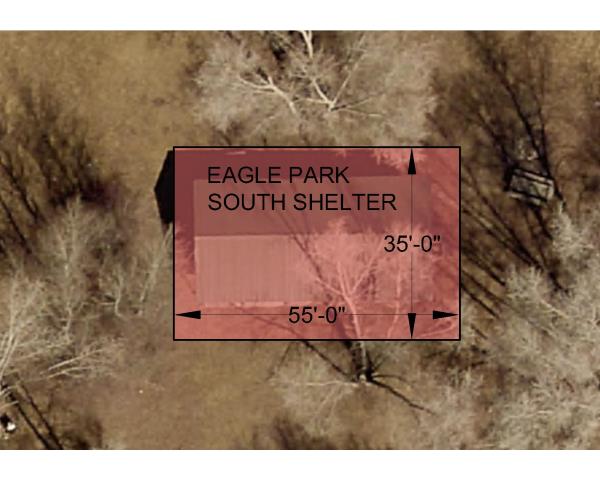
Evergreen Park:
- Evergreen Park Shelter
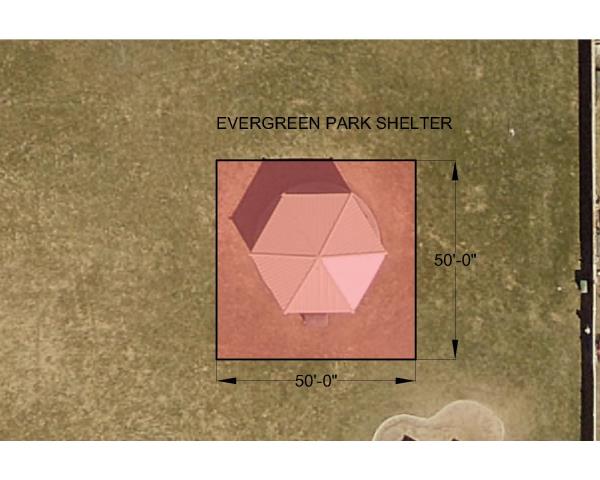
Nature Park:
- Nature Park Northeast Shelter
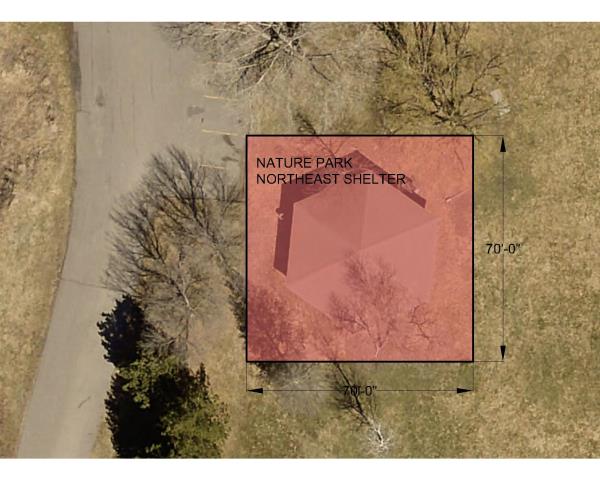 Nature Park Northwest Shelter
 - Nature Park Southeast Shelter
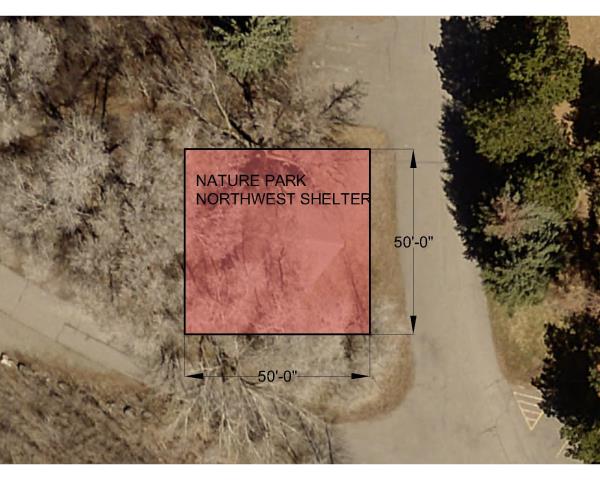
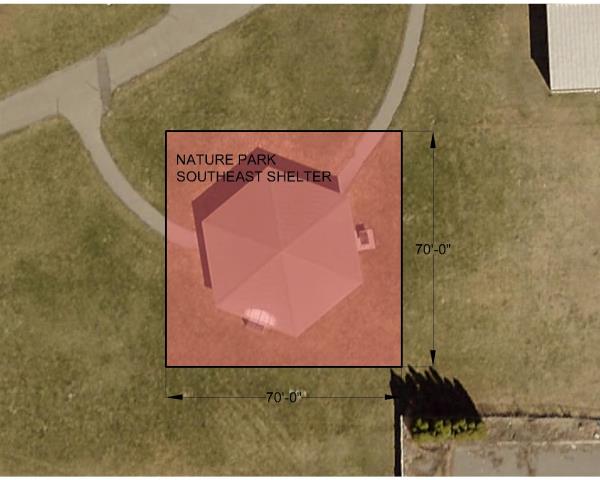
- Nature Park Southwest Shelter
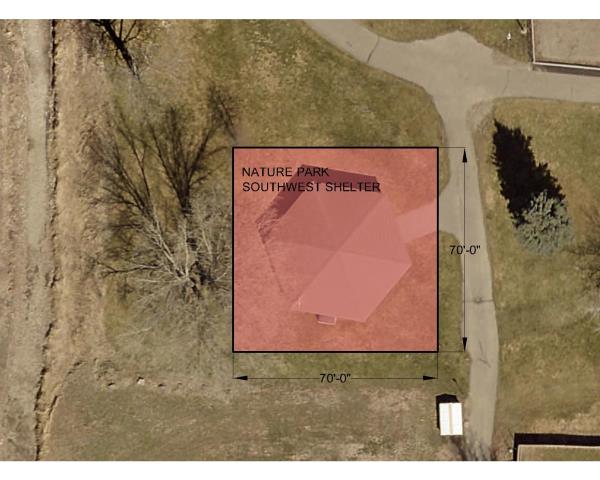
Porter Park:
- Porter Park North Shelter
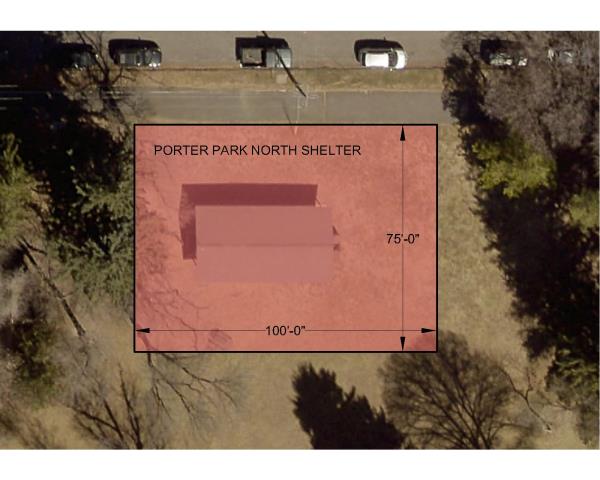
- Porter Park Beehive Stage and South Shelter (Depiction of the separate facility reservations/areas)
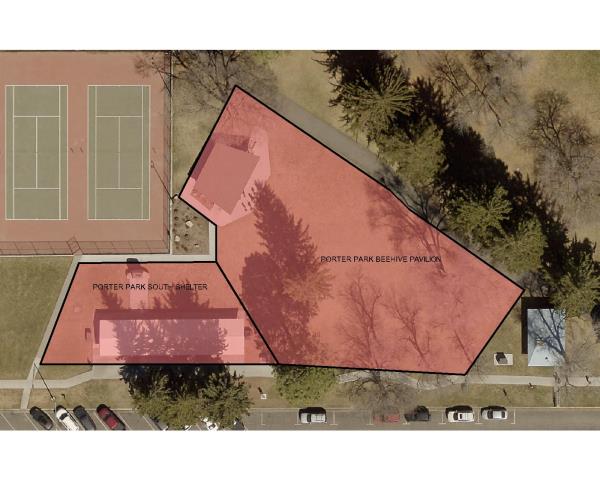
Smith Park:
- Smith Park Gazebo
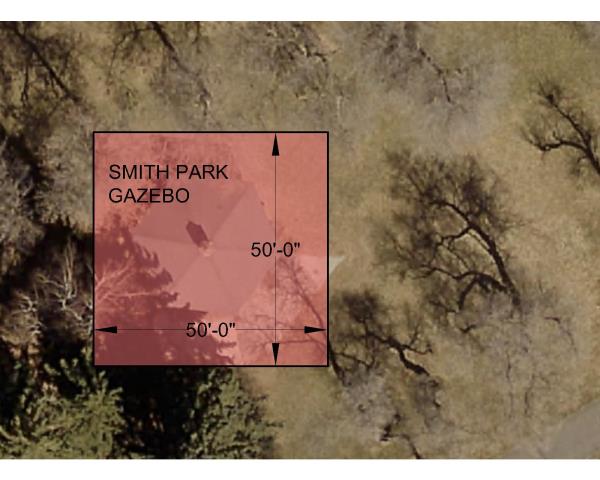
- Smith Park East (North) Shelter
 Shelter.jpg)
- Smith Park South Shelter
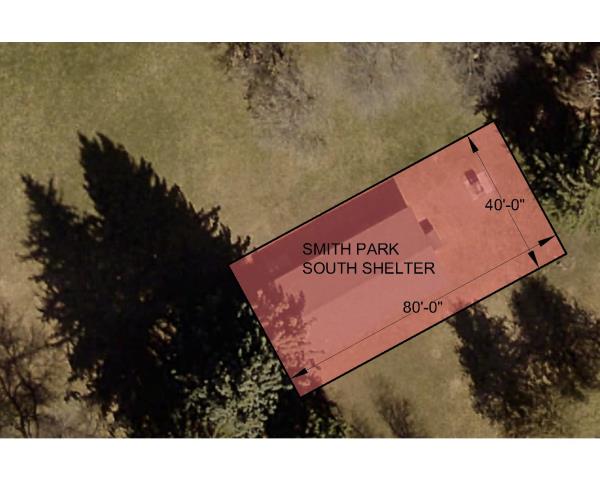
Adopted by Ord. 1310 on 5/1/2024
Adopted by Ord. 1310 - Recorded Copy Recorded Ordinance 1310 on 5/1/2024
It shall be unlawful to drive or park any motorized vehicle except on a street, driveway or parking lot in any Park; or to park or leave any such vehicle in any place other than established for public parking, without a written permit from the City Council or designated agent of the City of Rexburg relative to Parks. Motorized wheelchairs may be used. (Ord. 1019 Art I §6, 2009). (Ord. 968, §6(b), 2006).
It shall be unlawful for any person to bring or harbor any animal in the Parks, except as may be allowed pursuant to established leash laws for the City of Rexburg.
Note to Section 12.04.060: See Section 6.04.010 for leash requirements and other animal owner responsibilities. (Ord. 968, §6(c), 2006).
It shall be unlawful for any person other than those designated by the City Council or designated agent of the City of Rexburg relative to Parks, to vend, sell, peddle, or offer for sale any commodity or article within any Park. (Ord. 968, §6(d), 2006).
It shall be unlawful for any person to use nicotine products within the Park. Smoking, vaping, and chewing tobacco is not allowed within any Park. (Ord. 968, §6(e), 2006).
It shall be unlawful for any person to have in his or her possession, custody or control any alcoholic beverages or illegal drug/substance of any kind whatsoever. (Ord. 968, §6(f), 2006).
Recorded by Ord. 639 Unlawful to Transport Liquor in Open Container on 10/7/1981
Repealed & Reenacted by Ord. 1211 on 5/1/2019
It shall be unlawful for anyone to paste, glue, tack or otherwise post any sign, placard, advertisement, or inscription whatever, or for any person to erect or cause to be erected any sign whatever on any public lands or highways or roads adjacent to a Park without first having obtained permission from the City Council or designated agent of the City of Rexburg relative to Parks. (Ord. 968, §6(g), 2006).
Any person, firm or corporation who fails, neglects, or refuses to comply with the provisions of this ordinance shall be deemed to be in violation thereof and guilty of an infraction, and upon conviction thereof, shall be subject to a fine of not less than twenty-five dollars and not more than three hundred dollars, or may be confined in jail for a period of not more than thirty days, either or both such fine and imprisonment may be imposed, and in addition thereto, any person so convicted shall pay such costs as the Court may assess. (Ord. 968, §7, 2006).
Provided that the provisions of sections 12.04.010 – 12.04.100 shall not apply to any properly authorized government official in pursuit of any official duty. (Ord. 968, §6(part), 2006).
City Parks use policy adopted by the City Council in the January 5, 2022 City Council Meeting.
- All City facilities, including parks and park amenities, are to be used only for their intended purpose(s). Any facilities which are not maintained during certain seasons will not be available.
- Parks are for public use. Public access to a park, or portions of a park, shall not be restricted by private groups, except in designated areas such as directly under a park picnic pavilion. Private ticketed events are not allowed.
- Unless an exception is granted by the City Council, vending in City Parks is not allowed.
Eagle Park Campground Use Rules
- Camping Season. Camping at Eagle Park Campground shall be permitted annually from April 15 through October 15.
- Permitted Camping Days and Park Hours. Overnight camping shall be permitted only on Friday, Saturday, and Sunday nights. On all other days, Eagle Park shall be limited to day use only and shall close at 11:00 p.m., consistent with the operating hours of other City parks.
- Camping Permit and Payment Required. All persons camping at Eagle Park Campground must obtain and pay for a camping permit before occupying a campsite. Payment may be made electronically through the City’s designated payment system or in person at Rexburg City Hall during regular business hours. The camping permit must be clearly displayed at the campsite throughout the camper’s stay. Any person found camping without a valid, properly displayed permit may be required to immediately vacate the campsite and the campground.
- Law Enforcement Patrols. The City will coordinate with the Rexburg Police Department to provide regular nighttime patrols of Eagle Park Campground to promote compliance with campground rules and to address public safety concerns.
12.05.015 Sidewalk Snow Removal
12.05.020 Open Alcoholic Container
12.05.030 Public Use Of Sidewalk - Restricted
12.05.040 Selling, Displaying Or Advertising Of Merchandise - Restricted
12.05.050 Public Use Of Sidewalks - Exceptions
12.05.060 Liability Insurance - Required
12.05.070 Clearance For Pedestrian Passage
12.05.080 Violation - Penalty
Adopted by Ord. 1019 Sidewalk Safety and Standards on 4/1/2009
Amended by Ord. 1164 Misdemeanor to Infraction on 6/14/2017
It shall be unlawful for any person to obstruct any street, alley or public sidewalk within the corporate limits of the City of Rexburg. (Ord. 1019 Art I §2, 2009).
Any person or persons, firm or corporation owning or occupying premises within the corporate limits of the City of Rexburg, shall be responsible for the removal of snow from any sidewalks adjacent to their premises. It shall be unlawful to fail to remove snow from designated sidewalks within (24) hours after being notified by the City of a declaration by the Mayor or the Public Works Director of a “Pedestrian Safety Snow Emergency” in accordance with the then existing policies of the city. If the responsible party fails to remove the snow, or notifies the City of an inability to remove the snow, the City shall have the right, but not the obligation, to cause the snow to be removed at the owner’s expense, as part of the public utility function provided by the City. The occupant or owner of the property who has been assessed a snow removal fee can appeal the assessment to the City Council. (Ord 1019 Art. I §3-2, 2009)
It shall be unlawful for any person to transport or have in his physical possession or control any alcoholic liquor or beer in an open or unsealed container of any kind while being upon the streets, parking lots or sidewalks of the City of Rexburg, Idaho. (Ord. 639 § 1, 1981).
It shall be unlawful for any person to store, install, maintain or operate any material, vehicle, structure, fixture or business upon any public sidewalk within the city, except as permitted by Section 12.05.050. (Ord. 1019 Art I §4, 2009).
It shall be unlawful to sell, display or advertise the sale of any goods, wares, merchandise, food or beverage upon or from any cart, rack, structure or vehicle situated upon any public sidewalk within the city, except as permitted by Section 12.05.050. (Ord. 1019 Art I §5, 2009.)
Notwithstanding Sections 12.05.010 through 12.05.040, the City Council may by resolution duly passed and adopted, declare a day or days in the commercial areas of the City of Rexburg during which licensed merchants may display and sell goods, wares and merchandise in front of their respective places of business. The merchandise so displayed shall be confined within an area extending from the store front toward the street line no more than 1/2 the total width, and under no circumstance shall the display area extend any closer than five (5) feet from the street line, and shall not cover any more than a total of one half (1 /2) of the total area of sidewalk in front of the business. Nothing herein contained shall allow for placement of merchandise in such a manner as to require, or encourage pedestrians to walk upon the street. (Ord. 1019 Art I §6, 2009.)
Any licensed merchant or other person conducting a lawful business in the commercial area, may for the purpose of displaying goods, wares and merchandise, petition the City of Rexburg for permission to engage in such conduct on a regular basis provided that said merchant, shall first be required to indemnify the City of Rexburg from any and all liability by reason.thereof to the extent of $500,000.00 for any one accident and to file proof with the City of such liability insurance indemnifying the City of Rexburg, and the same restrictions as set forth above in Section 12.05.040 shall apply as to placement. Provided that any such display of merchandise shall be removed at the end of each business day or during any period when the adjacent business in not open for business. (Ord. 1019 Art I §7, 2009.)
At any location in the commercial area where the sidewalk is less than six feet in width, then the clear space for pedestrian passage shall not be reduced to less than four feet. (Ord. 1019 Art I §8, 2009).
Any person, firm or corporation violating any provision of this chapter shall, upon conviction thereof, be punishable by a fine not to exceed three hundred dollars or by imprisonment for not more than six months or by both such fine and imprisonment for any single violation. (Ord. 1019 Art III §1, 2009.)
12.06.020 Application
12.06.030 Fees
12.06.040 Standards For Issuance
12.06.050 Notice Of Denial Of Application
12.06.060 Alternative Permit
12.06.070 Appeal Procedure
12.06.080 Contents Of Permit
12.06.090 Duties Of Permittee
12.06.100 Prohibitions And Regulations
12.06.110 Violation - Penalties
12.06.120 Emergency Cancellation/Termination
12.06.130 Severability
The following words and phrases when used in this chapter shall have the meaning set out in this section.
- Chief of Police: The Chief of Police of the city of Rexburg or the chief's authorized designee.
- City Clerk: The clerk of the city or the clerk's authorized designee. (Ord. 810 §1, 1998).
- A person seeking a permit shall obtain and file an application with the city clerk on forms provided by such officer.
- An application for a permit shall be filed with the city clerk at least forty-five days and not more than one year before the parade or public assembly is proposed to commence. (Ord. 810 §2, 1998).
The City Council may establish such fees as are necessary and reasonable by resolution. (Ord. 810 §3, 1998).
- Only one permit will be granted for the same time and/or location. The city clerk shall issue a permit on a first-come, first-served basis.
- Any other reasonable regulation or restriction deemed necessary by the chief of police for the protection and safety of the parade participants, viewing public or for the public health, safety and general welfare of the citizens of the city may be imposed by the chief of police. However, such additional regulations or restrictions shall be specified in writing to the applicant with all reasons therefore clearly enumerated. (Ord. 810 §4, 1998).
The City Clerk shall act promptly upon a timely filed application for an activity requiring a permit but in no event shall grant or deny a permit less than twenty days prior to the event. If the City Clerk denies the application, the applicant shall be notified by either personal delivery or United States mail at least twenty days prior to the event of his action and state the reasons for the denial to the address or telephone number provided on the permit application. (Ord. 810 §5, 1998).
- The City Clerk, in denying an application for an activity requiring a permit, may authorize the conduct or the activity requiring a permit at a date, time or place different from that named by the applicant. An applicant desiring to accept an alternate permit shall, within five (5) days after notice of the action of the City Clerk, file a written notice of acceptance with the City Clerk.
- An alternate permit shall conform to the requirements of, and shall have the effect of, a permit issued under this Ordinance. (Ord. 810 §6, 1998.)
Any applicant shall have the right to appeal the denial of a permit to the City Council. The denied applicant shall make the appeal within five days after receipt of the denial by filing a written notice with the City Clerk and a copy of the notice with the City Clerk. The city council shall act upon the appeal at the next regularly scheduled meeting following receipt of the notice of appeal. (Ord. 810 §7, 1998).
Each permit shall state at least the following:
- Starting and approximate ending time; and
- The portions of the streets that may be occupied by the activity requiring a permit. (Ord. 810 §8, 1998).
A permittee hereunder shall comply with all permit conditions and with all federal, state and local laws. (Ord. 810 §9, 1998).
A. A permittee hereunder shall comply with all permit conditions and with all federal, state and local laws. (Ord. 810 §9, 1998).
B. No personal property may be placed on the public right-of-way before 6:00 P.M. the day prior to the event.
C. Any personal property placed on the public right-of-way before 6:00 P.M. the day prior to the event will be removed.
Amended by Ord. 1310 on 5/1/2024
Amended by Ord. 1310 - Recorded Copy Recorded Ordinance 1310 on 5/1/2024
Any person who violates or fails to comply with any of the provisions of this chapter or who, having obtained a permit hereunder, willfully fails to continue to comply with the conditions set forth in this chapter is guilty of an infraction, and upon conviction thereof, may be fined in accordance with state statutes. (Ord. 810 §11, 1998).
The chief of police may order an activity requiring a permit to terminate and disperse in the event of a natural calamity or in the event public peace is breached and/or life and/or property is in eminent danger. (Ord. 810 §12, 1998).
The provisions of this chapter are severable and if any provision, clause, sentence, subsection, word or part thereof is held illegal, invalid or unconstitutional or inapplicable to any person or circumstance, such illegality, invalidity or unconstitutional or inapplicability shall not affect or impair any of the remaining provisions, clauses, sentences, subsections, words or parts of this chapter or their application to other persons or circumstances. It is declared to be the legislative intent that this chapter would have been adopted if such illegal, invalid or unconstitutional provision, clause sentence, subsection, word or part had not been included therein, and if such person or circumstance to which the chapter or part thereof is held inapplicable had been specifically exempt therefrom. (Ord. 810 §15, 1998).
12.07.020 Sidewalk Shutdown
12.07.030 Sidewalk Standards And Specifications
12.07.040 Sidewalk Requirement Amendments
12.07.050 Penalties And Effective Date
At any location in the.commercial area where the sidewalk is less than six (6) feet in width, then the clear space for pedestrian passage shall not be reduced to less than four (4) feet. (Ord. 1019 Art I, 2009.)
The. City of Rexburg reserves the right to place on hold/shut down any sidewalk project due to a springtime thaw. (Ord. 1019, Article II. (A), 2009.)
Within the Corporate limits of the City of Rexburg there is a requirement for a 7' Landscape Strip behind curb and gutter followed by a 5' Wide Portland Cement Concrete Sidewalk on both sides of a street at all locations. The sidewalk must be constructed per the current City of Rexburg Standard sidewalk drawings and compliant with ADA Standards. (Ord. 1019 Art II, 2009.)
Notwithstanding Sections 12.07.020, and 12.07.030 , the City Council may by resolution, duly passed and adopted, amend or modify the standards and specifications for sidewalks in the City of Rexburg as detailed in Appendix A.
- Any person, firm or corporation violating any provision of this Ordinance shall, upon conviction thereof, be guilty of an infraction, and be punishable by a fine not to exceed Three Hundred Dollars ($300.00). In addition, the City shall have the right to remove the obstruction at their discretion, and the cost of so doing shall be added to the monthly utility billing sent out by the City to the appropriate property owner or account holder.
- All ordinances or parts of ordinances in conflict herewith are hereby repealed. (Ord. 1019 Art III, 2009).
CHAPTER 13.2 WATER METERS
CHAPTER 13.3 WASTEWATER REGULATIONS
CHAPTER 13.4 WASTEWATER RATES AND CHARGES
Title 13 sets forth the regulations, requirements and enforcement provisions concerning the City’s water and sewers.
For statutory provisions allowing cities to create, develop, maintain and operate domestic water systems, see Idaho Code §50-323; for provisions giving cities control of sewers and drains within their jurisdiction, see Idaho Code §50-332; for provisions giving cities the power to establish, operate, maintain and collect fees or charges for water and sewer systems, see Idaho Code §50-1030.
13.01.020 Superintendent Of The Waterworks - Powers And Duties
13.01.030 Access For Examination Of Apparatus - Penalty For Violation Of Regulations
13.01.040 Service Pipe
13.01.050 Water Use Restrictions In Areas Where Water Mains Are Installed
13.01.060 Water Main Charge
13.01.070 Fire Hydrants
13.01.080 Public Use Of A Fire Hydrant And Fees Associated
13.01.090 Water Supply Limitations For Animal Troughs And Other Facilities
13.01.100 Service - Application - Deposit Requirements
13.01.110 Service - Classifications Designated
13.01.120 Service - Water User Charges
13.01.130 Service - Meter Rental Charges
13.01.140 Service - Rates And Charges - Monthly Statement
13.01.150 Service - Rates And Charges - Payment Delinquency Qualifications - Penalties
13.01.160 Using Water After Turnoff For Nonpayment Of Rates - Penalty
13.01.170 Unlawful Uses Of Water Or Appurtenances Designated - Penalty
13.01.180 Wasting Water Prohibited - Penalty
13.01.190 Liability Limitations
13.01.200 Changes To Or Amendment Of Chapter Provisions - City Council Authority
The water system for the supply of the city shall be under the sole and exclusive control of the Mayor and City Council, who may from time to time direct the construction of such works, placing of mains, service pipes and fire hydrants as the necessities of the city may require. (Ord. 110 §1, 1907).
The superintendent of the city waterworks shall, under the directions of the mayor and city council, have charge of such works, mains, pipes and hydrants and of the putting in of all service pipes, shall regulate the water supply to fire hydrants and all water consumed, and shall report to the mayor and city council quarterly, or as often as required, the condition of the waterworks and make such suggestions as the nature of the service may require. (Ord. 110 §2, 1907, amended by Ord. 216, 237, and 317).
Free access at all reasonable hours shall be allowed the superintendent of waterworks or mayor, city clerk-treasurer or committee from the city council, to all places supplied with water, to examine the apparatus, the amount used and the manner of using same. Any water user violating any of the rules and regulations controlling the water supply shall forfeit all payments made and the right to the use of water. (Ord. 110 §17, 1907, amended by Ord. 216, 237, and 317).
- Stopcock and Key Box Required. For each service pipe there shall be attached at the inside line of the curb a stopcock and key box, which shall be paid for by the water consumer and be under the exclusive control of the superintendent. (Ord. 110 §7, 1907, amended by Ord. 216, 237, and 317).
- Material Specifications - Permit Required for Extensions. All service and other pipes used underground shall be of cast iron, galvanized iron, extra strong lead or tin-lined lead (except private pipes where the city council authorizes the use of special material), laid not less than four feet below the surface of the ground, and of sufficient strength to stand the water pressure. All work upon and alterations to or extensions of water pipes and size of pipes shall be to the acceptance of the superintendent. No extension of service pipes shall be made without first obtaining a permit therefore from the superintendent, for which permit there shall be paid the sum of one dollar. No extension shall be made to another water taker from the same service pipe without a stopcock and key box being attached at the junction of such service pipe. (Ord. 110 §8, 1907, amended by Ord. 216, 237, and 317).
- Maintenance Responsibility and Repair Instructions. All water users shall keep their service pipes, connections and other apparatus in good repair and protected from frost at their own expense, but no person, except under the direction of the superintendent, shall be allowed to dig into the street or sidewalk for the purpose of laying, removing or repairing any service pipe. (Ord. 110 §10, 1907, amended by Ord. 216, 237, and 317).
Whenever the water mains are laid, no person shall be allowed to convey the water of the city from any ditch or place by private pipes for fountains, mechanical or other purposes except the ordinary irrigation of lots under the direction of the superintendent, nor shall the water be diverted from the ordinary irrigation ditches for the supply of steam boilers or other purposes. (Ord. 110 §19, 1907, amended by Ord. 216, 237, and 317).
- Water main charge: hereafter, any person, firm, corporation or entity, before obtaining a permit to connect to any water main constructed substantially at city expense, shall pay a water main charge therefore at the rate of ten dollars ($10.00) per lineal foot of property abutting either side of the water line. This water main charge shall be in addition to all other hook-up fees or charges required by the City of Rexburg. All water mains owned by the City of Rexburg shall be deemed to have been constructed substantially at city expense, except those mains constructed within recently platted and improved subdivisions where the permittee can establish to the satisfaction of the city that the water main was not constructed substantially at city expense.
- If the city places stub-outs from a main sewer or water line accessible to an owner's property, the property owner shall reimburse the city for the cost of said stub-out when the property owner obtains a permit to hook-up to a city sewer or water line.
- Access and Repair Restrictions. All public fire hydrants shall be kept in repair by the superintendent of waterworks, and in case of fire the members of the fire department and such other persons as the superintendent shall authorize, shall have access to the hydrant. No other persons shall open or operate any fire hydrants, or attempt to draw water therefrom, or obstruct the approach thereto. (Ord. 110 §3, 1907, amended by Ord. 216, 237, and 317).
- Wrenches and Use Restrictions. Wrenches for fire hydrants shall be furnished by the chief of emergency services for the use of the members of the fire department, and to such other persons as he may deem proper, and any officer or member of the fire department or other person having charge of one or more of the wrenches who shall permit the same to be taken from their place of deposit, or to be used for any other purpose than that authorized by the chief of emergency services, shall be liable to a fine of not exceeding fifty dollars for each offense, besides costs. (Ord. 110 §5, 1907, amended by Ord. 216, 237, and 317).
- Unauthorized Use and Willful Damage Prohibited. Any person who shall willfully or carelessly run any vehicle against a fire hydrant or hitch any animal to same, or draw or attempt to draw water therefrom, shall be guilty of an infraction, and upon conviction thereof shall be punishable by a fine in any sum not to exceed one hundred dollars and costs, and be liable for all damages done to said hydrant. (Ord. 110 §4, 1907, amended by Ord. 216, 237, and 317).
- In order to prevent possible contamination from back flow of the Rexburg City water system, any person or entity desiring to obtain water from a Rexburg City fire hydrant must comply with the following:
- Obtain a written permit from Rexburg City Hall, 35 North 1st E, before attempting to take any water; and
- Take water only from the one filling station (fire hydrant) designated by the City Water Department; and
- Check out the back flow and metering device from the Water Department to be attached to the fire hydrant agreed upon between the City Water Department and the potential user; and
- A deposit for the actual cost of the back flow meter will be required upon issuing the permit to buy water out of the City fire hydrant. The minimum deposit fee shall be $1,100; and
- Any damage to or loss of the back flow meter by the permit requestor will cause the entire deposit to be paid to the City for the purpose of replacing the back flow meter or repairing the back flow meter to its original condition; and
- The deposit will be refunded less $50.00 if the back flow meter is returned to the City Water Department without any damage to the fire hydrant or the back flow meter; and SECTION V: The City Water Department will perform a final inspection to determine the final charges for the permit; and
- Based upon the number of gallons taken as shown on the back flow metering device, the person or entity obtaining the water shall pay to the City the fee established by the City for the quantity of water taken at the rate of $5.00 per 1,000 gallons with a minimum charge of $10.00; and
- Any person or entity not complying with this Ordinance shall be assessed a penalty charge of $400.00, in addition to the normal charge for water taken.
- A backflow meter can be purchased by the requestor of the permit for the purpose of measuring the water at the City's effective cost of the backflow meter; or the requestor can lease the backflow meter by paying a deposit of up to the cost of the backflow meter. (Ord. 935 §1-8, 2005.)
Watering troughs for animals shall not be allowed a constant flow of water, but shall only be allowed to use such quantity as shall supply the actual wants of the stock having access thereto; nor shall continuous streams of water be permitted to flow from hydrants, faucets or stops over wash basins, water closets or urinals, or from any other apparatus drawing water. (Ord. 110 §16, 1907, amended by Ord. 216, 237, and 317).
- Deposit Requirements. With each and every application for water and sewer service to be supplied through the water and sewer systems of the city, there shall be deposited with the city clerk or city treasurer a sum in cash, the amount to be determined by resolution of the City Council. Such deposits shall be held by the city so long as the service applied for is supplied by the city, and if and when the service is discontinued or terminated as to any water and/or sewer consumer or user, the amount of the deposit, less any amount owing the city for such water and/or sewer service, shall be refunded. (Ord. 629 §3, 1980: Ord. 322 §7, 1935: Ord. 317 §2, 1934).
- Water Meter Deposit Requirements. Whenever an application is made for water to be supplied through the city water-works system, it shall be the duty of the City Clerk-Treasurer to ascertain whether or not a meter has been installed to measure water supplied to the building or premises, and if so whether such meter has been paid for or not, and if not paid for whether there is on deposit with the City Clerk-Treasurer the amount required by the provisions of Sections 13.02.030 and 13.02.040 of this code; and if the amount required by the provisions cited above is not on deposit, then to require that such deposit be made before accepting such application. The city superintendent of waterworks shall not turn on the water for use in any building or on any premises, or for any purpose whatsoever, until he shall have received notice from the city clerk--treasurer that the requirements of this chapter have been complied with. (Ord. 317 §2, 1934, amended by Ord. 629, 1980).
Applicants for the use of water on premises and buildings whereon water is supplied are classified, for the purpose of fixing rates and charges for water supplied through the city waterworks system, into five classes.
- Class One: Residences, dwelling houses having only one apartment and occupied by only one family, and not used for or connected with any hind of business for profit.
- Class Two: Apartment houses, including dwelling houses containing more than one apartment or occupied by more than one family, supplied through one meter, and not used for or connected with any kind of business for profit.
- Class Three: Businesses, including building and construction work, dairies, stockyards, and all other places where any business, trade, occupation or enterprise of any kind or characteristic carried for profit.
- Class Four: ??
- Class Five: Indigents and poor persons. (Ord. 317 §4, 1934, amended by Ord. 629, 1980.)
Commencing September 1, 1993, the water user charges shall, as a minimum, be reviewed annually and updated by resolution of the city council to reflect actual costs of operation, maintenance, replacement and financing of the city water system. (Ord. 749 §1, 1993: Ord. 555 §1, 1974: Ord. 401 §1, 1956: Ord. 399 §1, 1956: Ord. 322 §1, 1935: Ord. 317 §6, 1934: Ord. 309 §3, 1931).
To each and every one of the classified users set forth in Section 13.01.110, there shall be added monthly the amount provided in Sections 13.02.030 and 13.02.040 of this code for meter rental and service charges, when such rental and service charges should be applied, pursuant to the provisions of such sections. (Ord. 555 §2, 1974).
It shall be the duty of the City Clerk-Treasurer to prepare and send by United States mail to every owner of property, or to the agent or tenant of the owner of property whereon water is furnished, as directed in the application filed with the Clerk--Treasurer, on the first day of each month, a written statement showing the charges for monthly service and water used, which statement in each case where no meter is in use shall show the charges for the ensuing month according to the rates provided in Section 13.01.120, and in each case where a meter is used said statement shall show the charges for the month immediately passed, according to the rates set forth in Section 13.01.120 of this chapter. (Ord. 309 §5, 1931, amended by Ord. 629, 1980).
If any bill, charge or account for services or water furnished is not paid within thirty days after the service of the statement thereof as provided in Section 13.01.140, the City Clerk-Treasurer shall notify the superintendent of waterworks of such delinquency, and it shall be the duty of the superintendent of waterworks to immediately shut off the water supplied to the property in respect to which such delinquency exists; when water has been so shut off it shall not be turned on again until all delinquent charges plus penalties have been paid. (Ord. 309 §6, 1931, amended by Ord. 629, 1980).
If any person, after the water has been turned off from his premises on account of nonpayment of rates or other violations of the rules and regulations pertaining to the water supply, shall turn on or permit the water to be turned on, or use or permit the water to be used without authority, he shall on conviction thereof be fined not exceeding fifty dollars for each offense. (Ord. 110 §13, 1907, amended by Ord. 216, 237, and 317).
Any person who, by himself, family, servants or agents, shall use the water running through the water mains without paying first therefore, as provided in this chapter, or who shall, without authority, open any stopcocks, valves or other fixtures attached to the system of water supply, or who shall in any way injure, deface or impair any part or appurtenance of the waterworks, or who shall cast anything into any tank or reservoir belonging to the water-works, or in any manner obstruct the same, shall be punished by a fine not exceeding one hundred dollars for each offense or by imprisonment in the city jail not exceeding sixty days or by both such fine and imprisonment. (Ord. 110 §12, 1907, amended by Ord. 216, 237, and 317).
If any water user wastes water, or allows it to be wasted by imperfect water stops, valves, leaky joints or pipes, or runs water through basins or other apparatus, or uses the water for any other purposes than those for which they have paid, or uses water in violation of the rules and regulations controlling the water supply and the provisions of this chapter, he shall be liable to a fine of not to exceed twenty-five dollars for each offense, and the water may be cut off from such water users and all payment forfeited, unless such persons shall promptly pay such reasonable charges as may be charged therefore by the superintendent. (Ord. 110 §11, 1907, amended by Ord. 216, 237, and 317).
The city corporation shall not be held liable for damages to any water user by reason of a stoppage or other interruption of the water supply caused by a scarcity of water, accident to works or mains, alterations, additions, repairs or from other unavoidable causes. (Ord. 110 §18, 1907, amended by Ord. 216, 237, and 317).
Nothing contained in this chapter shall prohibit the city council from amending, altering or adding to the provisions of this chapter in relation to the water supply, or the rules of same which may be adopted in conformity therewith, provided that no alteration in water rates shall apply to any charge upon or contract made with a water user under this chapter until after the expiration of the time for which such charge was made or contract entered into. (Ord. 110 §25, 1907, amended by Ord. 216, 237, and 317).
13.02.020 Specifications Generally - Approval Required
13.02.030 City To Supply Meters - Installation Costs - Deposit Requirements
13.02.040 Location Requirements
13.02.050 Access Requirements - Superintendent Of Waterworks Authority
13.02.060 Disconnection And Removal Authorization - Report Required
13.02.070 Rental And Service Charges For Meters Not Paid For - Private Installation Of Meter Permissions
13.02.080 Testing - Costs
13.02.090 Use Of Unmetered Water Restrictions
13.02.100 Cross Connections And Backflow Devices
It is the purpose and policy of the city to require that meters be installed for the measuring of water by gallons to all users of water who are served by the city waterworks system, and that such meters be installed by or under the supervision of the superintendent of waterworks. (Ord. 316 §1, 1934).
All water meters installed in pursuance of the provisions of this chapter shall be of standard types and qualities and of makes and kinds approved by the mayor and city council, and no meter of any kind shall be placed, installed in or connected with the waterworks system that has not been so approved. Each meter shall be of such size and capacity as will deliver the quantity of water required to supply the needs of the user to be served thereby. (Ord. 316 §3, 1934).
The city shall purchase meters for installation in pursuance of this chapter in quantities to meet the requirements of such work, and shall supply them to property owners or water users as required for installation as provided in this chapter at the cost thereof to the city plus the cost and expenses of installation, in each case, and such cost, price and expense of installation shall be due from the water user or owner of the property whereon same is installed to the city clerk--treasurer as soon as the meter is installed and before water is turned on for use on such property. If such charges are not so paid then the owner of the property or occupant thereof shall be required to make a cash deposit with the city clerk--treasurer before the water is turned on. (Ord. 316 §4(part), 1934).
In all cases where practicable, meters shall be placed on or immediately next to the line dividing the private property from the public street, and all meters shall be placed in suitable boxes and at sufficient depth in the ground to afford protection from injury by frost and other external causes. Meters shall be kept sealed, and all boxes shall be kept locked with substantial locks, and the keys to such locks shall be kept by the city or its officers or employees; provided, a meter may be placed in the basement or cellar of a building wherein water is to be used, if sufficiently protected against freezing and other injury, if the superintendent of waterworks or his assistants may have free access thereto for reading and other services; and provided further that there is no tap or other means of drawing water between the meter and the city main. (Ord. 316 §5, 1934).
The city superintendent of water – works shall have access to all property buildings wherein meters have been placed for reading, repairs and other service, at all reasonable times, and if admittance to any property or building is denied to the superintendent of waterworks or his assistants, for any of such purposes, such denial shall constitute sufficient cause for shutting off the water from such property and building, and it shall be the duty of the superintendent of waterworks in any such case to immediately shut off such water. (Ord. 316 §6, 1934).
It is unlawful for any person, except the superintendent of waterworks or his assistant, to remove, disconnect or in any manner disturb or break the seal of any water meter installed in or connected with the city water-works system, except as otherwise provided in this section; provided, if any meter located in a basement or cellar is injured by freezing or other cause, such meter may be removed by any licensed plumber, with the consent of the superintendent of waterworks first obtained. Such plumber may reconnect the water lines in such case, and in every such case such plumber shall make a written report to the superintendent of waterworks within twenty-four hours after such meter is removed, stating the number of the meter, the number of the building in which it was installed, and the date and hour when same was removed, and such report shall be signed by the person who removed the meter. Any person who removes any meter except as herein provided shall be guilty of an infraction, and any plumber who removes a meter and fails to make report thereof as herein provided shall be guilty of an infraction, and any violation of the provisions of this section shall be punishable as set forth in Chapter 1.02.020 of this code. (Ord. 316 §7, 1934).
- The City shall purchase meters for installation in pursuance of this ordinance, in quantities to meet the requirements of such work, and shall supply them to property owners or water users as required for installation as provided herein, at the cost thereof to the city plus the cost and expenses of installation, in each case, and such cost price and expense of installation shall be due from the user or owner of the property whereon same is installed, the the City Clerk as soon as the meter is installed, and before water is turned on for use on such property; and if not so paid then the owner of said property or occupant thereof shall be required to make a cash deposit with the City Clerk, before the water is turned on, of the amount herein specified, depending upon the size of the meter in each case, as follows:
3/4 in. meter $5.00 1 in. meter $10.00 1 1/4 in. meter $15.00 1 1/2 in. meter $25.00 over 1 1/2 in. in size $40.00 - And every user of water taken through a meter not paid for, or the owner of the property whereon same is installed, shall be charged and shall pay to the city a rental and service charge as follows:
3/4 in. meter $0.25 per month 1 in. meter $0.50 per month 1 1/4 in. meter $0.75 per month 1 1/2 in. meter $1.00 per month over 1 1/2 in. in size $1.25 per month - and said rental and service charge shall be due and payable at the same time as the monthly charge for water is due, and as long as such user shall occupy the premises served by such meter.
- Deposit Return. And upon such occupant removing from the premises, he shall be entitled to have said deposit returned to him, if all rental and service charged and water dues have been paid, and if not, then the City Clerk shall withhold such amount as may be due to the city.
- Own Meter Installation. Provide, any property owner or water user may install a meter on the premises owned or occupied by him at his own expense, but only under the supervision of the Superintendent of Waterworks, and provided further, that any such meter shall have been approved the the Mayor and City Council. (Ord. 316 §4(part), 1934.)
Any meter may be removed and tested by the superintendent of waterworks at the request of the owner or occupant of the property served by such meter on the payment or deposit by such owner or occupant of the sum of three dollars to cover the charge of testing, and if such meter is found to be accurate within the limits of the guaranty of the manufacturer of the meter, the amount deposited shall be retained by the city. If such meter is found to be inaccurate beyond the limits of such guaranty, then the deposit shall be refunded, and the meter shall be corrected or another one installed; and in such case the water charges collected from the user served by such meter shall be adjusted on such terms as may appear to the waterworks committee to be just. (Ord. 316 §8, 1934).
When a meter has been installed to measure water drawn from the city waterworks system for use on any premises, no water for any purposes shall be drawn for use on such premises except through such meter, and it is unlawful for any person to place or connect any pipes, tap, valve or other fixture or device in the waterworks system by means of which water may be drawn for use on such premises without passing through such meter, or to use any such pipe, tap, valve or other fixture or device for drawing water for use on such premises, and any person violating of the provisions of this section shall be guilty of an infraction and upon conviction thereof shall be punishable as set forth in Chapter 1.02.020 of this code. (Ord. 316 §9, 1934).
The purpose of this section is to protect the public health of water consumers of the City of Rexburg by the control of actual and/or potential cross-connections.
- Definitions:
- Backflow: The flow other than the intended direction of flow, of any foreign liquids, gases, or substances into the distribution system of the City water supply.
- Backflow Prevention Device: A device to counteract back pressure or prevent back siphonaqe.
- City: City means the City of Rexburg and its designated representatives.
- Contamination: The entry into or presence in a City water supply of any substance which may be deleterious to health and/or quality of the water.
- Cross-Connection: Any physical arrangement whereby the City water supply is connected, directly or indirectly, with any other water supply system, sewer, drain, conduit, pool, storage reservoir, plumbing fixture, or other device which contains or may contain contaminated water, sewage or other waste or liquids of unknown or unsafe quality which may be capable of imparting contamination to the City water supply as a result of backflow.
- Cross-Connections. No water service connection to any premises shall be installed or continued in the City unless the water supply is protected by backflow prevention devices as may be required by this ordinance, Idaho Code, and all standards, rules, and regulations of the State of Idaho, the Idaho Department of Health and Welfare, and any other Federal, State, County, or City authority or agency thereof.
- The installation or maintenance of a cross-connection which will endanger the water quality of the potable water supply of the City of Rexburg shall be unlawful and is prohibited. Any such cross-connection now existing or hereafter installed is hereby declared to be a public nuisance and the same shall be abated.
- The control or elimination of cross -connections shall be in accordance with this ordinance, Idaho Code, and all standards, rules, and regulations of the State of Idaho, the Idaho Department of Health and Welfare, and any other Federal, State, County, or City authority or agency thereof, together with the latest addition of appropriate manuals of standard practice pertaining to cross-connection control enacted by the City and any applicable County, State, and Federal authorities and agencies. The City shall have the authority to establish requirements more stringent than State regulations if it deems that the conditions so dictate.
- Use of Backflow Prevention Devices.
- Backflow prevention devices shall be installed in connection with water service connections or within any premises where, in the judgment of the City, the nature and extent of the activities, or the materials stored on the premises, would present an immediate and dangerous hazard to health and/or be deleterious to the quality of the water should a cross -connection occur; even though such cross-connection does not exist at the time the backflow prevention devices shall be installed under circumstances including but not limited to the following:
- Premises having an auxiliary water supply, unless the quality of the auxiliary supply is in compliance with Idaho Code, and all standards, rules, and regulations of the State of Idaho, the Idaho Department of Health and Welfare, and any other Federal, State, County, or City authority or agency thereof and is acceptable to the City.
- Premises having internal cross -connections that are not correctable, or intricate plumbing arrangements which make it impracticable to ascertain whether or not cross connections exist.
- Premises where entry is restricted so that inspections for cross-connections cannot be made with sufficient frequency or at sufficiently short notice to ensure that cross connections do not exist.
- Premises having a repeated history of cross connections being established or re-established.
- Premises on which any substance is handled under pressure so as to permit entry into the City water supply, or where a cross -connection could reasonably be expected to occur. This shall include the handling of process waters and cooling waters.
- Premises where materials of a toxic or hazardous nature are handled in such a way that if back siphonage should occur, a serious health hazard might result.
- The following types of facilities will fall into one of the above categories where a backflow prevention device is required to protect the City water supply. A backflow prevention device shall be installed at these facilities unless the City and applicable State, County, and Federal authorities and agencies determine that no hazard exists:
- Hospitals, mortuaries, clinics
- Laboratories, including school laboratories
- Metal plating industries
- Sewage treatment plants
- Food or beverage processing plants
- Chemical plants using a water process
- Petroleum processing or storage plants
- Cat washes
- Dry cleaners
- Other premises as specified by the City, where backflow prevention devices are required to protect the City water supply.
- The type of protective device required shall depend on the degree of hazard which exists:
- An air-gap separation or a reduced pressure principle backflow prevention device shall be installed where the City water supply may be contaminated with sewage, industrial waste of a toxic nature, or other contaminant which could cause a health or system hazard.
- In the case of a substance which may be objectionable but not hazardous to health, a double check valve assembly, air prevention device shall be installed.
- Backflow prevention devices required by this ordinance shall be installed at the meter, at the property line of the premises when meters are not used, or at a location designated by the City. The device shall be located so as to be readily accessible for maintenance and testing, and furthermore, where no part of the device will be submerged.
- Backflow prevention devices required by this ordinance shall be installed under the supervision of, and with the approval of, the City.
- Any protective device requited by this ordinance shall be approved by the City, applicable State, County, and Federal authorities and agencies. These devices shall be furnished and installed by and at the expense of the customer.
- Backflow prevention devices installed pursuant to this ordinance, shall be inspected and tested annually, or more often if necessary. Inspections, tests, and maintenance shall be at the customer's expense, and, if requested by the City, by a certified tester retained and paid by the customer. Whenever the devices are found to be defective, they shall be repaired, overhauled, or replaced at the customer's expense. Inspections, tests, repairs, and records thereof shall be accomplished in accordance with all standards, rules, and regulations of the ordinance, Idaho Code, and all standards, rules, and regulations of the State of Idaho, the Idaho Department of Health and Welfare, and any other Federal, State, County, or City authority or agency thereof by certified testers retained and paid by the customer.
- No underground sprinkling device will be installed without adequate backflow prevention devices at the point from which the water for irrigation is taken from the City water supply.
- Failure of the customer to cooperate in the installation, maintenance, testing, or inspection of backflow prevention devices requited by this ordinance, Idaho Code, and all standards, rules and regulations of the State of Idaho, the Idaho Department of Health and Welfare, and any other Federal, State, County, or City authority or agency thereof shall be grounds for the termination of water service to the premises, or, in the alternative, the installation of an air -gap separation at the customer's expense.
- In the event that documentation of test and repairs are not received by June 1" of the year when required, the City at the property owner's expense, may hire a State of Idaho licensed backflow prevention tester to test the backflow device(s) and add the cost of the test(s) plus a handling fee of $10.00 to the property owner's City of Rexburg utility bill.
- Backflow prevention devices shall be installed in connection with water service connections or within any premises where, in the judgment of the City, the nature and extent of the activities, or the materials stored on the premises, would present an immediate and dangerous hazard to health and/or be deleterious to the quality of the water should a cross -connection occur; even though such cross-connection does not exist at the time the backflow prevention devices shall be installed under circumstances including but not limited to the following:
- Cross-Connection Inspection
- No water shall be delivered to any structure hereafter built within the City or within areas served by City water until the same shall have been inspected by the City for possible cross -connections and been approved as being free of the same.
- Any construction for industrial or other purposes which is classified as hazardous facilities pursuant to Section 4(1) (G) of this ordinance, where it is reasonable to anticipate cross -connections, or as determined by the City, shall be protected by the installation of one or more backflow prevention devices at the point of service from the City water supply or any other location designated by the City, and applicable County, State, and Federal authorities and agencies.
- Inspections may be made periodically of all buildings, structures, or improvements of any nature now receiving water through the City's system, for the purpose of ascertaining whether cross-connections exist. Such inspections shall be made by the City or applicable County, State, and Federal authorities and agencies.
- Installation Permits. If cross-connection control device(s) are found to be necessary, the owner of the property served must apply to the City for a specific installation permit.
- Additional Remedies.
- In the event an improper cross-connection is not corrected within the time limits set by the City or in the event the City is refused access to any property for the purpose of determining whether or not cross -connections exist, the City may cease delivery of water to the property until the deficiency is corrected to the City's satisfaction.
- In addition, the City without waiving any terms of this ordinance may, but shall not be required to, effect the necessary repairs or installations at the expense of the property owner and refuse delivery of water to the property until the cost thereof shall have been paid.
- Violations of this ordinance are hereby declared to be a nuisance, and the City, after notice to the customer or property owner to remove or correct the violation, may prevent, remove, and abate the same at the expense of the party creating or maintaining the same, in which event the City may levy a special assessment as provided in Idaho Code 50-1008 on the land or premises whereon the nuisance is situated to defray the cost or to reimburse the City for the cost of abating the same.
- Civil Action. In addition to, or in lieu of the foregoing, the City may bring any appropriate civil action, including abatement, injunction, and/or damages in which event the City shall be entitled to all costs including attorney's fees in the prosecution of such action.
- Infraction. In addition to the foregoing, any person violating the provisions of this ordinance shall be deemed guilty of a misdemeanor and upon conviction thereof shall be subject to the penalties as provided by law.
- Liability. This ordinance shall not be construed to hold the City responsible for any damage to persons or property by reason of the inspection or testing herein, or the failure to inspect or test or by reason of approval of any cross -connections. (Ord. 1093, 2013.)
13.03.020 Connection To Public Sewer - Authorized Personnel Required - Accountability
13.03.030 Permit Requirements - Posting
13.03.040 Permit - Application - Fee - Issuance Conditions
13.03.050 Permit - Compliance With Certain Plumbing Regulations Prerequisite To Issuance
13.03.060 Permit - Revocation Conditions
13.03.070 Manholes - Opening Prohibited - Exception
13.03.080 Prohibited Discharges - Garbage Or Other Obstructions
13.03.090 Injuring Sewers Or Appurtenances Prohibited
13.03.100 Violation - Penalty
ARTICLE I GENERAL PROVISIONS
ARTICLE II GENERAL REQUIREMENTS
ARTICLE III WASTEWATER DISCHARGE PERMIT REQUIREMENTS
ARTICLE IV REPORTING REQUIREMENTS
ARTICLE V SAMPLING AND ANALYTICAL REQUIREMENTS
ARTICLE VI COMPLIANCE MONITORING
ARTICLE VII CONFIDENTIAL INFORMATION
ARTICLE VIII PUBLICATION OF USERS IN SIGNIFICANT NON-COMPLIANCE
ARTICLE IX ADMINISTRATIVE ENFORCEMENT REMEDIES
ARTICLE X JUDICIAL ENFORCEMENT REMEDIES
ARTICLE XI SUPPLEMENTAL ENFORCEMENT ACTION
ARTICLE XII AFFIRMATIVE DEFENSES TO DISCHARGE VIOLATIONS
ARTICLE XIII WASTEWATER TREATMENT RATES
ARTICLE XIV MISCELLANEOUS PROVISIONS
It is unlawful for the owner or owners of any property within this city, or his, her or their agent or agents, or other person or persons having charge of or occupying such property, such property being located on any street, alley, court, passageway or area, and within one hundred fifty feet of a sewer along any street or alley of this city, to neglect or refuse, for the period of thirty days after notice from the board of health of this city, to discontinue the use of, clean out, disinfect and fill up all privy vaults and cesspools on such property, or to neglect or refuse for such period after such notice to remove all outside closets on such property. (Ord. 248 §6, 1920).
It is unlawful for any person to connect any drain or sewer pipe with the public sewer unless such person is a drain layer or plumber duly licensed by the city. The drain layer or plumber will be held strictly accountable to the city for any damage done in the prosecution of his work. (Ord. 248 §7, 1920).
It is unlawful for any person to commence or to carry on the work of laying, repairing, altering or connecting any sewer pipe with the public sewer, without first having a permit to do so from the superintendent of sewers. Such permit must be on the grounds during the whole time the work is in progress, and must be exhibited to any person demanding to see it. (Ord. 248 §8, 1920).
Applications for a permit for sewer connections for each user proposing to use such sewer must be made in writing by the owner of the premises or his authorized agent, and must be accompanied by a plan showing the cause of the connection, its size, and the size and location of all branches to be connected with it. The application and plan, together with the fee set by the Mayor and City Council, shall be deposited with the superintendent of sewers, which plan shall be examined by the superintendent of sewers. If in his judgment the carrying out of the plan will cause no injury to the street in which the sewer sought to be connected with is laid, or to the carrying out of improvements projected or which may thereafter be made on said street, or prejudicial to the interest of persons whose property has been or may thereafter be connected with the sewer, and that the plan in all things does conform to the ordinances of this city, then the application to connect with the sewer will be granted, subject to the provisions of such ordinances. All sewer connections shall be put into line and grades designated by the city engineer, who shall prepare a plat of each connection and file such plat in his office. (Ord. 356 §1, 1946: Ord. 260 §1, 1920: Ord. 248 §9, 1920).
Permits to connect with the public sewer must not be issued unless the plumbing in the house or building to be connected is in accordance with the provisions of the building ordinance pertaining to plumbing, unless a special permit for such connection is granted by the superintendent of sewers. (Ord. 248 §18, 1920).
All permits for sewer connections shall be issued to the applicant therefore, and the City Council may at any time revoke a permit for defective work or other cause, or upon request of the person at whose instance the permit is issued. (Ord. 248 §10, 1920).
It is unlawful for any person to open any sewer manhole without the permission of the superintendent of the sewers. (Ord. 248 §5, 1920).
It is unlawful for any person to empty or discharge into the public sewers any night soil, garbage or other similar matter or thing likely to obstruct the sewer. (Ord. 248 §4, 1920).
It is unlawful for any person to willfully injure, break or remove any part or portion of any sewer or any sewer appliance or appurtenance. (Ord. 248 §3, 1920).
Any person violating any of the provisions of this chapter shall, upon conviction thereof, be punishable as set forth in Chapter 1.02.020 of this code. (Ord. 248 §19, 1920).
13.03.120 Administration
13.03.130 Definitions
13.03.140 Abbreviations
- This Ordinance sets forth uniform requirements for users of the Publicly Owned Treatment Works (POTW) for the City of Rexburg and enables the City of Rexburg to comply with all applicable State and Federal Laws, including the clean water act (33USC 1251 et seq. ) and the general Pretreatment Regulations (40 CFR Part 403). The objective of this ordinance is:
- To prevent the introduction of pollutants into the POTW that will interfere with the operation of the POTW;
- To prevent the introduction of pollutants into the POTW which will pass through the POTW, inadequately treated into receiving waters or otherwise be incompatible with the POTW;
- To ensure that the quality of wastewater treatment plant sludge is maintained at a level that allows its use and disposal in compliance with the applicable statues and regulations;
- To protect the POTW personnel who may be affected by wastewater and sludge in the course of their employment and to protect the general public; and
- To improve the opportunity to recycle, and reclaim wastewater and sludge from the POTW.
- This ordinance shall apply to all users of the POTW. The ordinance authorizes the issuance of wastewater discharge permits: authorizes monitoring, compliance, and enforcement activities; establishes administrative review procedures; requires user reporting; and provides for the setting of fees for the equitable distribution of costs resulting from the program established herein. (Ord. 1016 §1.1, 2009.)
Except as otherwise provided herein, the Superintendent or his/her duly authorized representative shall administer, implement, and enforce the provisions of this ordinance. Any powers granted to or duties imposed upon the superintendent may be delegated to other City personnel. (Ord. 1016 §1.2, 2009).
Unless a provision explicitly states otherwise, the following terms and phrases, as used in this ordinance, shall have the meanings hereinafter designated.
- Act or the Act: The Federal Water Pollution Control Act, also known as the Clean Water Act, as amended, 33 U.S.C. 1251 et seq .
- Applicable Pretreatment Standards: For any specified pollutant, The City of Rexburg prohibitive standards, The City of Rexburg specific pretreatment standards, and local limits, State of Idaho pretreatment standards, or EPA's Categorical Pretreatment Standards (when effective) whichever standards are appropriate or more stringent.
- Authorized Representative of the User:
- If the user is a corporation:
- The president, secretary, treasurer, or a vice president of the cooperation in charge of the principal business function, or any other person who performs similar policy or decision making functions for the cooperation; or
- The manager of one or manufacturing, production, or operation facilities, provided, the manager is authorized to make management decisions which govern the operation of the regulated facility including having the explicit or implicit duty of making major capital investment recommendations and initiating and directing other comprehensive measures to assure long-term environmental compliance with the environmental laws and regulations; can ensure that the necessary systems are established or actions taken to gather complete and accurate information for control mechanism requirements; and where authority to sign documents has been assigned or delegated to the manager in accordance with corporate procedures.
- If the user is in partnership or sole proprietorship: general partner or proprietor, respectively;
- If the user is a Federal, State, or local governmental Facility: a director or highest official appointed or designated to oversee the operation and performance of the activities of the government facility, or his/her designee.
- The individuals described in paragraphs 1 through 3 above may designate another authorized representative if the authorization is in writing, the authorization specifies the individual or position responsible for the overall operation of the facility, from which the discharge occurs or having overall responsibility for the environmental matters for the company, and the written authorization is submitted to the City of Rexburg Wastewater Department.
- If the user is a corporation:
- Best Management Practices or BMPs: Means schedules of activities, prohibitions of practices, maintenance procedures, and other management practices to implement the prohibitions listed in §403.5 (a) (1) and (b). BMP also include treatment requirements, operating procedures, and practices to control plant site runoff, spills, or leaks, sludge or waste disposal, or drainage from raw materials storage.
- Biochemical Oxygen Demand (BOD): The quantity of oxygen utilized in the oxidation of organic matter under standard laboratory procedures for (5) five days at 20' Celsius, usually expressed as a concentration [ milligrams per liter] (mg/1).
- Categorical Pretreatment Standard or Categorical Standard: Any regulation containing -pollutant discharge limits promulgated by the U.S. EPA in accordance with sections 307(b) and (c) of the Act (33 U.S.C. 1317) which applies to specific category of users and appears in 40 CFR Chapter I, subchapter N, parts 405-471.
- Categorical User: A user regulated by one of EPA's categorical pretreatment Standards The City of Rexburg or the City Council of Rexburg.
- Control Authority: (1) the POTW if the POTW's pretreatment submissions have ben approved in accordance with requirements of 403.11; or (2) the approval authority if the submission has not been approved.
- Color: The optical density at the visual wave length of maximum absorption, relative to distilled water. One hundred percent (1001/6) transmittance is equivalent to (0.0) optical density.
- Composite Sample: The sample resulting from the combination of individual wastewater samples taken at selected intervals based on an increment of either flow or time.
- Cooling water/non-contact cooling water: Water used for cooling which does not go into direct contact with any raw material, intermediate product, waste product, or finished product. Cooling water may be generated from any use, such as air conditioning, heat exchangers, cooling or refrigeration to which the only pollutant added is heat.
- Domestic User (Residential User): Any user who contributes, causes, or allows the contribution of wastewater into the City of Rexburg POTW that is similar volume and/or chemical makeup to that of a residential dwelling unit. Discharges from a residential dwelling unit will typically include up to 100 gallons per capita per day, 0.2 pounds of BOD per capita per day, and 0.17 pounds of TSS per capita per day.
- Environmental Protection Agency: The U.S. Environmental Protection Agency or, where appropriate, the director of the region 10 office of water, or other duly sworn official of the said agency.
- Existing Source: A categorical industrial user, the construction or operation of whose facility commenced prior to the publication by EPA of proposed categorical pretreatment standards, which would be applicable to such source if and when the standard is thereafter promulgated in accordance with section 307 of the act.
- Existing Users: Any Non -categorical user that is discharging wastewater prior to the effective date of the ordinance, or a specific date that the code will become effective.
- Grab Sample: A sample taken from a waste stream on a onetime basis without regard for the flow, or time.
- Indirect discharge or Discharge: The introduction of pollutants into the POTW from any non-domestic source regulated under section 307(b), (c), or (d) of the act. The discharge into the POTW is normally by means of pumping stations, pipes, conduits, force mains, constructed drainage ditches, surface water interceptors, and all constructed devices and appliances.
- Industrial Wastewater Discharge Permit (IWDP): An authorization or equivalent control document issued by the City of Rexburg Wastewater Department to the user discharging wastewater to the POTW. The said permit will contain pretreatment standards and requirements, as set forth within this document.
- Interference: A discharge which alone or in conjunction with a discharge or discharges from other sources, either (1) inhibits or disrupts the POTW, it's treatment processes or operations; (2) inhibits or disrupts the sludge processes, use or disposal; or (3) is a cause of a violation of the City of Rexburg's NPDES permit or of the prevention of sewage sludge use or disposal in compliance with any of the following statutory/regulatory provisions or permits issued there under (or more stringent State or Local regulations): Section 405 of the clean water act; the Solid Waste Disposal Act (SWDA), including title II commonly referred to as the Resource Conservation and Recovery Act R( CRA) any State regulations contained in any sludge management plan prepared pursuant to subtitle D of the SWDA; the clean air act; the toxic substances control act; and the marine protection, research, and sanctuaries Act.
- Maximum Allowable Discharge Limit: The maximum concentration (or Loading) of a pollutant allowed to be discharged at any time, determined from the analysis of any discrete or composite sample collected, independent of the industrial flow rate and the duration of the sample event.
- Medical Waste: Isolation waste, infectious agents, human blood, and blood products, pathological wastes, body parts contaminated bedding, surgical wastes, potentially contaminated laboratory wastes, and dialysis waste.
- New Source:
- Any building, structure, facility, or installation from which there is (or may be) a discharge of pollutants, the construction of which commenced after the publication of proposed categorical pretreatment standards under section 307 of the act which will be applicable to such source if such standards are thereafter promulgated in accordance with that section, provided that;
- The building, structure, facility, or installation is constructed at a site at which no other source is located; or
- The building, structure, facility, or installation totally replaces the process or production equipment causes the discharge of pollutants at an existing source; or
- The production or wastewater generating processes of the building, structure, facility, or installation are substantially independent of an existing source at the same site. In determining these are substantially independent, factors such as the extent to which the facility is integrated with the existing plant, and the extent to which the new facility is engaged in the same general type of activity as the existing source, should be considered.
- Construction on a site at which an existing source is located results in a modification rather than a new source if the construction does not create a new building, structure, facility, or installation meeting the criteria of section(1) (b) or (c) above or otherwise, alters replaces or adds to an existing process or production equipment.
- Construction of New source as defined under this paragraph has commenced when the owner or operator has:
- Begun, of caused to begin as part of a continuous on-site construction program
- any placement, assembly, or installation of facilities or equipment: or
- Significant site preparation work including clearing, excavating, or removal of existing buildings, structures, or facilities which is necessary for the placement of new source facilities or equipment; or
- Entered into a binding legal contractual obligation for the purchase of facilities or equipment which is intended to be used in its operation within reasonable time. Options to purchase or contracts which can be terminated or modified without substantial loss, and contracts for feasibility, engineering, and design studies do not constitute a contractual obligation under this paragraph.
- Begun, of caused to begin as part of a continuous on-site construction program
- Any building, structure, facility, or installation from which there is (or may be) a discharge of pollutants, the construction of which commenced after the publication of proposed categorical pretreatment standards under section 307 of the act which will be applicable to such source if such standards are thereafter promulgated in accordance with that section, provided that;
- New User: A "New User" is a user that is not regulated under federal categorical pretreatment standards but that applies to the City of Rexburg for a new building permit or occupies an existing building and plans to commence discharge of wastewater to the City of Rexburg collection system after the effective date of this ordinance. Any person that buys an existing facility that is discharging non-domestic wastewater will be considered an "existing user" if no significant changes are made in the manufacturing operation.
- Pass Through: A discharge which exits the POTW into the waters of the United States in quantities or concentrations which alone or in conjunction with a discharge or discharges from other sources, is cause of a violation of any requirement by the City of Rexburg's NPDES permit.
- Permittee: A person or user issued a wastewater discharge permit Person: Any individual, partnership, co -partnership, firm, company, corporation, association, joint stock company, trust, estate, governmental entity, or any other legal entity; or their legal representatives , agents, or assigns. This definition includes all federal, State, or Local governmental agencies.
- pH: A measure of the acidity or alkalinity of a substance, expressed in standard units.
- Pollutant: Any dredged spoil, solid waste, incinerator residue, sewage, garbage, sewage sludge, medical waste, chemical waste, biological waste, radioactive materials, wrecked or discharged equipment, rock, sand , dirt, agricultural, or industrial waste, and the characteristics of wastewater pH, temperature, TSS, color, BOD, chemical Oxygen demand (COD), toxicity, or odor.
- Pretreatment: The reduction of the amount of pollutants, the elnriination of pollutants, or the alteration of the nature of the pollutant properties in wastewater prior to introducing such pollutants into the POTW. This reduction or alteration can be obtained by physical, chemical, or biological processes; by process changes; or by other means (except for diluting the concentration of the pollutants unless allowed by an applicable pretreatment standard) .
- Pretreatment Requirement: Any substantive or procedural requirement related to pretreatment imposed on a user, other than a pretreatment standard.
- Pretreatment Standard(s): Prohibited discharge standards, categorical pretreatment standards, and local limits and or BM -Ps established by the City of Rexburg POTW.
- Prohibited Discharge Standards: Absolute prohibitions against the discharge of certain substances, which appear in section 2.1 (A) and (B) of this ordinance.
- Publicly Owned Treatment Works (POTW): A "treatment works," as defined by section 212 of the act (33 U.S.C. 1292) which is owned by the City of Rexburg. This definition includes any devices or systems used in collections, storage, treatment, recycling, and reclamation of sewage or industrial waste of a liquid nature and any conveyances which convey wastewater to a treatment plant.
- Septic Tank Waste: Any sewage from holding tanks such as vessels, chemical toilets, campers, trailers, and septic tanks.
- Sewage: Human excrement and gray water (household showers, dishwashers, other household operations.
- Sewer: Any pipe, conduit ditch, or other device used to collect and transport sewage from the generating source.
- Shall, May : "Shall" is mandatory, "May" is permissive.
- Significant Industrial User:
- A user subject to categorical pretreatment standards; or
- A user that:
- Discharges an average of 25,000 GPD or more of process wastewater to the POTW (excluding sanitary, non -contact cooling, and boiler blow down wastewater): or
- Contributes a process waste stream which makes five (5) percent or more of the average dry weather hydraulic or organic capacity of the POTW; or
- Is designated as such by the City of Rexburg on the basis that is has a reasonable potential to adversely affect the POTW's operation or violate any pretreatment standards or requirements.
- Upon finding that a user meeting the criteria in sub-section(2) has no reasonable potential for adversely affecting the POTW's operation or for violating any applicable pretreatment standards or requirements. The City of Rexburg may at any time, on its own initiative or in response to a petition received from a user [ in accordance with procedures in 40 CFR 403.8(£)(6) ] determine that such user should not be considered significant industrial user.
- Slug Load: Any discharge at a flow rate or concentration which could cause a violation of the discharge standards in section2.1 through 2.4 of this ordinance or any discharge of non-routine, episodic nature, including but not limited to, accidental spill or non -customary batch discharge.
- Standard Industrial Classification (SIC) Code: A classification pursuant to the Standard Industrial Classification Manual issued by the United States Office of Management and Budget.
- Storm Water: Any flow occurring during or following any form of natural precipitation, and resulting from such precipitation, including snowmelt.
- Superintendent/Foreman: The person designate by the City of Rexburg to supervise the operations of the POTW, and who is in charge of certain duties and responsibilities by this ordinance, and duly authorized representative.
- Total Suspended Solids: The total suspended matter that floats on the surface of, or is suspended in water, wastewater, or other liquid, and which is removed by laboratory filtering.
- Treatment Plant Effluent: The discharge from the POTW into waters of the United States.
- User or Industrial User: A source of indirect discharge. The source shall not include "domestic user" as defined herein.
- Wastewater: Liquid and water -carried industrial wastes and sewage from the residential dwellings, commercial buildings, industrial manufacturing facilities, and institutions, whether treated or untreated, which are contributed to the POTW.
- Wastewater Discharge Permits (Industrial Wastewater Discharge Permit: An authorization or equivalent control document issued by the City of Rexburg to users discharging wastewater to the POTW. The permit may contain appropriate pretreatment standards and requirements as set forth in this ordinance.
- Wastewater Treatment Plant or Treatment Plant: The portion of the POTW which is designed to provide treatment of municipal sewage and industrial waste. (Ord. 1016 §1.4, 2009.)
The following abbreviations shall have the designated meanings:
ASPP Accidental Spill Prevention Plan BOD Biochemical Oxygen Demand CFR Code of Federal Regulations COD Chemical Oxygen Demand EPA U.S. Environmental Protection Agency GPD Gallons Per Day IWA Industrial Waste Acceptance L Liter LEL Lower Explosive Limit MG Milligrams MGL Milligrams per liter NPDES National Pollutant Discharge Elimination System O&M Operation & Maintenance POTW Publicly Owned Treatment Works RCRA Resource Conservation and Recovery Act SIC Standard Industrial Classification SWDA Solid Waste Disposal Act (42 U.S.C. 6901,) TSS Total Suspended Solids USC United States Code (Ord. 1016 §1.4, 2009.)
13.03.160 Federal Categorical Pretreatment Standards
13.03.170 State Requirements
13.03.180 Local Limits
13.03.190 City's Right Of Revision
13.03.200 Special Agreement
13.03.210 Dilution
13.03.220 Pretreatment Facilities
13.03.230 Deadline For Compliance With Applicable Pretreatment Requirements
13.03.240 Additional Pretreatment Measures
13.03.250 Accidental Spill Prevention Plans
13.03.260 Septic Tank Waste, And Haulers
- General Prohibitions: No user shall introduce or cause to be introduced into the POTW any pollutant or wastewater which causes pass through or interference. These general prohibitions apply to all users of the POTW whether or not they are subject to categorical pretreatment standards or any other National, State, or local pretreatment standards or requirements.
- Specific Prohibitions: No user shall introduce or cause to be introduced into the POTW the following pollutants, substances, or wastewater:
- Pollutants which create a fire or explosive hazard in the POTW, including, but not limited to, waste streams with a closed -cup flashpoint of less than 140°F (60°C) using the test methods specified in 40 CFR 261.21;
- Wastewater having a pH less than 6.5 or more than 9.0, or otherwise causing corrosive structural damage to the POTW or equipment;
- Solid or viscous substances which will cause obstruction of the flow in the POTW resulting in interference.
- Pollutants, including oxygen -demanding pollutants (BOD, etc.), released in a discharge at a flow rate and/or pollutant concentration which, either singly or by interaction with other pollutants, will cause interference with the POTW;
- Wastewater having a temperature which will inhibit biological activity in the treatment plant resulting in interference, but in no case wastewater which causes the temperature at the introduction into the treatment plant to exceed 104°F (40°C) unless the Approval Authority, upon the request of the POTW, approves alternate temperature limits;
- Petroleum oil, non -biodegradable cutting oil, or products of mineral oil origin, in amounts that will cause interference or pass through;
- Pollutants which result in the presence of toxic gases, vapors, or fumes within the POTW in a quantity that may cause acute worker health and safety problem.
- Trucked or hauled pollutants, except at discharge points designated by the City.
- Noxious or malodorous liquids, gases, solids, or other wastewater which, either singly or by interaction with other wastes, are sufficient to create a public nuisance or a hazard to life, or to prevent entry into the sewers for maintenance or repair;
- Wastewater which imparts color which cannot be removed by the treatment process, such as, but not limited to, dye wastes and vegetable tanning solutions, which consequently imparts color to the treatment plant's effluent, thereby violating the City's NPDES permit. Color (in combination with turbidity) shall not cause the treatment plant effluent to reduce the depth of the compensation point for photosynthetic activity by more than ten percent (10%) from the seasonably established norm for aquatic life
- Wastewater containing any radioactive wastes or isotopes except as specifically approved by the Superintendent in compliance with applicable State or Federal regulations;
- Storm water, surface water, ground water, artesian well water, roof runoff, subsurface drainage, swimming pool drainage, condensate, de -ionized water, non -contact cooling water, and unpolluted wastewater, unless specifically authorized by the Superintendent;
- Any sludges, screenings, or other residues from the pretreatment of industrial wastes or from industrial processes;
- Medical wastes, except as specifically authorized by the Superintendent;
- Wastewater causing, alone or in conjunction with other sources, the treatment plant's effluent to fail a toxicity test;
- Detergents, surface-active agents, or other substances which may cause excessive foaming in the POTW;
- Any liquid, solids, or gases which by reason of their nature or quantity are, or may be, sufficient either alone or by interaction with other substances to cause fire or explosion or be injurious in any other way to the POTW or to the operation of the POTW. At no time shall two (2) successive readings on an explosion meter, at the point of discharge into the system (or at any point in the system), be more than five (5%) percent nor any single reading over ten (10%) per cent of the lower explosive limit (LEL) of the meter.
- Grease, animal guts or tissues, paunch manure, bones, hair, hides or fleshings, entrails, whole Blood, feathers, ashes, cinders, sand, spent lime, stone or marble dusts, metal, glass, straw, shavings, grass clippings, rags, spent grains, spent hops, waste paper, wood plastic, gas, tar, residues from refining or processing of fuels, mud, glass grinding or polishing wastes.
- Any substance which will cause the POTW to violate its NPDES and/or other disposal system permits.
- Any wastewater, which in the opinion of the Superintendent can cause harm either to the sewers, sewage treatment process, or equipment; have an adverse effect on the receiving stream; or can otherwise endanger life, limb, public property, or constitute a nuisance, unless allowed under special agreement by the Superintendent (except that no special waiver shall be given from categorical pretreatment standards).
- The contents of any tank or other vessel owned or used by any person in the business of collecting or pumping sewage, effluent, septage, or other wastewater unless said person has first obtained testing and approval as may be generally required by the City of Rexburg and paid all fees assessed for the privilege of said discharge.
- Any hazardous wastes as defined in rules published by the State of Idaho or in EPA rules 40 CFR Part 261.
- Persistent pesticides and/or pesticides regulated by the Federal Insecticide Fungicide Rodenticide Act (FIFRA)
- Pollutants, substances, or wastewater prohibited by this section shall not be processed or stored in such a manner that they could be discharged to the POTW. (Ord. 1016 §2.1, 2009.)
The national categorical pretreatment standards found at 40 CFR Chapter I, Subchapter N, Parts 405-471 are hereby incorporated. (Ord. 1016 §2.2, 2009).
State requirements and limitations on discharges to the POTW shall be met by all users which are subject to such standards in any instance in which they are more stringent than federal requirements and limitations, or those in this chapter or other applicable ordinance. (Ord. 1016 §2.3, 2009).
The following pollutant limits are established to protect against pass through and interference. No person shall discharge wastewater containing in excess of the following daily maximum allowable discharge limits.
| Daily Maximum | Perameter |
| 0.4830 mg/l | Arsenic |
| 0.2600 mg/1 | Cadmium |
| 1.7100 mg/1 | Chromium |
| 2.07 mg/l | Copper |
| 0.3067 mg/l | Cyanide T |
| 0.3342 mg/1 | Lead |
| 0.0041 mg/1 | Mercury |
| 2.3800 mg/1 | Nickel |
| 125 mg/1 | Oil and Grease (petroleum and vegetable based) |
| 0.4135 mg/1 | Silver |
| 1.6929 mg/1 | Zinc |
The above limits apply at the point where the wastewater is discharged to the POTW (end of the pipe). All concentrations for metallic substances are for "total" metal unless indicated otherwise. The Superintendent may impose mass limitations in addition to (or in place of) the concentration - based limitations above. Where a user is subject to a categorical pretreatment standard and a local limit for a given pollutant, the more stringent limit or applicable pretreatment standard shall apply. (Ord. 1016 §2.4, 2009.)
The city reserves the right to establish, by ordinance or in industrial wastewater discharge permits, more stringent standards or requirements on discharges to the POTW. (Ord. 1016 §2.5, 2009).
The City reserves the right to enter into special agreements with users setting out special terms under which they may discharge to the POTW. In no case will a special agreement waive compliance with a categorical pretreatment standard or federal pretreatment requirement. However, the user may request a net gross adjustment to a categorical standard in accordance with 40 CFR 403.15. They may also request a variance from the categorical pretreatment standard from the Approval Authority in accordance with 40 CFR 403.13. (Ord. 1016 §2.6, 2009).
No user shall ever increase the use of process water, or in any way attempt to dilute a discharge, as a partial or complete substitute for adequate treatment to achieve compliance with an applicable pretreatment standard or requirement unless expressly authorized by an applicable pretreatment standard or requirement. The Superintendent may impose mass limitations on a user which he believes may be using dilution to meet applicable pretreatment standards or requirements, or in other cases when the imposition of mass limitations is appropriate. (Ord. 1016 §2.7, 2009).
Users shall provide necessary wastewater treatment as required to comply with this ordninance and shall achieve compliance with all applicable pretreatment standards and requirements set out in this ordinance within the time limitations specified by the EPA, the State, or the Superintendent, whichever is more stringent. Any facilities required to pretreat wastewater to a level acceptable to the City shall be provided, operated, and maintained at the user’s expense. Detailed plans showing the pretreatment facilities and operating procedures shall be submitted to the City for review, and shall be acceptable to the City before construction of the facility. The review of such plans and operating procedures will in no way relieve the user from the responsibility of modifying the facility as necessary to produce an acceptable discharge to the City under the provisions of this ordinance. (Ord. 1016 §2.8, 2009).
Compliance by existing sources covered by Categorical Pretreatment Standards shall be within 3 years of the date the Standard is effective unless a shorter compliance time is specified in the appropriate Standard. The City shall establish a final compliance deadline date for any existing user not covered by Categorical Pretreatment Standards or for any categorical user when the local limits for said user are more restrictive than EPA's Categorical Pretreatment Standards.
New source dischargers and "new users" are required to comply with applicable pretreatment standards within 3 years of the date the standard is effective unless a shorter compliance time is specified in the appropriate standard. The City shall establish a final compliance deadline date for any existing user not covered by the categorical pretreatment standards or for any categorical user when the local limits for said user are more than the federal categorical pretreatment standards. New Sources and "new users" are required to comply with applicable standards within the shortest feasible time, Any industrial wastewater discharge permit issued to a categorical user shall not contain a compliance date beyond any deadline date established in EPA's Categorical Pretreatment Standards. Any other existing user or a categorical user that must comply with a more stringent local limit, which is in non-compliance with any local limits shall be provided with a compliance schedule placed in an industrial wastewater discharge permit to insure compliance within the shortest time feasible. (Ord. 1016 §2.9, 2009).
- Whenever deemed necessary the wastewater Foreman or Public Works Director may require users to restrict their discharge during peak flow periods, designate that certain wastewater be discharged only into specific sewers, relocate and/or consolidate points of discharge, separate sewage wastestream's from industrial wastestream's, and such other conditions as may be necessary to protect the POTW and determine the user's compliance with the requirements of this ordinance.
- Each user discharging into the POTW greater than 10,000 gallons per day or greater than ten percent (10%) of the average daily flow into the POTW, whichever is less, shall install and maintain, on his property and at his expense, a suitable storage and flow -control facility to insure equalization of flow over a twenty four (24) hour period. The facility shall have a capacity for at least ten percent (10%) of the daily discharge volume and shall be equipped with alarms and a rate of discharge controller, the regulation of which shall be directed by the Superintendent. An Industrial Waste Acceptance Permit may be issued solely for flow equalization.
- Grease, oil, and sand interceptors shall be provided when, in the opinion of the Superintendent, they are necessary for the proper handling of wastewater containing excessive amounts of grease and oil, or sand, except that such interceptors shall not be required for residential users. All interception units shall be of type and capacity approved by the Superintendent and shall be so located to be easily accessible for cleaning and inspection. Such interceptors shall be inspected, cleaned, and repaired regularly, as needed, by the user at his expense.
- Users with the potential to discharge flammable substances may be required to install and maintain an approved combustible gas detection meter. (Ord. 1016 §2.10, 2009.)
The Superintendent may require any user to develop and implement an accidental spill prevention plan (ASPP) or slug control plan. Where deemed necessary by the City, facilities to prevent accidental discharge or slug discharges of pollutants shall be provided and maintained at the user's cost and expense. An accidental spill prevention plan or slug control plan showing facilities and operating procedures to provide this protection shall be submitted to the City for review and approval before implementation. The City shall determine which user is required to develop a plan and require said plan to be submitted within 30 days after notification by the City. Each user shall implement its ASPP as submitted or as modified after such plan has been reviewed and approved by the City. Review and approval of such plans and operating procedures by the City shall not relieve the user from the responsibility to modify its facility as necessary to meet the requirements of this ordinance.
- Any user required to develop and implement an accidental spill prevention plan shall submit a plan which addresses, at a minimum, the following:
- Description of discharge practices, including non -routine batch discharges;
- Description of stored chemicals;
- Procedures for immediately notifying the POTW of any accidental or slug discharge. Such notification must also be given for any discharge which would violate any of the standards of this ordinance; and
- Procedures to prevent adverse impact from any accidental or slug discharge. Such procedures include, but are not limited to, inspection and maintenance of storage areas, handling and transfer of materials, loading and unloading operations, control of plant site runoff, worker training, building of containment structures or equipment, measures for containing toxic organic chemicals (including solvents), and/or measures and equipment for emergency response.
- Users shall notify the City Wastewater Treatment Plant immediately after the occurrence of a slug or accidental discharge of substances regulated by this Ordinance. The notification shall include location of discharge, date and time thereof, type of waste, concentration and volume, and corrective actions. Any affected user shall be liable for any expense, loss, or damage to the POTW, in addition to the amount of any fines imposed on the City on account thereof under state or federal law.
- Within five (5) days following an accidental discharge, the user shall submit to the Superintendent a detailed written report describing the cause of the discharge and the measures to be taken by the user to prevent similar future occurrences. Such notification shall not relieve the user of any expense, loss, damage, or other liability which may be incurred as a result of damage to the POTW, fish kills, or any other damage to person or property nor shall such notification relieve the user of any fines, civil penalties, or other liability which may be imposed by this Ordinance or other applicable law.
- Signs shall be permanently posted in conspicuous places on the user's premises advising employees whom to call in the event of a slug or accidental discharge. Employers shall instruct all employees who may cause or discover such a discharge with respect to emergency notification procedures. (Ord. 1016 §2.11, 2009.)
- Septic tank waste may be introduced into the POTW only at a designated receiving structure within the treatment plant area, and at such times as are established by the Superintendent. Such wastes shall not violate this Section of the ordinance or any other requirements established or adopted by the City. Industrial Waste Acceptance Permits for individual vehicles to use such facilities shall be issued by the Superintendent.
- Septic tank waste haulers may only discharge loads at locations specifically designated by the Superintendent. No load may be discharged without prior consent of the Superintendent. The Superintendent may collect samples of each hauled load to ensure compliance with applicable pretreatment standards. The Superintendent may require the hauler to provide a waste analysis of any load prior to discharge.
- Septic tank waste haulers must provide a waste-tracking form for every load. This form shall include, at a minimum, the name and address of the waste hauler, permit number, truck identification, sources of waste, and volume and characteristics of waste.
- Fees for dumping hauled wastes will be established in section 14 pretreatment charges and fees of this ordinance. (Ord. 1016 §2.12, 2009.)
13.03.280 Wastewater Discharge Permitting: Existing SIU
13.03.290 Wastewater Discharge Permitting: New Source And New User
13.03.300 Wastewater Discharge Permitting: Extra-Jurisdictional Users
13.03.310 Wastewater Discharge Permit Application Contents
13.03.320 Signatory And Certification Requirement
13.03.330 Wastewater Discharge Permit Decisions
13.03.340 Wastewater Discharge Permit Contents
13.03.350 Wastewater Discharge Permit Appeals
13.03.360 Wastewater Discharge Permit Duration
13.03.370 Wastewater Discharge Permit Modification
13.03.380 Wastewater Discharge Permit Transfer
13.03.390 Wastewater Discharge Permit Revocation
13.03.400 Wastewater Discharge Permit Reissuance
- No significant industrial user shall discharge wastewater into the POTW without first obtaining a wastewater discharge permit from Wastewater Department; the permit must be enforceable and contain all the elements as required by 40 CFR 403.8(f)(1)(iii)(B). Any violation of the terms and conditions of a wastewater discharge permit shall be deemed a violation of this ordinance and subjects the wastewater discharge permittee to the sanctions set forth in this ordinance. Obtaining a wastewater discharge permit does not relieve a permittee of its obligation to comply with all Federal and State pretreatment standards or requirements or with any other requirements of Federal, State, and local law.
- The Superintendent, or Public Works Director may require other users, including liquid waste haulers, to obtain wastewater discharge permits (as necessary) to carry out the purposes of this ordinance. (Ord. 1016 §3, 2009).
Any SIU that was discharging wastewater into the POTW prior to the effective date of this ordinance and that wishes to continue such discharges in the future shall, within [60] days after notification by the wastewater Department, submit a permit application to the City of Rexburg in accordance with Section 13.03.310 of this ordinance and shall not cause or allow discharges to the POTW to continue after 180 days after the effective date of this ordinance except in accordance with a wastewater discharge permit issued by the City of Rexburg Wastewater Department. (Ord. 1016 §3.1, 2009).
At least 90 days prior to the anticipated start-up, any new source, which is a source that becomes a user subsequent to the proposal of an applicable categorical pretreatment standard that is later promulgated, and any new user considered by the City to fit the definition of SIU shall apply for a wastewater discharge permit and will be required to submit to the City at least the information listed in paragraphs (A)-(E) of Section 13.03.310. A new source or new user cannot discharge without first receiving a wastewater discharge permit from the City. New sources and new users shall also be required to include in their application information on the method of pretreatment they intend to use to meet applicable pretreatment standards. New Sources and new users shall give estimates of the information requested in paragraphs (D) and (E) of Section 13.03.310. (Ord. 1016 §3.2, 2009).
Any existing user who is located beyond the City limits and who is required to obtain a wastewater discharge permit shall submit a wastewater discharge permit application as outlined in Section 13.03.280. New Source and new users who are located beyond [the City] limits and who are required to obtain a wastewater discharge permit shall comply with Section 13.03.290. (Ord. 1016 §3.3, 2009).
- All users required to obtain a wastewater discharge permit must submit, at a minimum, the following information. Wastewater Department shall approve a form to be used as a permit application. Categorical users submitting the following information shall have complied with 40 CFR '403.12(b) ( pg. 38).
- Identifying information: The user shall submit the name and address of the facility including the name of the operator and owners;
- Permits: The user shall submit a list of all environmental control permits held by or for the facility;
- Description of operations: The user shall submit a brief description of the nature, average rate of production, and Standard Industrial Classification of the operation(s) carried out by such Industrial User, including a list of all raw materials and chemicals used or stored at the facility which are or could accidentally or intentionally be discharged to the POTW; number and type of employees; hours of operation; each product produced by type, amount, process or processes, and rate of production; type and amount of raw materials processed (average and maximum per day) and the time and duration of discharges. This description should also include a schematic process diagram which indicates points of discharge to the POTW from the regulated or manufacturing processes; site plans; floor plans; mechanical and plumbing plans; and details to show all sewers, sewer connections, inspection manholes, sampling chambers and appurtances by size, location and elevation.
- Flow Measurement.
- Categorical User: The user shall submit information showing the measured average daily and maximum daily flow, in gallons per day, to the POTW from each of the following:
- Regulated or manufacturing process streams; and
- Other streams as necessary
- The user shall take a minimum of one representative sample to compile that data necessary to comply with the requirements of this paragraph.
- Where an alternate concentration or mass limit has been calculated in accordance with 40 CFR'403.6(e) for a categorical user, this adjusted limit along with supporting data shall be submitted as part of the application.
- Non -Categorical User:
- The user shall identify the applicable pretreatment standards for its wastewater discharge.
- In addition, the user shall submit the results of sampling and analysis identifying the nature and concentration in the discharge (or mass where required by the City of regulated pollutants contained in Sections 13.03.050 through 13.03.180, as appropriate. Both daily maximum and average concentration (ox mass, where required) shall be reported. The sample shall be representative of daily operations and shall conform to sampling and analytical procedures outlined in Article 5.
- The user shall take a minimum of one representative sample to compile that data necessary to comply with the requirements of this paragraph.
- Where the Wastewater Department developed alternate concentration or mass limits because of dilution, this adjusted limit along with supporting data shall be submitted as part of the application.
- Categorical User: The user shall submit information showing the measured average daily and maximum daily flow, in gallons per day, to the POTW from each of the following:
- Certification: The user shall submit a statement, worded as specified in 13.03.320, which has been reviewed by an authorized representative of the user, and certified by a qualified professional, indicating whether the applicable Pretreatment Standards are being met on a consistent basis, and, if not, whether additional operation and maintenance (O and M) and/or additional pretreatment is required for the user to meet the applicable Pretreatment Standards and Requirements.
- Compliance Schedule: If additional pretreatment and/or O and M will be required to meet the applicable Pretreatment Standards, the user shall submit the shortest schedule by which the user will provide such additional pretreatment and/or O and M. The user's schedule shall conform with the requirements of Section 4:4. The completion date in this schedule shall not be later than the compliance date established pursuant to Section 2.9 of this Ordinance.
- Where the user's categorical Pretreatment Standard has been modified by a removal allowance (40 CFR'403.7), the combined wastestream formula (40 CFR'403.6(e)), and/or a Fundamentally Different Factors variance (40 CFR'403.13) at the time the user submits the report required by this paragraph, the information required by paragraphs (F) and (G) of this section shall pertain to the modified limits.
- If the categorical Pretreatment Standard is modified by a removal allowance (40 CFR '403.7), the combined wastestream formula (40 CFR'403.6(e)), and/or a Fundamentally Different Factors variance (40 CFR'403.13) after the user submits the report required by paragraphs (F) and (G) of this section, then a report containing modified information shall be submitted by the user within 60 days after the new limit is approved.
- The user shall submit any other information as may be deemed necessary by the Wastewater Department to evaluate the discharge permit application. (Ord. 1016 §3.4, 2009.)
- Identifying information: The user shall submit the name and address of the facility including the name of the operator and owners;
- All wastewater discharge permit applications and user reports must be signed by a responsible officer or manager, or sole proprietor or general partner as applicable, or duly authorized representative. For the purpose of this section, a responsible officer or manager means: a president, vice-president, secretary, or treasurer of the corporation in charge of a principal business function, or any other person who performs similar policy- or decision-making functions for the corporation, or the manager of one or more manufacturing, production, or operating facilities, provided, the manager is authorized to make management decisions which govern the operation of the regulated facility including having the explicit or implicit duty of making major capital investment recommendations and initiating and directing other comprehensive measures assure long-term environmental compliance with environmental laws and regulations; can ensure that the necessary systems are established or actions taken to gather complete and accurate information for control mechanism requirements; and where authority to sign documents has been assigned or delegated to the manager in accordance with corporate procedures. This authorization must be made in writing by the principal executive officer or ranking elected official and submitted to the Approval Authority prior to or together with the report being submitted of the user and contain the following certification statement:
- A duly authorized representative is an individual designated by the responsible officer, manager, sole proprietor or general partner in writing.
- The written authorization must be submitted to the City and also specifies either an individual or a position having the responsibility of the overall operation of the facility from with the Industrial Discharge originates, such as the position of plant manager, operator of a well, or well field superintendent, or a position of equivalent responsibility, or having overall responsibility for environmental matters for the company.
- If an authorization in this section is no longer accurate because a different individual or position has responsibility for the overall operation of the facility, or overall responsibility for environmental matters for the company, a new authorization satisfying the requirements of this section must be submitted to the City prior to or together with any reports to be signed by an authorized representative.
- "I certify under penalty of law that this document and all attachments were prepared under my direction or supervision in accordance with a system designed to assure that qualified personnel properly gather and evaluate the information submitted. Based on my inquiry of the person or persons who manage the system, or those persons directly responsible for gathering the information, the information submitted is to the best of my knowledge and belief, true, accurate, and complete. I am aware that there are significant penalties for submitting false information, including the possibility of fines and imprisonment for knowing violations." (Ord. 1016 §3.5, 2009.)
- A duly authorized representative is an individual designated by the responsible officer, manager, sole proprietor or general partner in writing.
The Wastewater Department will evaluate the data furnished by the user and may require additional information. Within 60 days of receipt of a complete wastewater discharge permit application, the Wastewater Personnel will determine whether or not to issue a wastewater discharge permit. Upon a determination to issue, the permit shall be issued within [30] days of full evaluation and acceptance of the data furnished. The Wastewater Facility may deny any application for a wastewater discharge permit. (Ord. 1016 §3.6, 2009).
Wastewater discharge permits shall include such conditions as are reasonably deemed necessary by the Wastewater department to prevent pass through or interference, protect the quality of the water body receiving the treatment plant's effluent, protect worker health and safety, facilitate sludge management and disposal, and protect against damage to the POTW. Wastewater discharge permits must contain the following conditions:
- A statement that indicates wastewater discharge permit duration, which in no event shall exceed five (5) years;
- A statement that the wastewater discharge permit is non -transferable without prior notification to and approval from the City, and provisions for furnishing the new owner or operator with a copy of the existing wastewater discharge permit;
- Applicable pretreatment standards and requirements, including any special State requirements;
- Self monitoring, sampling, reporting, notification, submittal of technical reports, compliance schedules, and record-keeping requirements. These requirements shall include an identification of pollutants to be monitored, sampling location, sampling frequency, and sample type based on Federal, State, and local law;
- Requirement for immediate notification to the City where self-monitoring results indicate non-compliance;
- Requirement to report a bypass or upset of a pretreatment facility;
- Requirement to report immediately to the City all discharges, including slug loadings, that could cause problems to the POTW;
- Requirement for the SIU who reports non-compliance to repeat the sampling and analysis and submit results to the City Wastewater Department within 30 days after becoming aware of the violation.
- A statement of applicable civil, criminal, and administrative penalties for violation of pretreatment standards and requirements, and any applicable compliance schedule.
- Requirements to control Slug discharges, if determined by the POTW to be necessary. (Ord. 1016 §3.7, 2009.)
- Any person, including the user, may petition the City to reconsider the terms of a wastewater discharge permit within one 30 days of its issuance.
- Failure to submit a timely petition for review shall be deemed to be a waiver of the administrative appeal.
- In its petition, the appealing party must indicate the wastewater discharge permit provisions objected to, the reasons for this objection, and the alternative condition, if any, it seeks to place in the wastewater discharge permit.
- The effectiveness of the wastewater discharge permit shall not be stayed pending the appeal.
- If the City fails to act within 90 days, a request for reconsideration shall be deemed to be denied. Decisions not to reconsider a wastewater discharge permit, not to issue a wastewater discharge permit, or not to modify a wastewater discharge permit shall be considered final administrative actions for purposes of judicial review.
- Aggrieved parties seeking judicial review of the final administrative wastewater discharge permit decision must do so by filing a complaint with the Madison County 7' Judicial Court. (Ord. 1016 §3.8, 2009.)
Wastewater discharge permits shall be issued for a specified time period, not to exceed five (5) years. A wastewater discharge permit may be issued for a period less than five (5) years, at the discretion of the wastewater Department. Each wastewater discharge permit will indicate a specific date upon which it will expire. (Ord. 1016 §3.9, 2009).
- The Wastewater Department may modify the wastewater discharge permit for good cause including, but not limited to, the following:
- To incorporate any new or revised Federal, State, or local pretreatment standards or requirements;
- To address significant alterations or additions to the user's operation, processes, or wastewater volume or character since the time of wastewater discharge permit issuance;
- A change in the POTW that requires either a temporary or permanent reduction or elimination of the authorized discharge;
- Information indicating that the permitted discharge poses a threat to the City's POTW, the City of Rexburg Wastewater Personnel, or the receiving waters;
- Violation of any terms or conditions of the wastewater discharge permit;
- Misrepresentations or failure to fully disclose all relevant facts in the wastewater discharge permit application or in any required report;
- Revision of or a grant of variance from categorical pretreatment standards pursuant to 40 CFR '403.13;
- To correct typographical or other errors in the wastewater discharge permit; or
- To reflect a transfer of the facility ownership and/or operation to a new owner/operator. (Ord. 1016 §3.10, 2009.)
- Wastewater discharge permits may be reassigned or transferred to a new owner and/or operator only if the pertnittee gives at least 30 days advance notice to wastewater department and the Superintendent approves the wastewater discharge permit transfer. The notice to the department must include a written certification by the new owner and/or operator which:
- States that the new owner and/or operator has no immediate intent to change the facility's operations and processes;
- Identifies the specific date on which the transfer is to occur; and
- Assumes full responsibility for complying with the existing wastewater discharge permit, beginning on the date of the transfer.
- Failure to provide advance notice of a transfer renders the wastewater discharge permit voidable as of the date of facility transfer. (Ord. 1016 §3.11, 2009.)
- Wastewater discharge permits may be revoked for, but not limited to, the following reasons:
- Failure to notify the City of significant changes to the wastewater prior to the changed discharge;
- Failure to provide prior notification to the City of changed conditions;
- Misrepresentation or failure to fully disclose all relevant facts in the wastewater discharge permit application;
- Falsifying self-monitoting reports; Tampering with monitoring equipment;
- Refusing to allow the City timely access to the facility premises and records;
- Failure to meet discharge limitations;
- Failure to pay fines;
- Failure to pay sewer charges;
- Failure to meet compliance schedules;
- Failure to complete a wastewater survey or the wastewater discharge permit application;
- Failure to provide advance notice of the transfer of a permitted facility; or
- If the City has to invoke its emergency provision as cited in Section 9.7 of the Ordinance Emergency Suspension.
- Violation of any pretreatment standard or requirement, or any terms of the wastewater discharge permit or this ordinance.
- Wastewater discharge permits shall be voidable upon cessation of operations or transfer of business ownership. All wastewater discharge permits issued to a particular user are void upon the issuance of a new wastewater discharge permit to that user. (Ord. 1016 §3.12, 2009.)
A user who is required to have a wastewater discharge permit shall apply for wastewater discharge permit reissuance by submitting a complete wastewater discharge permit application, in accordance with Section 13.03.310 of this ordinance, a minimum of 180 days prior to the expiration of the user's existing wastewater discharge permit. A user whose existing wastewater discharge permit has expired and who has submitted its re-application in the time period specified herein shall be deemed to have an effective wastewater discharge permit until the City issues or denies the new wastewater discharge permit. A user whose existing wastewater discharge permit has expired and who failed to submit its re-application in the time period specified herein will be deemed to be discharging without a wastewater discharge permit. (Ord. 1016 §3.13, 2009).
13.03.420 Final Compliance Report (Initial Compliance Report)
13.03.430 Periodic Compliance Report
13.03.440 Compliance Schedules For Meeting Applicable Pretreatment Standards
13.03.450 Notification Of Significant Production Changes
13.03.460 Hazardous Waste Notification
13.03.470 Notice Of Potential Problems, Including Accidental Spills, Slug Loadings
13.03.480 Non-Compliance Reporting
13.03.490 Notification Of Changed Discharge
13.03.500 Reports From Un-Permitted Users
13.03.510 Record Keeping
- Within either one hundred and eighty (180) days after the effective date of a categorical pretreatment standard or the final administrative decision on a category determination under 40 CFR'403.6(a)(4) (whichever is later) existing categorical users currently discharging to or scheduled to discharge to the POTW, shall be required to submit to the Wastewater personnel a report which contains the information listed in paragraph 2, below. At least ninety (180) days prior to commencement of their discharge, new sources, and sources that become categorical users subsequent to the promulgation of an applicable categorical standard, shall be required to submit to the Wastewater Department a report which contains the information listed in paragraph 2, below. A new source shall also be requited to report the method of pretreatment it intends to use to meet applicable categorical standards. A new source shall also give estimates of its anticipated flow and quantity of pollutants discharged.
- Users described above shall submit the information set forth below.
- Identifying Information. The name, and address of the facility, including the name of the operator and owner.
- Environmental Permits. A list of any environmental control permits held by or for the facility.
- Description of Operations. A brief description of the nature, average rate of production, and standard industrial classifications of the operation(s) carried out by such user. This description should include a schematic process diagram which indicates points of discharge to the POTW from the regulated processes.
- Flow Measurement. Information showing the measured average daily and maximum daily flow, in gallons per day, to the POTW from regulated process streams and other streams, as necessary, to allow use of the combined wastestream formula set out in 40 CFR 403.6(e).
- Measurement of Pollutants
- The categorical pretreatment standards applicable to each regulated process.
- The results of sampling and analysis identifying the nature and concentration (and/or mass, where required by the standard or by [the City]) of regulated pollutants in the discharge from each regulated process. Instantaneous, daily maximum, and long term average concentrations (or mass, where required) shall be reported. The sample shall be representative of daily operations and shall be analyzed in accordance with procedures set out in Section 5 of this ordinance. Sampling must be performed in accordance with procedures set out in Article 5 of this ordinance.
- Certification. A statement, reviewed by the users authorized representative and certified by a qualified professional, indicating whether pretreatment standards are being met on a consistent basis, and, if not, whether additional Operation and Maintenance (O&M) and/or additional pretreatment, is required to meet the pretreatment standards and requirements.
- Compliance Schedule. If additional pretreatment and/or O&M will be required to meet the pretreatment standards, the shortest schedule by which the user will provide such additional pretreatment and/or O&M. The completion date in this schedule shall not be later than the compliance date established for the applicable pretreatment standard. A compliance schedule pursuant to this section must meet the requirements set out in Section 13.03.440 of this ordinance.
- Signature and Certification. All baseline monitoring reports must be signed and certified in accordance with Section 13.03.320 of this ordinance. (Ord. 1016 §4.1, 2009.)
- Within 90 days following the date for final compliance of an existing Significant Industrial User with applicable pretreatment standards and requirements set forth in this ordinance, in federal categorical standards, or in a wastewater discharge permit, or, in the case of a new source or a new user considered by the Wastewater Department to fit the definition of SIU, within 90 days following commencement of the introduction of wastewater into the POTW, the affected user shall submit to the City a report containing the information outlined in Paragraph (D) -(F) of Section 13.03.110.
- For users subject to equivalent mass or concentration limits established by the City in accordance with procedures established in 40 CFR'403.6 (c), this report shall contain a reasonable measure of the user's long term production rate. For all other users subject to categorical pretreatment standards expressed in terms of allowable pollutant discharge per unit of production (or other measure of operation), this report shall include the user's actual production during the appropriate sampling period. (Ord. 1016 §4.2, 2009.)
- Any user that is required to have an industrial waste discharge permit and performs self-monitoring shall comply with all applicable requirements under 40 CFR 403.12 and submit to the wastewater department during the months of June and December, unless required on other dates or more frequently by the City, a report indicating the nature of the effluent over the previous reporting period. The frequency of monitoring shall be as prescribed within the industrial waste discharge permit.
- The report shall include a record of the concentrations (and mass if specified in the wastewater discharge permit) of the pollutants listed in the wastewater discharge permit that were measured and a record of all flow measurements (average and maximum) taken at the designated sampling locations and shall also include any additional information required by this ordinance or the wastewater discharge permit. Production data shall be reported if required by the wastewater discharge permit. Both daily maximum and average concentration (or mass, where required) shall be reported. If a user sampled and analyzed more frequently than what was required by the City or by this ordinance, using methodologies in 40 CFR Part 136, it must submit all results of sampling and analysis of the discharge during the reporting period.
- Any user subject to equivalent mass or concentration limits established by the City or by unit production limits specified in the applicable categorical standards shall report production data as outlined in Section 13.03.420(2).
- If the City calculated limits to factor out dilution flows or non-regulated flows, the user will be responsible for providing flows from the regulated process flows, dilution flows and non-regulated flows.
- Flows shall be reported on the basis of actual measurement, provided, however, that the City may accept reports of average and maximum flows estimated by verifiable techniques if the City determines that an actual measurement is not feasible. Discharges sampled shall be representative of the user's daily operations and samples shall be taken in accordance with the requirements specified in Article 5.
- The City may require reporting by users that are not required to have an industrial wastewater discharge permit if information or data is needed to establish a sewer charge, determine the treatability of the effluent, or determine any other factor which is related to the operation and maintenance of the sewer system.
- The City may require self-monitoring by the user or, if requested by the user, may agree to perform the periodic compliance monitoring needed to prepare the periodic compliance report required under this section. If the City agrees to perform such periodic compliance monitoring, it may charge the user for such monitoring, based upon the costs incurred by the City for the sampling and analyses. Any such charges will be billed in a separate transaction from the City. The City's wastewater department is under no obligation to perform periodic compliance monitoring for a user. (Ord. 1016 §4.3, 2009.)
- The schedule shall contain increments of progress in the form of dates for the commencement and completion of major events leading to the construction and operation of additional pretreatment required for the user to meet the applicable pretreatment standards (e.g., hiring an engineer, completing preliminary plans, completing final plans, executing contract for major components, commencing construction, completing construction, etc.).
- No increment referred to in paragraph (1) of this section shall exceed 9 months.
- Not later than 14 days following each date in the schedule and the final date for compliance, the user shall submit a progress report to the City including, at a minimum, whether or not it complied with the increment of progress to be met on such date and, if not, the date on which it expects to comply with this increment of progress, the reason for delay, and the steps being taken by the user to return the construction to the schedule established. In no event shall more than 9 months elapse between such progress reports. (Ord. 1016 §4.4, 2009.)
Any user operating under a wastewater discharge permit incorporating equivalent mass or concentration limits shall notify the City within two (2) business days after the user has a reasonable basis to know that the production level will significantly change within the next calendar month. Any user not providing a notice of such anticipated change will be required to comply with the existing limits contained in its wastewater discharge permit. (Ord. 1016 §4.5, 2009).
- Any user that is discharging more than 15 kilograms of hazardous wastes as defined in 40 CFR 261 (listed or characteristic wastes) in a calendar month or any facility discharging any amount of acutely hazardous wastes as specified in 40 CFR 261.30(d) and 261.33(e) is requited to provide a onetime notification in writing to the City, to the EPA Region 10 Office of Waste and Chemicals Management Director, and to the State of Idaho Hazardous Waste Division, Department of Environmental Quality (DEQ). Any existing user exempt from this notification shall comply with the requirements contained herein within 30 days of becoming aware of a discharge of 15 kilograms of hazardous wastes in a calendar month or any discharge of acutely hazardous wastes to the City sewer system.
- Such notification shall include:
- The name of the hazardous waste as set forth in 40 CFR Part 261,
- The EPA Hazardous waste number; and
- The type of discharge (continuous, batch, or other).
- If an industrial user discharges more than 100 kilograms of such waste per calendar month to the sewer system, the notification shall also contain the following information to the extent it is known or readily available to the industrial user:
- An identification of the hazardous constituents contained in the wastes,
- An estimation of the mass and concentration of such constituents in the waste streams discharge during that calendar month, and
- An estimation of the mass of constituents in the waste streams expected to be discharged during the following 12 months.
- Whenever the EPA publishes final rules identifying additional hazardous wastes or new characteristics of hazardous waste, a user shall notify the Wastewater Department of the discharge of such a substance within 90 days of the effective date of such regulations. In the case of any notification made under this paragraph, an industrial user shall certify that it has a program in place to reduce the volume and toxicity of hazardous wastes generated to the degree it has determined to be economically practical. (Ord. 1016 §4.6, 2009.)
Any user shall notify the Control Authority and the POTW if the POTW is not the Control Authority immediately of all discharges that could cause problems to the POTW, including any slug loads, as defined in Section 13.03.130. The notification shall include the concentration and volume and corrective action. Steps being taken to reduce any adverse impact should also be noted during the notification. Any user who discharges a slug load of pollutants shall be liable for any expense, loss, or damage to the POTW, in addition to the amount of any fines imposed by the City under state or federal law. (Ord. 1016 §4.7, 2009).
- If sampling performed by a user indicates a violation, the user shall notify the Control Authority within 24 hours of becoming aware of the violation. The user shall also repeat the sampling within 5 days and submit the results of the repeat analysis to the Control Authority within 30 days after becoming aware of the violation Where the Control Authority has performed the sampling and analysis in lieu of the Industrial User, the Control Authority must performed the repeat sampling and analysis unless it notifies the User of the violation and requires the User to perform the repeat analysis.
- Re -sampling is not required if:
- The Control Authority performs sampling at the Industrial User at a frequency of at least once per month, or:
- The Control Authority performs sampling at the User between the time when the initial sampling was conducted and the time when the User or the Control Authority receives the results of this sampling. (Ord. 1016 §4.8, 2009.)
- Re -sampling is not required if:
All users shall promptly notify the Control Authority and the POTW if the POTW is not the Control Authority in advance of any substantial change in the volume or character of pollutants in their discharge, including significant manufacturing process changes, pretreatment modifications, and the listed or characteristic hazardous wastes for which the user has submitted initial notification under 40 CFR 403.12 (p). (Ord. 1016 §4.9, 2009).
All users not required to obtain a wastewater discharge permit shall provide appropriate reports to the City as the Wastewater Foreman may require. (Ord. 1016 §4.10, 2009).
Users subject to the reporting requirements of this ordinance shall retain and make available for inspection and copying all records of information obtained pursuant to any monitoring activities required by this ordinance and any additional records of information obtained pursuant to monitoring activities undertaken by the user independent of such requirements. Records shall include the date, exact place, method, and time of sampling and the name of the person(s) taking the samples; the dates analyses were performed; who performed the analyses; the analytical techniques or methods used; and the results of such analyses. These records shall remain available for a period of at least three (3) years. This period shall be automatically extended for the duration of any litigation concerning the user or POTW, or where the user has been specifically notified of a longer retention period by the Superintendent. (Ord. 1016 §4.11, 2009).
13.03.530 Analytical Requirements
13.03.540 City Monitoring Of User's Wastewater
- Grab samples must be used for pH, cyanide, total phenols, oil and grease, sulfide, and volatile organic compounds. For all other pollutants, 24-hour composite samples must be obtained through flow -proportional composite sampling techniques, unless time - proportional composite sampling or grab sampling is authorized by the Control Authority, the samples must be representative of the Discharge and the decision to allow the alternative sampling must be documented in the Industrial User file for that facility or facilities. Using protocols (including appropriate preservation) specified in 40 CFR Part 136 and appropriate EPA guidance, multiple grab samples collected during the 24-hour period may be composited prior to the analysis as follows: for cyanide, total phenols, and sulfides the samples may be composited in the laboratory. Composite samples for other parameters unaffected by compositing procedures as documented in approved EPA methodologies may be authorized by the Control Authority, as appropriate.
- For sampling required in support of baseline monitoring and 90 -day compliance reports, a minimum of four (4) grab samples must be used for pH, cyanide, total phenols, oil and grease, sulfide and volatile organic compounds for facilities for which historical sampling data do not exist; for facilities for which historical sampling data are available, the Control Authority may authorize a lower minimum. For the reports required by 40 CFR 403.12 (e) and (h), the Control Authority shall require the number of grab samples necessary to assess and assure compliance by Industrial Users with Applicable Pretreatment Standards and Requirements.
- Samples shall be taken immediately downstream from pretreatment facilities if such exist, immediately downstream from the regulated or manufacturing process if no pretreatment exists, or at a location determined by the City and specified in the users wastewater discharge permit. For categorical users, if other wastewaters are mixed with the regulated wastewater prior to pretreatment, the user shall measure the flows and concentrations necessary to allow use of the combined waste stream formula of 40 CFR'403.6(e) in order to evaluate compliance with the Applicable Categorical Pretreatment Standards. For other SIUs, for which the City has adjusted its local limits to factor out dilution flows, the user shall measure the flows and concentrations necessary to evaluate compliance with the adjusted pretreatment standard(s). (Ord. 1016 §5.1, 2009.)
All pollutant analyses, including sampling techniques, shall be performed in accordance with the techniques prescribed in 40 CFR Part 136, unless otherwise specified in an applicable categorical pretreatment standard. If 40 CFR Part 136 does not contain sampling or analytical techniques for the pollutant in question, sampling and analyses must be performed in accordance with procedures approved by the EPA. (Ord. 1016 §5.2, 2009).
The City will follow the same procedures as outlined in Sections 13.03.520 and 13.03.530. (Ord. 1016 §5.3, 2009).
13.03.560 Monitoring Facilities
13.03.570 Search Warrants
13.03.580 Vandalism
- The City shall have the right to enter the facilities of any user to ascertain whether the purpose of this ordinance and any wastewater discharge permit or order issued hereunder is being met and whether the user is complying with all requirements thereof. Users shall allow the wastewater personnel ready access to all parts of the premises for the purposes of inspection, sampling, records examination and copying, and the performance of any additional duties.
- Where a user has security measures in force which require proper identification and clearance before entry into its premises, the user shall make necessary arrangements with its security guards so that, upon presentation of suitable identification, the wastewater personnel will be permitted to enter without delay for the purposes of performing specific responsibilities.
- The superintendent or duly sworn official shall have the right to set up on the user's property, or require installation of, such devices as are necessary to conduct sampling and/or metering of the user's operations.
- Any temporary or permanent obstruction to safe and easy access to the facility to be inspected and/or sampled shall be promptly removed by the user at the written or verbal request of the Superintendent and shall not be replaced. The costs of clearing such access shall be borne by the user.
- Unreasonable delays in allowing the wastewater personnel access to the user's premises shall be a violation of this ordinance. (Ord. 1016 §6.1, 2009.)
- Each user shall provide and operate at its own expense a monitoring facility to allow inspection, sampling, and flow measurements of each sewer discharge to the City. Each monitoring facility shall be situated on the user's premises, except, where such a location would be impractical or cause undue hardship on the user, the City may concur with the facility being constructed in the public street or sidewalk area, providing that the facility is located so that it will not be obstructed by landscaping or parked vehicles. The Superintendent, whenever applicable, may require the construction and maintenance of sampling facilities at other locations for example, at the end of a manufacturing line or a wastewater treatment system.
- There shall be ample room in or near such sampling facility to allow accurate sampling and preparation of samples for analysis. The facility, including the sampling and measuring equipment, shall be maintained at all times in a safe and proper operating condition at the expense of the user.
- The Superintendent may require the user to install monitoring equipment as necessary. All monitoring facilities shall be constructed and maintained in accordance with all applicable local construction standards and specifications. All devices used to measure wastewater flow and quality shall be calibrated to ensure their accuracy. (Ord. 1016 §6.2, 2009).
If the wastewater personnel has been refused access to a building, structure or property, or any part thereof and is able to demonstrate probable cause to believe that there may be a violation of this ordinance, or that there is a need to inspect as part of a routine inspection program of the City designed to verify compliance with this ordinance or any wastewater discharge permit or order issued hereunder, or to protect the overall public health, safety and welfare of the community, then the wastewater personnel shall seek issuance of a search and/or seizure warrant from the Madison County 7th judicial court of the City of Rexburg. Such warrant shall be served at reasonable hours by the wastewater personnel in the company of a uniformed police officer of the City of Rexburg or Madison County Sherriff. (Ord. 1016 §6.3, 2009).
No person shall willfully or negligently break, damage, destroy, uncover, deface, tamper with, or prevent access to any structure, appurtenance or equipment, or other part of the POTW. Any person found in violation of this requirement shall be subject to the sanctions set out in this ordinance. (Ord. 1016 §6.4, 2009).
Information and data on a user obtained from reports, surveys, wastewater discharge permit applications, wastewater discharge permits, and monitoring programs, and from City inspection and sampling activities shall be available to the public without restriction, unless the user specifically requests and is able to demonstrate to the satisfaction of the City that the release of such information would divulge information, processes or methods of production entitled to protection as trade secrets under applicable State law. When requested and demonstrated by the user furnishing a report that such information should be held confidential, the portions of a report which might disclose trade secrets or secret processes shall not be made available for inspection by the public but shall be made available immediately upon request to governmental agencies for uses related to the NPDES program or pretreatment program and in enforcement proceedings involving the person furnishing the report. Wastewater constituents and characteristics and other "effluent data" as defined by 40 CFR '2.302 will not be recognized as confidential information and will be available to the public without restriction. (Ord. 1016 §7, 2009).
- The City shall publish annually, in a newspaper(s) of general circulation that provides meaningful public notice within the jurisdiction(s) served by the POTW, a list of the users which, during the previous twelve (12) months, were in significant non-compliance with applicable pretreatment standards and requirements. For the purposes of this provision, an industrial user is in significant noncompliance if its violation meets one or more of the following criteria:
- Chronic violations of wastewater discharge limits, defined here as those in which sixty-six percent (66%) or more of wastewater measurements taken for the same pollutant parameter during a six- (6) month period exceed (by any magnitude) a numeric Pretreatment Standard or Requirement, including instantaneous limits, as defined by 40 CFR 403.3(1);
- Technical Review Criteria (TRC) violations, defined here as those in which thirty-three percent (33%) or more of wastewater measurements taken for each pollutant parameter during a six -(6) month period equals or exceeds the product of the numeric Pretreatment Standard or Requirement, including instantaneous limits, as defined by 40 CFR 403.3(1) multiplied by the TRC [TRC=1.4 for BOD, TSS, fats, oils and grease, and 1.2 for all other pollutants except pHJ;
- Any other discharge violation of a Pretreatment Standard or Requirement as defined by 40 CFR 403.3(1) (daily maximum, longer-term average, instantaneous limit, or narrative Standard) that the POTW determines has caused, alone or in combination with other discharges, interference or pass through (including endangering the health of POTW personnel or the general public);
- Any discharge of pollutants that has caused imminent endangerment to the public or to the environment, or has resulted in the City's exercise of its emergency authority to halt or prevent such a discharge;
- Failure to meet, within ninety (90) days of the scheduled date, a compliance schedule milestone contained in a wastewater discharge permit or enforcement order for starting construction, completing construction, or attaining final compliance;
- Failure to provide within thirty (30) days after the due date, any required reports, including baseline monitoring reports, reports on compliance with categorical pretreatment standard deadlines, periodic self-monitoring reports, and reports on compliance with compliance schedules;
- Failure to accurately report non-compliance; or
- Any other violation or group of violations, which may include a violation of Best management Practices, which the POTW determines will adversely affect the operations or implementation of the local Pretreatment program. (Ord. 1016 §8, 2009.)
13.03.620 Consent Orders
13.03.630 Show Cause Hearing
13.03.640 Compliance Orders
13.03.650 Cease And Desist Orders
13.03.660 Administrative Fines
13.03.670 Emergency Suspensions
13.03.680 Termination Of Discharge (Non-Emergency)
When the Superintendent finds that a user has violated or continues to violate any provision of this ordinance, a wastewater discharge permit or order issued hereunder, or any other pretreatment standard or requirement, the Superintendent may serve upon that user a written Notice of Violation via certified letter. Within 10 days of the receipt of this notice, an explanation of the violation and a plan for the satisfactory correction and prevention thereof, to include specific required actions, shall be submitted by the user to the Superintendent. Submission of this plan in no way relieves the user of liability for any violations occurring before or after receipt of the Notice of Violation. Nothing in this section shall limit the authority of the City of Rexburg to take any action, including emergency actions or any other enforcement action, without first issuing a Notice of Violation. (Ord. 1016 §9.1, 2009).
- The Superintendent may enter into Consent Orders, assurances of voluntary compliance, or other similar documents establishing an agreement with any user responsible for non-compliance. Such documents will include specific action to be taken by the user to correct the non-compliance within a time period specified by the document.
- Such documents shall have the same force and effect as the administrative orders issued pursuant to Sections 13.03.640 and 13.03.650 of this ordinance and shall be judicially enforceable. Use of a consent Order shall not be a bar against, or prerequisite for, taking any other action against the user. (Ord. 1016 §9.2, 2009).
The Superintendent may order via a certified letter a user which has violated or continues to violate any provision of this ordinance, a wastewater discharge permit or order issued hereunder, or any other pretreatment standard or requirement, to appear before [the Superintendent and show cause why the proposed enforcement action should not be taken. Notice shall be served on the user specifying the time and place for the meeting, the proposed enforcement action, the reasons for such action, and a request that the user show cause why the proposed enforcement action should not be taken. The notice of the meeting shall be served personally or by registered or certified mail return receipt requested at least 10 days prior to the hearing. Such notice may be served on any authorized representative of the user. A show cause hearing shall not be a bar against, or prerequisite for, taking any other action against the user. (Ord. 1016 §9.3, 2009).
When the Superintendent finds that a user has violated or continues to violate any provision of this ordinance, a wastewater discharge permit or order issued hereunder, or any other pretreatment standard or requirement, the Superintendent may issue an order to the user responsible for the discharge directing that the user come into compliance within a time specified in the order. If the user does not come into compliance within the time specified in the order, sewer service may be discontinued unless adequate treatment facilities, devices, or other related appurtenances are installed and properly operated. Compliance orders may also contain other requirements to address the non-compliance, including additional self-monitoring, and management practices designed to minimize the amount of pollutants discharged to the sewer. Issuance of a compliance order shall not be a bar against, or a prerequisite for, taking any other action against the user. (Ord. 1016 §9.4, 2009).
- When the Superintendent finds that a user has violated or continuer to violate any provision of this ordinance, a wastewater discharge permit or order issued hereunder, or any other pretreatment standard or requirement, or that the user's past violations are likely to recur, the Superintendent may issue an order to the user directing it to cease and desist all such violations and directing the user to:
- Immediately comply with all requirements; and
- Take such appropriate remedial or preventive action as may be needed to properly address a continuing or threatened violation, including halting operations and/or terminating the discharge. Issuance of a cease and desist order shall not be a bar against, or a prerequisite for, taking any other action against the user. (Ord. 1016 §9.5, 2009.)
- When the City finds that a user has violated or continues to violate any provision of this ordinance, a wastewater discharge permit or order issued hereunder, or any other pretreatment standard or requirement, the City of Rexburg may fine such user in the amount of $250.00 per day per violation and up to $1000.00 per day per violation. Such fines shall be assessed on a per violation, per day basis. In the case of monthly or other long term average discharge limits, fines shall be assessed for each day during the period of violation.
- Unpaid charges, fines, and penalties shall, after 30 calendar days, be assessed an additional penalty of five percent (5 %) of the unpaid balance, and interest shall accrue thereafter at a rate of 15 percent (15 %) per month. Alien against the user's property will be sought for unpaid charges, fines, and penalties.
- Users desiring to dispute such fines must file a written request for the City of Rexburg Public Works Director to reconsider the fine along with full payment of the fine amount within 10 days of being notified of the fine. Where a request has merit, the Public Works Director shall convene a hearing on the matter within 30 days of receiving the request from the user. In the event the user's appeal is successful, the payment, together with any interest accruing thereto, shall be returned to the user. The City may add the costs of preparing administrative enforcement actions, such as notices and orders, to the fine.
- Issuance of an administrative fine shall not be a bar against, or a prerequisite for, taking any other action against the user. (Ord. 1016 §9.6, 2009.)
- The City of Rexburg may immediately suspend a user's discharge (after informal notice to the user) whenever such suspension is necessary to stop an actual or threatened discharge which reasonably appears to present or cause an imminent or substantial endangerment to the health or welfare of persons. The City may also immediately suspend a user's discharge (after notice and opportunity to respond) that threatens to interfere with the operation of the POTW or which presents or may present an endangerment to the environment.
- Any user notified of a suspension of its discharge shall immediately stop or eliminate its contribution. In the event of a user's failure to immediately comply voluntarily with the suspension order, the City shall take such steps as deemed necessary, including immediate severance of the sewer connection, to prevent or minimize damage to the POTW, its receiving stream, or endangerment to any individuals. The City shall allow the user to recommence its discharge when the user has demonstrated to the satisfaction of the City of Rexburg that the period of endangerment has passed, unless the termination proceedings in Section 13.03.680 of this ordinance are initiated against the user.
- A user that is responsible, in whole or in part, for any discharge presenting imminent endangerment shall submit a detailed written statement, describing the causes of the harmful contribution and the measures taken to prevent any future occurrence, to [the Superintendent] prior to the date of any show cause or termination hearing under Sections 13.03.630 and 13.03.680 of this ordinance. Nothing in this section shall be interpreted as requiring a hearing prior to any emergency suspension under this section. (Ord. 1016 §9.7 2009.)
- In addition to the provisions in Section 13.03.390 of this ordinance, any user that violates the following conditions is subject to discharge termination:
- Violation of wastewater discharge permit conditions;
- Failure to accurately report the wastewater constituents and characteristics of its discharge;
- Failure to report significant changes in operations or wastewater volume, constituents and characteristics prior to discharge;
- Refusal of reasonable access to the user's premises for the purpose of inspection, monitoring or sampling; or
- Violation of the pretreatment standards in Article 2 of this ordinance. Such user will be notified of the proposed termination of its discharge and be offered an opportunity to show cause under Section 13.03.630 of this ordinance why the proposed action should not be taken. Exercise of this option by the City shall not be a bar to, or a prerequisite for, taking any other action against the user. (Ord. 1016 §9.8, 2009.)
13.03.700 Civil Penalties
13.03.710 Criminal Prosecution
13.03.720 Remedies Non-Exclusive
When [the Wastewater Department finds that a user has violated (or continues to violate) any provision of this ordinance, a wastewater discharge permit, or order issued hereunder, or any other pretreatment standard or requirement, the City may petition the Madison County 7th Judicial Court through the City's Attorney for the issuance of a temporary or permanent injunction, as appropriate, which restrains or compels the specific performance of the wastewater discharge permit, order, or other requirement imposed by this ordinance on activities of the user. The City may also seek such other action as is appropriate for legal and/or equitable relief, including a requirement for the user to conduct environmental remediation. A petition for injunctive relief shall not be a bar against, or a prerequisite for, taking any other action against a user. (Ord. 1016 §10.1, 2009).
- A user which has violated or continues to violate any provision of this ordinance, a wastewater discharge permit, or order issued hereunder, or any other pretreatment standard or requirement shall be liable to the City for a minimum civil penalty of $250.00 per day per violation under State law but not more than $1,000 per violation, per day. In the case of a monthly or other long-term average discharge limit, penalties shall accrue for each day during the period of the violation.
- The City of Rexburg Wastewater may recover reasonable attorneys' fees, court costs, and other expenses associated with enforcement activities, including sampling and monitoring expenses, and the cost of any actual damages incurred by the City.
- In determining the amount of civil liability, the Court shall take into account all relevant circumstances, including, but not limited to, the extent of harm caused by the violation, the magnitude and duration, any economic benefit gained through the user's violation, corrective actions by the user, the compliance history of the user, and any other factor as justice requires.
- Filing a suit for civil penalties shall not be a bar against, or a prerequisite for, taking any other action against a user.
- The City of Rexburg Wastewater Facility has the authority to seek civil or criminal penalties in the amount of at least $250.00 per day and up to $1000.00 per day per violation in accordance with 40 CFR '403.8(£) (1) (vi) (A). (Ord. 1016 §10.2, 2009.)
- A user which has willfully or negligently violated any provision of this ordinance, a wastewater discharge permit, or order issued hereunder, or any other pretreatment standard or requirement shall, upon conviction, be guilty 6f a misdemeanor, punishable by a fine of $250.00 per day per violation and up to $1000.00 per day per violation, or imprisonment for a minimum of 6 months, or both.
- A user which has willfully or negligently introduced any substance into the POTW which causes personal injury or property damage shall, upon conviction, be guilty of a misdemeanor and be subject to a penalty of at least $1000.00 maximum under State law and/or be subject to imprisonment for 6 months. This penalty shall be in addition to any other cause of action for personal injury or property damage available under State law.
- A user which knowingly made any false statements, representations, or certifications in any application, record, report, plan, or other documentation filed, or required to be maintained, pursuant to this ordinance, wastewater discharge permit, or order issued hereunder, or who falsified, tampered with, or knowingly rendered inaccurate any monitoring device or method requited under this ordinance shall, upon conviction, be punished by a fine of not more than $1000.00 per violation per day, or imprisonment for not more than 6 months, or both.
- D. In the event of a second conviction, a user shall be punished by a fine of not more than $1000.00 per violation per day, or imprisonment for not more than 3 years, or both. (Ord. 1016 §10.3, 2009.)
The provisions in Sections 13.03.600 through 13.03.780 of this chapter are not exclusive remedies. The City of Rexburg reserves the right to take any, all, or any combination of these actions against a non-compliant user. Enforcement in response to pretreatment violations will generally be in accordance with the City's enforcement response plan. However, the City reserves the right to take other action against any user when the circumstances warrant. Further, the City of Rexburg is empowered to take more than one enforcement action against any non-compliant user. These actions may be taken concurrently. (Ord. 1016 §10.4, 2009).
13.03.740 Liability Insurance
13.03.750 Water Supply Severance
13.03.760 Public Nusances
13.03.770 Informant Rewards
13.03.780 Contractor Listing
The Wastewater Department may decline to issue or reissue a wastewater discharge permit to any user which has failed to comply with any provision of this ordinance, a previous wastewater discharge permit or order issued hereunder, or any other pretreatment standard or requirement unless such user first files a satisfactory bond, payable to the City, in a sum not to exceed a value determined by the Wastewater Personnel to be necessary to achieve consistent compliance. (Ord. 1016 §11.1, 2009).
The Wastewater Facility may decline to issue or reissue a wastewater discharge permit to any user which has failed to comply with any provision of this ordinance, a previous wastewater discharge permit or order issued hereunder, or any other pretreatment standard or requirement, unless the user first submits proof that it has obtained financial assurances sufficient to restore or repair damage to the POTW caused by its discharge. (Ord. 1016 §11.2, 2009).
Whenever a user has violated or continues to violate any provision of this ordinance, a wastewater discharge permit or order issued hereunder, or any other pretreatment standard or requirement, water service to the user may be severed. Service will only recommence, at the user's expense, after it has satisfactorily demonstrated its ability to comply. (Ord. 1016 §11.3, 2009).
A violation of any provision of this ordinance, a wastewater discharge permit, or order issued hereunder, or any other pretreatment standard or requirement, is hereby declared a public nuisance and shall be corrected or abated as directed by the City of Rexburg Wastewater Department. Any person(s) creating a public nuisance shall be subject to the provisions of the City Code governing such nuisances, including reimbursing the City for any costs incurred in removing, abating, or remedying said nuisance. (Ord. 1016 §11.4, 2009).
The City of Rexburg may pay up to 500 dollars ($500.00) for information leading to the discovery of noncompliance by a user. In the event that the information provided results in an administrative fine or civil penalty levied against the user, the City may disburse up to 3 percent (3%) of the collected fine or penalty to the informant. However, a single reward payment may not exceed 3000.00 dollars. (Ord. 1016 §11.5, 2009).
Users which have not achieved compliance with applicable pretreatment standards and requirements are not eligible to receive a contractual award for the sale of goods or services to the City. Existing contracts for the sale of goods or services to the City held by a user found to be in significant non-compliance with pretreatment standards or requirements may be terminated at the discretion of the City. (Ord. 1016 §11.6, 2009).
13.03.800 Prohibited Discharge Standards
13.03.810 Bypass
- For the purposes of this section, "upset" means an exceptional incident in which there is unintentional and temporary non-compliance with applicable pretreatment standards because of factors beyond the reasonable control of the user. An upset does not include non-compliance to the extent caused by operational error, improperly designed treatment facilities, inadequate treatment facilities, lack of preventive maintenance, or careless or improper operation. An upset shall constitute an affirmative defense to an action brought for non-compliance with applicable pretreatment standards if the requirements of paragraph 3 of this section are met. A user who wishes to establish the affirmative defense of upset shall demonstrate, through properly signed, contemporaneous operating logs, or other relevant evidence that:
- An upset occurred and the user can identify the cause(s) of the upset;
- The facility was at the time being operated in a prudent and workman -like manner and in compliance with applicable operation and maintenance procedures; and the user has submitted the following information to the POTW and treatment plant operator within twenty four (24) hours of becoming aware of the upset if this information is provided orally, a written submission must be provided within five (5) days:
- A description of the indirect discharge and cause of non-compliance;
- The period of non-compliance, including exact dates and times or, if not corrected, the anticipated time the non-compliance is expected to continue;
- Steps being taken and/or planned to reduce, eliminate, and prevent recurrence of the non-compliance.
- A. In any enforcement proceeding, the user seeking to establish the occurrence of an upset shall have the burden of proof. Users will have the opportunity for a judicial determination on any claim of upset only in an enforcement action brought for non-compliance with applicable pretreatment standards.
- Users shall control production of all discharges to the extent necessary to maintain compliance with applicable pretreatment standards upon reduction, loss, or failure of their treatment facility until the facility is restored or an alternative method of treatment is provided. This requirement applies in the situation where, among other things, the primary source of power of the treatment facility is reduced, lost, or fails. (Ord. 1016 §12.1, 2009.)
A user shall have an affirmative defense to an enforcement action brought against it for non-compliance with the prohibitions in Section 13.03.150 A and B(3) through (7) if it can prove that it did not know, or have reason to know, that its discharge, alone or in conjunction with discharges from other sources, would cause pass through or interference and that either: (a) a local limit exists for each pollutant discharged and the user was in compliance with each limit directly prior to, and during, the pass through or interference; or (b) no local limit exists, but the discharge did not change substantially in nature or constituents from the user's prior discharge when the City’s Wastewater Facility was regularly in compliance with its NPDES permit, and in the case of interference, was in compliance with applicable sludge use or disposal requirements. (Ord. 1016 §12.2, 2009).
- For the purposes of this section:
- Bypass: The intentional diversion of waste streams from any portion of a user's treatment facility.
- Severe property damage: Substantial physical damage to property, damage to the treatment facilities which causes them to become inoperable, or substantial and permanent loss of natural resources which can reasonably be expected to occur in the absence of a bypass. Severe property damage does not mean economic loss caused by delays in production.
- A user may allow any bypass to occur which does not cause applicable pretreatment standards or requirements to be violated, but only if it also is for essential maintenance to assure efficient operation. These bypasses are not subject to the provision of paragraphs (3) and (4) of this section.
- Notice of Bypass
- If a user knows in advance of the need for a bypass, it shall submit prior notice to the POTW at least ten (10) days before the date of the bypass, if possible.
- A user shall submit oral notice to the City of an unanticipated bypass that exceeds applicable pretreatment standards within twenty four (24) hours from the time it becomes aware of the bypass. A written submission shall also be provided within five (5; days of the time the user becomes aware of the bypass. The written submission shall contain a description of the bypass and its cause; the duration of the bypass, including exact dates and times, and, if the bypass has not been corrected, the anticipated time it is expected to continue; and steps taken or planned to reduce, eliminate, and prevent recurrence of the bypass. The POTW may waive the written report on a case-by-case basis if the oral report has been received within twenty four (24) hours.
- Bypass Conditions
- Bypass is prohibited, and the POTW may take an enforcement action against a user for a bypass, unless
- Bypass was unavoidable to prevent loss of life, personal injury, or severe property damage;
- There were no feasible alternatives to the bypass, such as the use of auxiliary treatment facilities, retention of untreated wastes, or maintenance during normal periods of equipment downtime. This condition is not satisfied if adequate back- up equipment should have been installed in the exercise of reasonable engineering judgment to prevent a bypass which occurred during normal periods of equipment downtime orprevendve maintenance; and (c) The user submitted notices as required under paragraph (3) of this section.
- The POTW may approve an anticipated bypass, after considering its adverse effects, if the POTW determines that it will meet the three conditions listed in paragraph (4)(1) of this section. (Ord. 1016 §12.3, 2009.)
- Bypass is prohibited, and the POTW may take an enforcement action against a user for a bypass, unless
City of Rexburg Local Limit BOD & TSS:
| BOD | Bio-oxygen Chemical Demand | 200 mg/l |
| TSS | Total Suspended Solids | 200 mg/l |
13.03.830 Septic Waste Haulers And Disposal Fees
13.03.840 Excessive Strength Discharges
13.03.850 Severability
13.03.860 Conflicts
- The City of Rexburg Wastewater Department may adopt reasonable fees for reimbursement of costs of setting up and operating the Pretreatment Program which may include:
- A. Fees for wastewater discharge permit applications including the cost of processing such applications;
- Fees for monitoring, inspection, and surveillance procedures including the cost of collection and analyzing a user's discharge, and reviewing monitoring reports submitted by users;
- Fees for reviewing and responding to accidental discharge procedures and construction;
- Fees for filing appeals; and
- Other fees as the City may deem necessary to carry out the requirements contained herein. These fees relate solely to the matters covered by this ordinance and are separate from all other fees, fines, and penalties chargeable by the City. (Ord. 1016 §14.1, 2009.)
- Fee Structure:
- $.10 per gallon of septic waste, i.e.:
- a 1000 gallon tank charge is $100.00
- a 1500 gallon tank charge is $150.00
- Fees: These fees are based on tank capacity.
- No service station or garage sumps will be accepted, domestic sewage is the only waste that will be accepted.
- Septic waste haulers are required to report prior to each dump to the City of Rexburg's Collection system, notice must be made to the Wastewater department personnel, by phone at 359-3035. Failure to do so may lead to fines punishable within accordance to this ordinance section 9.6 administrative fines. (Ord. 1016 §14.2, 2009.)
- Maximum allowable BOD 200 mg/l per day
- Maximum allowable TSS 200 mg/l per day
- When any user contributes wastewater having an average Biochemical Oxygen Demand (BOD) and/or (TSS) Total Suspended Solids loading in excess of the maximum allowable "normal limit as
such shall be levied a surcharge. The user's "Surcharge for Excessive Strength" shall be computed as follows:
- EXAMPLE: Wastewater flow of 10,000 gallons/day having 800 mg/1 of BOD, 10,000 x 800 subtract - 200 x by the number of days, assuming 30 days is: 8.34 x 10,000 gal. x 600 mg/l x 30 days = 1501.2 x $0.36 = $540.43
- EXAMPLE: Wastewater flow of 10,000 gallons/day having 800 mg/1 of BOD, 10,000 x 800 subtract - 200 x by the number of days, assuming 30 days is: 8.34 x 10,000 gal. x 600 mg/l x 30 days = 1501.2 x $0.36 = $540.43
- Total Suspended Solids would be charge in the same manner as the example of BOD, the excessive strength charge per pound on TSS being $0.18 per pound. (Ord. 1016 §14.3, 2009.)
If any provision of this ordinance is invalidated by any court of competent jurisdiction, the remaining provisions shall not be affected and shall continue in full force and effect. (Ord. 1016 §14.4, 2009).
All other ordinances and parts of other ordinances inconsistent or conflicting with any part of this ordinance are hereby repealed to the extent of the inconsistency or conflict. (Ord. 1016 §14.5, 2009).
13.04.020 User Rates - Basis
13.04.030 User Rates - Surcharge For Excessive Strength
13.04.040 User Rates - Review And Revision
13.04.050 User Rates - Request For Change
13.04.060 Wastewater Connection - Required
13.04.070 Wastewater Connection - Fees
13.04.080 Wastewater Connection - Full Fee
13.04.090 Wastewater Connection - Half Fee
13.04.100 Wastewater Connection - Business Block Or Shopping Center - Full And Half Fee
13.04.110 Wastewater Connection - Subdivision Of Unimproved Property - Collection Lines Required - Costs
13.04.120 Wastewater Main Charge
13.04.130 Metered Service
13.04.140 Water And Wastewater Bills Combined - Delinquency Notice
13.04.150 Delinquency Notice - Pretermination Hearing
13.04.160 Delinquent Bills Attributable To Prior Consumers
13.04.170 Violation - Penalty
13.04.180 Enforcement
This is a user charge system for a small community which follows model number one in Appendix B of the Federal Register, dated 9/27/78. This treatment works is primarily flow dependent and will utilize a winter time culinary water volume basis to establish sewer rates.
A sewer user charge shall be levied on all users of the sewage collection and treatment facilities to cover the actual or estimated cost of operation, maintenance, replacement and financing of this facility. The user charge system shall distribute these costs to each user in proportion to such user's contribution to the total wastewater load of such facilities. (Ord. 645 §3(part), 1982).
The sewer user rates for such user shall be based on a delivery flow rate determined by the size of the culinary water meter and the user's measured contribution to the total flow at the treatment facilities based on culinary water usage during October, November, December, January, February, March and April. (Ord. 645 §3 (part), 1982).
- When any user contributes wastewater having an average Biochemical Oxygen Demand (BOD) and/or Total Suspended Solids (TSS) loading in excess of the maximum allowable "normal" limits as such are hereinafter designated by resolution of the City Council, a "Surcharge For Excessive Strength" shall be levied against such user. Said surcharge shall be based on the actual quantities of Flow, Biochemical Oxygen Demand (BOD) and Total Suspended Solids (TSS) that are discharged into the wastewater system. The BOD and TSS loadings shall be determined from estimates or tests made by city officials or its designated agents.
- The user's "Surcharge For Excessive Strength" shall be computed as follows:
- The quantities of BOD and/or TSS that are in excess of the "normal" limits of BOD and/or TSS (as such are established by Resolution of the City Council) multiplied by the "Surcharge Rates for Excessive Strength" (as such are established by Resolution of the City Council) multiplied by the "number of days" that each test sample of wastewater represents = the user's Surcharge for Excessive Strength for that time period.
- For example, assuming a wastewater flow of 10,000 gal/day having 800 mg/liter of BOD, the "Excessive Strength" quantity of BOD would be: 10,000 gal/day X (800mg/liter - 200mg/liter (i.e., the assumed "normal" quantity of BOD discharged) ) X 30 days (number of days represented by the test sample) X (8.34 lbs./gal divided by 1,000,000 gal.) = 1501 lbs. of BOD. The "Surcharge for Excessive Strength" for BOD would be 1501 lbs. of BOD X $0.40/lb. (the assumed rate per pound for "excessive strength" BOD) = $600.40.]
- The charge for excessive "Total Suspended Solids" (TSS) would be calculated in a like manner. The charge for the quantity of "Flow" would be based upon the volume of waste water discharged from the user's premises multiplied by the normal rate in "cents per 1000 gal." as such is established by the City Council. The charge per pound for the "excessive strength" quantity of BOD or TSS shall be set by resolution of the City Council. The surcharge for Excessive Strength shall be in addition to the normal charge for all wastewater loadings below the "normal" loadings of BOD or TSS as such are established by resolution of the City Council.
- The quantities of BOD and/or TSS that are in excess of the "normal" limits of BOD and/or TSS (as such are established by Resolution of the City Council) multiplied by the "Surcharge Rates for Excessive Strength" (as such are established by Resolution of the City Council) multiplied by the "number of days" that each test sample of wastewater represents = the user's Surcharge for Excessive Strength for that time period.
- A copy of the list of users surcharged, the characteristics of their sewage, and the surcharge for each shall be kept on file at all times in the office of the City Clerk. (Ord. 772A §1, 1995: Ord. 645 §3(part), 1982.)
The sewer user charges shall, as a minimum, be established by the Council by Resolution upon the passage of this ordinance and be reviewed annually and updated by Resolution of the Council, to reflect actual costs of operation, maintenance, replacement, and financing of the sewage collection and treatment facilities.
- Any revisions of the user charges shall be based on actual operation, maintenance,.replacement, and financing expenses, the total daily flow, the total daily BOD, and/or the total daily suspended solids. The City may install flow -measuring devices and/or collect wastewater samples at any time in any user's service line to determine actual usage as a basis for revision of the user's charge. Revisions due only to changes in expenses and user class shall be made by the City.
- Revisions involving user's flow, BOD and/or suspended solids shall normally only be made upon the recommendation of a registered professional engineer. All changes in user charges applicable to this ordinance shall be computed by the methods outlined herein. (Ord. 645 §3(part), 1982.)
Any sewer user, who feels his user charge is unjust and inequitable as applied to his premises within the spirit and intent of the foregoing provisions, may make written application to the city council requesting a review of his user charge. Said written request shall, where necessary, show the actual or estimated average flow and strength of his wastewater in comparison with the values upon which the charge is based, including how the measurements or estimates were made. Any flow measurements and/or testing of wastewater shall be approved in detail by the city and/or its engineer. Review of the request by the city council shall determine if it is substantiated or not, including recommended further study of the matter for the city and/or user by a registered professional engineer. (Ord. 645 §3(part), 1982).
Every parcel of land or premises within the boundaries of the city, improved for occupancy and occupied or used by any person or persons, or as a commercial business, shall be connected to the public sanitary sewer system; provided, however, connection to the sanitary sewer system from inflow (storm drain or non-sewage source) sources into the sanitary sewer system shall neither be required nor permitted. The owner or person in charge of such land shall make or cause to be made, such connection within sixty days after receiving official notice from the city to so connect. All charges associated with the laying of pipe from the home or facilities to be served to the city's mains and all other costs incurred in connecting to said mains shall be borne by the property owner. All such connections to the city's mains shall be properly designed and constructed in conformity with requirements specified by the city. If a parcel of land is not within three hundred feet of a sewer, connection is optional. (Ord. 645 §2, 1982).
From and after September 19, 1990, sewer connection fees shall be reviewed annually and set by resolution of the council. Any connections not covered by resolution of the council shall have fees set by the mayor and city council in each individual situation. Such fees are for the privilege of connecting to the city sewer and all work necessary for making proper connection shall be done to the satisfaction of and under the supervision of the city plumbing inspector and shall be paid for in advance by the person desiring such connection. (Ord. 711 §1, 1990: Ord. 645 §4, 1982: Ord. 431 §1(part), 1962).
Any applicant for a sewer connection to any lot abutting on a street, alley or other right-of-way containing a main sewer line shall pay the full connection fee therefore. (Ord. 645 §5(l), 1982: Ord. 431 §1(1), 1962).
In case two or more dwellings exist on any lot under the same ownership, and if any of such dwellings is located to the rear of the other or if at least seventy-five feet from the property line abutting on any street, alley or right-of-way containing a main sewer line, the rear dwelling shall be charged one-half the applicable full connection fee where the owner thereof requests only one stub for dwellings on such lot and the same service lateral is used for all such dwellings. (Ord. 645 §5(2), 1982: Ord. 431 §1(2), 1962).
In any business block or shopping center containing more than one adjoining business or commercial establishment under one ownership, where more than one such establishment is connected with the same service lateral but separate applications for service are made and separate billings requested, one of such establishments shall pay the applicable full connection fee and each additional establishment shall pay one-half the applicable connection fee required for connection of similar size. (Ord. 645 §5(3), 1982: Ord. 431 §1(3), 1962).
Any person owning unimproved real property which does not abut a street, alley or right-of-way containing a main sewer line and who subdivides the same for construction of dwellings, shall install collection lines acceptable to the city and connect the same to an existing city main sewer line at a place to be determined by the city council, all at the cost and expense of the subdivider. (Ord. 645 §5(4), 1982: Ord. 431 §1(4), 1962).
- Sewer main charge: hereafter, any person, firm, corporation, or entity, before obtaining a permit to connect to any public sanitary sewer, whether lateral, main or interceptor, shall pay a sewer main charge therefore at the rate of ten dollars ($10.00) per lineal foot of property abutting either side of said sewer line. Said sewer main charge shall be in addition to all other hookup fees or charges required; provided, however, no sewer main charge shall be required if the installation is within a recently platted and improved sub -division where the permittee can establish to the satisfaction of the city that the sewer line was not constructed substantially at city expense.
- From and after passage of this ordinance, all future water main fees and sewer main fees shall be reviewed annually and set by resolution of the City Council. (Ord. 760 §§3-4, 1994.)
Whenever the council deems it appropriate and in the best interests of the city and its citizens to require a user to have the sewer and/or water service to his facilities metered to more appropriately determine the amount of service provided such user by the system, the council may by resolution require the user to install a meter and/or meters which will accurately measure the service provided; and the council may further establish by resolution the rates to be charged for such service as will properly pay the fair share of the services provided such user. The cost of the meter and its installation shall be borne by the user. (Ord. 645 §9, 1982).
Water and sewer bills shall be combined and billed on a regularly established day of each and every month, in the month succeeding the month in which the service was rendered. Bills shall be payable as of the date mailed, and shall be deemed delinquent if not paid before the sixteenth day thereafter. Water and/or sewer consumers and users should be notified of this delinquency and if the bill is not paid in full within fifteen days after service of this notification on the water and/or sewer consumer and user, the right to water and sewer services shall cease and terminate unless the water and/or sewer consumer and user requests a pretermination hearing. Should the water and/or sewer consumer and user not request a pretermination hearing or if an adverse decision is rendered against the water and/or sewer consumer and user as a result of the pretermination hearing, the city may require the water and/or sewer consumer and user to pay the delinquent water and/or sewer bill attributable to his own use, plus a turn-on charge to be determined by resolution of the council as a condition of receiving water and sewer service again. (Ord. 645 §8(1), 1982: Ord. 629 §2(1), 1980: Ord. 431 §1(part), 1962).
The city in its delinquency notice to all water and/or sewer consumers and users shall inform in writing all water and/or sewer consumers and users of their right to a pretermination hearing, with such hearing to be held with the due process protection described below; and the city will not discontinue water and/or sewer service to any water and/or sewer consumer and user prior to a fair and impartial hearing, after timely and adequate notice and an opportunity to confront witnesses, to personally appear with or without retained counsel, to be judged on facts adduced at the hearing and to otherwise be heard and defend the claim made by the city, if a pretermination hearing is requested by any water and/or sewer consumer and user. The city council shall have the responsibility of holding pretermination hearings. The city council shall make a record of any pretermination hearing. The city council shall render its decision in writing, giving the reasons for its determination. In decisions adverse to the water and/or sewer consumer and user, the city council will inform the water and/or sewer consumer and user of the right to appeal the decision pursuant to the Idaho State Administrative Procedures Act. (Ord. 645 §8(2), 1982: Ord. 629 §2(2), 1980: Ord. 431 §1(part), 1962).
The city shall not initially deny or discontinue water and/or sewer service to any water and/or sewer consumer and user because of any delinquent water and sewer bill on that premises that is attributable to the prior water and sewer use of another water and/or sewer consumer. The city shall not initially deny water and/or sewer service to any water and/or sewer user for whatever reason without informing the water and/or sewer consumer and user of the right to a hearing before the city council on the issue of whether the city can initially deny water and/or sewer services. In the case of an initial denial of water and/or sewer service, the city is not required to provide water and/or sewer service pending a hearing. However, a hearing upon request of a water and/or sewer consumer and user initially denied water and sewer services shall be held as expeditiously as possible and held in the manner and in accordance with the procedures for pretermination hearings delineated in Section 13.04.090. In case such water service is discontinued for delinquency, it shall not be restored until such delinquency is paid, or arrangements for payment satisfactory to the city have been made, and a fee of twenty-five dollars for discontinuing and restoring service has been paid. (Ord. 645 §8(3), 1982: Ord. 629 §2(3), 1980: Ord. 431 §1(part), 1962).
Any person who violates any provision of this chapter upon conviction shall be guilty of an infraction, and shall be fined not to exceed three hundred dollars or by imprisonment in the city/county jail not to exceed six months, or by both. Any violation of any or all provisions of this chapter for any one day shall constitute a separate offense. (Ord. 645 §10, 1982).
The proper local authorities of the city, county or state, in addition to the other remedies, may institute any appropriate action or proceedings to correct or abate any violations of this chapter. (Ord. 645 §11, 1982).
Ordinances 548 & 642 codified in Ord. 1115, 2014. Ordinance 1115 was repealed and reenacted by Ordinance 1200 The City of Rexburg Development Code. Chapter 11 Manufactured/Mobile Homes of the Rexburg Development Code states the requirements for Manufactured/Mobile Homes.
CHAPTER 15.2 LIFE SAFETY
CHAPTER 15.3 EXCAVATIONS
CHAPTER 15.4 ELECTRICAL CODE
CHAPTER 15.5 FUEL GAS (IFGC) INSTALLATIONS
CHAPTER 15.6 SIGN CODE
CHAPTER 15.07 INTERNATIONAL FIRE CODE
CHAPTER 15.8 FIRE DEPARTMENT LOCK BOX
CHAPTER 15.9 FLOOD DAMAGE PREVENTION
CHAPTER 15.10 COMMERCIAL BUILDING DESIGN STANDARDS
Title 15 sets forth building and construction regulations relative to excavations, gas, fire, flood, etc.
For statutory provisions authorizing cities to adopt nationally recognized codes by reference, see Idaho Code §50-901.
15.01.015 Code Adoption
15.01.020 Amendments To Adopted Building Code
15.01.030 Amendments To Adopted Residential Code
15.01.040 Amendments To Adopted Energy Conservation Code
15.01.050 Amendments To Adopted Mechanical Code
15.01.060 Amendments To Adopted Fuel Gas Code
15.01.070 Amendments To Adopted Plumbing Code
15.01.130 Fees
15.01.140 Severability
15.01.150 Violation - Penalty
Note to Chapter 15.1: For statutory provisions authorizing cities to adopt nationally recognized codes by reference, see Idaho Code §50-901.
That certain documents, three (3) copies of each code of which are on file in the office of the City of Rexburg, Community Development Department of the City of Rexburg, being marked and designated as the International Building Code 2018 edition as amended, the International Existing Building Code 2018 edition as amended; the 2018 International Residential Code; 2017 Idaho State (uniform) Plumbing Code or Division of Building Safety currently adopted edition; 2018 International Energy Conservation Code (IECC) with 2018 IECC amendments for Residential portion; Repeal Ordinance 1109 by adopting the 2018 International Fire Code including State Fire Marshall amendments; 2017 National Electrical Code (effective July 1, 2017) or Division of Building Safety currently adopted edition; 2018 International Mechanical Code or Division of Building Safety currently adopted edition as amended. All published by the International Code Council and the National Fire Protection Association (NFPA) are hereby adopted as the Building Code of the City of Rexburg, in the State of Idaho for regulating and governing the conditions and maintenance of all property, buildings and structures; by providing the standards for supplied utilities and facilities and other physical things and conditions essential to ensure that structures are safe, sanitary and fit for occupation and use; and the condemnation of buildings and structures unfit for human occupancy and use and the demolition of such structures as herein provided: proving for the issuance of permits and collection of fees therefore; and each and all of the regulations, provisions, penalties, conditions and term of said Building Codes on file in the office of the City of Rexburg Building Department are hereby referred to adopted and made a part hereof as if fully set out in this ordinance, with the additions, insertions and deletions and changes, if any, prescribed in 15.01.020 through 15.01.070 and Chapter 15.07 of this ordinance. (Ord. 1059 § 1, 2010).
That the editions of the following recognized codes as currently adopted by the State of Idaho as the official building codes of the City of Rexburg, including amendments and revisions as set forth in the IDAPA 24.39.30, by the Idaho Building Code Board of the Division of Building Safety as authorized and provided in 15.01.020. through 15.01.070 and 15.07
The adopted versions of the foregoing codes shall be effective January 1, 2021. The foregoing codes shall be deemed superseded by successive versions of such codes as they are adopted or approved by the State of Idaho effective on the 1st day of January the year following the date any such codes are made effective for the state, unless a different date is required by state statute.
- 2018 International Building Code
- 2018 International Existing Building Code
- 2018 International Residential Code
- 2017 Idaho State (Uniform) Plumbing Code or Division of Building Safety currently adopted edition
- 2018 IECC with 2012 amendments for Residential portion
- 2018 Idaho Fire Code including State Fire Marshall amendments
- 2017 National Electrical Code (NFPA) or Division of Building Safety currently adopted edition
- 2018 International Mechanical Code or Division of Building Safety currently adopted edition
State of Idaho (IDAPA 24.39.30) 2018 International Building Code Amendments
The following section is hereby revised/amended as set forth in the IDAPA 24.39.30, by the Idaho Building Code Board of the Division of Building Safety as authorized:
- Any reference to Sections 101.4 concerning Electrical and 101.4.3 Plumbing shall be deleted, thus solely regulated under the State of Idaho IC 54-1001 and IC 54-2601.
- Delete Section 1608.2 and replace with the following: 1608.2 Ground snow loads. The ground snow load to be used is 50 lb.
- All Appendices with the exception of Appendix B of the IBC, 2018 Edition, are hereby deleted.
- Delete Section 305.2.3 and replace with the following: 305.2.3 Twelve (12) or fewer children in a dwelling unit. A facility such as the above within a dwelling unit and having twelve (12) or fewer children receiving such day care shall be classified as a Group R-3 occupancy or shall comply with the International Residential Code. (3-20-20)T
- Delete Section 303.2.4 and replace with the following: 308.2.4 Five (5) or fewer persons receiving custodial care. A facility with five (5) or fewer persons receiving custodial care shall be classified as a Group R.3 occupancy or shall comply with the International Residential Code. (3-20-20)T
- Delete Section 308.3.2 and replace with the following: 308.3.2 Five (5) or fewer persons receiving medical care. A facility with five (5) or fewer persons receiving medical care shall be classified as a Group R-3 occupancy. (3-20-20)T
- Delete Section 308.5.4 and replace with the following: 308.5.4 Persons receiving care in a dwelling unit. A facility such as the above within a dwelling unit and having twelve (12) or fewer children receiving day care or having five (5) or fewer persons receiving custodial care shall be classified as a Group R-3 occupancy or shall comply with the International Residential Code. (3-20-20)T
- Delete Section 310.4 and replace with the following: 310.4 Residential Group R-3. Residential Group R-3 occupancies where the occupants are primarily permanent in nature and not classified as Group R-1, R-2, R-4, E or I, including:
- Buildings that do not contain more than two (2) dwelling units.
- Care facilities that provide accommodations for five (5) or fewer persons receiving personal care, custodial care or medical care.
- Congregate living facilities (nontransient) with sixteen (16) or fewer occupant, including boarding houses (nontransient), convents, dormitories, fraternities and sororities, and monasteries.
- Congregate living facilities (transient) with ten (10) or fewer occupants, including boarding houses (transient).
- Dwelling units providing day care for twelve (12) or fewer children.
- Lodging houses (transient) With five (5) or fewer guest rooms and ten (10) or fewer occupants, (3-20-20)T
- Delete Section 310.4.1 and replace with the following: 310.4.1 Care facilities within a dwelling, Care facilities for twelve (12) or fewer children receiving day care or for five (5) or fewer persons receiving personal care or custodial care that are within a one- or two-family dwelling are permitted to comply with the International Residential Code. (3-20-20)T
- Delete footnote e under Table 2902.1 Minimum Number of Required Plumbing Fixtures and replace with the following: e For business occupancies excluding restaurants and mercantile occupancies with an occupant load of thirty (30) or fewer; service sinks shall not be required. (3-20-20)T
- Delete footnote f from Table 2902.1 Minimum Number of required Plumbing Fixtures, add footnote f in the header row of the column in Table 2902.1 labeled "Drinking Fountains," and delete footnote f under Table 2902.1 and replace with the following: f Drinking fountains are not required for an occupant load of thirty (30) or fewer. (3-20-20)T
- Delete Section 3113.1 and replace with the following: 3113.1 General. The provisions of this Section shall apply to relocatable buildings. Relocatable buildings manufactured after the effective date of this code shall comply with the applicable provisions of this code; title 39, chapter 43, Idaho Code; and IDAPA 24.39.31. Exception: This Section shall not apply to manufactured housing used as dwellings. (3-20- 20)T
City of Rexburg 2018 International Building Code Amendments
Delete Section 903.2.8 and replace with the following:
903.2.8 Group R. An automatic sprinkler system installed in accordance with Section 903.3 shall be provided throughout all buildings with a Group R fire area. Exceptions:
- All single family homes and multiple family dwellings up to two (2) units that are physically separated by ten (10) feet or more of space, to the nearest building, are hereby exempted from the provisions of the International Fire Code, the International Building Code and the Idaho Residential Code that require such dwellings to have automatic fire sprinkler systems installed. Nothing in this section shall prevent any person from voluntarily installing an automatic fire sprinkler system in any residential dwelling.
Section 1805-Footings and Foundations: The below prescriptive format to be employed in the Jurisdiction, only with the permission of the Building Official after review of the site specific. The Prescriptive method will be used in place of the Tables referenced in Code Sections 1809-Concrete Footings (Table 1809.7) and 1807-Foundation Walls (Tables 1807.1.6.2 through 1807.1.6.3(3)) Add Prescriptive alternative: Prescriptive Method of Footing and Foundation Walls in The City of Rexburg:
- Concrete footings constructed in the jurisdiction shall have a minimum steel reinforcement consisting of at least 2ea. #4 horizontal reinforcing bars placed continuously along the footing and located a minimum of 3 inches from the bottom and sides of the footings (see table 1809.7 for footing width and thickness ONLY). Steel reinforcement shall be securely positioned by hanging wire ties, concrete blocks, or other approved methods that will hold the reinforcing steel securely in place during the concrete placement.
- Foundation walls 4 feet or less in height shall have a minimum nominal concrete wall thickness of 6 inches and shall have a minimum steel reinforcement consisting of not less than one #4 horizontal bar located in the upper six inches of the wall. The remaining height of the foundation wall shall have horizontal #4 bars spaced evenly at a distance of no greater than 24 inches between bars.
- Foundation walls constructed in the jurisdiction supporting more than four feet of unbalanced backfill, shall have a minimum nominal concrete thickness of 8 inches, and shall have a minimum steel reinforcement consisting of not less than two #4 horizontal bars located in the upper 12 inches of the wall. The remaining height of the wall shall have horizontal #4 bars equally spaced at a distance no greater than 24 inches between bars.
- Foundation walls constructed within this jurisdiction shall have a minimum vertical steel reinforcement consisting of “L”-shaped #4 vertical bars spaced at a horizontal distance from one another no greater than 48 inches between bars if the wall is 48 inches or less in height, and shall have 24 inch horizontal spacing between bars if the wall is higher than 48 inches. The short horizontal portion of the “L”-shaped #4 bars shall be at least 6 inches in length, and shall be approximately centered (vertically) in the concrete footing. Concrete shall be tamped around the “L”-shaped portion of the vertical steel placed in the footing, so that the steel is firmly encased in the footing concrete. If additional re-bar is added to the vertical portion of the #4 “L”-shaped bar to gain additional height, the lap shall be at least 15 inches in length. all steel shall have a minimum concrete cover of 3 inches when the wall is poured against earth, and 2 inches cover when pored against air (formed free-standing) or against adjacent wall materials. Wall reinforcing steel shall be wire-tied together to prevent movement or displacement of the steel during the concrete placement.
State of Idaho (IDAPA 24.30.39) 2018 International Residential Code Amendments
- Delete the exception under Section R101.2 Scope, and replace with the following" Exception: The following shall also be permitted to be constructed in accordance with this code:
- Owner-occupied lodging houses with five (5) or fewer guestrooms and ten (10) or fewer total occupants.
- A care facility with five (5) or fewer persons receiving custodial care within a dwelling unit or single-family dwelling.
- A care facility for five (5) or fewer persons receiving personal care that are within a dwelling unit or single-family dwelling.
- A care facility with twelve (12) or fewer children receiving day care within a dwelling unit or single-family dwelling. (3-20-20)T
- Delete Section R104.10.1 Flood hazard areas. (3-20-20)T
- Delete item number 7 under the "Building" subheading of Section R105.2 Work exempt from permit, and replace with the following: 7. Prefabricated swimming pools that are not greater than four (4) feet (one thousand, two hundred nineteen ( 1219) mm) deep. (3-24-24)T
- Add the following as item number 11 under the "Building" subheading of Section R105.2 Work exempt from permit: 11. Flag poles. (3-20-20)T
- Delete Section R109.1.3 and replace with the following: R109.1.3 Floodplain inspections. For construction in areas prone to Flooding as established by Table R301.2(1), upon placement of the lowest floor, including basement, the building official is authorized to require submission of documentation of the elevation of the lowest floor, including basement, required in Section R322. (3-20-20)T
- Delete Section R301.2.1.2 Protection of Openings.
- Delete Table R302.1(1) and replace with the following:
 - Exterior Walls.png)
 - Exterior Walls.png)
- Delete Section R302.12 Fire protection of floors. (3-20-20)T
- Delete Section R303.4 and replace with the following: R303.4 Mechanical Ventilation. Dwelling units shall be provided with whole-house mechanical ventilation in accordance with Section M1505.4. (3-20-20)T
- Delete the exception under Section R313.1 Townhouse automatic fire sprinkler systems, and replace with the following: Exception: Automatic residential fire sprinkler systems shall not be required in townhouses where either two (2) one (1)- hour fire-resistance-rated walls or a common two (2)-hour fire-resistance rated walls, as specified in item number 2 of Section R302.2.2 is installed between dwelling units or when additions or alterations are made to existing townhouses that do not have an automatic residential fire sprinkler system installed. (3-20-20)T
- Delete Section R313.2 One- and two-family dwellings automatic fire sprinkler systems. (3-20-20)T
- Delete the exceptions under Section R314.2.2 Alterations, repairs and additions, and replace with the following: Exceptions:
- Work involving the exterior surfaces of dwellings, such as, but not limited to, replacement of roofing or siding, or the addition or replacement of windows or doors, or the addition of a porch or deck or electrical permits, are exempt from the requirements of this section.
- Installation, alteration or repairs of plumbing or mechanical systems are exempt from the requirements of this section. (3-20-20)T
- Delete the exceptions under Section R315.2.2 Alterations, repairs and additions, and replace with the following: Exceptions:
- Work involving the exterior surfaces of dwellings, such as, but not limited to, replacement of roofing or siding, or the addition or replacement of window or doors, or the addition of a porch or deck or electrical permits, are exempt from the requirements of this section.
- Installation, alteration or repairs of non-combustion plumbing or mechanical systems are exempt from the requirements of this section. (3-20-20)T
- Delete Section R322.1.10 As-built elevation documentation. (3-20-20)T
- Delete Section R322.2.1 and replace with the following: R322.2.1 Elevation requirements.
- Buildings and structures in flood hazard areas, including flood hazard areas designated as Coastal A Zones, shall have the lowest floors elevated to or above the base flood elevation.
- In areas of shallow flooding (AO Zones), buildings and structures shall have the lowest floors (including basement) elevated to a height above the highest adjacent grade of not less than the depth number specified in feet (mm) on the FIRM, or not less than two (2) feet (610 mm) if a depth number is not specified.
- Basement floors that are below grade on all sides shall be elevated to or above base flood elevation. Exception: Enclosed areas below the design flood elevation, including basements with floors that are not below grade on all sides, shall meet the requirements of Section R322.2.2. (3-20-20)T
- Delete subparagraph 2.1 of Section R322.2.2 Enclosed area below design flood elevation, and replace with the following: 2.1. The total net area of all openings shall be at least one (1) square inch (645 mm2) for each square foot (0.093 m2) of enclosed area, or the opening shall be designed and the construction documents shall include a statement that the design and installation of the openings will provide for equalization of hydrostatic flood force on exterior walls by allowing the automatic entry and exit of floodwaters. (3-20-20)T
- Delete Tables R403 Minimum Depth (D) and Width (W) pf Crushed Stone Footings (inches), R403.1(1) Minimum Width and Thickness for Concrete Footings for Light-Frame Construction (inches), R403.1(2) Minimum Width and Thickness for Concrete Footings for Light-Frame Construction and Brick Veneer (inches), and R403.1(3) Minimum Width and Thickness for Concrete Footings with Cast-In-Place or Fully Grouted Masonry Wall Construction (inches). (3-20-20)T
- Add the following as Table R403.1: For SI: 1 inch= 25.4 mm, 1 pound per square foot = 0.0479 kPa. a Where minimum footing width is twelve (12) inches, use of a single wythe of solid or fully grouted twelve (12)-inch nominal concrete masonry units is permitted. (3-20-20)T
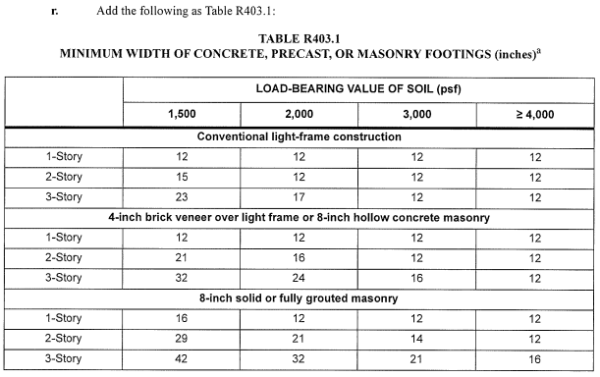
- Delete Section R403.1.1 and replace with the following: R403.1.1 Minimum size. Minimum sizes for concrete and masonry footings shall be as set forth in Table R403.1 and Figure R403.1(1). The footing width (W) shall be based on the load bearing value of the soil in accordance with Table R401.4.1. Spread footings shall be at least six (6) inches in thickness (T). Footing projections (P) shall be at least two (2) inches and shall not exceed the thickness of the footing. The size of footings supporting piers and columns shall be based on the tributary load and allowable soil pressure in accordance with Table R401.4.1. Footings for wood foundations shall be in accordance with the details set forth in Section R403.2 and Figures R403.1(2) and R403.1(3). (3-20-20)T
- Delete Section R602.10 and replace with the following: R602.10 Wall bracing. Buildings shall be braced in accordance with this Section or, when applicable Section R602.12, or the most current edition of APA System Report SR-102 as an alternate method. Where a building, or portion thereof, does not comply with one (1) or more of the bracing requirements in this Section, those portions shall be designed and constructed in accordance with Section R301.1. (3-20-20)T
- Amend Section 403.1.3.1-Foundations with Stem Walls by insertion of the following prescriptive methodology: The below prescriptive format to be employed in the Jurisdiction, only with the permission of the Building Official after review of the site specific by the building official.
Concrete footings constructed in the jurisdiction shall have a minimum steel reinforcement consisting of at least 2ea.#4 horizontal reinforcing bars placed continuously along the footing and located a minimum of 3 inches from the bottom and sides of the footings (see table R404.1.1(1) through R404.1.1(4) for footing width and thickness ONLY). Steel reinforcement shall be securely positioned by hanging wire ties, concrete blocks, or other approved methods that will hold the reinforcing steel securely in place during the concrete placement. Foundation walls 4 feet or less in height shall have a minimum nominal concrete wall thickness of 6 inches and shall have a minimum steel reinforcement consisting of not less than one #4 horizontal bar located in the upper six inches of the wall. The remaining height of the foundation wall shall have horizontal #4 bars spaced evenly at a distance of no greater than 24 inches between bars.
Foundation walls constructed in the jurisdiction supporting more than four feet of unbalanced backfill, shall have a minimum nominal concrete thickness of 8 inches, and shall have a minimum steel reinforcement consisting of not less than two #4 horizontal bars located in the upper 12 inches of the wall. The remaining height of the wall shall have horizontal #4 bars equally spaced at a distance no greater than 24 inches between bars.
Foundation walls constructed within this jurisdiction shall have a minimum vertical steel reinforcement consisting of “L”-shaped #4 vertical bars spaced at a horizontal distance from one another no greater than 48 inches between bars if the wall is 48 inches or less in height, and shall have 24 inch horizontal spacing between bars if the wall is higher than 48 inches. The short horizontal portion of the “L”-shaped #4 bars shall be at least 6 inches in length, and shall be approximately centered (vertically) in the concrete footing. Concrete shall be tamped around the “L”-shaped portion of the vertical steel placed in the footing, so that the steel is firmly encased in the footing concrete. If additional re-bar is added to the vertical portion of the #4 “L”-shaped bar to gain additional height, the lap shall be at least 15 inches in length. Wall steel shall have a minimum concrete cover of 3 inches when the wall is poured against earth, and 2 inches cover when pored against air (formed free-standing) or against adjacent wall materials. Wall reinforcing steel shall be wire-tied together to prevent movement or displacement of the steel during the concrete placement.
Agricultural Buildings - Non-commercial Agricultural buildings, (As Defined by Appendix C-C101.1) with the review and approval of the City Building Official, and further subject to any surface water and environmental authorities, MAY be exempt from this code upon approval of application for such exemption
City of Rexburg 2018 International Residential Code Amendments
Table R301.2(1) of the International Residential Code, 2018 Edition, shall be amended to read as follows:
TABLE R301.2(1) CLIMATIC AND GEOGRAPHIC DESIGN CRITERIA
Table R301.2 (1) The following listed values are herewith adopted as the minimum design criteria to be used when designing or constructing any structures falling under the purview of this ordinance:
DESIGNSnowCRITERIANAME VALUE Ground Snow Load 50 lb Minimum Wind Design Speed 90 mph Topographic Effects No Special Wind Region (Air Freezing Index) 2500 Windbourne Debris Zone No Seismic Design Category D-0 Subject To Damage From Weathering Severe Frost Line Depth (Final Grade to bottom of footing minimum) 36 inches Termite Slight to Moderate Winter Design Temperature (Rexburg) -5°F Ice Barrier Underlayment Required Yes FloodHazards HazardsbeamendedHazardsAdoptedJune 3 JuneAdopted3, 1991 NVG 1991 FIRM Map Air Freezing Index 2500 Minimum Roof Snow Load 35 #/sq.ft Mean Annual Temperature 43.5°F Tabel
State of Idaho (IDAPA 24.39.30) 2018 International Energy Conservation Code Amendments
- Add the following as Section C101.5.2: C101.5.2 Industrial, electronic, and manufacturing equipment. Buildings or portions thereof that are heated or cooled exclusively to maintain the required operating temperature of industrial, electronic, or manufacturing equipment shall be exempt from the provisions of this code. Such buildings or portions thereof shall be separated from connected conditioned space by building thermal envelope assemblies complying with this code. (3-20-20)T
- Add the following as an exception under Section C402.5 Air leakage-thermal envelope (Mandatory): Exception: For buildings having over fifty thousand (50,000) square feet of conditioned floor area, air leakage testing shall be permitted to be conducted on less than the whole building, provided the following portions of the building are tested and their measured air leakage is area-weighted by the surface areas of the building envelope:
- The entire floor area of all stories that have any spaces directly under a roof.
- The entire floor area of all stories that have a building entrance or loading dock.
- Representative above-grade wall sections of the building totaling at least twenty-five percent (25%) of the above-grade wall area enclosing the remaining conditioned space. Floor area tested under subparagraphs 1 or 2 of this exception shall not be included in the twenty-five percent (25%) of above-grade wall sections tested under this subparagraph. (3-20-20)T
- Add the following as exception number 7 under Section C403.5 Economizers (Prescriptive): 7. Unusual outdoor air contaminate conditions - Systems where special outside air filtration and treatment for the reduction and treatment of unusual outdoor contaminants, makes an air economizer infeasible. (3-20-20)T
- Delete Table C404.5.1 and replace with the following:
.png)
.png)
- Delete the rows in Table R402.1.2 for climate zones "5 and Marine 4" and "6" and replace with the following:
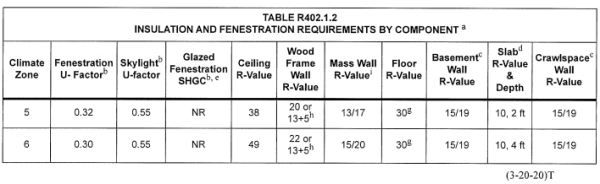
- Add the following as footnote k to the title of Table R402.1.2 - Insulation and Fenestration Requirements by Component: k For residential log home building thermal envelope construction requriements see Section R402.6. (3-20-20)T
- Delete the rows in Table R402.1.4 for climate zones "5 and Marine 4" and "6" and replace with the following:
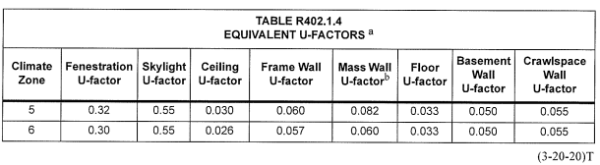
- Delete Section R402.4.1 and replace with the following: R402.4.1 Building thermal envelope.
- Until June 30, 2021, the building thermal envelope shall comply with Sections R402.4.1.1 (Installation) and either Section R402.4.1.2 (Testing) or Section R402.4.1.3 (Visual inspection).
- Effective July 1, 2021, the building thermal envelope of a minimum of twenty percent (20%) of all new single-family homes constructed by each builder shall comply with Section R402.4.1.1 (Installation) and Section R402.4.1.2 (Testing). The authority having jurisdiction may: 2.1. Determine how to enforce this requirement, starting with the fifth house and continuing with each subsequent fifth house. 2.2 Waive this requirement if significant testing indicates the five (5) air changes per hour (ACH) requirement is consistently being met or exceeded (Resulting in a lower ACH). 2.3 Grant exceptions to this requirement in rural areas where testing equipment is not available or cost effective.
- Effective July 1, 2021, the building thermal envelope of eighty percent (80%) of all new single-family homes constructed by each builder shall comply with Section R402.4.1.1 (Installation) and either Section R402.4.1.2 (Testing) or Section R402.4.1.3 (Visual inspection ).
- The sealing methods between dissimilar materials shall allow for differential expansion and contraction. (3-20-20)T
- Delete Section R402.4.1.1 and replace with the following: R402.4.1.1 Installation. The components of the building thermal envelope as listed in Table R402.4.1.1 shall be installed in accordance with the manufacturer's instructions and the criteria listed in Table R402.4.1.1, as applicable to the method of construction. (3-20-20)T
- Add the following as Section R402.4.1.3: R402.4.1.3 Visual inspection. Building envelope tightness and insulation installation shall be considered acceptable when the items listed in Table R402.4.1.1, applicable to the method of construction, are field verified. Where required by code official in approved party independent form the installer of the insulation shall inspect the air barrier and insulation. (3-20-20)T
- Add the following as Section R402.6: R402.6 Residential log home thermal envelope. Residential log home construction shall comply with Section R401 (General), Section R402.4 (Air leakage), Section R402.5 (Maximum fenestration U-factor and SHGC), Section R403.1 (Controls), the mandatory sections of Sections R403.3 through R403.9, Section R404 (Electrical Power and Lighting Systems). and either 1., 2., or 3. as follows: 1. Sections R402.2 through R402.3, Section R403.3.1 (Insulation), Section R404.1 (Lightning equipment) and Table R402.6 (Log Home Prescriptive Thermal Envelope Requirements by Component). 2. Section R405 (Simulated Performance Alternative). 3. REScheck (US Department of Energy Building Codes Program).
- Add the following as Table R402.6:
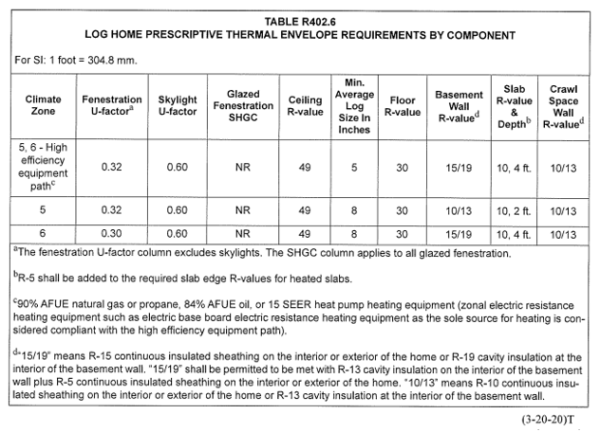
- Delete Section R403.5.3 and replace with the following: R403.5.3 Hot water pipe insulation (Prescriptive). Insulation for hot water piping with a thermal resistance, R-value, of not less than R-3 shall be applied to the following:
- Piping serving more than one (1) dwelling unit.
- Piping located outside the conditioned space.
- Piping located under a floor slab.
- Buried piping.
- Supply and return piping in recirculation systems other than demand recirculation systems.
- Delete Section R404.1 and replace with the following: R404.1 Lighting equipment (Mandatory). A minimum of seventy-five percent (75%) of the lamps in permanently installed lighting fixtures shall be high-efficacy lamps or a minimum of seventy-five percent (75%) of the permanently installed lighting fixtures shall contain only high efficacy lamps.
- Delete Section R406.3 and replace with the following: R406.3 Energy Rating Index. The Energy Rating Index (ERI) shall be determined in accordance with RESNET/ICC 301. Energy used to recharge or refuel a vehicle used for transportation on roads that are not on the building site shall not be included in the ERI reference design or the rated design. (3-20-20)T
- Delete Table R406.4 and replace with the following:
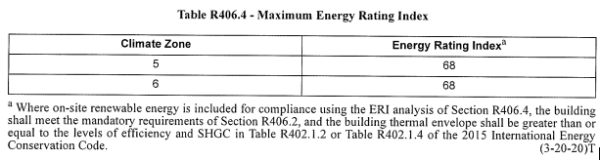
City of Rexburg 2018 International Energy Conservation Code Amendments
- An exception to Section R403.3.5 shall be added as follows: Exception: Building-framing cavities used as ducts or plenums shall comply with Section M1601.1.1 (IRC).
City of Rexburg 2018 International Mechanical Code Amendments
- Section 103.2 of the International Mechanical Code 2015 2018 Edition, shall be amended to read as follows: 103.2 Appointment. The Code Official shall be appointed by the chief appointing authority of the jurisdiction.
- Section 109.1 of the International Mechanical Code, 2015 2018 Edition, shall be amended to read as follows: 109.1 Application for appeal. A person shall have the right to appeal a decision of the code official to the board of appeals. An application for appeal shall be based on a claim that the true intent of this code or the rules legally adopted thereunder have been incorrectly interpreted. The application shall be filed on a form obtained from the code official within twenty (20) days after the notice was served.
City of Rexburg 2018 International Fuel Gas Code Amendments
- Section 103.2 of the International Fuel Gas Code, 2018 Edition, shall be amended to read as follows: 103.2 Appointment. The code official shall be appointed by the chief appointing authority of the jurisdiction.
- Section 109.1 of the International Fuel Gas Code, 2018 Edition, shall be amended to read as follows: 109.1 Application for appeal. A person shall have the right to appeal a decision of the code official to the board of appeals. An application for appeal shall be based on a claim that the true intent of this code or the rules legally adopted thereunder, have been incorrectly interpreted. The application shall be filed on a form obtained from the code official within twenty (20) days after the notice was served.
State of Idaho (IDAPA 07.02.06.16) 2017 Idaho Plumbing Code Amendments
- IDAPA Rule 07.02.06.011.16 shall be deleted and replaced with the following language: Pot sinks, scullery sinks, and dishwashing sinks, silverware sinks, commercial dishwashing machines, silverware-washing machines, and other similar fixtures shall be connected directly to the drainage system. A floor drain shall be provided adjacent to the fixture, and the fixture shall be connected on the sewer side of the floor drain trap, provided that no other drainage line is connected between the floor drain waste connection and the fixture drain. The fixture and floor drain shall be trapped and vented as required by this Code.
- IDAPA Rule 07.02.06.011.20 shall be deleted and replaced with the following language: Food preparation sinks, pot sinks, scullery sinks, dishwashing sinks, silverware sinks, commercial dishwashing machines, silverware-washing machines, steam kettles, potato peelers, ice cream dipper wells, and other similar equipment and fixtures must be indirectly connected to the drainage system by means of an air gap. The piping from the equipment to the receptor must not be smaller than the drain on the unit, but it must not be smaller than one (1) inch (twenty-five and four tenths (25.4) mm).
- IDAPA Rule 07.02.06.011.20 shall be deleted and replaced with the following language: Food preparation sinks, pot sinks, scullery sinks, dishwashing sinks, silverware sinks, commercial dishwashing machines, silverware-washing machines, steam kettles, potato peelers, ice cream dipper wells, and other similar equipment and fixtures must be indirectly connected to the drainage system by means of an air gap. The piping from the equipment to the receptor must not be smaller than the drain on the unit, but it must not be smaller than one (1) inch (twenty-five and four tenths (25.4) mm).
City of Rexburg 2017 Idaho State Plumbing Code Amendments
- Chapter 1, Administration. Chapter 1 of the Idaho State Plumbing Code is hereby deleted and replaced with Chapter 1 of the International Building Code, (2012 Edition).
- Chapter 3, General Regulations. 313.12.4 Shall be deleted.
- 422.1 shall be amended to read as follows: “Plumbing fixtures shall be provided for the type of building occupancy and in the minimum number shown in Chapter 29 of the City’s currently adopted International Building Code, (2018 Edition).”
- Chapter 6, Water Supply and Distribution. 608.5(7) shall be amended to read as follows: “Discharge from a relief valve into a water heater pan shall be allowed, provided that the pan connection and its drain piping are sized at least one (1) pipe size larger than the outlet of the relief valve.”
- Chapter 10, Traps and Interceptors. Table 10-1 shall be amended to change the footnote that is indicated by an asterisk to read as follows: “The trap arm lengths of water closets or similar fixtures which depend upon self-siphoning and re-filling of their traps for proper operation shall be unlimited.”
That building permit fees and other inspection fees not identified in Chapter 15.1 Building Codes above, shall be collected at time of Building Permit issuance and shall be as identified by the current City of Rexburg Master Fee List. (Ord. 1059 §3, 2010)
Refunds: The building official may authorize refunding of any fee paid hereunder which was erroneously paid or collected. The building official may authorize refunding of not more than 80 percent of the permit fee paid when no work has been done under a permit issued in accordance with this code. The building official may authorize refunding of not more than 80 percent of the plan review fee paid when an application for a permit for which a plan review fee has been paid is withdrawn or canceled before any plan reviewing is done.
That if any section, subsection, sentence, clause or phrase of this ordinance is, for any reason, held to be unconstitutional, such decision shall not affect the validity of the remaining portions of the ordinance. The Rexburg City Council hereby declares that it would have passed this ordinance, and each section, subsection, clause or phrase thereof, irrespective of the fact that any one or more sections, subsections, sentences, clauses and phrases be declared unconstitutional. (Ord. 1059 §5, 2010.) That nothing in this ordinance or in the Building Code hereby adopted shall be construed to affect any suit or proceeding impending in any court, or any rights acquired, or liability incurred, or any cause or causes of action acquired or existing, under any act or ordinance hereby repealed as cited in Section 15.01.020 through Section 15.01.070 of this ordinance: nor shall any just or legal right or remedy of any character lost, impaired or affected by this ordinance. (Ord. 1059 §6, 2010.)
Any person, firm, or corporation violating any provision of the Building and Fire Code as described in Chapters 15.01 and 15.07 of this document, shall upon conviction thereof, be guilty of a general infraction, which shall be punishable by a fine not to exceed Three Hundred Dollars ($300.00) or by imprisonment for not more than Six (6) Months, or by both said fine and imprisonment for any single violation, in addition to any penalty for any sanction provided for in the adopted Building and Fire Code as described in Chapter 15.01 and Chapter 15.0100707 of this document. Each day of violation shall constitute a separate offense.
15.02.010 Scope Of Application
15.02.020 Life Safety - Building Requirements
15.02.030 Administration And Appeal
15.02.040 Violation; Penalties
Note to Chapter 15.2: For statutory provisions concerning life safety issues, administration and appeal, and violation –penalty, see Rexburg Ordinance 851.The following is a non-inclusive list of life safety issues for all existing apartment buildings in the Rexburg City Limits. This list is for existing apartments only. All new apartments and existing buildings being converted to apartments shall be built in accordance with the Codes that are in place at the time the structure is built. The purpose of this Ordinance is to provide a reasonable degree of safety to persons occupying existing apartment buildings built and/or converted prior to 1985. Apartments built or converted after January 1, 1985 shall comply with the code and Ordinances in place at the time of construction or conversion. (Ord. 851 § 1, 2001).
- Every floor above the first story or basement used as apartments serving over 12 persons shall have a minimum of two exits.
- One of these exits for an upper floor may be a fire escape built to the standards set forth in Section 3407.4 of the currently adopted Uniform Building Code (UBC). An exit ladder device may be used in lieu of a fire escape when approved by the City of Rexburg Fire Department.
- For apartment units requiring two exits that have a floor level of not more than 20 feet above grade and basements apartments requiring two exits, one exit will be allowed when all bedrooms have egress windows that meet the requirements of item No. 8 in this list, but also must have a minimum opening area of 5.7 square feet. All doors or windows providing access to a fire escape shall be provided with fire escape signs.
- Exit signs shall be provided at exits where more than one exit is required and in corridors used for exiting from multiple units. Exit signs shall be as per the currently adopted Uniform Building Code.
- Primary entrance to an apartment is not allowed through a garage.
- A one- hour firewall may be erected to separate the apartment entrance from the garage.
- If a door is needed from the apartment entrance firewall to the interior of the garage, it must be a door as described in item No. 3 below.
- All stairs used as part of an exit shall have a maximum riser height of 8", a minimum run of 9" and a minimum width of 30" (exclusive of handrails).
- An 8-1/2" riser will be allowed if the minimum tread is increased to 10".
- Every stairway with over 3 risers shall be provided with a handrail.
- All stairs require landings with a minimum dimension of 30" run in direction of travel at each point of access to stairwell.
- All stairwells will have a minimum 6'6" headroom.
- Exit corridors serving occupant loads of 30 or more occupants shall have walls and ceilings of not less than one-hour fire resistive construction.
- Wood lath and plaster or 1/2" drywall in good condition are permitted as substitution for one layer of 5/8" type X drywall in corridor construction.
- Openings with fixed wired glass set in steel frames are allowed in corridors.
- Doors entering in to corridors (with exception of those opening directly outside) shall be 20 -minute fire rated assemblies, or solid wood doors not less than 1 1/4" thick.
- Where the existing frames will not accommodate a 1 1/4" thick solid wood door, a 1 3/8" thick solid bonded wood -core door or equivalent insulated steel door shall be permitted.
- Doors shall be self-closing or automatic closing by smoke detectors.
- Transoms must be covered with 1/2" drywall unless approved by the City Building Official.
- The City Building Official may nullify the above corridor requirements when an approved sprinkler system is provided.
- Interior vertical shafts, including but not limited to stairways, elevator hoistways, service and utility shafts, shall be enclosed by a minimum of one-hour fire - resistive construction.
- All openings into such shafts shall be protected with one- hour fire assemblies that shall be maintained self-closing or be automatic closing by smoke detection.
- All other openings shall be fire protected in an approved manner.
- Existing fusible link -type automatic door -closing devices may be permitted if the fusible link rating does not exceed 135 F (57.2C).
- EXCEPTIONS:
- An enclosure is not required for openings serving one adjacent floor.
- Vertical openings need not be protected if the building is protected by an approved automatic sprinkler system.
- An approved sprinkler system shall be installed in basements or stories exceeding 1,500 square feet of habitable area and not having a minimum 30"x 80" door or a minimum 30"x 42" window in every 50 lineal feet of exterior wall (or fraction thereof) on at least one side of the building.
- A sprinkler system shall be installed in any portion of the basement or upper story that is over 75 feet from opening as described above.
- One hour dwelling separation shall be provided between all apartment units.
- Wood lath and plaster and 1/2" drywall is acceptable as one hour separation when in good shape and continuous on both sides of walls and on ceilings, provided the floors above are of a double layer variety.
- Buildings with sprinkler systems have different area separation requirements. Consult the City of Rexburg Building Official for more information.
- Window egress is required. Each bedroom will have a window that meets the minimum size requirements of 20" wide, 22" high.
- The windows will not be required to meet the minimum opening area of 5.7 square feet.
- A permanent object (foot locker or seat) will be allowed to be built against a wall below a window to allow sill heights greater than 44".
- Window wells are required to have a clear opening 24" in front of window and to have steps if window well is deeper than 44". Door hardware must not be able to be locked so that it cannot be opened from the inside without the use of a key or some special knowledge.
- Aisles, corridors and hallways or any part of the exit, exit access or exit discharge shall not be blocked and shall be a minimum of 30" wide.
- Stairs shall be secure.
- Guardrails shall be installed at any walking surface adjacent to a drop of 30" or greater.
- Doors or any part of exit, exit access or exit discharge to be in operable condition.
- Fire Extinguisher. All apartments shall be equipped with an approved wall mounted fire extinguisher.
- Exits and access to fire extinguishers shall be unobstructed.
- The minimum size is a 2A-10BC, unless a smaller IA extinguisher already exists.
- The existing IA shall be replaced when it is 6 years old with a 2A- 1 OBC, therefore, all apartments 1A fire extinguishers shall be replaced before 6 years from the adoption date of this Life Safety Code.
- The extinguisher shall be mounted in a conspicuous location near the kitchen.
- Extinguishers must also be accessible in common areas such as computer rooms, lounges, game rooms, laundry rooms, etc.
- Apartment Monthly Inspections. Extinguishers shall have monthly inspections by owners or manager. Apartment owners or managers shall create and maintain a program for monthly extinguisher inspections.
- Garbage. Garbage and trash need to be removed from the premises on a timely basis.
- Outside trash containers must be kept at a proper distance from buildings for fire safety.
- Smoke Detectors. Smoke detectors shall be provided in each sleeping room and one additional detector at each floor of each unit.
- The detectors shall be placed on a wall near ceiling but not closer than 6"of the ceiling.
- Smoke detectors may be battery operated or may receive their primary power from the building wiring when such wiring is served from a commercial source.
- Wiring shall be permanent and without disconnecting switches other than those required for overcurrent protection.
- Apartment Monthly Inspections. Each apartment owner or manager shall check detectors monthly for operation and for battery function. Apartment owners or managers must create, maintain and document a program for monthly detector inspection.
- Wiring.
- Romex or other wire for greater than 100 volt use shall be encased in a wall, floor, ceiling cavity or in any NEC approved conduit or chase. Open wiring is not allowed.
- Electrical Panels. Electrical panels must not be blocked or obstructed in any manner.
- Electrical panel doors must be able to be closed and latched.
- All openings in the service panels must be plugged.
- All outlets and switches will have covers.
- All electrical connections will be provided with a junction box and cover. No frayed wires will be allowed.
- Improperly sized fuses or breakers must be replaced with properly sized units.
- All wire entrances into metal boxes will be made with NEC approved connectors.
- Over loaded panels must be replaced with adequate service.
- All outlets in bathrooms, kitchens, garages and outdoors to be replaced with ground fault devices.
- Electrical conduits to be fastened securely to structure.
- Overhead wires from out buildings to be at least 10' above any ground surface (including decks or raised walking surfaces). All stairs between floors to be provided with lighting. Exterior stairs to be provided with lighting.
- Heating system shall not require the use of portable electric heaters to adequately heat building.
- All light fixtures are required to have canopies and to be securely attached to structure.
- Extension cords are not allowed to replace proper wiring.
- Electrical in general to be in safe working manner. State Electrical Inspector to inspect when any question arises.
- Gas Water Heaters and Furnaces. Require all gas meters, pipes or appurtenances to be protected from vehicles.
- Require combustion air to gas appliances located in small, unventilated rooms.
- Require gas water heaters greater than 4' tall with flexible connections to be strapped to structure.
- Require 2" minimum space for flue vents from any combustible construction.
- Gas water heater and furnace flues must be connected with at least 3 screws at all joints and must be tightly installed.
- Require that all gravity venting between 450 and 60° be considered as horizontal venting and require that the total run of horizontal vent be less than 75% of the vertical height of the vent.
- Require that all high efficiency gas furnace flue discharge points be located in areas that are not below doors or windows that can be opened or within 4' from such windows or doors.
- Gas water heater and furnace flues must be connected with at least 3 screws at all joints and must be tightly installed.
- Require proper clearance for heating equipment (water heaters and furnaces). Gas water heaters or furnaces located in a bedroom or a bedroom closet must be totally isolated from the bedroom with a tight fitting door and must receive combustion air from an other source besides the bedroom.
- Require 24" clear space in front of water heaters and furnaces. This requirement may be met by the opening of a door or an access panel.
- Storage or trash shall not be allowed within 24" of gas water heater or furnace.
- Require 24" clear space in front of water heaters and furnaces. This requirement may be met by the opening of a door or an access panel.
- Portable gas heaters are not allowed.
- Water heater corroded pressure relief valves must be replaced.
- Backflow Prevention for Sprinkler Systems. Require back flow prevention for lawn sprinkler systems.
- All wooden structural components (headers, beams, columns, rafters, trusses, joists, bearing walls etc.) to be free of stress cracks, fastened securely and free of rot.
- Steel and concrete structural components (beams, columns, slabs, girders, purlins, girders, footings, etc.) to be free from defects, stress cracks, strain or fatigue that could cause loss of structural integrity.
- Roof to be without leaks.
- Address Posted. Address must be posted on building so that it is clearly visible from the street in a manner that is compliant with Emergency Services. Contact Emergency Services for more information. (Ord. 851 § 2, 2001).
The 15.02.020 list is not intended to address every safety issue that may present itself.
- The inspector at his/her discretion may identify additional safety items that need to be remedied. Situations may arise that can't be feasibly remedied to satisfy this list.
- If at any time an owner or manager thinks that the inspection requests are excessive or unnecessary he/she may submit the matter to the Rexburg U.B.C. Board of Appeals for review.
- The Board will then make their recommendations to the City of Rexburg City Council. The Council will have final say on the matter.
- If the owner or manager of an apartment complex has reason to think that alternative technology may satisfy the requirements of any of the Life Safety Issues, he/she may submit the idea to the City of Rexburg Building Official for review.
- If the Official rejects the alternative, the owner or manager may opt to submit the matter to the Rexburg U.B.C. Board of Appeals for review.
- The Board will then make their recommendations to the City of Rexburg City Council. The Council will have final say on the matter.
- The inspector will notify the State of Idaho Electrical Inspector if any electrical problems exist that are out of the inspector's area of expertise.
- It is our intent to have only one inspector represent the City of Rexburg at the time of inspection.
- The Fire Department, the Building Department, the Water Department and Wastewater Department will combine and supply training for one inspector from the Building Department and one from the Fire Department.
- The intent is to have two trained inspectors with one acting as regular and the other as a back-up.
- It is our intent to have only one inspector represent the City of Rexburg at the time of inspection.
- All apartments seeking a new business License from the City of Rexburg shall be inspected and given 3 months to establish a plan of compliance.
- The owner shall have another 3 months to perform work, at which time an inspection by the City of Rexburg shall be called for.
- License will not be granted until work is completed satisfactorily according to the plan of compliance, at which time if owner is not compliant, such premise shall be vacated.
- All apartment owners in the City of Rexburg not seeking a new business license will be sent notices to supply the City of Rexburg Clerk with a proposal for compliance within 18 months of notice.
- Initial inspections will be scheduled at this time.
- Owners will have 3 years from original notice to complete work and have it inspected by the City for compliance or such premise shall be vacated until made to conform. (Ord. 851 § 3, 2001).
Any person who violates or fails to comply with any of the provisions of this Ordinance or who, having obtained a permit hereunder, wilfully fails to continue to comply with the conditions set forth in this ordinance is guilty of an infraction, and upon conviction thereof, may be fined in accordance with State Statutes.
15.03.010 Standards Applicable
15.03.020 Permit - Required - Recordkeeping - Fee
15.03.030 Permit - Application - Notice Of Commencement Of Work
15.03.040 Permit - Bond
15.03.050 Permit - Insurance Required
15.03.060 Backfilling And Asphalt Repairs - Specifications - Permittee Responsibility
15.03.070 Safeguarding And Maintenance Responsibility
15.03.080 Asphalt Repairs - Completion Time
15.03.090 Asphalt Repairs - Performed By City When - Costs
15.03.100 Precautions To Prevent Injury Required - Penalty For Failure To Provide
15.03.110 Violation Deemed InfractionHISTORY
Adopted by Ord. 530 Street Excavation Permits on 5/17/1972
Amended by Ord. 565 Street Permits Amend Ord 530 on 9/3/1975
Amended by Ord. 647 Street Permits Amend Ord 647 on 8/4/1982Where not otherwise specified in this code, all materials and equipment used in the construction of public works in the city shall meet the standards as set forth in and approved by the American Society for Testing Materials. (Ord. 530 §3, 1972).
No person shall hereafter make any excavation in any street, alley, or easement of the city without first having obtained a permit so to do from the City Clerk, said permit to be issued in triplicate and a copy thereof delivered by the City Clerk to the water department superintendent, a copy of the permit shall be filed, and kept on file, with the City Clerk for a period of not less than five years after its issue. The City Council, by resolution, shall set a fee to be charged the applicant by the City Clerk and paid by the applicant before the issuance of the permit. (Ord. 647 §1, 1982; Ord. 565 §1, 1975; Ord. 530 §1(A), 1972).
Applications for permits may be made in person, by telephone, or by other medium of communication, but if the application is not made in person then the permittee or his/its qualified agent shall appear at the office of the city clerk-treasurer to execute the permit papers and file the necessary bond required in Section 15.03.040 not later than noon of the first working day following the application and before any excavation shall commence. Regardless of when any permit to excavate is issued, the permittee shall give notice to the city clerk-treasurer not more than twenty-four hours nor less than two hours before the time when the excavation is to commence. (Ord. 565 §3, 1975; Ord. 530 §1(C), 1972).
No permit shall be issued for any excavation unless the applicant shall present with the application, or file with the city clerk-treasurer, a bond in an amount sufficient to reconstruct said street, alley or easement as hereinafter in this chapter provided. The amount of said bond shall be fixed and determined by the street department superintendent, who shall make an estimate of the cost of such reconstruction of the street, alley or easement. In the event the applicant fails to reconstruct the street, alley or easement as hereinafter set forth, the city may proceed to do so and the cost thereof shall be paid from the bond filed by the applicant. (Ord. 565 §2, 1975; Ord. 530 §1(B)(a), 1972).
No permit shall be issued for any excavating unless the applicant shall present with the application, or have on file with the city clerk-treasurer, a certificate of insurance from an insurance company qualified to write contracts within the state, certifying that the applicant has public liability insurance with limits not less than five thousand dollars for property damage and not less than twenty thousand dollars per person and one hundred thousand dollars per occurrence for injury to the person, including death. All permits of any permittee shall be revoked immediately upon cancellation or expiration of the insurance. (Ord. 530 §1(B), 1972).
The permittee shall be responsible for the backfilling and permanent asphalt repairs of the street, alley or easement in accordance with standard specifications on file in the office of the engineer. (Ord. 530 §1(D), 1972).
It shall be the responsibility of the permittee to provide continuous maintenance and proper safeguards to the excavation until a permanent patch is completed and accepted by the street department. (Ord. 530 §1(E), 1972).
Permanent asphalt repairs will be completed not later than ten days after the excavation has been backfilled, weather conditions permitting. In the event weather conditions prohibit permanent repairs, the street superintendent may authorize temporary cold patches to be replaced by the applicant when weather permits. (Ord. 530 §1(F), 1972).
In the event the permittee does not make repairs within ten days after completion of backfill, the city may, at its election, complete the work and make such repair. In the event the repairs are completed by the city, the permittee agrees to pay to the city, within five days after determination of the amount, the cost of the city's repairs, based upon actual charges and cost to the city of repairs at the time the repair was completed. (Ord. 530 §1(G), 1972).
- Any person who shall make any excavation along or upon any of the streets or alleys of the city shall use all necessary precautions to prevent injury to any person lawfully upon said streets.
- Any person who makes any opening or excavation upon any of the public streets of the city and who fails to protect the public by proper warnings shall be deemed guilty of an infraction. (Ord. 530 §2, 1972).
Any person who shall make any excavation upon any of the public streets, alleys or easements of the city in violation of the terms of this chapter shall be deemed guilty of an infraction. (Ord. 530 §1(H), 1972).
15.04.010 Electric Code Adopted By Reference
15.04.020 Copies On File
Note to Chapter 15.4: For statutory provisions authorizing cities to adopt nationally recognized codes by reference, see Idaho Code §50-901.That the document known as the National Electrical Code, copyrighted by the National Fire Protection Association, 2008 Edition, together with the amendments and revisions thereof, with the inclusion of appendices, is hereby adopted as the Electrical Code of the City of Rexburg, Idaho. Said Code provides for regulating and controlling the design, installation, quality of material, erection, installation, alteration, repair, location, relocation, replacement, addition to, use or maintenance of electrical systems, wires, circuit, motors, or other miscellaneous electrical equipment except as otherwise provided in said Code. (Ord. 785 §1, 1996).
There has been on file and there shall hereafter be kept on file, in the office of the Clerk or City Engineer three (3) copies of said National Electrical Code, 2008 Edition, duly certified by the Clerk, for use and examination by the public. (Ord. 785 §2, 1996).
15.05.010 Definitions
15.05.020 Gas Production Facilities
15.05.030 Construction, Operation And Maintenance Facilities For Transmission And Distribution
15.05.040 Gas Installations In Buildings, Adoption Of N.B.F.U Pamphlet No 54 As Gas Code
15.05.050 Permit - Required
15.05.060 Permit - Not Required For Certain Work
15.05.070 Permit - Application - Information Required
15.05.080 Permit - Cost - Inspection Fee
15.05.090 Inspection - Requirements Generally - Piping And Pressure Tests
15.05.100 Inspector Qualifications And Supervisory Authority
15.05.110 Inspection - Installations Completed Before Passage Of Chapter Provisions
15.05.120 Inspection - Notification Of Readiness Required - Reinspection Fee
15.05.130 Inspection - Certification
15.05.140 Inspection - By Gas Supplier - Right Of Entry
15.05.150 Restrictions For Turning On Gas
15.05.160 Licensing - Installation Work - Certification Of Competency Required
15.05.170 Licensing - Classifications Of Competency Designated - Qualifications
15.05.180 Licensing - Gas Fitting Contractor - Insurance Prerequisite To Licensing
15.05.190 License Requirements Installation Work
15.05.200 Violation - PenaltyHISTORY
Adopted by Ord. 455 Fuel Gas (IFGC) Installations on 7/7/1965
Amended by Ord. 1240 on 12/16/2020As used in this chapter:
- Gas: Natural gas, manufactured gas, hydrocarbon gas, or any mixture of gases produced, transmitted, distributed or furnished by any gas utility or agency.
- Gas installations: The installation of all facilities for producing, transmitting and distributing gas, and all accessory equipment, appurtenances and appliances necessary for the control and utilization of gas. (Ord. 455 §1, 1965).
Section 3 of Ordinance no. 1054, adopting part of General Order No. 98 of the State of Idaho Public Utilities Commission, is hereby adopted and the same is hereby made a part hereof insofar as the provisions of said Section 3 of Ordinance No. 1054 are applicable to the installation and maintenance of gas facilities in buildings. (Ord. 455 §2(a), 1965).
Section 2 of Ordinance No. 1054 adopting ASA B31.1.8 - 1959, as so adopted by Section 2 of Ordinance No. 1054, is made a part hereof insofar as the same is applicable to the installations and maintenance of gas facilities in buildings. (Ord. 455 §2(b), 1965).
The National Fire Protections Association Code No. 54 of 1969, regulating the construction, installation and maintenance of gas piping and gas appliances in buildings, and said National Fire Protection Association Code No. 54 under date of 1969, being of a general and permanent character as shown by three (3) copies thereof now on file in the office of the City Clerk, is hereby ratified and adopted as ordinances of Rexburg, and part of this ordinance, as regulating gas piping and gas appliances in buildings. (Ord. 524 §1, 1972: Ord. 455 §2(c), 1965).
It is unlawful for any person, firm or corporation to do or cause or permit to be done, whether acting as principal, agent or employee, any gas installation work of any nature in buildings or service lines thereto without first procuring a permit from the building inspector authorizing such work to be done. (Ord. 455 §3(a), 1965).
A permit shall not be required for the clearing of stoppages or repairing of leaks in pipes, valves, or fixtures when such repairs do not involve or require the replacement of rearrangement of pipes, valves or fixtures. It shall be required, notwithstanding, that work of this nature be performed by persons qualified under this chapter as competent to do such work. (Ord. 455 §3(b), 1965).
Any person, firm or corporation legally entitled to receive a permit shall make application at the building inspector's office on the form provided. A description of the work proposed to be done, and location, ownership, occupancy and use of the premises shall be given. The building inspector may require plans and specifications and other such information as may be deemed necessary and pertinent for examination before granting the permit. When it has been determined that the information furnished by the applicant is in compliance with this chapter, the permit shall be issued, upon payment of the required fees as hereinafter fixed. (Ord. 455 §3(c), 1965).
The applicant shall pay for each permit issued, at the time of issuance, a permit fee, plus an inspection fee in accordance with fees set by the City Council. (Ord. 455 §3(d), 1965).
All pipes, fittings, valves, vents, fixtures, and appliances shall be inspected by the Building Inspector, or his designated and qualified agent, to assure compliance with the provisions of the ordinance. The following inspections shall be made:
- Piping inspection, to be made after all piping and venting authorized by the permit has been installed, and after the permit holder has assured himself that the system will meet the test, but before any such piping has been covered or concealed, and before any gas appliance has been attached thereto, at which time
- The pressure test prescribed in Section 2.10, N.B.F.U. Pamphlet 54, shall be made by permit holder in the presence of the Inspector, to be made after all piping and venting is completed and all appliances authorized by the permit have been placed and connected, and before gas is admitted to the system. (Ord. 524 §2, 1972; Ord. 455 §4(a), 1965).)
The Rexburg city installation inspector shall be under the supervision of the fire department. The inspector furnished by the city shall pass the examination for a gas-fitting contractor by the examining board; there will be no charge by the city for such examination. (Ord. 455 §4(g), 1965).
All gas installations completed prior to the passage of the ordinance codified in this chapter must be inspected and have an inspection tag securely attached as hereinabove provided, to show compliance with this chapter, and in order to bring substandard installations up to the standards herein provided, for the benefit of the health, safety and protection and general welfare of the public. (Ord. 455 §4(f), 1965).
It shall be the duty of the permit holder to notify the building inspector at least four (4) hours prior to the time of inspection, exclusive of Saturdays, Sundays and legal holidays, that he is ready for such inspection. When reinspection is required, after the final inspection as before described, it shall be made at a flat charge of two dollars per reinspection. (Ord. 455 §4(d), 1965).
The building inspector shall either approve that portion of the work completed at the time of inspection, or shall notify the permit holder of wherein the same fails to comply with this chapter; and when final inspection has been made and the work approved, the building inspector shall certify to the gas company or utility supplying gas to the premises, by attaching securely an inspection tag at the approximate location of the appliance, that such inspection has been made and the system found satisfactory as required by this chapter and ready for the setting of a gas meter or meters. (Ord. 455 §4(b), 1965).
The right is reserved for entry to the premises by the gas company or utility, and it shall be required that said supplier make its own inspection of all facilities before connecting the meter and admitting gas to the system. The gas company or utility shall make a second inspection of all facilities after gas is admitted to the system to assure, in the presence of the permit holder, the proper functioning of the system and all appliances. (Ord. 455 §4(c), 1965).
It is unlawful for any person to turn on gas in any building unless all outlets are properly connected or capped with screwed fittings; and further, it is unlawful for any person, except a qualified employee or agent of the company or utility furnishing gas to the premises, to turn on or connect gas service in any building or on any premises where and when gas service is not at the time being rendered; further, it is unlawful for any gas company or utility furnishing gas to set or cause to be set or connected any gas meter, or to turn on gas, until the inspector's certificate of inspection has been given as before stipulated. (Ord. 455 §4(e), 1965).
It is unlawful for any person, firm or corporation to engage in the work or business of making gas installations unless such person, or a responsible person representing the firm or corporation as hereinafter in this chapter prescribed, has successfully passed an examination conducted by the board of examiners, and has had issued to him a certificate of competency by said board in accordance with provisions of this chapter. (Ord. 455 §5(a), 1965).
There shall be three classifications of competency as herein defined:
- Gas-Fitting Contractor: Shall be any person or firm skilled in the planning and supervision of the installation of gas piping, venting, and equipment, and who is familiar with the laws, and regulations covering the same, and who is competent to assure work on a contract basis and to direct the work of qualified employees. A gas-fitting contractor who in person does gas-fitting work shall also be qualified as a journeyman gas fitter.
- Journeyman Gas Fitter: Shall be any person who, as part of his principal occupation, is engaged in the practical installation of gas piping and equipment, and who is familiar with the code requirements governing the same, and who works under the direction of a gas contractor.
- Apprentice Gas Fitter: Shall be any person, other than a journeyman, who as a part of his principal occupation is engaged in learning and assisting in the installation of gas piping and equipment. Apprentices shall not perform gas installation work except under the supervision of a licensed Journeyman gas fitter. (Ord. 455 §5(b), 1965.)
Every gas fitting contractor, before securing a license as hereinafter in this chapter provided, must post a certificate of insurance with the city, evidencing the insurance of the gas fitting contractor against property damage in an amount consistent with state regulations. (Ord. 455 §5(c), 1965).
Before any person, firm or corporation shall carry on or engage in the work or business of making gas installations, he shall procure a license applicable to the classification in which he proposes to work, and pay the annual license fee imposed on such classifications. The license shall not be transferable. Every applicant for a license shall present a certificate of competency or other identification as proof that he is entitled to or has been approved by the board of examiners as competent for the classification sought. If the applicant be a partnership, firm or corporation, the application shall be made by a bona fide member or agent thereof, who shall at all times be in actual charge of the applicant's gas installation business. When any person is designated and authorized to be or act as an agent for the applicant, such authorization shall be in writing, signed by the applicant and the person designated, one copy of which shall be filed with the examining board and one copy in the office of the city building inspector or the City Clerk. (Ord. 455 §5(d), 1965).
Any person, firm or corporation that violates, disobeys, omits, neglects or refuses to comply with, or resists the enforcement of any of the provisions of this chapter, upon conviction thereof shall be punishable as set forth in Chapter 1.02.020 of this code. (Ord. 455 §7, 1965).
15.06.070 Violation - Penalty
15.06.080 Severability
Note to Chapter 15.06: Prior Ordinance History: Ords. 528, 775, 908, 1027, 1095, 1115 and 1200.See Development Code Sign Standards
HISTORY
Amended by Ord. 1164 Ord Violation Misdemeanor to Infraction on 6/14/2017
Repealed & Reenacted by Ord. 1200 City of Rexburg Development Code on 2/6/2019Any person, firm or corporation violating any provision of this chapter shall be guilty of an infraction, and be subject to the following civil penalties or remedies:
- If a sign is placed in or projects into any public right-of-way, or has been deemed unsafe by the building department and/or city engineer it may be immediately removed by the City at the owner's, sign company's and/or responsible person's expense.
- If in violation of some other provision of this Ordinance, the City may cause a written notice to be given requiring that the violation be corrected within (14) days and if the owner, sign company and/or responsible person for the violation fails to comply, then the violator(s) shall be liable for civil penalties of up to $300. The City shall have the right to remove the sign at the violator's expense in addition to the aforementioned penalties for each day of violation.
- The City may seek injunctive relief through the courts for enforcement of the provisions of this Ordinance and in addition to the relief sought shall also be entitled to its attorney's fees and costs. (Ord. 1115 §5, 2014: Ord. 1027 §7, 2010.
The sections of this chapter are severable and the invalidity of a section shall not affect the validity of the remaining sections, which should be construed as closely as possible with the overall purpose and intent of this chapter in the event any portion hereof is deemed to be invalid. (Ord. 1115 §6, 2014: Ord. 1027 §8, 2010).
15.07.010 International Fire Code 2018
15.07.020 Official Records 104.6
15.07.030 Permits Required 105.1.1
15.07.040 Automatic Fire-Extinguishing Systems 105.7.1
15.07.050 Fire Alarm And Detection Systems And Related Equipment 105.7.5
15.07.060 Fire Pumps And Related Equipment 105.7.6
15.07.070 Re-Inspection Fees 106.5
15.07.080 Tags 107.1.1
15.07.090 Violation Penalties 109.3
15.07.100 Failure To Apply 111.4
15.07.110 Schedule Of Permit Fees 113.2
15.07.120 Work Commencing Before Permit Issuance 113.3
15.07.130 Reimbursement Of Operational Costs 113.6
15.07.140 Safety System Certification Permit 114
15.07.150 Silencing Fire Alarms 401.3.4
15.07.160 Making False Report 401.5
15.07.170 Construction Documents 501.3
15.07.180 Timing Of Installation 501.4
15.07.190 Added Definitions 502.1
15.07.200 Building And Facilities 503.1.1
15.07.210 Turning Radius 503.2.4
15.07.220 Obstruction Of Fire Apparatus Access Roads 503.4
15.07.230 Specifications 503.2
15.07.240 Bridge Load Limits 503.2.6.1
15.07.250 Address Identification 505.1
15.07.260 Barricade Specifications 503.5.2
15.07.270 Security Gates 503.7.7
15.07.280 Multi-Family Dwelling Address 505.3
15.07.290 Knox Box Location 506.1
15.07.300 Type Of Water Supply 507.2
15.07.310 Water Service Connections 507.3
15.07.320 Fire Hydrant Systems 507.5
15.07.330 Pipe Hashed Parking Spaces 507.5.4
15.07.340 Clear Space Around Hydrants 507.5.5
15.07.350 Fire Hydrant Distance From Buildings 507.5.7
15.07.360 Fire Hydrant Models 507.5.8
15.07.370 Equipment Access 509.2
15.07.380 Records 901.6.2
15.07.390 Group R Automatic Sprinkler System Installation 903.2.8
15.07.400 Fire Department Connections 903.3.7
15.07.410 Certification Of Service Personnel For Fire-Extinguishing Equipment 904.1.1
15.07.420 Installation Standard 905.2
15.07.430 Certification Of Service Personnel For Portable Fire 906.2.1
15.07.440 Conspicuous Location 906.5
15.07.450 General 907.1
15.07.460 Wiring 907.6.1
15.07.470 Zone And Address Location Labeling 907.6.5
15.07.480 Stairway To Roof 1011.12
15.07.490 Scope 1101.1
15.07.500 Deleted Sections
15.07.510 Out Of Service For One Year 5704.2.13.1.3
15.07.520 Water Supply Tests 507.4
15.07.530 Scope D101.1
15.07.540 Access And Loading D102.1
15.07.550 Signs D103.6
15.07.560 Proximity To Building D105.3
Note to Chapter 15.7: Prior ordinance history: Ords. 654, 672, 689, 718, 784, 828, 873, 918, 933, 997, 1042, 1063, 1096, and 1109. Ord. 1109 is repealed by Ordinance 1240Adopting 2018 International Fire Code and repealing previously adopted 2012 International Fire Code by reference Ord 1109 §2, 2014.
Providing State Fire Marshall and Madison Fire Department Amendments to the 2018 International Fire Code in Chapter 15.07.
The fire code official shall keep official records as required by Sections 104.6.1 through 104.6.4. Investigations shall show the cause, the findings and deposition of each. Such official records shall be retained as indicated in the City of Rexburg Records Management Manual, Appendix D, September 2006. (Ord. 1109 §3(B), 2014).
Permits required by this code shall be obtained from the City of Rexburg Building Department. Permit fees are located here and shall be paid prior to issuance of the permit. Issued permits shall be kept on the premises designated therein at all times and shall be readily available for inspection by the fire code official. (Ord. 1109 §3(C), 2014).
A construction permit and safety system certification permit are required for installation of or modification to an automatic fire-extinguishing system. Maintenance performed in accordance with this code is not considered a modification and does not require a permit (Ord. 1109 §3(D), 2014).
A construction permit and a safety system certification permit are required for installation of/or modification to fire alarm and detection systems and related equipment. Maintenance performed in accordance with this code is not considered a modification and does not require a permit (Ord. 1109 §3(E), 2014).
A construction permit and safety system certification permit are required for installation of/or modification to fire pumps and related fuel tanks, jockey pumps, controllers and generators. Maintenance performed in accordance with this code is not considered a modification and does not require a permit (Ord. 1109 §3(F), 2014).
A re-inspection fee may be assessed for each re-inspection when such portion of work for which inspection is called for is not completed or when corrections called for are not made within the allotted time (Ord. 1109 §3(G), 2014).
Tags for maintenance of fire suppression systems, fire extinguishers, and fire alarm systems are required to be obtained from the Community Development Department for use in the City of Rexburg.
Persons who shall violate a provision of this code or shall fail to comply with any of the requirements therein or who shall erect, install, alter, repair, or do work in violation of the approved construction documents or directive of the fire code official, or of a permit or certificate used under provisions of this code, shall be guilty of an infraction, punishable by a fine of not more than $500.00 dollars, or by imprisonment not exceeding 180 days, or both such fine and imprisonment. Each day that a violation continues after due notice has been served shall be deemed a separate offence (Ord. 1109 §3(H), 2014).
Delete entire 111.4 Failure to apply section.
A fee for each permit and repeated nuisance alarms shall be paid as required, in accordance with the Rexburg Master Fee List (Ord. 1109 §3(K), 2014).
Any person who commences any work, activity or operation regulated by this code, before obtaining the necessary permits shall be subject to an additional fee established by the applicable governing authority which shall be in addition to the required permit fees. An exception shall be granted for emergency repair work performed during off-business hours. Emergency repair work shall be work similar in nature to repairing frozen or physically damaged piping in order to return a system to service (Ord. 1109 §3(L), 2014).
Madison Fire Department is authorized to seek reimbursement of response, suppression and ambulance costs from or related to incidents. The costs shall be based upon the current edition of the Idaho Fire Service Organization Rate Book (Ord. 1109 §3(M), 2014)
All installations, modifications, required maintenance, or servicing of life-safety systems are to be performed by an approved licensed business or person(s). A business or person(s) shall obtain a “Safety System Certification Permit” from the Community Development Department to do any work in the City of Rexburg. Permits shall expire one year from the date of issuance unless otherwise noted on the permit. Fire Alarm Contractors shall provide proof of Liability Insurance and proof of having a minimum of a NICET Level III certification for fire alarm systems design and NICET Level I for testing and startup. Certifications shall be equal to/or the equivalent as specified in NFPA 72.
Fire Sprinkler Contractors shall provide proof of Liability Insurance and proof of having a minimum of a NICET Level III certification for sprinkler system design, NICET Level I for testing, and any additional certifications as required. Certifications shall be equal to/or the equivalent as specified in NFPA 72 (Ord. 1109 §3(N), 2014)It is prohibited for anyone other than fire department personnel or fire protection system contractors, while in the performance of their duties, to silence, restore, or reset a fire alarm system without the expressed permission of Madison Fire Department (Ord. 1109 §3(P), 2014)
A person shall not give, signal, or transmit a false report. The Fire Chief shall be authorized to seek restitution from the perpetrator and/or any and all accomplices for making false reports. Restitution for making false reports shall be the actual cost recovery of personnel, engines, and supplies according to the current edition of the Idaho Fire Service Organization Rate Book (Ord. 1109 §3(Q), 2014.
Construction documents for proposed driveways, fire apparatus access, location of fire lanes, security gates across fire apparatus access and construction documents and hydraulic calculations for fire hydrant systems shall be submitted the fire department for review and approval prior to construction.
When fire apparatus access roads, driveways, or a water supply for fire protection is required to be installed, such protection shall be installed and made serviceable prior to/and during the time of construction except when approved alternative methods of protection are provided. Temporary street signs shall be installed at each street intersection when construction of new roadways allows passage by vehicles in accordance with Section 505.2 (Ord. 1109 §3(S), 2014).
Driveway: A vehicular ingress and egress route that serves no more than five (5) single family dwellings, not including accessory structures (Ord. 1109 §3(T), 2014).
Fire Station: A building or portion of a building that provides, at a minimum, all weather protection for fire apparatus. Temperatures inside the building used for this purpose must be maintained at above thirty-two (32) degrees Fahrenheit.
Approved fire apparatus access roads shall be provided for every facility, building or portion of a building hereafter constructed or move into or within the jurisdiction. The fire apparatus access road shall comply with the requirements of this section and shall extend to within 150 feet of all portions of the facility and all portions of the exterior walls of the first story of the building as measured by an approved route around the exterior of the building or facility. Driveways shall be provided and maintained in accordance with Sections 503.7 through 503.11
The minimum turning radius shall be not less than 30 feet and an outside turning radius of not less than 45 feet (Ord. 1109 §3(W), 2014).
Fire apparatus access roads shall not be obstructed in any manner, including the parking of vehicles, the accumulation of snow, or the growing of vegetation. The minimum widths and clearances established in Section 503.2.1 shall be maintained at all times (Ord. 1109 §3(X), 2014).
Driveways shall be provided when any portion of an exterior wall of the first story of a building is located more than 150 feet from a fire apparatus access road. Driveways shall provide a minimum unobstructed width of 12 feet and minimum unobstructed height of 13 feet 6 inches. Driveways in excess of 150 feet in length shall be provided with turnarounds. Driveways in excess of 200 feet in length and 20 feet in width may require turnouts in addition to a turnaround (Ord. 1109 §3(Y), 2014).
For more information on driveway specifications, see the City of Rexburg currently adopted International Fire Code sections 503.2.1 through 503.2.8.
Vehicle load limits shall be posted at both entrances to bridges on driveways and private roads. Design loads for bridges shall be established by the fire code official and the city engineer (Ord. 1109 §3(BB), 2014).
All buildings shall have a permanently posted address, which shall be placed at each driveway entrance and be visible from both directions of travel along the road. In all cases the address shall be posted at the beginning of construction and maintained thereafter. The address shall be visible and legible from the road on which the address is located. Address signs along one-way roads shall be visible from both the intended direction of travel and the opposite direction. Where multiple addresses are required at a single driveway, they shall be mounted on a single post and additional signs shall be posted at locations where driveways divide (Ord. 1109 §3(CC), 2014).
If emergency vehicle access roadways are secured with a barricade, chain, gate, or bollard, such barricade shall meet the following criteria. Removal or opening of said barricade must result in a clear unobstructed road width of at least twenty (20) feet. Chains and locks shall not damage fire department cutting tools nor shall cutting operations result in any unnecessary time delay. Bollards must be of an easily removable type, shall leave nothing protruding up from the roadway surface when removed, and shall be approved by the fire code official. Access roadways shall be maintained year-round, including snow removal (Ord. 1109 §3(FF), 2014).
Where security gates are installed, they shall have an approved means of emergency operation. The security gates and emergency operation shall be maintained operational at all times.
- When individual apartment, condominium, or town house structures within a common complex are designated with separate addresses, individual unit numbers shall be assigned so there is no duplication of unit designations within a building. The first floor shall be 100 series, second floor 200 series and so on for each successive floor. Basements shall be 10 series if the next higher floor is designated the first floor, or basements shall be designated 100 series if the next level is called the second floor.
- When apartment, condominium, or town house complexes (more than one structure) have been assigned one address, each individual building shall also be assigned a number. The building number shall be posted in a conspicuous location with the number being a minimum of twelve (12) inches in height in a contrasting color to the background. Unit or apartment numbers shall then be assigned in the 10, 100, 200, 300, etc. series per floor as identified in paragraph a. of this section (Ord. 1109 §3(Q), 2014).
Where access to or within a structure or an area is restricted because of secured openings or where immediate access is necessary for life-saving or fire-fighting purposes, the fire code official is authorized to require a Knox Box® (s) to be installed in approved locations. The Knox Box®(s) shall contain keys, cards, or codes to gain necessary access and operate life safety equipment as required by the fire code official. All newly constructed structures subject to this section shall have the Knox Box®(s) installed and containing the required keys prior to the issuance of an occupancy permit. Locations shall include:
- Commercial, industrial, or educational structures protected by an automatic alarm system or automatic suppression system, or such structures that are secured in a manner that restricts access during an emergency;
- Multi-family residential structures that have restricted access through locked doors and have a common corridor for access to the dwelling units;
- Governmental structures and nursing care facilities;
- Buildings and structures with 20,000 square feet or more shall have a minimum of two (2) Knox Box®(s).
A water supply shall consist of water delivered by fire apparatus, reservoirs, pressure tanks, elevated tanks, water mains, or other sources capable of providing the required fire flow as approved by the fire code official. No exceptions allowed. Water supply shall consist of water delivered by fire apparatus, reservoirs, pressure tanks, elevated tanks, water mains or other sources approved by the fire code official capable of providing the required fire flow.
All water service connections that are metered in a building or structure shall have a valve located outside of the building or structure for shutting off service in the case of an emergency. The valve shall be installed in an approved location at the time of construction. If the water service connection supplies the fire suppression system and the valve is located outside of the city right-of-way, the valve shall be installed adjacent to the fire lane. The valve shall be a monitored post indicator valve, or a similar valve that is acceptable to the Fire Code Official.
Fire hydrant systems shall comply with sections 507.5.1 through 507.5.8.
Pipe hashed parking spaces shall be 5 feet (5') where Fire Code Official determines needed.
A 3-foot clear space shall be maintained around the circumference of fire hydrants, including snow, except as otherwise required or approved (Ord. 1109 §3(OO), 2014).
Fire hydrants shall not be installed closer than forty (40) feet and/or at access points to buildings. In such areas of the city where forty (40) feet is an impractical distance, the code official may allow a lesser distance. Access to hydrants not adjacent to a building or structure's fire lane must be approved by the fire code official (Ord. 1109 §3(PP), 2014).
New fire hydrants shall be the Waterous® WB67-250, Mueller® A-423, or Clow® F-2545. New hydrants shall be painted red and installed with a 5 inch Storz fitting and cap (Ord. 1109 §3(QQ), 2014).
Approved access shall be provided and maintained for all fire protection equipment to permit immediate safe operation and maintenance of such equipment. Storage, trash and other materials, or objects shall not be placed or kept in such a manner that would prevent such equipment from being readily accessible. A working space shall be clearly marked and identified of not less than thirty (30) inches on each side of fire suppression sprinkler riser piping and not less than thirty-six (36) inches in front of fire suppression sprinkler riser piping shall be provided.
Records of all system inspections, tests and maintenance required by the referenced standards shall be maintained on the premises for a minimum of three years. An additional copy of all inspection and test reports shall be sent to Madison Fire Department by the contractor (person) doing the maintenance or inspection (Ord. 1109 §3(RR), 2014).
Delete Section 903.2.8 and replace with the following:
903.2.8 Group R. An automatic sprinkler system installed in accordance with Section 903.3 shall be provided throughout all buildings with a Group R fire area. Exceptions:
- All single family homes and multiple family dwellings up to two (2) units that are physically separated by ten (10) feet or more of space, to the nearest building, are hereby exempted from the provisions of the International Fire Code, the International Building Code and the Idaho Residential Code that require such dwellings to have automatic fire sprinkler systems installed. Nothing in this section shall prevent any person from voluntarily installing an automatic fire sprinkler system in any residential dwelling.
The location of fire department connections (FDC) shall be within 150 feet of a hydrant and adjacent to the fire apparatus access road, installed with clappers, and be 2 1/2" NH. (Ord. 1096 §3(OO), 2012)
If required by the authority having jurisdiction, service personnel providing or conducting maintenance on automatic fire-extinguishing systems, other than automatic sprinkler systems, shall possess a valid certificate issued by an approved governmental agency, or other approved organization for the type of system and work performed.
Standpipe systems shall be provided in new buildings and structures in accordance with this section. The hose threads used in connection with standpipe systems shall be approved and shall be compatible with fire department hose threads. The location of fire department hose connections shall be approved. All Standpipe systems shall be automatic standpipe systems as defined by NFPA 14 unless approved by the Fire Chief or his designee. In buildings used for high-piled combustible storage, fire protection shall be in accordance with Chapter 23 (Ord. 1109 §3(WW), 2014).
Service personnel providing or conducting maintenance on portable fire extinguishers shall possess a valid certificate issued by an approved governmental agency. Or other approved organization for the type of work performed.
Portable fire extinguishers shall be located in conspicuous locations where they will be readily accessible and immediately available for use. R-2 occupancies shall have at a minimum one portable fire extinguisher within the dwelling unit located near the cooking area. These locations shall be along normal paths of travel, unless the fire code official determines that the hazard posed indicates the need for placement away from normal paths of travel. (Ord. 1109 §3(YY), 2014: Ord. 1096 §2(RR), 2012)
This section covers the application, installation, performance, and maintenance of fire alarm systems and their components in new and existing buildings and structures. The requirements of Section 907.2 are applicable to new buildings and structures. The requirements of Section 907.9 are applicable to existing buildings and structures. When fire alarm systems not required by the International Fire Code are installed, the notification devices shall meet the minimum design and installation requirements for systems which are required by this code.
No partial fire alarm and detection systems shall be allowed (Ord. 1109 §3(ZZ)(part), 2014).Wiring shall comply with the requirements of NFPA 70 and NFPA 72. Wireless protection systems utilizing radio-frequency transmitting devices shall comply with the special requirements of supervision of low-power wireless systems in NFPA 72. (Ord. 1109 §3(AAA), 2014).
Fire alarm control panels (FACP) shall have all zones and address points plainly and permanently labeled as to their location, on the outside of the panel or on an easily readable map of the building affixed to the outside of the panel. The annual inspection shall include inspections items identified in NFPA 72 and include a random inspection of 10% of the initiating devices to ensure proper labeling of the address on the device and address verification at the FACP. The access doors leading to the FACP shall be posted with “FACP” in four inch tall letters with ½” stroke width. Remote annunciators shall be installed in approved locations. (Ord. 1109 §3(BBB), 2014: Ord. 1096 §2(UU), 2012)
In buildings four or more stories above grade plane, one stairway shall extend to the roof surface unless the roof has a slope steeper than four units vertical in 12 units horizontal (33-percent slope).
The provisions of this chapter shall apply to existing buildings constructed prior to the adoption of this code and only if in the opinion of the fire code official, they constitute a distinct hazard to life or property.
Delete Sections 5601.1.3, 5601.2.2, 5601.2.3, 5601.2.4.1, 5601.2.4.2, and sections 5608.2, 5608.2.1, and 5608.3 of the International Fire Code.
Underground tanks that have been out of service for a period of one year shall be removed from the ground in accordance with Section 5704.2.14 or abandoned in place in accordance with Section 5704.2.13.1.4. Upon approval of the Chief underground tanks that comply with the performance standards for new or upgraded underground tanks set forth in Title 40 Section 280.20 or 280.21 of the Code of Federal Regulations may remain out of service indefinitely so long as they remain in compliance with the operation, maintenance and release detection requirements of the federal rule.
Fire flow testing of hydrants shall be supervised by the fire code official. Documentation of the hydrant testing shall be made available to the fire code official within 10 working days. (Ord. 1096 §2(WW), 2012)
Fire apparatus access roads shall be in accordance with this appendix and all other applicable requirements of the International Fire Code. Driveways as described in section 503.7 through 503.11 are not subject to the requirements of this appendix.
Facilities, buildings or portions of buildings hereafter constructed shall be accessible to fire department apparatus by way of an approved fire apparatus access road designed and maintained to support the imposed loads of the responding fire apparatus and shall be surface so as to provide all-weather driving capabilities.
All occupancies classified as commercial shall have fire access roadways posted with the proper signs as in Section D103.6 at seventy-five (75) foot intervals from the center of the fire access road. Additionally, curbs shall be painted red and maintained as required by the fire code official. (Ord. 1109 §3(LLL), 2014)
Buildings or structures of four stories or less shall have at least one of the required access routes located within a minimum of 15 feet and maximum of 45 feet from the building, and shall be positioned parallel to one entire side of the building. Buildings or structures greater than four stories shall have at least one of the required access routes located within a minimum of 15 feet and maximum of 30 feet from the building, and shall be positioned parallel to one entire side of the building. The side of the building of which the aerial fire apparatus access road is positioned shall be approved by the fire code official.
(Ord. 1109 §3(MMM), 2014)- Knox Box® Location 506.1. Where access to or within a structure or an area is restricted because of secured openings or where immediate access is necessary for life-saving or fire-fighting purposes, the fire code official is authorized to require a Knox Box® (s) to be installed in approved locations. The Knox Box®(s) shall contain keys, cards, or codes to gain necessary access and operate life safety equipment as required by the fire code official. All newly constructed structures subject to this section shall have the Knox Box®(s) installed and containing the required keys prior to the issuance of an occupancy permit. Locations shall include:
- Commercial, industrial, or educational structures protected by an automatic alarm system or automatic suppression system, or such structures that are secured in a manner that restricts access during an emergency;
- Multi-family residential structures that have restricted access through locked doors and have a common corridor for access to the dwelling units;
- Governmental structures and nursing care facilities;
- Buildings and structures with 20,000 square feet or more shall have a minimum of two (2) Knox Box®(s). (Ord. 1109 §KK. 506.1, 2014 repealed & re-enacted by Ord 1240 on 12/16/2020 15.07.290.)
- The fire chief shall designate the type of key lock box system to be implemented within the city and shall have the authority to require all structures to use the designated system. (Ord. 918 §1(e), 2004 repealed & re-enacted by Ord. 985 §15.08.10, 2007.)
- The owner or operator of a structure required to have a key lock box shall, at all times, keep a key in the lock box that will allow for access to the structure. (Ord. 918 §1(f), 2004 repealed & re-enacted by Ord. 985 §15.08.10, 2007.)
HISTORY
Repealed & Reenacted by Ord. 985 Ord. 918 §1(e) & (f), 2004 repealed & re-enacted by Ord. 985 §15.08.10, 2007 on 8/15/2007
Repealed & Reenacted by Ord. 1240 15.07.290 on 12/16/2020Article I Statuary Authorization, Finding Of Fact, Purpose, And Objectives
Article II Definitions
Article III General Provisions
Article IV Administration
Article V Provisions For Flood Hazard Reduction
Article VI Legal StatusHISTORY
Repealed & Reenacted by Ord. 1129 Establishing Flood Hazards Repeal Ord 717 on 4/15/2015
Repealed & Reenacted by Ord. 1272 Flood Damage Prevention Repeal Ord 1129 on 12/15/202115.09.010 Statutory Authority
15.09.020 Findings Of Fact
15.09.030 Statement Of Purpose
15.09.040 Objectives And Methods Of Reducing Flood LossesThe Legislature of the State of Idaho, pursuant to Idaho Code §§ 46-1020, 46-1023, and 46-1024, authorizes local governments to adopt floodplain management ordinances that identify floodplains and minimum floodplain development standards to minimize flood hazards and protect human life, health, and property. Therefore, the City Council of the City of Rexburg, Idaho, does hereby ordain as follows: (Ord. 1272 §1.A, 2021).
- The flood hazard areas of the City of Rexburg are subject to periodic inundation that results in:
- loss of life and property;
- health, and safety hazards;
- disruption of commerce and governmental services;
- extraordinary public expenditures for flood relief protection; and
- impairment of the tax base, all of which adversely affect the public health, safety and general welfare.
- These flood losses may be caused by development in flood hazard areas, which are inadequately elevated, flood-proofed, or otherwise unprotected from flood damages, and by the cumulative effect of obstructions in floodplains causing increases in flood heights and velocities.
- Local government units have the primary responsibility for planning, adopting, and enforcing land use regulations to accomplish proper floodplain management (Ord. 1272 §1.B, 2021).
It is the purpose of this ordinance to promote the public health, safety, and general welfare, and to minimize public and private losses due to flood conditions in specific areas by provisions designed to:
- Protect human life, health, and property;
- Minimize damage to public facilities and utilities such as water purification and sewage treatment plants, water and gas mains, electric, telephone and sewer lines, streets, and bridges located in floodplains;
- Help maintain a stable tax base by providing for the sound use and development of flood prone areas;
- Minimize expenditure of public money for costly flood control projects;
- Minimize the need for rescue and emergency services associated with flooding, generally undertaken at the expense of the general public;
- Minimize prolonged business interruptions;
- Ensure potential buyers are notified that property is in an area of special flood hazard; and
- Ensure those who occupy the areas of special flood hazard assume responsibility for their actions. (Ord. 1272 §1.C, 2021.)
In order to accomplish its purposes, this ordinance includes methods and provisions to:
- Require that development which is vulnerable to floods, including structures and facilities necessary for the general health, safety, and welfare of citizens, be protected against flood damage at the time of initial construction;
- Restrict or prohibit development which are dangerous to health, safety, and property due to water or erosion hazards, or which increase flood heights, velocities, or erosion;
- Control filling, grading, dredging, and other development which may increase flood damage or erosion;
- Prevent or regulate the construction of flood barriers which will unnaturally divert flood waters or that may increase flood hazards to other lands
- Preserve and restore natural floodplains, stream channels, and natural protective barriers which carry and store flood waters (Ord. 1272 §1.D, 2021).
15.09.050 DefinitionsUnless specifically defined below, words or phrases used in this ordinance shall be interpreted so as to give this ordinance it’s most reasonable application.
- ACCESSORY STRUCTURES (appurtenant structure): a structure on the same lot or parcel as a principal structure, the use of which is incidental and subordinate to the principal structure.
- ADDITION (to an existing building): an extension or increase in the floor area or height of a building or structure.
- AGRICULTURAL STRUCTURES (appurtenant structure): a structure which is used exclusively in connection with the production, harvesting, storage, raising, or drying of agricultural commodities and livestock; specifically excludes any structures used for human habitation.
- APPEAL: a request for review of the Floodplain Administrator's interpretation of provisions of this ordinance or request for a variance.
- AREA OF SPECIAL FLOOD HAZARD: see Special Flood Hazard Area (SFHA).
- BASE FLOOD: the flood having a one percent (1%) chance of being equaled or exceeded in any given year.
- BASE FLOOD ELEVATION (BFE): a determination by the Federal Insurance Administrator of the water surface elevations of the base flood, that is, the flood level that has a one percent or greater chance of occurrence in any given year. When the BFE has not been provided in a Special Flood Hazard Area, it may be obtained from engineering studies available from a Federal, State, or other source using FEMA-approved engineering methodologies. This elevation, when combined with the Freeboard, establishes the Flood Protection Elevation.
- BASEMENT: any area of the building having its floor sub grade (below ground level) on all sides.
- BUILDING: see Structure.
- CRITICAL FACILITIES: facilities that are vital to flood response activities or critical to the health and safety of the public before, during, and after a flood, such as a hospital, emergency operations center, electric substation, police station, fire station, nursing home, school, vehicle and equipment storage facility, or shelter; and facilities that, if flooded, would make the flood problem and its impacts much worse, such as a hazardous materials facility, power generation facility, water utility, or wastewater treatment plant.
- DATUM: the vertical datum is a base measurement point (or set of points) from which all elevations are determined. Historically, that common set of points was the National Geodetic Vertical Datum of 1929 (NGVD29). The vertical datum currently adopted by the federal government as a basis for measuring heights is the North American Vertical Datum of 1988 (NAVD88).11.
DEVELOPMENT: any man-made change to improved or unimproved real estate, including but not limited to buildings or other structures, mining, dredging, filling, grading, paving, excavation or drilling operations, or storage of equipment and materials.
- DEVELOPMENT: any man-made change to improved or unimproved real estate, including but not limited to buildings or other structures, mining, dredging, filling, grading, paving, excavation or drilling operations, or storage of equipment and materials.
- DEVELOPMENT ACTIVITY: any activity defined as Development which will necessitate a Floodplain Development Permit; such as: the construction of buildings, structures, or accessory structures; additions or substantial improvements to existing structures; bulkheads, retaining walls, piers, and pools; the placement of mobile homes; or the deposition or extraction of materials; the construction or elevation of dikes, berms and levees.
- ELEVATED BUILDING: for insurance purposes, a non-basement building which has its lowest elevated floor raised above ground level by foundation walls, shear walls, posts, piers, pilings, or columns.
- ELEVATION CERTIFICATE: The Elevation Certificate is an important administrative tool of the NFIP. It is used to determine the proper flood insurance premium rate; it is used to document elevation information; and it may be used to support a request for a Letter of Map Amendment (LOMA) or Letter of Map Revision based on fill (LOMR-F).
- ENCLOSURE: an area enclosed by solid walls below the BFE/FPE or an area formed when any space below the BFE/FPE is enclosed on all sides by walls or partitions. Insect screening or open wood lattice used to surround space below the BFE/RFPE is not considered an enclosure.
- ENCROACHMENT: the advance or infringement of uses, fill, excavation, buildings, structures, or development into a floodplain, which may impede or alter the flow capacity of a floodplain.
- EXISTING CONSTRUCTION: for the purposes of determining rates, structures for which the “start of construction” commenced before the effective date of the FIRM. “Existing construction” may also be referred to as “existing structures.”
- EXISTING MANUFACTURED HOME PARK OR MANUFACTURED HOME SUBDIVISION: a manufactured home park or subdivision where the construction of facilities for servicing the lots on which the manufactured homes are to be affixed (including, at a minimum, the installation of utilities, the construction of streets, and final site grading or the pouring of concrete pads) is completed before the effective date of the original floodplain management regulations adopted by the community, Ordinance 717 adopted on April 17, 1991.
- EXISTING STRUCTURES: see existing construction.
- EXPANSION TO AN EXISTING MANUFACTURED HOME PARK OR SUBDIVISION: the preparation of additional sites by the construction of facilities for servicing the lots on which the manufactured homes are to be affixed (including the installation of utilities, the construction of streets, and either final site grading or the pouring of concrete pads).
- FLOOD or FLOODING:
- A general and temporary condition of partial or complete inundation of normally dry land areas from:
- The overflow of inland or tidal waters.
- The unusual and rapid accumulation or runoff of surface waters from any source.
- Mudslides (i.e., mudflows) which are proximately caused by flooding as defined in paragraph a.ii of this definition and are akin to a river of liquid and flowing mud on the surfaces of normally dry land areas, as when earth is carried by a current of water and deposited along the path of the current.
- The collapse or subsidence of land along the shore of a lake or other body of water as a result of erosion or undermining caused by waves or currents of water exceeding anticipated cyclical levels or suddenly caused by an unusually high water level in a natural body of water, accompanied by a severe storm, or by an unanticipated force of nature, such as flash flood or an abnormal tidal surge, or by some similarly unusual and unforeseeable event which results in flooding as defined in paragraph a.i of this definition.
- A general and temporary condition of partial or complete inundation of normally dry land areas from:
- FLOOD ELEVATION DETERMINATION: See Base Flood Elevation (BFE).
- FLOOD ELEVATION STUDY: See Flood Insurance Study (FIS).
- FLOOD INSURANCE RATE MAP (FIRM): an official map of a community, on which the Federal Insurance Administrator has delineated both the special flood hazard areas and the risk premium zones applicable to the community.
- FLOOD INSURANCE STUDY (FIS): an examination, evaluation, and determination of flood hazards and, if appropriate, corresponding water surface elevations; or an examination, evaluation and determination of mudslide (i.e., mudflow) and/or flood-related erosion hazards.
- FLOOD ZONE: a geographical area shown on a Flood Hazard Boundary Map (FHBM) or Flood Insurance Rate Map (FIRM) that reflects the severity or type of flooding in the area, and applicable insurance rate.
- FLOODPLAIN OR FLOOD-PRONE AREA: any land area susceptible to being inundated by water from any source (see definition of “flooding”).
- FLOODPLAIN ADMINISTRATOR: the individual appointed to administer and enforce the floodplain management regulations.
- FLOODPLAIN DEVELOPMENT PERMIT: any type of permit that is required in conformance with the provisions of this ordinance, prior to the commencement of any development activity.
- FLOODPLAIN MANAGEMENT: the operation of an overall program of corrective and preventive measures for reducing flood damage, including but not limited to emergency preparedness plans, flood control works, and flood plain management regulations.
- FLOODPLAIN MANAGEMENT REGULATIONS: zoning ordinances, subdivision regulations, building codes, health regulations, special purpose ordinances (such as a flood plain ordinance, grading ordinance, and erosion control ordinance), and other applications of police power. The term describes such state or local regulations, in any combination thereof, which provide standards for the purpose of flood damage prevention and reduction.
- FLOODPROOFING: any combination of structural and non-structural additions, changes, or adjustments to structures which reduce or eliminate flood damage to real estate or improved real property, water and sanitary facilities, structures and their contents.
- FLOOD PROTECTION ELEVATION (FPE): the Base Flood Elevation plus the Freeboard.
- In “Special Flood Hazard Areas” where Base Flood Elevations (BFEs) have been determined, this elevation shall be the BFE plus 1 foot of freeboard for new structures; and
- In “Special Flood Hazard Areas” where no BFE has been established, this elevation shall be at least 2 feet above the highest adjacent grade.
- FLOOD PROTECTION SYSTEM: those physical structural works for which funds have been authorized, appropriated, and expended and which have been constructed specifically to modify flooding in order to reduce the extent of the area within a community subject to a “special flood hazard” and the extent of the depths of associated flooding. Such a system typically includes dams, reservoirs, levees, or dikes. These specialized flood modifying works are those constructed in conformance with sound engineering standards.
- FLOODWAY: the channel of a river or other watercourse and the adjacent land areas that must be reserved in order to discharge the base flood without cumulatively increasing the water surface elevation more than a designated height.
- FREEBOARD: a factor of safety usually expressed in feet above a flood level for the purposes of floodplain management. Freeboard tends to compensate for the many unknown factors that could contribute to flood heights greater than the height calculated for a selected size flood and floodway conditions, such as wave action, obstructed bridge openings, debris and ice jams, and the hydrologic effects of urbanization in a watershed. The Base Flood Elevation (BFE) plus the freeboard establishes the Flood Protection Elevation (FPE). Freeboard shall be a minimum of one (1) foot for new structures. Modifications to existing structures that meet the definition of Substantial Improvements do not require freeboard if the Lowest Floor is already at or above the Base Flood Elevation.
- FUNCTIONALLY DEPENDENT USE: a facility that cannot be used for its intended purpose unless it is located or carried out in close proximity to water, such as a docking or port facility necessary for the loading and unloading of cargo or passengers, shipbuilding, or ship repair facilities. The term does not include long-term storage, manufacture, sales, or service facilities.
- HIGHEST ADJACENT GRADE (HAG): the highest natural elevation of the ground surface prior to construction, adjacent to the proposed walls of a structure. Refer to the FEMA Elevation Certificate for HAG related to building elevation information.
- HISTORIC STRUCTURE: a structure that is:
- Listed individually in the National Register of Historic Places (a listing maintained by the U.S. Department of Interior) or preliminarily determined by the Secretary of the Interior as meeting the requirements for individual listing on the National Register;
- Certified or preliminarily determined by the Secretary of the Interior as contributing to the historical significance of a registered historic district or to a district preliminarily determined by the Secretary to qualify as a registered historic district;
- Individually listed on a state inventory of historic places and determined as eligible by states with historic preservation programs which have been approved by the Secretary of the Interior; or
- Individually listed on a local inventory of historic places and determined as eligible by communities with historic preservation programs that have been certified either:
- by an approved state program as determined by the Secretary of the Interior, or
- directly by the Secretary of the Interior in states without approved programs.
- LETTER OF MAP CHANGE (LOMC): a general term used to refer to the several types of revisions and amendments to FIRMs that can be accomplished by letter. They include Letter of Map Amendment (LOMA), Letter of Map Revision (LOMR), and Letter of Map Revision based on Fill (LOMR-F)
- LETTER OF MAP AMENDMENT (LOMA): an official amendment, by letter, to an effective National Flood Insurance Program (NFIP) map. A LOMA establishes a property’s or structure’s location in relation to the Special Flood Hazard Area (SFHA). LOMAs are usually issued because a property or structure has been inadvertently mapped as being in the floodplain but is actually on natural high ground above the base flood elevation.
- LETTER OF MAP REVISION (LOMR): FEMA's modification to an effective Flood Insurance Rate Map (FIRM) or a Flood Boundary and Floodway Map (FBFM) or both. LOMRs are generally based on the implementation of physical measures that affect the hydrologic or hydraulic characteristics of a flooding source and thus result in the modification of the existing regulatory floodway, the effective Base Flood Elevations (BFEs), or the Special Flood Hazard Area (SFHA). The LOMR officially revises the Flood Insurance Rate Map (FIRM) or Flood Boundary and Floodway Map (FBFM), and sometimes the Flood Insurance Study (FIS) report, and when appropriate, includes a description of the modifications. The LOMR is generally accompanied by an annotated copy of the affected portions of the FIRM, FBFM, or FIS report.
- LETTER OF MAP REVISION BASED ON FILL (LOMR-F): FEMA's modification of the Special Flood Hazard Area (SFHA) shown on the Flood Insurance Rate Map (FIRM) based on the placement of fill outside the existing regulatory floodway. The LOMR-F does not change the FIRM, FBFM, or FIS report.
- CONDITIONAL LETTER OF MAP REVISION (CLOMR): A formal review and comment as to whether a proposed flood protection project or other project complies with the minimum NFIP requirements for such projects with respect to delineation of special flood hazard areas. A CLOMR does not revise the effective Flood Insurance Rate Map (FIRM) or Flood Insurance Study (FIS). Upon submission and approval of certified as-built documentation, a Letter of Map Revision (LOMR) may be issued by FEMA to revise the effective FIRM. Building Permits and/or Flood Development Permits cannot be issued based on a CLOMR, because a CLOMR does not change the NFIP map.
- LEVEE: a man-made structure, usually an earthen embankment, designed and constructed according to sound engineering practices, to contain, control, or divert the flow of water so as to provide protection from temporary flooding.
- LEVEE SYSTEM: a flood protection system that consists of a levee, or levees, and associated structures, such as closure and drainage devices, which are constructed and operated in accordance with sound engineering practices.
- LOWEST ADJACENT GRADE (LAG): the lowest point of the ground level next to the structure. Refer to the FEMA Elevation Certificate for LAG related to building elevation information.
- LOWEST FLOOR: the lowest floor of the lowest enclosed area (including basement). An unfinished or flood resistant enclosure, usable solely for parking of vehicles, building access or storage in an area other than a basement area is not considered a building's lowest floor; provided, that such enclosure is not built so as to render the structure in violation of the applicable non-elevation design requirements of 44 CFR § 60.3 and this ordinance.
- MANUFACTURED HOME: a structure, transportable in one or more sections, built on a permanent chassis and designed to be used with or without a permanent foundation when connected to the required utilities. The term “Manufactured Home” does not include a “Recreational Vehicle.”
- MANUFACTURED HOME PARK OR SUBDIVISION: a parcel (or contiguous parcels) of land divided into two or more manufactured home lots for rent or sale.
- MARKET VALUE: the building value, not including the land value and that of any accessory structures or other improvements on the lot. Market value may be established by independent certified appraisal; replacement cost depreciated for age of building and quality of construction (Actual Cash Value); or adjusted tax assessed values.
- MEAN SEA LEVEL: for purposes of the National Flood Insurance Program (NFIP), the National Geodetic Vertical Datum (NGVD) of 1929 or other datum (such as North America Vertical Datum of 1988 - NAVD88) to which Base Flood Elevations (BFEs) shown on a community’s FIRM are referenced.
- NATIONAL FLOOD INSURANCE PROGRAM (NFIP): The NFIP is a Federal program created by Congress to mitigate future flood losses nationwide through sound, community-enforced building and zoning ordinances and to provide access to affordable, federally backed flood insurance protection for property owners.
- NEW CONSTRUCTION: for floodplain management purposes, a structure for which the start of construction commenced on or after the effective date of a floodplain management regulation adopted by a community and includes any subsequent improvements to such structures. Any construction started after June 3, 1991 and before the effective start date of this floodplain management ordinance is subject to the ordinance in effect at the time the permit was issued, provided the start of construction was within 180 days of permit issuance.
- NEW MANUFACTURED HOME PARK OR SUBDIVISION: a place where the construction of facilities for servicing the lots on which the manufactured homes are to be affixed (including at a minimum the installation of utilities, the construction of streets, and final site grading or the pouring of concrete pads) is completed on or after June 3, 1991, the effective date of the initial Flood Insurance Rate Map (FIRM).
- POST-FIRM: construction or other development for which the “start of construction” occurred on or after the effective date of the initial Flood Insurance Rate Map (FIRM).
- PRE-FIRM: construction or other development for which the “start of construction” occurred before June 3, 1991, the effective date of the initial Flood Insurance Rate Map (FIRM).
- RECREATIONAL VEHICLE: a vehicle that is:
- Built on a single chassis, and
- 400 square feet or less when measured at the largest horizontal projection, and
- Designed to be self-propelled or permanently towed by a light duty truck, and
- Designed primarily not for use as a permanent dwelling but as temporary living quarters for recreational, camping, travel, or seasonal use.
- REGULATORY FLOODWAY: See Floodway.
- REMEDY A VIOLATION: to bring the structure or other development into compliance with State or local flood plain management regulations, or, if this is not possible, to reduce the impacts of its non-compliance. Ways that impacts may be reduced include protecting the structure or other affected development from flood damages, implementing the enforcement provisions of the ordinance or otherwise deterring future similar violations, or reducing Federal financial exposure with regard to the structure or other development.
- REPETITIVE LOSS STRUCTURE: An NFIP-insured structure that has had at least two paid flood losses of more than $1,000 each in any 10-year period since 1978.
- RIVERINE: relating to, formed by, or resembling a river (including tributaries), stream, brook, etc.
- SPECIAL FLOOD HAZARD AREA (SFHA): the land in the flood plain within a community subject to a one percent (1%) or greater chance of flooding in any given year. For purposes of these regulations, the term “special flood hazard area” is synonymous in meaning with the phrase “area of special flood hazard”.
- START OF CONSTRUCTION: includes substantial improvement, and means the date the building permit was issued, provided the actual start of construction, repair, reconstruction, rehabilitation, addition placement, or other improvement was within 180 days of the permit date. The actual start means either the first placement of permanent construction of a structure on a site, such as the pouring of slab or footings, the installation of piles, the construction of columns, or any work beyond the stage of excavation; or the placement of a manufactured home on a foundation. Permanent construction does not include land preparation, such as clearing, grading and filling; nor does it include the installation of streets and/or walkways; nor does it include excavation for a basement, footings, piers, or foundation or the erection of temporary forms; nor does it include the installation on the property of accessory buildings, such as garages or sheds not occupied as dwelling units or not part of the main structure. For a substantial improvement, the actual start of construction means the first alteration of any wall, ceiling, floor, or other structural part of a building, whether or not that alteration affects the external dimensions of the building.
- STRUCTURE: a walled and roofed building, including a gas or liquid storage tank that is principally above ground, as well as a manufactured home.
- SUBSTANTIAL DAMAGE: damage of any origin sustained by a structure whereby the cost of restoring the structure to its before-damaged condition would equal or exceed 50 percent (50%) of its market value before the damage occurred. See definition of “substantial improvement”.
- SUBSTANTIAL IMPROVEMENT: any reconstruction, rehabilitation, addition, or other improvement of a structure, the cost of which equals or exceeds 50 percent (50%) of the market value of the structure before the “start of construction” of the improvement. This term includes structures which have incurred “substantial damage”, regardless of the actual repair work performed. The term does not, however, include either:
- Any project for improvement of a structure to correct existing violations of state or local health, sanitary, or safety code specifications which have been identified by the local code enforcement official and which are the minimum necessary to assure safe living conditions, or
- Any alteration of a “historic structure”, provided that the alteration will not preclude the structure's continued designation as a “historic structure” and the alteration is approved by variance issued pursuant to this ordinance.
- TECHNICAL BULLETINS AND TECHNICAL FACT SHEETS: FEMA publications that provide guidance concerning the building performance standards of the NFIP, which are contained in Title 44 of the U S Code of Federal Regulations § 60.3. The bulletins and fact sheets are intended for use primarily by State and local officials responsible for interpreting and enforcing NFIP regulations and by members of the development community, such as design professionals and builders. New bulletins, as well as updates of existing bulletins, are issued periodically as needed. The bulletins do not create regulations. Rather they provide specific guidance for complying with the minimum requirements of existing NFIP regulations.
- TEMPERATURE CONTROLLED: having the temperature regulated by a heating and/or cooling system, built-in or appliance.
- VARIANCE: a grant of relief from the governing body from a requirement of this ordinance.
- VIOLATION: the failure of a structure or other development to be fully compliant with the community's flood plain management regulations. A structure or other development without the Finished Construction Elevation Certificate, other certifications, or other evidence of compliance required in 44 CFR § 60.3(b)(5), (c)(4), (c)(10), (d)(3), (e)(2), (e)(4), or (e)(5) is presumed to be in violation until such time as that documentation is provided.
- WATER SURFACE ELEVATION: the height, in relation to the National Geodetic Vertical Datum (NGVD) of 1929 or the North American Vertical Datum (NAVD) of 1988 (or other specified datum), of floods of various magnitudes and frequencies in the flood plains of coastal or riverine areas.
- WATERCOURSE: a lake, river, creek, stream, wash, channel, or other topographic feature on or over which waters flow at least periodically. Watercourse includes specifically designated areas in which substantial flood damage may occur. (Ord. 1272 §2.0, 2021).
15.09.060 Lands To Which This Chapter Applies
15.09.070 Basis For Special Flood Hazard Areas
15.09.072 Establishment Of Floodplain Development Permit
15.09.074 Compliance
15.09.076 Abrogation And Greater Restrictions
15.09.077 Interpretation
15.09.078 Warning And Disclaimer Of Liability
15.09.080 Penalties For ViolationThis ordinance shall apply to all areas of special flood hazards within the jurisdiction of the City of Rexburg. Nothing in this ordinance is intended to allow uses or structures that are otherwise prohibited by the zoning ordinance. (Ord.1272 §3.A, 2021).
The Special Flood Hazard Areas identified by the Federal Insurance Administrator in a scientific and engineering report titled "Flood Insurance Study (FIS) for Madison County, Idaho and Incorporated Areas," dated June 3, 1991, with accompanying Flood Insurance Rate Maps (FIRM), and other supporting data, are adopted by reference and declared a part of this ordinance. The FIS and the FIRM are on file at the office of the City Clerk at 35 North 1st East, Rexburg, Idaho 83440. (Ord. 1272 §3.B, 2021).
A Floodplain Development Permit shall be required in conformance with the provisions of this ordinance prior to the commencement of any development activities within Special Flood Hazard Areas determined in accordance with the provisions of Section IV-B (Ord 1272 §3.C, 2021).
No structure or land shall hereafter be located, extended, converted, altered, or developed in any way without full compliance with the terms of this ordinance and other applicable regulations (Ord 1272 §3.D, 2021).
This ordinance shall not in any way repeal, abrogate, impair, or remove the necessity of compliance with any other laws, ordinances, regulations, easements, covenants, or deed restrictions, etcetera. However, where this ordinance and another conflict or overlap, whichever imposes more stringent or greater restrictions shall control (Ord 1272 §3.E, 2021).
In the interpretation and application of this ordinance all provisions shall be:
- Considered as minimum requirements;
- Liberally construed in favor of the governing body; and
- Deemed neither to limit nor repeal any other powers granted under State Statutes (Ord 1272 §3.F, 2021).
The degree of flood protection required by this ordinance is considered reasonable for regulatory purposes and is based on scientific and engineering considerations. Larger floods can and will occur. Flood heights may be increased by man made or natural causes. This ordinance does not imply that land outside the Special Flood Hazards Areas or uses permitted within such areas will be free from flooding or flood damages. This ordinance shall not create liability on the part of the City of Rexburg or by any officer or employee thereof for flood damages that result from reliance on this ordinance or an administrative decision lawfully made hereunder (Ord 1272 §3.G, 2021).
No structure or land shall hereafter be located, extended, converted, or altered unless in full compliance with the terms of this ordinance and other applicable regulations. Violation of the provisions of this ordinance or failure to comply with any of its requirements, including violation of conditions and safeguards established in connection with grants of variance or special exceptions, shall constitute a misdemeanor. Any person who violates this ordinance or fails to comply with any of its requirements shall, upon conviction thereof, be fined not more than $300 or imprisoned for not more than 180 days, or both. Nothing herein contained shall prevent the City of Rexburg from taking such other lawful actions as is necessary to prevent or remedy any violation (Ord. 1272 §3.H, 2021).
15.09.090 Designation Of Floodplain Ordinance Administrator
15.09.100 Duties And Responsibilities Of The Floodplain Administrator
15.09.130 Floodplain Development Application, Permit, And Certification Requirements
15.09.152 Corrective Procedures
15.09.160 Variance ProceduresThe Mayor will appoint a staff member to act as the “Floodplain Administrator”, to administer and implement the provisions of this ordinance. If a Floodplain Administrator has not been appointed by the Mayor or if the appointed person is no longer able to perform these duties, the ordinance will be administered and implemented by the City Building Official, until a new Floodplain Administrator is appointed (Ord. 1272 §4.A, 2021).
The Floodplain Administrator shall perform, but not be limited to, the following duties:
- Review all floodplain development applications and issue permits for all proposed development within Special Flood Hazard Areas to assure that the requirements of this ordinance have been satisfied and all proposed development is reasonably safe from flooding.
- Review all proposed development within Special Flood Hazard Areas to assure that all necessary Local, State, and Federal permits have been received, including Section 404 of the Federal Water Pollution Control Act Amendments of 1972, 33 USC 1334.
- Notify adjacent communities and the Idaho Department of Water Resources State Coordinator for the National Flood Insurance Program (NFIP) prior to any alteration or relocation of a watercourse and submit evidence of such notification to the Federal Insurance Administrator (FIA).
- Assure that the flood carrying capacity within the altered or relocated portion of any watercourse is maintained;
- Obtain and maintain actual elevation (in relation to mean sea level) of the lowest floor (including basement) and all attendant utilities of all new and substantially improved structures, in accordance with the provisions of Section IV-C.3.
- Obtain and maintain actual elevation (in relation to mean sea level) to which all new and substantially improved structures and utilities have been floodproofed, in accordance with the provisions of Section IV-C.3.
- Review plans to verify public utilities are constructed in accordance with the provisions of Sections V-A.5 to .7.
- When floodproofing is utilized for a particular structure, obtain and maintain certifications from a registered professional engineer or architect in accordance with the provisions of Section IV-C.3 and Section V-B.2.
- Where interpretation is needed as to the exact location of boundaries of the Special Flood Hazard Areas, and floodways (for example, where there appears to be a conflict between a mapped boundary and actual field conditions), make the necessary interpretation. The person contesting the location of the boundary shall be given a reasonable opportunity to appeal the interpretation as provided in this article.
- Permanently maintain all records that pertain to the administration of this ordinance and make these records available for public inspection, recognizing that such information may be subject to the Privacy Act of 1974, as amended.
- Make on-site inspections of work in progress. As the work pursuant to a floodplain development permit progresses, the Floodplain Administrator shall make as many inspections of the work as may be necessary to ensure that the work is being done according to the provisions of the local ordinance and the terms of the permit. In exercising this power, the Floodplain Administrator has a right, upon presentation of proper credentials, to enter on any premises within the jurisdiction of the community at any reasonable hour for the purposes of inspection or other enforcement action.
- Issue stop-work orders as required. Whenever a building or part thereof is being constructed, reconstructed, altered, or repaired in violation of this ordinance, the Floodplain Administrator may order the work to be immediately stopped. The stop-work order shall be in writing and directed to the person doing or in charge of the work. The stop-work order shall state the specific work to be stopped, the specific reason(s) for the stoppage, and the condition(s) under which the work may be resumed. Violation of a stop-work order constitutes a misdemeanor.
- Revoke floodplain development permits as required. The Floodplain Administrator may revoke and require the return of the floodplain development permit by notifying the permit holder in writing stating the reason(s) for the revocation. Permits shall be revoked for any substantial departure from the approved application, plans, and specifications; for refusal or failure to comply with the requirements of State or local laws; or for false statements or misrepresentations made in securing the permit. Any floodplain development permit mistakenly issued in violation of an applicable State or local law may also be revoked.
- Make periodic inspections throughout the Special Flood Hazard Areas within the jurisdiction of the community. The Floodplain Administrator and each member of his or her inspections department shall have a right, upon presentation of proper credentials, to enter on any premises within the territorial jurisdiction of the department at any reasonable hour for the purposes of inspection or other enforcement action.
- Follow through with corrective procedures of Section IV-D.
- Review, provide input, and make recommendations for variance requests.
- Maintain a current map repository to include, but not limited to, the FIS Report, FIRM and other official flood maps, and studies adopted in accordance with the provisions of Section III-B of this ordinance, including any revisions thereto including Letters of Map Change, issued by FEMA. Notify the NFIP State Coordinator and FEMA of your community’s mapping needs.
- Coordinate revisions to FIS reports and FIRMs, including Letters of Map Revision Based on Fill (LOMR-Fs) and Letters of Map Revision (LOMRs).
- A community's base flood elevations may increase or decrease resulting from physical changes affecting flooding conditions. As soon as practicable, but not later than six months after the date such information becomes available, a community shall notify the Federal Insurance Administrator (FIA) of the changes by submitting technical or scientific data in accordance with this part. Such a submission is necessary so that upon confirmation of those physical changes affecting flooding conditions, risk premium rates and flood plain management requirements will be based upon current data.
- Upon occurrence, notify the Federal Insurance Administrator (FIA) in writing whenever the boundaries of the community have been modified by annexation or the community has otherwise assumed or no longer has authority to adopt and enforce flood plain management regulations for a particular area. In order that all FHBM's and FIRM's accurately represent the community's boundaries, include within such notification a copy of a map of the community suitable for reproduction, clearly delineating the new corporate limits or new area for which the community has assumed or relinquished flood plain management regulatory authority (Ord. 1272 §4.B, 2021).
- Application Requirements. Application for a Floodplain Development Permit shall be made to the Floodplain Administrator prior to any development activities located within Special Flood Hazard Areas. The following items shall be presented to the Floodplain Administrator to apply for a floodplain development permit:
- A plot plan drawn to scale which shall include, but shall not be limited to, the following specific details of the proposed floodplain development:
- the nature, location, dimensions, and elevations of the area of development/disturbance; existing and proposed structures, utility systems, grading/pavement areas, fill materials, storage areas, drainage facilities, and other development;
- the boundary of the Special Flood Hazard Area as delineated on the FIRM or other flood map as determined in Section III-B, or a statement that the entire lot is within the Special Flood Hazard Area;
- the flood zone(s) designation of the proposed development area as determined on the FIRM or other flood map as determined in Section III-B;
- the boundary of the floodway(s) as determined in Section III-B;
- the Base Flood Elevation (BFE) where provided as set forth in Section III-B; Section III-C; or Section V-C; and
- the old and new location of any watercourse that will be altered or relocated as a result of proposed development.
- Proposed elevation, and method thereof, of all development within a Special Flood Hazard Area including but not limited to:
- Elevation in a relation to mean sea level of the proposed lowest floor (including basement) of all structures;
- Elevation in relation to mean sea level to which any non-residential structure in Zone AE will be floodproofed; and
- Elevation in relation to mean sea level to which any proposed utility equipment and machinery will be elevated or floodproofed.
- If floodproofing, a Floodproofing Certificate (FEMA Form 086-0-33) with supporting data, an operational plan, and an inspection and maintenance plan that include, but are not limited to, installation, exercise, and maintenance of floodproofing measures will be required prior to Certificate of Occupancy/Completion.
- A Foundation Plan, drawn to scale, which shall include details of the proposed foundation system to ensure all provisions of this ordinance are met. These details include but are not limited to:
- The proposed method of elevation, if applicable (i.e., fill, solid foundation perimeter wall, solid backfilled foundation, open foundation, or on columns/posts/piers/piles/shear walls); and
- Openings to facilitate automatic equalization of hydrostatic flood forces on walls in accordance with Section V-A.8.b. when solid foundation perimeter walls are used in Zones AE.
- Usage details of any enclosed areas below the lowest floor.
- Plans and/or details for the protection of public utilities and facilities such as sewer, gas, electrical, and water systems to be located and constructed to minimize flood damage.
- Certification that all other Local, State, and Federal permits required prior to floodplain development permit issuance have been received.
- Documentation for placement of recreational vehicles and/or temporary structures, when applicable, to ensure that the provisions of Sections V-B.5 to .6 of this ordinance are met.
- A description of proposed watercourse alteration or relocation, when applicable, including an engineering report on the effects of the proposed project on the flood-carrying capacity of the watercourse and the effects to properties located both upstream and downstream; and
- A map (if not shown on plot plan) showing the location of the proposed watercourse alteration or relocation.
- A plot plan drawn to scale which shall include, but shall not be limited to, the following specific details of the proposed floodplain development:
- Permit Requirements. The Floodplain Development Permit shall include, but not be limited to:
- A complete description of all the development to be permitted under the floodplain development permit (i.e. house, garage, pool, septic, bulkhead, cabana, pole barn, chicken coop, pier, bridge, mining, dredging, filling, rip-rap, docks, grading, paving, excavation or drilling operations, or storage of equipment or materials, etcetera).
- The Special Flood Hazard Area determination for the proposed development in accordance with available data specified in Section III-B.
- The Flood Protection Elevation required for the lowest floor and all attendant utilities.
- The Flood Protection Elevation required for the protection of all utility equipment and machinery.
- All certification submittal requirements with timelines.
- The flood openings requirements, if in Zones AE.
- All floodplain development permits shall be conditional upon the start of construction of work within 180 days. A floodplain development permit shall expire 180 days after issuance unless the permitted activity has commenced as per the Start of Construction definition.
- Fully enclosed areas below the lowest floor are usable solely for parking of vehicles, building access, or storage.
- All materials below BFE/FPE must be flood resistant materials.
- Certification Requirements.
- Elevation Certificates
- A Construction Drawings Elevation Certificate (FEMA Form 86-0-33) is RECOMMENDED prior to the actual start of any new construction.
- A Building Under Construction Elevation Certificate (FEMA Form 86-0-33) is RECOMMENDED after the lowest floor is established.
- A final as-built Finished Construction Elevation Certificate (FEMA Form 86-0-33) is REQUIRED after construction is completed and prior to Certificate of Compliance/Occupancy issuance. It shall be the duty of the permit holder to submit to the Floodplain Administrator a certification of final as-built construction of the elevation of the lowest floor and all attendant utilities. The Floodplain Administrator shall review the certificate data submitted. Deficiencies detected by such review shall be corrected by the permit holder immediately and prior to Certificate of Compliance/Occupancy issuance. In some instances, another certification may be required to certify corrected as-built construction. Failure to submit the certification or failure to make required corrections shall be cause to withhold the issuance of a Certificate of Compliance/Occupancy.
- Floodproofing Certificate. If non-residential floodproofing is used to meet the Flood Protection Elevation requirements, design plans, with supporting data, an operational plan, and an inspection and maintenance plan are required prior to the actual start of any new construction. It shall be the duty of the permit holder to submit to the Floodplain Administrator a certification of the floodproofed design elevation of the lowest floor and all attendant utilities, in relation to mean sea level. Floodproofing certification shall be prepared by or under the direct supervision of a professional engineer or architect and certified by same. The Floodplain Administrator shall review the certificate data, the operational plan, and the inspection and maintenance plan. Deficiencies detected by such review shall be corrected by the applicant prior to permit approval. Failure to submit the certification or failure to make required corrections shall be cause to deny a Floodplain Development Permit. Prior to request for a Certificate of Compliance/Occupancy a Floodproofing Certificate (FEMA Form 086-0-34) shall be provided to the Floodplain Administrator for review and approval.
- If a manufactured home is placed within Zone AE and the elevation of the chassis is more than 36 inches in height above grade, an engineered foundation certification is required in accordance with the provisions of Section V-B.3.b
- If a watercourse is to be altered or relocated, the following shall all be submitted by the permit applicant prior to issuance of a floodplain development permit:
- a description of the extent of watercourse alteration or relocation; and
- a professional engineer’s certified report on the effects of the proposed project on the flood-carrying capacity of the watercourse and the effects to properties located both upstream and downstream; and
- a map showing the location of the proposed watercourse alteration or relocation; and
- an Idaho Stream Channel Alteration Permit approval shall be provided by the applicant to the Floodplain Administrator.
- Certification Exemptions. The following structures, are exempt from the elevation/floodproofing certification requirements specified in items a. and b. of this subsection:
- Recreational Vehicles meeting requirements of Section V-B.5.a;
- Temporary Structures meeting requirements of Section V-B.6; and
- Accessory Structures less than 200 square feet meeting requirements of Section V-B.7.
- Elevation Certificates
- Determinations for Existing Buildings and Structures. For applications for building permits to improve buildings and structures, including alterations, movement, enlargement, replacement, repair, change of occupancy, additions, rehabilitations, renovations, improvements, repairs of damage, and any other improvement of or work on such buildings and structures, the Floodplain Administrator, in coordination with the Building Official, shall:
- Estimate the market value, or require the applicant to obtain an appraisal of the market value prepared by a qualified independent appraiser, of the building or structure before the start of construction of the proposed work. In the case of repair, the market value of the building or structure shall be the market value before the damage occurred and before any repairs are made;
- Compare the cost to perform the improvement, the cost to repair a damaged building to its pre-damaged condition, or the combined costs of improvements and repairs, if applicable, to the market value of the building or structure;
- Determine and document whether the proposed work constitutes substantial improvement or repair of substantial damage; and
- Notify the applicant if it is determined that the work constitutes substantial improvement or repair of substantial damage and that compliance with the flood resistant construction requirements of the adopted Idaho Building Code and this ordinance is required.
- Any other information deemed necessary for review of public safety and floodplain management requirements by the floodplain administrator (Ord. 1272 §4.C, 2021).
- Violations to be Corrected. When the Floodplain Administrator finds violations of applicable State and local laws, it shall be his or her duty to notify the owner or occupant of the building of the violation. The owner or occupant shall immediately remedy each of the violations of law cited in such notification.
- Actions in Event of Failure to Take Corrective Action. If the owner of a building or property shall fail to take prompt corrective action, the Floodplain Administrator shall give the owner written notice, by certified or registered mail to the owner’s last known address or by personal service, stating:
- that the building or property is in violation of the floodplain management regulations;
- that a hearing will be held before the Floodplain Administrator at a designated place and time, not later than ten (10) days after the date of the notice, at which time the owner shall be entitled to be heard in person or by counsel and to present arguments and evidence pertaining to the matter; and
- that following the hearing, the Floodplain Administrator may issue an order to alter, vacate, or demolish the building; or to remove fill as applicable.
- Order to Take Corrective Action. If, upon a hearing held pursuant to the notice prescribed above, the Floodplain Administrator shall find that the building or development is in violation of the Flood Damage Prevention Ordinance, he or she shall issue an order in writing to the owner, requiring the owner to remedy the violation within a specified time period, not less than sixty (60) calendar days, nor more than one-hundred-eighty (180) calendar days. Where the Floodplain Administrator finds that there is imminent danger to life or other property, he or she may order that corrective action be taken in such lesser period as may be feasible.
- Appeal. Any owner who has received an order to take corrective action may appeal the order to the local elected governing body by giving notice of appeal in writing to the Floodplain Administrator and the clerk within ten (10) days following issuance of the final order. In the absence of an appeal, the order of the Floodplain Administrator shall be final. The local governing body shall hear an appeal within a reasonable time and may affirm, modify and affirm, or revoke the order.
- Failure to Comply with Order. If the owner of a building or property fails to comply with an order to take corrective action for which no appeal has been made or fails to comply with an order of the governing body following an appeal, the owner shall be guilty of a misdemeanor and shall be punished at the discretion of the court (Ord 1272 §4.D, 2021).
- The City Council as established by the City of Rexburg, hereinafter referred to as the “appeal board”, shall hear and decide requests for variances from the requirements of this ordinance.
- Variances may be issued for:
- the repair or rehabilitation of historic structures upon the determination that the proposed repair or rehabilitation will not preclude the structure's continued designation as a historic structure and that the variance is the minimum necessary to preserve the historic character and design of the structure;
- functionally dependent facilities, if determined to meet the definition as stated in Article II of this ordinance, provided provisions of Sections IV-E.8.b, c, and d, have been satisfied, and such facilities are protected by methods that minimize flood damages during the base flood and create no additional threats to public safety; or
- any other type of development, provided it meets the requirements of this Section.
- the repair or rehabilitation of historic structures upon the determination that the proposed repair or rehabilitation will not preclude the structure's continued designation as a historic structure and that the variance is the minimum necessary to preserve the historic character and design of the structure;
- In passing upon variances, the appeal board shall consider all technical evaluations, all relevant factors, all standards specified in other sections of this ordinance, and:
- the danger that materials may be swept onto other lands to the injury of others;
- the danger to life and property due to flooding or erosion damage;
- the susceptibility of the proposed facility and its contents to flood damage and the effect of such damage on the individual owner;
- the importance of the services provided by the proposed facility to the community;
- the necessity to the facility of a waterfront location as defined under Article II of this ordinance as a functionally dependent facility, where applicable;
- the availability of alternative locations, not subject to flooding or erosion damage, for the proposed use;
- the compatibility of the proposed use with existing and anticipated development;
- the relationship of the proposed use to the comprehensive plan and floodplain management program for that area;
- the safety of access to the property in times of flood for ordinary and emergency vehicles;
- the expected heights, velocity, duration, rate of rise, and sediment transport of the flood waters and the effects of wave action, if applicable, expected at the site; and
- the costs of providing governmental services during and after flood conditions including maintenance and repair of public utilities and facilities such as sewer, gas, electrical and water systems, and streets and bridges.
- the danger that materials may be swept onto other lands to the injury of others;
- The applicant shall include a written report addressing each of the above factors in Sections IV-E.3.a to .k with their application for a variance.
- Upon consideration of the factors listed above and the purposes of this ordinance, the appeal board may attach such conditions to the granting of variances as it deems necessary to further the purposes and objectives of this ordinance.
- Any applicant to whom a variance is granted shall be given written notice over the signature of a community official specifying the difference between the Base Flood Elevation (BFE) and the elevation to which the structure is to be built and that such construction below the BFE increases risks to life and property, and that the issuance of a variance to construct a structure below the BFE will result in increased premium rates for flood insurance up to $25 per $100 of insurance coverage. Such notification shall be maintained with a record of all variance actions, including justification for their issuance.
- The Floodplain Administrator shall maintain the records of all appeal actions and report any variances to the Federal Insurance Administrator and the State of Idaho upon request.
- Conditions for Variances:
- Variances shall not be issued when the variance will make the structure in violation of other Federal, State, or local laws, regulations, or ordinances.
- Variances shall not be issued within any designated floodway if the variance would result in any increase in flood levels during the base flood discharge.
- Variances shall only be issued upon a determination that the variance is the minimum necessary, considering the flood hazard, to afford relief.
- Variances shall only be issued prior to development permit approval.
- Variances shall only be issued upon:
- a showing of good and sufficient cause;
- a determination that failure to grant the variance would result in exceptional hardship; and
- a determination that the granting of a variance will not result in increased flood heights, additional threats to public safety, of extraordinary public expense, create nuisance, cause fraud on or victimization of the public, or conflict with existing local laws or ordinances.
- a showing of good and sufficient cause;
- Variances shall not be issued when the variance will make the structure in violation of other Federal, State, or local laws, regulations, or ordinances.
- A variance may be issued for solid waste disposal facilities or sites, hazardous waste management facilities, salvage yards, and chemical storage facilities that are located in Special Flood Hazard Areas provided that all of the following conditions are met.
- The use serves a critical need in the community.
- No feasible location exits for the use outside the Special Flood Hazard Area.
- The lowest floor of any structure is elevated or floodproofed to at least the Flood Protection Elevation.
- The use complies with all other applicable Federal, State, and local laws.
- The use serves a critical need in the community.
- The City of Rexburg will notify the State NFIP Coordinator of the Idaho Department of Water Resources of its intention to grant a variance at least thirty (30) calendar days prior to granting the variance.
- Any person aggrieved by the decision of the appeal board may appeal such decision to the Court, as provided in Idaho Code 67-6535. (Ord. 1272 §4.E, 2021.)
15.09.180 General Standards
15.09.190 Specific Standards
15.09.200 Standards For Riverine Floodplains With Base Flood Elevations But Without Established FloodwaysIn all areas of special flood hazards, the following standards are required: (Ord. 1129 §5.1, 2015.)
In all Special Flood Hazard Areas the following provisions are required:
- All new construction, substantial improvements, and development shall be designed (or modified) and adequately anchored to prevent flotation, collapse, and lateral movement of the structure resulting from hydrodynamic and hydrostatic loads, including the effects of buoyancy.
- All new construction, substantial improvements, and development shall be constructed with materials and utility equipment resistant to flood damage in accordance with the Technical Bulletin 2, Flood Damage-Resistant Materials Requirements, and available from the Federal Emergency Management Agency.
- All new construction, substantial improvements, and development shall be constructed by methods and practices that minimize flood damages.
- All new and replacement electrical, heating, ventilation, plumbing, and air conditioning equipment, and other service facilities shall be designed and/or located so as to prevent water from entering or accumulating within the components during conditions of flooding to the Flood Protection Elevation. These include, but are not limited to, HVAC equipment, water softener units, bath/kitchen fixtures, ductwork, electric/gas meter panels/boxes, utility/cable boxes, hot water heaters, and electric outlets/switches.
- All new and replacement water supply systems shall be designed to minimize or eliminate infiltration of floodwaters into the system.
- All new and replacement sanitary sewage systems shall be designed to minimize or eliminate infiltration of floodwaters into the systems and discharges from the systems into flood waters.
- On-site waste disposal systems shall be located and constructed to avoid impairment to them or contamination from them during flooding.
- A fully enclosed area, of new construction and substantially improved structures, which is below the lowest floor used solely for parking, access, and storage shall:
- be constructed entirely of flood resistant materials at least to the Flood Protection Elevation; and
- include, in Zones AE flood openings to automatically equalize hydrostatic flood forces on walls by allowing for the entry and exit of floodwaters. To meet this requirement, the openings must either be certified by a professional engineer or architect or meet or exceed the following minimum design criteria:
- A minimum of two flood openings on different sides of each enclosed area subject to flooding;
- The total net area of all flood openings must be at least one (1) square inch for each square foot of enclosed area subject to flooding;
- If a building has more than one enclosed area, each enclosed area must have flood openings to allow floodwaters to automatically enter and exit;
- The bottom of all required flood openings shall be no higher than one (1) foot above the interior or exterior adjacent grade;
- Flood openings may be equipped with screens, louvers, or other coverings or devices, provided they permit the automatic flow of floodwaters in both directions; and
- Enclosures made of flexible skirting are not considered enclosures for regulatory purposes, and, therefore, do not require flood openings. Masonry or flood resistant wood underpinning, regardless of structural status, is considered an enclosure and requires flood openings as outlined above.
- Any alteration, repair, reconstruction, or improvements to a structure, which is in compliance with the provisions of this ordinance, shall meet the requirements of “new construction” as contained in this ordinance.
- Nothing in this ordinance shall prevent the repair, reconstruction, or replacement of a building or structure existing on the effective date of this ordinance and located totally or partially within the floodway, or stream setback, provided there is no additional encroachment below the Flood Protection Elevation in the floodway, or stream setback, and provided that such repair, reconstruction, or replacement meets all of the other requirements of this ordinance.
- New solid waste disposal facilities and sites, hazardous waste management facilities, salvage yards, and chemical storage facilities shall not be permitted, except by variance as specified in Section IV-E.9. A structure or tank for chemical or fuel storage incidental to an allowed use or to the operation of a water treatment plant or wastewater treatment facility may be located in a Special Flood Hazard Area only if the structure or tank is either elevated or floodproofed to at least the Flood Protection Elevation and certified in accordance with the provisions of Section IV-C.3.
- All subdivision proposals and other development proposals shall be consistent with the need to minimize flood damage and determined to be reasonably safe from flooding.
- All subdivision proposals and other development proposals shall have public utilities and facilities such as sewer, gas, electrical, and water systems located and constructed to minimize flood damage.
- All subdivision proposals and other development proposals shall have adequate drainage provided to reduce exposure to flood hazards.
- All subdivision proposals and other development proposals shall have received all necessary permits from those governmental agencies for which approval is required by Federal or State law, including Section 404 of the Federal Water Pollution Control Act Amendments of 1972, 33 USC 1334.
- All subdivision proposals and other development proposals greater than 50 lots or 5 acres, whichever is the lesser, shall include within such proposals base flood elevation data.
- When a structure is partially located in a Special Flood Hazard Area, the entire structure shall meet the requirements for new construction and substantial improvements.
- When a structure is located in multiple flood hazard zones or in a flood hazard risk zone with multiple base flood elevations, the provisions for the more restrictive flood hazard risk zone and the highest Base Flood Elevation (BFE) shall apply (Ord. 1272 §5.A, 2021).
In all Special Flood Hazard Areas where Base Flood Elevation (BFE) data has been provided, as set forth in Section III-B, the following provisions, in addition to the provisions of Section V-A, are required:
- Residential Construction. New construction, substantial improvements, and development of any residential structure (including manufactured homes) shall have the lowest floor, including basement, and utilities including ductwork, elevated no lower than the Flood Protection Elevation, as defined in Article II of this ordinance.
- Non-Residential Construction. New construction, substantial improvements, and development of any commercial, industrial or other non-residential structure shall have the lowest floor, including basement, and utilities including ductwork, elevated no lower than the Flood Protection Elevation, as defined in Article II of this ordinance. Structures located in Zone AE may be floodproofed to the Flood Protection Elevation in lieu of elevation provided that all areas of the structure, together with attendant utility and sanitary facilities, below the Flood Protection Elevation are watertight with walls substantially impermeable to the passage of water, using structural components having the capability of resisting hydrostatic and hydrodynamic loads and the effect of buoyancy. A2. registered professional engineer or architect shall certify that the floodproofing standards of this subsection are satisfied. Such certification shall be provided to the Floodplain Administrator as set forth in Section IV-C.3, along with the operational plan and the inspection and maintenance plan.
- Manufactured Homes.
- New and replacement manufactured homes shall be elevated so that the lowest floor of the manufactured home is no lower than the Flood Protection Elevation, as defined in Article II of this ordinance.
- Manufactured homes shall be securely anchored to an adequately anchored foundation to resist flotation, collapse, and lateral movement, either by certified engineered foundation system, or in accordance with the most current edition of the Idaho Division of Building Safety’s “Idaho Manufactured Home Installation Standard” in accordance with Idaho Code § 44-2201(2). Additionally, when the elevation would be met by an elevation of the chassis thirty-six (36) inches or less above the grade at the site, the chassis shall be supported by reinforced piers or engineered foundation. When the elevation of the chassis is above thirty-six (36) inches in height, an engineering certification is required.
- All enclosures or skirting below the lowest floor shall meet the requirements of Sections V-A.8.a and b.
- An evacuation plan must be developed for evacuation of all residents of all new, substantially improved, or substantially damaged manufactured home parks or subdivisions located within flood prone areas. This plan shall be filed with and approved by the Floodplain Administrator and the local Emergency Management Coordinator.
- Additions/Improvements.
- Additions and/or improvements to pre-FIRM structures when the addition and/or improvements in combination with any interior modifications to the existing structure are
- i. not a substantial improvement, the addition and/or improvements must be designed to minimize flood damages and must not be any more non-conforming than the existing structure; or
- a substantial improvement, both the existing structure and the addition and/or improvements must comply with the standards for new construction.
- Additions to non-compliant post-FIRM structures that are a substantial improvement with no modifications to the existing structure other than a standard door in the common wall shall require only the addition to comply with the standards for new construction.
- Additions and/or improvements to non-compliant post-FIRM structures when the addition and/or improvements in combination with any interior modifications to the existing structure are
- i. not a substantial improvement, the addition and/or improvements only must comply with the standards for new construction; or
- a substantial improvement, both the existing structure and the addition and/or improvements must comply with the standards for new construction.
- Any combination of repair, reconstruction, rehabilitation, addition, or improvement of a building or structure taking place during a 2 year period, the cumulative cost of which equals or exceeds 50 percent (50%) of the market value of the structure before the improvement or repair is started, must comply with the standards for new construction. For each building or structure, the 2 year period begins on the date of the first improvement or repair of that building or structure subsequent to the effective date of this ordinance. If the structure has sustained substantial damage, any repairs are considered substantial improvement regardless of the actual repair work performed. The requirement does not, however, include either:
- any project for improvement of a building required to correct existing health, sanitary, or safety code violations identified by the building official and that are the minimum necessary to assume safe living conditions; or
- any alteration of a historic structure provided that the alteration will not preclude the structure’s continued designation as a historic structure.
- Additions and/or improvements to pre-FIRM structures when the addition and/or improvements in combination with any interior modifications to the existing structure are
- Recreational Vehicles. Recreational vehicles shall be either:
- Temporary Placement
- be on site for fewer than 180 consecutive days and i. be fully licensed and ready for highway use (a recreational vehicle is ready for highway use if it is on its wheels or jacking system, is attached to the site only by quick disconnect type utilities, and has no permanently attached additions); or
- Permanent Placement.
- i. Recreational vehicles that do not meet the limitations of Temporary Placement shall meet all the requirements for new construction, as set forth in Sections V-A, V-B.1, and V-B.3.
- Temporary Placement
- Temporary Non-Residential Structures. Prior to the issuance of a floodplain development permit for a temporary structure, the applicant must submit to the Floodplain Administrator a plan for the removal of such structure(s) in the event of a flash flood or other type of flood warning notification. The following information shall be submitted in writing to the Floodplain Administrator for review and written approval:
- a specified time period for which the temporary use will be permitted. Time specified may not exceed six (6) months, renewable up to one (1) year;
- the name, address, and phone number of the individual responsible for the removal of the temporary structure;
- the time frame prior to the event at which a structure will be removed (i.e., immediately upon flood warning notification);
- a copy of the contract or other suitable instrument with the entity responsible for physical removal of the structure; and
- designation, accompanied by documentation, of a location outside the Special Flood Hazard Area, to which the temporary structure will be moved.
- Temporary structures in the floodway must provide a Hydraulic and Hydrology Analysis along with a No-Rise Certification.
- Accessory and Agricultural Structures (Appurtenant structures). When accessory structures (sheds, detached garages, etc.) used solely for parking, and storage are to be placed within a Special Flood Hazard Area, elevation or floodproofing certifications are required for all accessory structures in accordance with Section IV-C.3, and the following criteria shall be met:
- Accessory structures shall not be used for human habitation (including working, sleeping, living, cooking, or restroom areas);
- Accessory structures shall not be temperature-controlled;
- Accessory structures shall be designed to have low flood damage potential;
- Accessory structures shall be constructed and placed on the building site so as to offer the minimum resistance to the flow of floodwaters;
- Accessory structures shall be firmly anchored in accordance with the provisions of Section V-A.1;
- All utility equipment and machinery, such as electrical, shall be installed in accordance with the provisions of Section V-A.4; and
- Flood openings to facilitate automatic equalization of hydrostatic flood forces shall be provided below Flood Protection Elevation in conformance with the provisions of Section V-A.8.
- Accessory structures not used solely for parking, access, and storage must be elevated per Sections V-B.1 and 2.
- An accessory structure with a footprint less than 200 square feet and is a minimal investment of $7,500 or less and satisfies the criteria outlined in paragraphs a - g above is not required to provide the elevation certificate per Section V-B.2.
- Tanks. When gas and liquid storage tanks are to be placed within a Special Flood Hazard Area, the following criteria shall be met:
- Underground tanks in flood hazard areas shall be anchored to prevent flotation, collapse, or lateral movement resulting from hydrodynamic and hydrostatic loads during conditions of the base flood, including the effects of buoyancy (assuming the tank is empty);
- Elevated above-ground tanks, in flood hazard areas shall be attached to and elevated to or above the design flood elevation on a supporting structure that is designed to prevent flotation, collapse, or lateral movement during conditions of the base flood. Tank-supporting structures shall meet the foundation requirements of the applicable flood hazard area;
- Not elevated above-ground tanks may be permitted in flood hazard areas provided the tanks are anchored or otherwise designed and constructed to prevent flotation, collapse or lateral movement resulting from hydrodynamic and hydrostatic loads during conditions of the design flood, including the effects of buoyancy assuming the tank is empty and the effects of flood-borne debris.
- Tank inlets, fill openings, outlets and vents shall be:
- at or above the flood protection elevation or fitted with covers designed to prevent the inflow of floodwater or outflow of the contents of the tanks during conditions of the base flood; and
- anchored to prevent lateral movement resulting from hydrodynamic and hydrostatic loads, including the effects of buoyancy, during conditions of the base flood.
- Construction of Below-Grade Crawlspace.
- The interior grade of a crawlspace must not be below the BFE and must not be more than two (2) feet below the exterior lowest adjacent grade (LAG).
- The height of the below-grade crawlspace, measured from the interior grade of the crawlspace to the top of the crawlspace foundation wall, must not exceed four (4) feet at any point.
- There must be an adequate drainage system that removes floodwaters from the interior area of the crawlspace. The enclosed area should be drained within a reasonable time after a flood event.
- The velocity of floodwaters at the site should not exceed five (5) feet per second for any crawlspace.
- Subdivision plats. Flood zones.
- A note must be provided on the final plat documenting the current flood zone in which the property or properties are located. The boundary line must be drawn on the plat in situations where two or more flood zones intersect over the property or properties being surveyed. An example note is as follows:
- FEMA FIRM panel(s): #16065C0020D FIRM effective date(s): 6/3/1991 Flood Zone(s): Zone X, Zone AE Base Flood Elevation(s): AE ____.0 ft., etc. Flood Zones are subject to change by FEMA & all land within a floodway or floodplain is regulated by Ordinance 1272 of the City Code.
- A note must be provided on the final plat documenting the current flood zone in which the property or properties are located. The boundary line must be drawn on the plat in situations where two or more flood zones intersect over the property or properties being surveyed. An example note is as follows:
- Critical Facilities: Construction of new critical facilities shall be, to the extent possible, located outside the limits of the special flood hazard area (SFHA) (100-year floodplain). Construction of new critical facilities shall be permissible within the SFHA if no feasible alternative site is available. Critical facilities constructed within the SFHA shall have the lowest floor elevated three feet (3') above BFE or to the height of the 500-year flood, whichever is higher. Access to and from the critical facility should also be protected to the height utilized above. Floodproofing and sealing measures must be taken to ensure that toxic substances will not be displaced by or released into floodwaters. Access routes elevated to or above the level of the base flood elevation shall be provided to all critical facilities to the extent possible (Ord. 1272 §5.B, 2021).
Along rivers and streams where Base Flood Elevation (BFE) data is provided by FEMA or is available from another source but floodways are not identified for a Special Flood Hazard Area on the FIRM or in the FIS report, the following requirements shall apply to all development within such areas:
- Standards of Sections V-A and V-B; and
- Until a regulatory floodway is designated, no encroachments, including fill, new construction, substantial improvements, or other development shall be permitted unless certification with supporting technical data by a registered professional engineer is provided demonstrating that the cumulative effect of the proposed development, when combined with all other existing and anticipated development, will not increase the water surface elevation of the base flood more than one foot at any point within the community (Ord. 1272 §5.C, 2021).
15.09.270 Effect Upon Outstanding Floodplain Development Permits
15.09.260 Effect On Rights And Liabilities Under The Existing Flood Damage Prevention Ordinance
15.09.280 Severability And Effective DateIn all areas of special flood hazards where base flood elevation data has been provided as set forth in SECTION III.II: BASIS FOR ESTABLISHING THE AREAS OF SPECIAL FLOOD HAZARD or SECTION min-n: USE OF OTHER BASE FLOOD DATA, the following provisions are required as identified in Article II. (Ord. 1129 §5.2, 2015.)
Nothing herein contained shall require any change in the plans, construction, size, or designated use of any development or any part thereof for which a Floodplain Development Permit has been granted by the Floodplain Administrator or his or her authorized agents before the time of passage of this ordinance. Provided, however, that when construction is not begun under such outstanding permit within a period of 180 days subsequent to the date of issuance of the outstanding permit, construction or use shall be in conformity with the provisions of this ordinance (Ord. 1272 §6.B, 2021).
This ordinance, in part, comes forward by re-enactment of some of the provisions of Ordinance 717 adopted on April 17, 1991 and replaced by Ordinance 1129 adopted on April 15, 2015, and it is not the intention to repeal but rather to re-enact and continue to enforce without interruption of such existing provisions, so that all rights and liabilities that have accrued thereunder are reserved and may be enforced. The enactment of this ordinance shall not affect any action, suit, or proceeding instituted or pending. All provisions of Ordinance 717 adopted on April 17, 1991 and replaced by Ordinance 1129 adopted on April 15, 2015, which are not reenacted herein are repealed (Ord. 1272 §6.A, 2021).
Severability
The ordinance is hereby declared to be severable. Should any portion of this ordinance be declared invalid by a court of competent jurisdiction, the remaining provisions shall continue in full force and effect and shall be read to carry out the purpose(s) of the ordinance before the declaration of partial invalidity.
Effective Date
This ordinance shall take effect and be in full force and effect from and after its passage, approval and due publication as provided by law.
(Ord. 1272 §6.C-D, 2021)
All commercial establishments are to follow the Commercial Design Standards. (Ord. 1200, 2019.)
See Development Code Commercial Standards
CHAPTER 16.1 DEVELOPMENT CODE
CHAPTER 16.2 DEVELOPMENT IMPACT FEE
CHAPTER 16.3 COMPREHENSIVE PLAN
CHAPTER 16.4 IMPACT AREA JOINT COMMISSION
CHAPTER 16.5 SUBDIVISION REGULATIONS
CHAPTER 16.6 URBAN RENEWAL
Title 16 together with the City of Rexburg Development Code sets forth the residential, commercial and other zoning regulations. They also describe impact area, parking, land use, and enforcement policies relating to the City’s zoning regulations. For statutory provisions authorizing cities to pass zoning ordinances, create zoning commissions and enforce compliance with zoning laws, see Idaho Code Ch. 50-12.16.01.010 AdoptionEnacting a development code for the city of Rexburg, dividing the city into districts in accordance with the revised comprehensive plan; regulating and restricting the height, number of stories, size of buildings and other structures and objects, the percentage of lot that may be occupied by structures, the size of yards and other open spaces, the density of population, location and use of buildings, structures and land for trade, commerce, industry, residence and other purposes. (Ord. 1200, 2019). Repealing Ord. 1115. For the City of Rexburg Development Code Ord. No. 1200 or contact City Hall.
16.02.010 Title And Purpose
16.02.020 Definitions
16.02.030 Application And Exemptions
16.02.040 Collection Of Impact Fees
16.02.050 Capital Improvement Projects
16.20.060 Calculation Of Impact Fees
16.02.070 General Methodology For Calculation
16.02.080 Inflationary Adjustment For Impact Fees
16.02.090 Administration Of Impact Fees
16.02.100 Credits And Reimbursements
16.02.110 Refunds
16.02.120 Appeals
16.02.130 Extraordinary Impacts
16.02.140 Capital Improvement And Impact Fee Analysis ("Reports")
16.02.150 Bonding
16.02.160 Effect Of Impact Fee On Zoning And Subdivision Regulations
16.02.170 Other Powers And Rights Not AffectedThe provisions of this ordinance shall be known as the "City of Rexburg Development Impact Fee Ordinance." The purpose of these regulations is to prescribe the procedure whereby developers of land shall pay an impact fee as set forth in this Ordinance for the purpose of providing the public facilities and system improvements needed to serve future residents and users of such development. It is further the purpose of this Ordinance to:
1. Ensure that adequate facilities are available to serve new growth and development;
2. Promote orderly growth and development by establishing uniform standards by which the City may require that those who benefit from new growth and development pay a proportionate share of the cost of new public facilities needed to serve new growth and development;
3. Ensure that those who benefit from new growth and development are required to pay no more than their proportionate share of the cost of public facilities needed to serve new growth and development and to prevent duplicate and ad hoc development requirements;
4. Collect and expend development impact fees pursuant to the enabling powers granted by the provision of the Idaho Development Impact Fee Act, Idaho Code Title 67, Chapter 82;
5. Provide the legal and procedural basis for the implementation of development impact fees within the area of city impact; and
6. Ensure that any capital improvement funded wholly or in part with impact fee revenue shall first be included in an approved capital improvements plan that lists the capital improvements that may be funded with impact fee revenues as well as the estimated costs and timing for each improvement.
(Ord. 1227 §1(part 010), 2020).
Definitions as used in this Chapter, the following words and terms shall have the following meanings, unless another meaning is plainly intended:
- Building Permit: The permit required for new construction and additions.
- Capital Improvements: Improvements with a useful life of ten (10) years or more, by new construction or other action, which increase the service capacity of a public facility, or service improvement.
- Capital Improvements Plan: A plan adopted and amended pursuant to the provision of the Development Impact Fee Act, Idaho Code 67-8208 that identifies capital improvements for which development impact fees may be used as a funding source. The capital improvements plan is included as a part of the Development Impact Fee Report.
- City: The City of Rexburg, a municipal corporation duly organized pursuant to the laws of the state of Idaho.
- Development: Any man-made change to improved or unimproved real property, the use of any principal structure or land, or any other activity that requires issuance of a building permit, or manufactured/mobile home permit, which creates additional demand and need for public facilities.
- Development Approval: Any written duly authorized document from the City that authorizes the commencement of a development.
- Development Impact Fee: A payment of money imposed as a condition of development approval to pay for a proportionate share of the cost of system improvements needed to serve development. This term is also referred to as an impact fee in this Ordinance. The term does not include the following:
- A charge or fee to pay the administrative, plan review or inspection cost associated with permits required for development;
- Connection or hookup charges;
- Availability charges for drainage, sewer, water, or transportation charges for services provided directly to the development; or
- Amounts collected from a developer in a transaction in which the City has incurred expenses in constructing capital improvements for the development if the owner or developer has agreed to be financially responsible for the construction or installation of the capital improvements, unless a written agreement is made pursuant to Idaho Code 67-8209(3), for credit or reimbursement.
- Development Requirement: A requirement attached to a developmental approval or other governmental action approving or authorizing a particular development project including, but not limited to a rezoning, which requirement compels the payment, dedication or contribution of goods, services, land, or money as a condition of approval.
- Extraordinary Costs: Those costs incurred as a result of an extraordinary impact.
- Extraordinary Impact: An impact which is reasonably determined by the City to:
- Result in the need for system improvements, the cost of which will significantly exceed the sum of the development impact fees to be generated from the project or the sum agreed to be paid pursuant to a development agreement as allowed by Section 67-8214(2), Idaho Code;
- Result in the need for system improvements which are not identified in the Capital Improvements Plan;
- Have an impact which results in a lower than acceptable level of service.
- Fee Payer: That person who pays or is required to pay a development impact fee.
- Gross Floor Area: The sum of the areas of the several floors of the building or structure, including areas used for human occupancy or required for the conduct of the business or use, as measured from the exterior faces of the walls. It does not include cellars, unenclosed porches, or attics when not used for human occupancy, nor any floor space in an accessory building, carport, or the main building intended or designed for the parking of motor vehicles in order to meet any City parking requirement nor nonresidential facilities; arcades, porticoes, and similar open areas which are located at or near street level, which are accessible to the general public, and which are not designed or used as sales, display, storage, service, or production areas.
- Impact Fee: See Development Impact Fee.
- Land Use Assumptions: A description of the service area and projections of land uses, densities, intensities, and population in the service area over at least a twenty (20) year period.
- Level of Service: A measure of the relationship between service capacity and service demand for public facilities.
- Manufactured Home: A structure, constructed according to HUD/FHA manufactured home construction and safety standards, transportable in one (1) or more sections, which:
- In the traveling mode, is eight (8) feet or more in width or is forty (40) body feet or more in length, or
- When erected on site, is three hundred twenty (320) or more square feet; and
- Is built on a permanent chassis and designed to be used as a dwelling with or without a permanent foundation when connected to the required utilities; and
- Includes the plumbing, heating, air conditioning, and electrical systems contained therein;
- Except that such term shall include any structure which meets all the requirements of this subsection except the size requirements and with respect to which the manufacturer voluntarily files a certification required by the secretary of housing and urban development and complies with the standards established under 42 U.S.C. 5401, et seq.
- In the traveling mode, is eight (8) feet or more in width or is forty (40) body feet or more in length, or
- Mobile Home: A structure similar to a manufactured home, but built to a mobile home code prior to June 15, 1976, the date of enactment of the Federal Manufactured Housing and Safety Standards Act (HUD Code).
- Modular Building: Any building or building component, other than a manufactured / mobile home, which is constructed according to standards contained in the Uniform Building Code, as adopted or any amendments thereto, which is of closed construction and is either entirely or substantially prefabricated or assembled at a place other than the building site.
- Present Value: The total current monetary value of past, present, or future payments, contributions or dedications of goods, services, materials, construction, or money.
- Project: A particular development on an identified parcel of land.
- Project Improvements: In contrast to system improvements, project improvements are site improvements and facilities that are planned and designed to provide service for a particular development project and that are necessary for the use and the convenience of the occupants or users of the project.
- Proportionate Share: That portion of the cost of system improvements determined pursuant to Section 67-8207, Idaho Code, which reasonably relates to the service demands and needs of the project.
- Public Facilities: Those types of improvements described in Idaho Code 50-1703, including but not limited to the following:
- Circulation facilities, streets
- Parks, open space and recreation areas, and related capital improvements; and
- Public safety facilities, including law enforcement, fire, emergency medical and rescue.
- Circulation facilities, streets
- Recreational Vehicle: A vehicular type unit primarily designed as temporary quarters for recreational, camping, or travel use, which either has its own motive power or is mounted on or drawn by another vehicle.
- Service Unit: A standardized measure of consumption, use, generation, or discharge attributable to an individual unit of development calculated in accordance with generally accepted engineering or planning standards for a particular public facility category (i.e. parks, law enforcement, fire, etc.) of capital improvements.
- System Improvements: In contrast to project improvements, mean capital improvements to public facilities which are designed to provide service to a service area including and without limitation, the type of improvements described in Section 50-1703, Idaho Code.
- System Improvements Costs: Costs incurred for construction or reconstruction of system improvements, including design, acquisition, engineering and other costs attributable thereto, and also including, without limitation, the type of costs described in Section 50-1702 (h), Idaho Code, to provide additional public facilities needed to service new growth and development. For clarification, system improvement costs do not include:
- Construction, acquisition or expansion of public facilities other than capital improvements identified in the capital improvements plan;
- Repair, operation or maintenance of existing or new capital improvements;
- Upgrading, updating, expanding or replacing existing capital improvements to serve existing development in order to meet stricter safety, efficiency, environmental or regulatory standards;
- Administrative and operating costs of the City unless such costs are attributable to development of the capital improvements plan, as provided in Section 67-8208, Idaho Code; or
- Principal payments and interest or other finance charges on bonds or other indebtedness except financial obligations issued by or on behalf of the City to finance capital improvements identified in the capital improvements plan.
- Unit(s) of Development: A quantifiable increment of development activity measured in terms of dwelling units, or other appropriate measurements contained in the impact fee schedule incorporated in the “Report.” (Ord. 1227 §1(part 020), 2020)
The provisions of this Ordinance shall apply uniformly to all those who benefit from new growth and development except as provided below.
The provisions of this Ordinance shall not apply to the following:
- Rebuilding the same amount of floor space of a structure that was destroyed by fire or other catastrophe, providing the structure is rebuilt and ready for occupancy within two (2) years of its destruction;
- Remodeling or repairing a structure that does not increase the number of service units;
- Replacing a residential unit, including a modular building or manufactured / mobile home, with another residential unit on the same lot, provided that the number of service units does not increase;
- Placing a temporary construction trailer or office on a lot;
- Constructing an addition on a residential structure that does not increase the number of service units;
- Adding uses that are typically accessory to residential uses, such as tennis courts or clubhouse, unless it can be clearly demonstrated that the use creates a significant impact on the capacity of system improvements;
- Upon demonstration by fee payer by documentation such as utility bills and tax records, to the installation of a modular building, manufactured / mobile home or recreational vehicle on that same lot or space for which a development impact fee has been paid previously, and as long as there is no increase in service units.
An exemption must be claimed by the fee payer upon application for a building permit. Any exemption not so claimed shall be deemed waived by the fee payer. Applications for exemption shall be submitted to and determined by the City Clerk, or his or her duly designated agent, within ninety (90) days. Appeals of the City Clerk’s, or his or her duly designated agent, determination shall be made under the provisions of Section 16.02.110 of this Ordinance entitled “Appeals.” (Ord. 1227 §2, 2020)
- The development impact fee shall be paid and collected at the time of issuance of a building permit or a manufactured/mobile home installation permit.
- No building permit or other equivalent City approval shall be issued for development as herein defined unless the impact fee is paid pursuant to this Ordinance.
- A manufactured / mobile home unit may not locate on a manufactured / mobile home site unless the impact fee is paid pursuant to this Ordinance or has been paid on a previous manufactured / mobile home unit on the same site.
- In the event payment is dishonored, the City shall have all lawful remedies including but not necessarily limited to the withholding of utility services, the imposition of reasonable interest and penalties, the imposition of liens pursuant to Idaho Code Chapter 5, Title 45, the withholding of other City approvals required for the development of other properties owned by the fee payer, and the issuance of “stop work” orders, and the revocation or suspension of the building permit. (Ord. 1227 §3, 2020)
The capital improvement projects to be financed by the impact fee are those as listed in the "Report,” incorporated herein by reference along with all footnotes, exhibits, appendices, and other attachments referenced. (Ord. 1227 §4, 2020).
- The City shall calculate the amount of the impact fee due for each building permit and manufactured / mobile home installation permit by the procedure set forth in the "Report".
- The calculation of a development impact fee shall be in accordance with generally accepted accounting principles. A development impact fee shall not be deemed invalid because payment of the fee may result in an incidental benefit to owners or developers within the service area other than the person paying the fee.
- A development impact fee shall be calculated on the basis of the Performance Standard for public facilities adopted in this Ordinance and in the “Report” that are applicable to existing development as well as new growth and development. The construction, improvement, expansion or enlargement of new or existing public facilities for which a development impact fee is imposed must be attributable to the capacity demands generated by the new development.
- If the development for which a building permit is sought contains a mix of uses, the impact fee will be calculated for each type of use.
- Certification: Prior to making an application for a building permit or manufactured / mobile home installation permit, a prospective applicant may request in writing a written certification of the development impact fee schedule or individual assessment for a particular project which shall establish the development fee for a period of one (1) year from the date of certification. The certification shall include an explanation of facilities considered under Section 67-8207, Idaho Code. The certification shall specify the system improvement(s) for which the impact fee is intended to be used.
- Individual Assessment: Individual assessment of impact fees is permitted in situations where the fee payer can demonstrate by clear and convincing evidence that the established impact fee is inappropriate.
- Individual assessments of development impact fees may be made by application to the City Clerk, or his or her duly designated agent, prior to receiving building permits manufactured/mobile home installation permits, or other necessary approvals from the City. The City Clerk, or his or her duly designated agent, shall evaluate such individual assessments under the guidelines provided for in Section 16.20.060(6)(d). If the guidelines are met, the individual assessment shall be approved by the City Clerk, or his or her duly designated agent. Any decision regarding a request for an individual assessment shall be provided in writing to the applicant and a copy of said decision, along with supporting documentation, shall be provided to the City Council within thirty (30) days of the decision.
- Late applications for individual assessments may be submitted within thirty (30) days after the receipt of a building permit only if the fee payer makes a showing that the facts supporting such application were not known or discoverable prior to receipt of a building permit and that undue hardship would result if said application is not considered.
- The City Clerk, or his or her duly designated agent, shall render a written decision regarding the individual assessment and forward it to the City Council within thirty (30) days of the date a complete application is submitted. The decision of the City Clerk, or his or her duly designated agent, shall establish the impact fee for the project in question for a period of one (1) year from the date said decision becomes final.
- The City Clerk, or his or her duly designated agent, shall evaluate an application for individual assessment and may approve the same if fee payer has shown by clear and convincing evidence that the established impact fee is inappropriate and that the following facts and conditions exist.
- Exceptional or extraordinary circumstances or conditions apply to the development that does not apply generally to other properties in the vicinity of the development.
- An individual assessment is necessary for the reasonable and acceptable development of the property.
- The approval of the individual assessment will not be materially detrimental to the public welfare or injurious to property in the vicinity in which the development is located.
- The approval of the individual assessment will not adversely affect the capital improvement plan for the City.
- Appeals to the City Clerk, or his or her duly designated agent, determination of individual assessment shall be made to the City Council by the filing of an appeal with the City Clerk within thirty (30) days of the date of mailing, faxing, or personal delivery of written notice of the decision of the City Clerk, or his or her duly designated agent. Final determination regarding the appeal of individual assessments shall be made by the City Council. (Ord. 1227 §5, 2020)
HISTORY
Recorded by Res. 2020 - 07 Current Impact Fee Rates Set By Resolution 2020-07 on 4/15/2020
Repealed & Reenacted by Ord. 1227 §5 on 5/20/2020- The amount of the impact fee shall be calculated using the methodology contained in the “Report.”
- A development impact fee shall not exceed a proportionate share of the cost of system improvements determined in accordance with Section 67-8207, Idaho Code. Development impact fees shall be based on actual system improvement costs or reasonable estimates of such costs.
- A developer shall have the right to elect to pay a project’s proportionate share of system improvement costs by payment of development impact fees according to the fee schedule as full and complete payment of the development project’s proportionate share of system improvement costs, except as provided in Section 67-8214(3), Idaho Code. The schedule of development impact fees for various land users per unit of development shall be as set forth in the “Report.”
- Proportionate Share Determination:
- All development impact fees shall be based on a reasonable and fair formula or method under which the development impact fee imposed does not exceed a proportionate share of the costs incurred or to be incurred by the City in the provision of system improvements to serve the new development. The proportionate share is the cost attributable to the new development after the City considers the following:
- Any appropriate credit, offset, or contribution of money, dedication of land, or construction of system improvements;
- Payments reasonably anticipated to be made by or as a result of a new development in the form of user fees, debt service payments, or taxes which are dedicated for system improvements for which development impact fees would otherwise be imposed; and
- All other available sources of funding such system improvements.
- In determining the proportionate share of the cost of system improvements to be paid by the developer, the following factors shall be considered by the City:
- The cost of existing system improvements within the service area or areas;
- The means by which existing system improvements have been financed;
- The extent to which the new development will contribute to the cost of system improvements through taxation, assessments, or developer or landowner contributions, or has previously contributed to the cost of system improvements through developer or landowner contributions.
- The extent to which the new development is required to contribute to the cost of existing system improvements in the future.
- The extent to which the new development should be credited for providing system improvements, without charge to other properties within the service area or areas;
- Extraordinary costs, if any, incurred in serving the new development;
- The time and price differential inherent in a fair comparison of fees paid at different times; and
- The availability of other sources of funding system improvements including, but not limited to, user charges, general tax levies, intergovernmental transfers, and special taxation. The City shall develop a plan for alternative sources of revenue, which shall include but not necessarily be limited to plans generated during the City’s annual budget process, lobbying efforts, tax increment financing, implementation of user fees and various forms of utilities. (Ord. 1227 §6, 2020)
- All development impact fees shall be based on a reasonable and fair formula or method under which the development impact fee imposed does not exceed a proportionate share of the costs incurred or to be incurred by the City in the provision of system improvements to serve the new development. The proportionate share is the cost attributable to the new development after the City considers the following:
This ordinance provides for the ability for the City Council to elect to use an automatic annual adjustment to the impact fee based on the Constructions Materials index for Seattle. The adjustment may increase or decrease the impact fee depending on the value of the index for that year. The inflationary adjustment will be capped at 2.5% each year. The annual effective date of this fee adjustment shall coincide with the beginning date of the City’s annual budget. (Ord. 1227 §7, 2020)
- Transfer of funds to City Finance Officer: Upon receipt of impact fees, the City Finance Officer, or his or her duly designated agent, shall be responsible for placement of such funds into separate accounts as hereinafter specified. All such funds shall be deposited in interest-bearing accounts, within the Capital Projects Fund, in a bank authorized to receive deposits of city funds. Interest earned by each account shall be credited to that account and shall be used solely for the purposes specified for funds of such account.
- Establishment and maintenance of accounts: The City Finance Officer, or his or her duly designated agent, shall establish separate accounts and maintain records for each such account whereby impact fees collected can be segregated.
- Maintenance of records: The City Finance Officer, or his or her duly designated agent, shall maintain and keep accurate financial records for each such account that shall show the source and disbursement of all revenues; that shall account for all monies received; that shall ensure that the disbursement of funds from each account shall be used solely and exclusively for the provision of projects specified in the capital improvements program; and that shall provide an annual accounting for each impact fee account showing the source and amount of all funds collected and the projects that were funded.
- Development impact fees shall only be spent for the public facility category (i.e. streets, parks, law enforcement, fire, etc.) of system improvements for which the fees are collected and either within or for the benefit of the service area in which the project is located.
- Review and modification: Unless the City Council deems some other time period is appropriate, the City shall at least once every five (5) years commencing from the date of the original adoption of the capital improvement plan, review the development potential of the area and update the capital improvements plan in accordance with the procedures set forth in Idaho Code Section 67-8206. The City may make any updates as are deemed necessary as a result of (1) development occurring in the prior year; (2) capital improvements actually constructed; (3) changing facility needs; (4) inflation; (5) revised cost estimates for capital improvements; (6) changes in the availability of other funding projects; and (7) such other factors as may be relevant.
- The City shall annually adopt a capital budget.
- As part of its annual audit process, the City shall prepare an annual Report describing the amount of all development impact fees collected, appropriated, or spent during the preceding year by category of public facility and service area.
- All other requirements of Idaho Code 67-8210, regarding earmarking and expenditure of collected development impact fees, shall apply. (Ord. 1227 §8, 2020)
- In the calculation of development impact fees for a particular project, credit or reimbursement shall be given for the present value of any construction of system improvements or contribution or dedication of land or money required by the City from a developer for system improvements of the public facility category (i.e. parks, police, circulation) for which the development impact fee is being collected. Credit or reimbursement shall not be given for project improvements unless those improvements are identified in the “Report” as a system improvement. In that event, the credit given will only be given for those project improvements that are specifically listed in the “Report” and not for any portion of the improvements that would otherwise be required by zoning, subdivision, or other city regulations.
- If a developer is required to construct, fund or contribute system improvements in excess of the development project’s proportionate share of system improvement costs, the developer shall receive a credit on future impact fees or be reimbursed at the developer’s choice for such excess construction, funding or contribution from development impact fees paid by future development which impacts the system improvements constructed, funded or contributed by the developer(s) or fee payer. If a credit for the payment of future impact fees is requested, the credit shall be given only for the public facility category that received system improvements in excess of the development’s proportionate share.
- If credit or reimbursement is due to the developer pursuant to this section, the City shall enter into a written agreement, with the fee payer, negotiated in good faith, prior to the construction, funding, or contribution. The agreement shall provide for the amount of credit or the amount, time and form of reimbursement.
- Any person requesting such credit or reimbursement shall submit their request in writing on a form provided by the City and present documentation of costs or payments for facilities to the City Public Works Director or his or her duly designated agent prior to issuance of a building permit or manufactured / mobile home installation permit. The determination shall be made no more than forty-five (45) days after complete documentation is submitted to the City Public Works Director or his or her duly designated agent. Any appeal from such a determination by the City Public Works Director, or his or her duly designated agent, shall be pursuant to Section 11 of this Ordinance. (Ord. 1227 §9, 2020)
- The current owner or contract purchaser of property on which an impact fee has been paid may request a refund of such fee if:
- Service is available but never provided;
- The project for which a building permit has been used has been lawfully altered resulting in a decrease in the amount of the impact fee due; or
- The City, after collecting the fee when service is not available, has failed to appropriate and expend the collected development impact fees pursuant to Idaho Code 67-8210(4).
- A building permit or permit for installation of a manufactured / mobile home is denied or abandoned.
- The request for refund must be filed in writing and submitted to the City Clerk or his or her duly designated agent on a form provided by the City for such purpose. The Owner shall provide such documentation as the City Clerk, or his or her duly designated agent, may require proving such satisfaction, reconveyance, or releases from contract sellers, mortgagees, lien holders, and / or others having an interest in the real property for which an impact fee has been paid.
- A request for refund must be filed within the time allowed by law.
- Within ninety (90) days of the date of receipt of a request for refund, the City Clerk or his or her duly designated agent must provide the owner, in writing, with a decision on the refund request including the reasons for the decision. If a right to refund exists, the City is required to send a refund to the owner of record within ninety (90) days after it is determined that a refund is due. A refund shall include a refund of interest at one-half (½) the legal rate provided for in Idaho Code 28-22-104.
- Owner may appeal the determination of the City Clerk, or his or her duly designated agent, to the City Council pursuant to the provisions in Section 16.02.110 of this Ordinance. (Ord. 1227 §10, 2020)
- A developer or fee payer may appeal the written determination of the applicability and amount of the development impact fee, or refund, or any discretionary action or inaction by or on behalf of the City to the City Council.
- The developer or fee payer must file a notice of appeal to the City Council with the City Clerk within thirty (30) days following the written determination, discretionary action, or inaction. When filing an appeal, the fee payer shall submit a letter providing a full explanation of the request, the reason for appeal, as well as all supporting documentation.
- The filing of an appeal shall not stay required payment of the impact fee, however, a fee payer can pay a development impact fee under protest in order to obtain development approval or building permit.
- Upon voluntary agreement by the fee payer and the City, any disagreement related to the impact fee for the proposed development may be mediated by a qualified independent party.
- Mediation may take place at any time during the appeals process and participation in mediation does not preclude the fee payer from pursuing other remedies provided for in this Ordinance.
- The fee payer and the City shall share mediation costs equally. (Ord. 1227 §11, 2020)
In determining the proportionate share of the cost of system improvements to be paid by the developer, the City Clerk or his or her duly designated agent shall consider whether any extraordinary costs will be incurred in serving the development based upon an extraordinary impact as defined in Section 1 of this ordinance. This determination shall be made prior to issuance of any permit for development and shall be paid prior to any such issuance except as may be provided pursuant to a private agreement between the parties as authorized by Idaho Code Section 67-8214. If the City Clerk or his or her duly designated agent determines that the development will result in an extraordinary impact, it shall advise the fee payer in writing what the extraordinary impact is, the reason for the extraordinary impact, and the estimated costs to be incurred as a result of the extraordinary impact. Nothing in this Ordinance shall obligate the City to approve any development that results in extraordinary impact. The fee payer may appeal the determination of an extraordinary impact or the amount of extraordinary costs incurred in writing by filing a notice of appeal to the City Council with the City Clerk pursuant to the terms set forth in Section 11, entitled “Appeals.” When filing an appeal, the fee payer shall submit a letter providing the reason for the appeal along with supporting documentation. The City Council shall consider the appeal and make a final determination within ninety (90) days of receipt of the written appeal. (Ord. 1227 §12, 2020)
Addendum “A” entitled “Capital Improvement and Impact Fee Analysis for Police, Fire, Parks and Trails, and Transportation (Streets),” herein after referred to as “Reports,” dated May 20, 2020, along with all footnotes, exhibits, appendices, and other attachments referenced therein, all of which are by this reference incorporated herein as if set forth fully. A description of acceptable levels of service for system improvements is described in the “Report.” (Ord. 1227 §13, 2020)
Funds pledged toward retirement of bonds, revenue certificates, or other obligations of indebtedness for such projects may include impact fees and other city revenues as may be allocated by the City Council. (Ord. 1227 §14, 2020)
This Ordinance shall not affect, in any manner, the permissible use of property, density of development, design and improvement standards and requirements, or any other aspect of the development of land or provision of capital improvements subject to the zoning and subdivision regulations or other regulations of the City, which shall be operative and remain in full force and effect without limitation with respect to all such development. (Ord. 1227 §15, 2020)
- Nothing in this Ordinance shall prevent the City from requiring a developer to construct reasonable project improvements in conjunction with a development project.
- Nothing in this Ordinance shall be construed to prevent or prohibit private agreements between property owners and developers, the Idaho Transportation Department, the City, and other governmental entities in regard to the construction or installation of system improvements or providing for credits or reimbursements for system improvement costs incurred by a developer including inter-project transfers of credits or providing for reimbursement for project improvements which are used or shared by more than one (1) development project. If it can be shown that a proposed development has a direct impact on a public facility under the jurisdiction of the Idaho Transportation Department, then the agreement shall include a provision for the allocation of impact fees collected from the developer for the improvement of the public facility by the Idaho Transportation Department.
- Nothing in this Ordinance shall obligate the City to approve development that results in an extraordinary impact. Extraordinary impacts shall be determined and processed pursuant to Section 16.02.130 of this Ordinance.
- Nothing in this Ordinance shall obligate the City to approve a development request that may reasonably be expected to reduce levels of service below minimum acceptable levels established in the development impact fee ordinance. To this end, the City may impose a development impact fee for system improvement costs incurred subsequent to adoption of the ordinance to the extent that new growth and development will be served by the system improvements.
- Nothing in this Ordinance shall be construed to create any additional right to develop real property or diminish the power of the City in regulating the orderly development of real property.
- Nothing in this Ordinance shall work to limit the use by the City of the power of eminent domain or supersede or conflict with requirements or procedures authorized in the Idaho Code for local improvement districts or general obligation bond issues.
- Nothing herein shall restrict or diminish the power of the City to annex property into its territorial boundaries or exclude property from its territorial boundaries upon request of a developer or owner, or to impose reasonable conditions thereon, including the recovery of project or system improvement costs required as a result of such voluntary annexation. (Ord. 1227 §16, 2020)
16.03.010 AdoptionThere is hereby adopted as the official Comprehensive Plan of the City of Rexburg, Idaho, that certain plan titled as City of Rexburg Comprehensive Plan 2020 of which Plan not fewer than three (3) copies have been and are now filed in the office of the City Clerk, and the same is adopted and incorporated as fully as if set forth at length herein. (Adopted by resolution).
16.04.010 Purpose
16.04.020 Definitions
16.04.030 Area Of City Impact Delineation
16.04.040 Establishment Of An Area Of City Impact Joint Commission
16.04.050 Area Of City Impact Renegotiation
16.04.060 Annexation
16.04.070 Dispute Resolution ProcessPursuant to Idaho Code §67-6526, all cities and towns in Idaho must identify an Area of City Impact within the unincorporated area of the county in which they reside. The local governments having Areas of City Impact falling entirely, or in part, within Madison County for purposes of this ordinance referred to as, “Local Governments” have prepared and adopted this ordinance to:
- Define the purpose and intent of Areas of City Impact within the County;
- Define the procedures for expansion or realignment of Areas of City Impact within the County; and
- Establish an Area of City Impact Joint Commission to evaluate proposed Areas of City Impact renegotiations. (Ord. 1012, §1, 2008).
HISTORY
Adopted by Ord. 1012 Creating Joint Commission for Areas of City Impact within Madison County - Madison County Ordinance No 365 on 6/28/2010- Area of City Impact: An unincorporated area bordering a municipality, governed under coordinated standards, mutually agreed upon by all affected local governments, to:
- Protect the health, safety, and welfare of Madison County residents;
- Ensure protection for municipalities and landowners against adjacent, incompatible development;
- Plan for orderly and consistent development where annexation is anticipated;
- Guide the efficient and prudent expenditure of local governmental resources;
- Organize and manage growth; and
- Minimize undue environmental degradation and loss of open space.
- Area of City Impact boundaries can accommodate changes in growth patterns and growth rates, natural and environmental constraints and concerns, and community interests.
- Build Out (Built Out): A measurement of the amount of land within a city or Area of City Impact that is developed and no longer available for potential development.
- Build out includes lands encumbered by constructed structures and site improvements reaching the maximum development allowed under current zoning. Build out includes parks and other lands protected as open space, but does not include vacant, platted lots of record, or bare ground.
- Governing Boards: Pursuant to the statutory scheme found in Idaho Code Chapter 65, Title 67, a governing board is a city council or a board of county commissioners.
- Joint Commission: A joint planning and zoning commission established by the Governing Boards to advise the Governing Boards on decisions regarding renegotiations of Areas of City Impact located entirely, or in part, within Madison County.
- Limited Developable Space: A measurement of the scarcity of lands available for development within existing Area of City Impact boundary, including lands within the existing city boundaries.
- Limited developable space is calculated as:
- Lands within the Arta of City Impact boundaries aro at least 70% built out
- Lands within the Area of City Impact boundaries are not sufficient to accommodate a maximum of 10 years ofpmjectedgrowth bared on current Zoning. Population projections, data on average household size, and zoning densities should be used to determine expected geographic demand for new development. See Exhibit A — Instructions for calculating development potential with an Area of City Impact. (Ord. 1012, §2, 2008.)
- Lands within the Arta of City Impact boundaries aro at least 70% built out
- Limited developable space is calculated as:
The following guidelines are intended to aid the Local Governments in their analysis of Areas of City Impact, and guide the Joint Commission in preparing recommendations to the Governing Boards regarding delineation and renegotiation of Area of City Impact boundaries.
- In defining an Area of City Impact, the following factors shall be considered:
- Trade area, defined as the region from which a city can expect the primary demand for a specific product or service, and which may cross County boundary lines;
- Geographic factors; and
- Areas that can reasonably be expected to be annexed into the municipality within ten years or less, and where the city is prepared to provide for and maintain infrastructure.
- Whenever reasonable, Area of City Impact boundary lines, at the discretion and negotiation of the affected governing bodies, should follow one or some combination of the following boundaries:
- Natural and geographic boundaries (i.e. waterways, heavily wooded areas, geologic features);
- Man-made boundaries (i.e. road, utility, train rights-of-way, survey section lines, private parcel lines); and
- Other similar clearly defined boundaries.
- Pursuant to Idaho Code §67-6526, Area of City Impact boundaries shall remain fixed until all affected governing bodies agree to the renegotiated boundaries.
- Expansion or realignment of an Area of City Impact may be considered under the following conditions:
- Limited Developable Space within existing Area of City Impact boundary, including lands within the existing city boundaries.
- Regularly scheduled comprehensive plan update. Pursuant to Idaho Code §67-6509, the land use map component of a Comprehensive Plan may be updated every six months.
- At the time of a regularly scheduled comprehensive plan update, an analysis of the available land for development within an impact area should be conducted. If limited developable space is found within the existing Area of City Impact boundary, including lands within the existing city boundaries, an expansion or realignment of the impact area boundaries may be appropriate.
- Regularly scheduled Area of City Impact boundary update. The Local Governments agree to conduct a Build Out analysis and consider the need for realignment or renegotiation of Area of City Impact boundaries every three years.
- At the time of a regularly scheduled Area of City Impact Boundary update, an analysis of the available land for development within an impact area should be conducted. If limited developable space is found within the existing Area of City Impact boundary, including lands within the existing city boundaries, an expansion or realignment of the impact area boundaries may be appropriate.
- Request by a property owner to be included within an Area of City Impact, when the city feels that impacting will help implement the vision outlined in its Comprehensive Plan, and
- When a city annexes up to an Area of City Impact boundary, resulting in municipal and Area of City Impact boundaries sharing the same boundary line. (Ord. 1012, §3, 2008.)
The Local Governments agree to the establishment of an ad hoc Joint Commission with the purpose of considering and analyzing requests for renegotiation of Area of City Impact boundaries. The Joint Commission will be structured as follows:
- Representation on the Joint Commission will include three (3) representatives of the Planning and Zoning Commissions of all affected Local Governments.
- Since the size of the Joint Commission will vary depending on the number of Local Governments affected, a quorum is considered to be the assembly of a simple majority, including at least one representative of each affected Local Government. Each affected Local Government shall have equal voting power.
- Members of the Joint Commission will serve on an ad hoc basis, and at any given time the Joint Commission may include various individuals from the Local Governments' Planning and Zoning Commissions based on context and the specific conditions surrounding the proposed Area of City Impact boundary renegotiation.
- The Joint Commission will meet at the following times:
- Any Local Government may call the assembly of the Joint Commission.
- On a minimum three-year cycle, corresponding to the agreed upon regularly scheduled Area of City Impact boundary review.
- As requests for Area of City Impact boundary realignments arise according to the conditions outlined in section 16.07.030 of this ordinance. (Ord. 1012, §4, 2008.)
Adhering to the standards and guidelines in section 16.04.030 and 16.04.040 of this ordinance, the Local Governments agree to the following process for expansion or realignment of Areas of City Impact (See Exhibit B - Joint Commission Diagram):
- Identification of a proposed expansion or realignment of an Area of City Impact by one or more Local Governments as part of a Comprehensive Plan Update or regularly scheduled Area of City Impact Boundary review.
- Submission of questions by the Governing Boards to the Joint Commission for consideration.
- Meeting of the Joint Commission to review the Governing Boards' questions.
- Noticing and public hearing before the Joint Commission.
- Recommendation by the Joint Commission to the Governing Boards on proposed Area of City Impact renegotiation.
- Noticing and public hearing before the Governing Boards.
- Adoption of ordinances by the Governing Boards adjusting the Area of City Impact boundaries.
- Adoption of Comprehensive Plan and Zoning Ordinance updates, as applicable, by all affected Local Governments. (Ord. 1012, §5, 2008.)
Adhering to the standards and guidelines in sections 16.04.030 and 16.04.040 of this ordinance, the Local Governments agree to the following process for expansion or realignment of Areas of City Impact.
- The Local Governments agree to follow the requirements and procedures for annexation recorded in Idaho Code 550-222, 567-6525, and 567-6526.
- Idaho Code 567-6526, states that, "Subject to the provisions of 550-222, an Area of City Impact must be established before a city may annex adjacent territory."
- All affected municipalities shall limit their annexation to those lands within their Areas of City Impact. If a municipality wishes to annex lands outside of its Area of City Impact, it shall renegotiate its Area of City Impact boundary with Madison County in accordance with Idaho Code 567-6526(d) and the procedures outlined in this agreement. The Local Governments agree to renegotiate Area of City Impact boundaries for all annexations, including Category A annexations as described in Idaho Code 550-222, Annexation by Cities. (Ord. 1012, §6, 2008.)
In the event that the Joint Commission cannot agree on realignment of an Area of City Impact boundary, disputes shall be resolved according to the dispute resolution process outlined in Idaho Code §67-6526. (Ord. 1012, §7, 2008).
16.05.010 Ordinance Adopted
16.05.020 Copies On File
Note to Chapter 16.9: For statutory provisions related to the development of planning commissions by cities, see Idaho Code Ch. 50-11; for provisions concerning plats and vacations, see Idaho Code Ch. 50-13.That certain document dated June 6, 1984, known as the "Rexburg Subdivision Ordinance," is adopted as the subdivision ordinance of the city, authorized by Idaho Code Title 50, Chapter 13 and Title 67, Chapter 65 , as amended or subsequently codified and Article 12, Section 2 of the Idaho Constitution. The purpose of this chapter is to promote the public health, safety, and general welfare. (Ord. 658 §2, 1984).
See Development Code Subdivision Ordinance.
HISTORY
Repealed & Reenacted by Ord. 1115 Repealed Ord. 548, 642, 658, 915, 1021, 1027, 1095 and 1026; Development Code; Revised Subdivision Section on 6/25/2014
Repealed & Reenacted by Ord. 1200 Repealed Ord. 1115; Development Code; Revised Subdivision Section on 2/6/2019There has been on file, and there shall hereafter be kept on file, in the office of the city clerk, three copies of the Rexburg subdivision ordinance, duly certified by the clerk, for use and examination by the public. (Ord. 658 §3, 1984).
16.06.010 Urban Renewal Agency
16.06.020 North Highway
16.06.030 Washington School
16.06.040 Downtown District Redevelopment Plan
16.06.050 South Arterial Urban Renewal Plan
16.06.060 The North Interchange Urban Renewal Plan
16.06.070 North Central Urban Renewal PlanOn or about the 6th day of November, 1991, by Council Resolution, the Council and Mayor of Rexburg created an urban renewal agency, the Rexburg Redevelopment Agency (the “Agency”), authorizing it to transaction business and exercise the powers granted by the Idaho Urban Renewal Law of 1965, being Idaho Code, Title 50, Chapter 20, as amended (the “Law”), and the Local Economic Development Act, the same being Idaho Code, Title 50, Chapter 29, as amended (the “Act”), upon making the findings of necessity required for creating said Urban Renewal Agency (Ord. 910(part), 2003).
For the City of Rexburg North Highway Urban Renewal Plan Ord. No. 728 and 815 go to www.rexburg.org or contact City Hall. For the City of Rexburg North Highway Urban Renewal Plan, 2nd East expansion Ord. No. 950 go to www.rexburg.org or contact City Hall.
For the First Amendment to the Second Amended and Restated Urban Renewal Plan North Highway Urban Renewal Project, including south addition, which First Amendment seeks to deannex certain parcels from the existing Second Amended and Restated Urban Renewal Plan North Highway Urban Renewal Project Ord No. 1230, click here.
HISTORY
Adopted by Ord. 728 North Highway Urban Renewal Plan on 12/27/1991
Amended by Ord. 1230 Deannex Certain Parcels of the North Highway Urban Renewal Plan on 6/17/2020- It is hereby found and determined that:
- The Downtown District Redevelopment Project Area as defined in the Downtown District Redevelopment Plan is a deteriorated or a deteriorating area as defined in the Law and the Act and qualifies as an eligible urban renewal area under the Law and Act.
- The rehabilitation, conservation, and redevelopment of the urban renewal area pursuant to the Downtown District Redevelopment Plan are necessary in the interests of public health, safety, and welfare of the residents of the City of Rexburg.
- There continues to be a need for the Rexburg Redevelopment Agency ("Agency") to function in the City of Rexburg.
- The Downtown District Redevelopment Plan conforms to the Comprehensive Plan of the City of Rexburg.
- The Downtown District Redevelopment Plan gives due consideration to the provision of adequate park and recreation areas and facilities that may be desirable for neighborhood improvement (recognizing the mixed use components of the Downtown District Redevelopment Plan, the need for overall public improvements, and the proposed public open space), and shows consideration for the health, safety, and welfare of any residents or businesses in the general vicinity of the urban renewal area covered by the Downtown District Redevelopment Plan.
- The Downtown District Redevelopment Plan affords maximum opportunity consistent with the sound needs of the City as a whole for the rehabilitation and redevelopment of the urban renewal area by private enterprises.
- The Downtown District Redevelopment Plan provides a feasible method for relocation of any displaced families residing within the urban renewal area.
- The collective base assessment roll of the Downtown District Project Area, the base assessment roll of the North Highway Project Area, the Amended and Restated North Highway Project Area (reflecting the area added in 1998) and the Washington School Site Project Area, do not exceed ten percent (10%) of the assessed value of the City of Rexburg.
- The City Council finds that the Downtown District Project Area and Revenue Allocation Area do not consist of predominantly open land, that the Agency does not intend to acquire any open land on any widespread basis, and that the Downtown District Project Area is planned to be redeveloped in a manner that will include both residential and nonresidential uses. Provided, however, the City Council finds that if portions of the Downtown District Project Area and Revenue Allocation Area are deemed "open land," the criteria set forth in the Law and Act have been met.
- The City Council finds that one of the Downtown District Redevelopment Plan objectives to increase the mixed use development opportunity to include housing does meet the sound needs of the City and will provide residential opportunities in an area that does not now contain such residential opportunities, and the portion of the Downtown District Project Area which is identified for nonresidential uses is necessary and appropriate to facilitate the proper growth and development standards in accordance with the objectives of the Rexburg Comprehensive Plan to overcome economic disuse, the need for improved traffic patterns, and the need for the correlation of this area with other areas of the City.
- The Downtown District Redevelopment Plan is attached hereto as Exhibit 3 and is made a part hereof, and the same is hereby approved.
- The City Clerk and/or the Agency may make certain technical corrections or revisions in keeping with the information and testimony presented at the December 3, 2003, hearing, and the December 17, 2003 meeting.
- No direct or collateral action challenging the Downtown District Redevelopment Plan shall be brought prior to the effective date of this Ordinance or after the elapse of thirty (30) days from and after the effective date of this Ordinance adopting the Downtown District Redevelopment Plan.
- Upon the effective date of this Ordinance, the City Clerk is authorized and directed to transmit to the County Auditor and Tax Assessor of Madison County and to the appropriate officials of Madison School District No. 321, Madison County, Rexburg Cemetery District, Madison Library District, City of Rexburg, Madison County Ambulance District, Madison County Mosquito Abatement District, and the State Tax Commission a copy of this Ordinance, a copy of the legal description of the boundaries of the Revenue Allocation Area, and a map or plat indicating the boundaries of the Revenue Allocation Area.
- The City Council hereby finds and declares that the Revenue Allocation Area as defined in the Downtown District Redevelopment Plan (defined as the Downtown District Project Area in the Downtown District Redevelopment Plan), the equalized assessed valuation of which the Council hereby determines is in and is part of the Downtown District Redevelopment Plan is likely to continue to increase as a result of the initiation and completion of urban renewal projects pursuant to the Downtown District Redevelopment Plan.
- The City Council hereby approves and adopts the following statement policy relating to the appointment of City Council members as members of the Agency's Board of Commissioners: If any City Council members are appointed to the Board, they are not acting in an ex officio capacity but, rather, as private citizens who, although they are also members of the City Council, are exercising their independent judgment as private citizens when they sit on the Board. Except for the powers to appoint and terminate Board members and to adopt the Downtown District Redevelopment Plan, the City Council recognizes that it has no power to control the powers or operations of the Agency. (Ord.910, 2003).
HISTORY
Recorded by Other 910 (Part) Downtown Redevelopment Plan on 12/17/2003
Adopted by Ord. 910 Downtown Redevelopment Urban Renewal Plan (Full) on 12/17/2003HISTORY
Recorded by Ord. 996 (Part) South Arterial Urban Renewal Plan on 12/19/2007
Adopted by Ord. 996 South Arterial Urban Renewal Plan (Full) on 12/19/2007